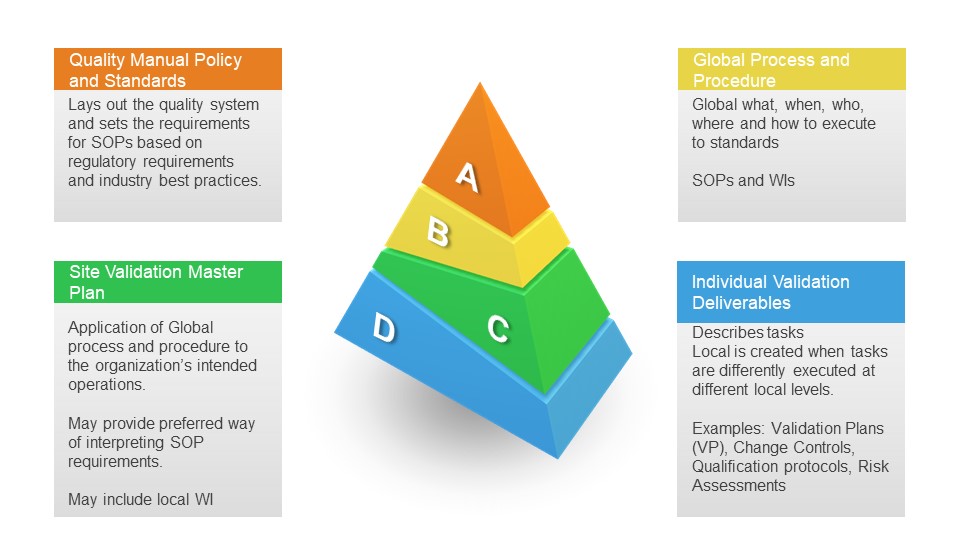
Normally, when I write a blog post, I include the graphics, but I decided to separate them out to show some of my thought processes for designing slides.
I start with a nice slide that introduces the topic I am going to discuss, introducing the main concept, the Validation Master Plan (VMP), and the Validation Plan (VP.)
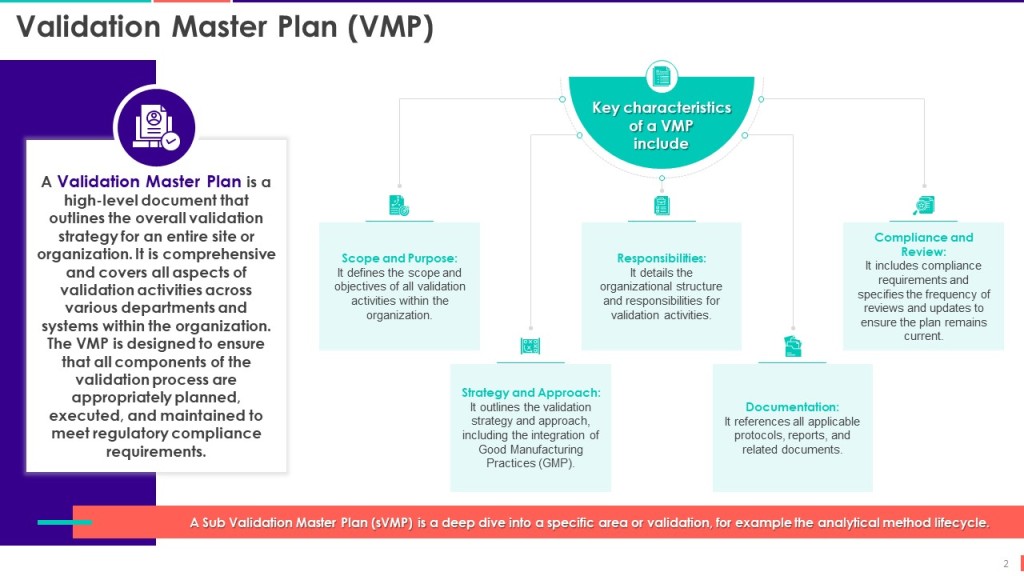
My next slide details the Validation Master Plan in more depth, covering the VMP’s core characteristics.
Then dive into the reasons for having a VMP.
Then cover the Validation plan characteristics.
These are still rather wordy, and I think the last slide can be divided into two. But I have a pretty good training here.
The Validation Master Plan (VMP) and Validation Plan (VP) are integral to the validation process but differ significantly in their scope, detail, and application. The VMP provides a strategic and comprehensive outline for validation activities (often capturing the whole commissioning/qualification/validation lifecycle) across an organization, ensuring compliance and coherence. The VP, derived from the VMP, focuses on specific validation projects, detailing the procedures, responsibilities, and requirements needed to achieve compliance for those specific systems or projects.
Validation Master Plan (VMP)
A Validation Master Plan is a high-level document that outlines the overall validation strategy for an entire site or organization. It is comprehensive and covers all aspects of validation activities across various departments and systems within the organization. The VMP is designed to ensure that all components of the validation process are appropriately planned, executed, and maintained to meet regulatory compliance requirements.
Key characteristics of a VMP include:
Scope and Purpose: It defines the scope and objectives of all validation activities within the organization.
Strategy and Approach: It outlines the validation strategy and approach, including integrating Good Manufacturing Practices (GMP).
Responsibilities: It details the organizational structure and responsibilities for validation activities.
Documentation: It references all applicable protocols, reports, and related documents.
Compliance and Review: It includes compliance requirements and specifies the frequency of reviews and updates to ensure the plan remains current.
A Subvalidation Master Plan (sVMP) is a deep dive into a specific area or validation, such as the analytical method lifecycle.
The purpose of a Validation Master Plan (VMP) is multifaceted, primarily serving as a comprehensive document that outlines the strategy for validation activities within an organization. It is designed to ensure that all validation processes are conducted correctly and comply with regulatory standards.
Here are the key purposes of a VMP:
Documentation of Compliance Requirements: The VMP documents the organization’s compliance requirements, ensuring that all validation activities meet the necessary regulatory standards.
Strategic Planning: Acts as a roadmap for validation, detailing what, how, and when validation activities will be executed. This includes the lifecycle of the manufacturing validation process and integrates Good Manufacturing Practices (GMP).
Resource Planning: The VMP identifies anticipated resource needs and provides key input into scheduling project timelines, which is crucial for efficient validation execution.
Control and Direction: The VMP controls and defines different parts of the production process to ensure consistency over time and directs validation strategies for instruments and systems.
Risk Mitigation: The VMP helps mitigate risks associated with product manufacturing by outlining the validation approach and specific validation activities.
Educational Tool: The VMP informs and educates senior management and other stakeholders about the importance of validation in terms of its impact on product quality, thereby fostering an understanding and support for validation activities.
Regulatory Audit Support: It provides essential documentation regulators require during an audit, demonstrating the organization’s control over quality and compliance with GMPs.
Organizational Alignment: The VMP enables stakeholders within the organization to unify around the details of the validation strategy, eliminating ambiguity and justifying validation activities internally and externally.
The Validation Master Plan is crucial for ensuring that all aspects of validation are planned, executed, and documented in accordance with regulatory requirements and organizational goals. It serves as a compliance tool and a strategic guide for managing and conducting validation activities effectively.
Validation Plan (VP)
A Validation Plan (VP) is more specific and detailed than a VMP and is typically written for a particular validation project or system. The VP focuses on the specific validation activities for individual pieces of equipment, systems, or processes and is derived from the broader directives set out in the VMP.
Key characteristics of a VP include:
Detailed Scope and Objectives: It describes what is to be validated, the specific tasks to be performed, and the expected outcomes.
Project-Specific Details: These include timelines, specific procedures, and responsibilities for the particular validation project.
Risk Assessments and Requirements: It details the risk assessments, quality parameters, and regulatory requirements specific to the system or project being validated.
Differences and Relationship
Level of Detail: The VMP is a high-level document that provides an overarching framework and strategy for validation activities across an organization. In contrast, a VP is a detailed, project-specific document that outlines the execution of validation activities for specific systems or projects.
Purpose and Use: The VMP sets the stage for all validation efforts within an organization and ensures consistency and compliance with industry standards. The VP, derived from the VMP, focuses on specific validation tasks and how they will be accomplished.
Scope: While the VMP covers an organization’s entire validation program, a VP is limited to a particular project or system.
A Validation Master Plan (VMP) should be reviewed and updated regularly to remain current and effective. The specific frequency of these reviews can vary depending on the organization’s needs, the complexity of the systems, and regulatory requirements. However, it is generally recommended that a VMP be reviewed at least annually.
This annual review is crucial to address any changes in the manufacturing process, regulatory updates, or modifications in the validation strategy. The review process should include evaluating the progress of validation activities, assessing the impact of any changes in the process or equipment, and updating the plan to reflect new or altered validation requirements.
Additionally, the VMP should be updated whenever significant changes occur that could affect the validation status of the systems or processes described in the plan. This could include major equipment upgrades, product design changes, or regulatory standard shifts.
Validation Plans (VP) should be revised based on changes in the project’s scope. Sometimes, a VP may be opened for an extended period of time for a complex project, in which case it should be evaluated for accuracy and completeness based on the project lifecycle.
Self-checking is one of the most effective tools we can teach and use. Rooted in the four aspects of risk-based thinking (anticipate, monitor, respond, and learn), it refers to the procedures and checks that employees perform as part of their routine tasks to ensure the quality and accuracy of their work. This practice is often implemented in industries where precision is critical, and errors can lead to significant consequences. For instance, in manufacturing or engineering, workers might perform self-checks to verify that their work meets the required specifications before moving on to the next production stage.
A proactive approach enhances the reliability, safety, and quality of various systems and practices by allowing for immediate detection and correction of errors, thereby preventing potential failures or flaws from escalating into more significant issues.
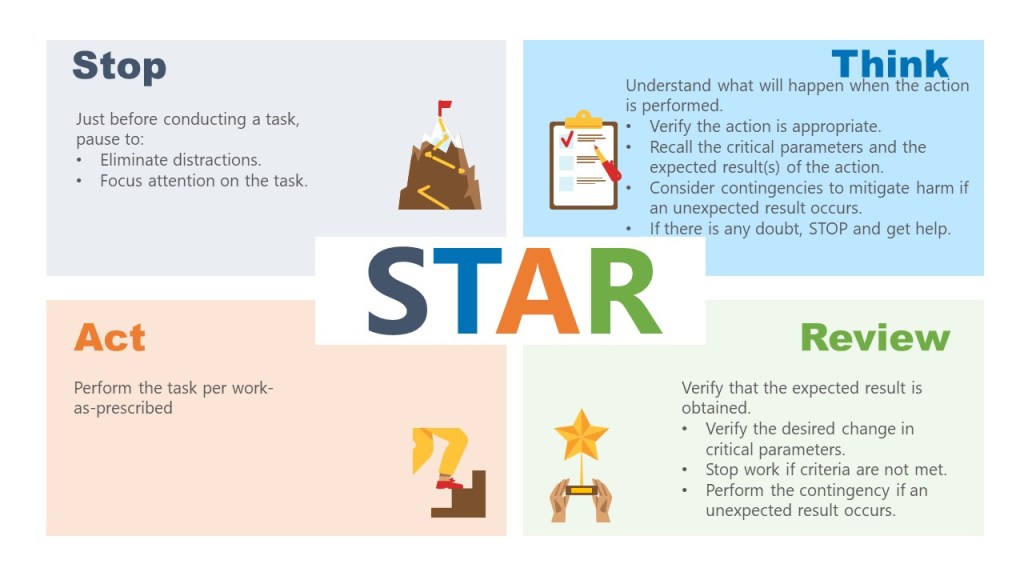
The memory aid STAR (stop, think, act, review) helps the user recall the thoughts and actions associated with self-checking.
Stop – Just before conducting a task, pause to:
Eliminate distractions.
Focus attention on the task.
Think – Understand what will happen when the action is performed.
Verify the action is appropriate.
Recall the critical parameters and the action’s expected result(s).
Consider contingencies to mitigate harm if an unexpected result occurs.
If there is any doubt, STOP and get help.
Act – Perform the task per work-as-prescribed
Review – Verify that the expected result is obtained.
Verify the desired change in critical parameters.
Stop work if criteria are not met.
Perform the contingency if an unexpected result occurs.
Risk-based thinking is a crucial component of modern quality management systems and consists of four key aspects: anticipate, monitor, respond, and learn. Each aspect ensures an organization can effectively manage and mitigate risks, enhancing overall performance and reliability.
Anticipate
Anticipating risks involves proactively identifying and analyzing potential risks that could impact the organization’s operations or objectives. This step is about foreseeing problems before they occur and planning how to address them. It requires a thorough understanding of the organization’s processes, the external and internal factors that could affect these processes, and the potential consequences of various risks. By anticipating risks, organizations can prepare more effectively and prevent many issues from occurring.
Monitor
Monitoring involves continuously observing and tracking the operational environment to detect risk indicators early. This ongoing process helps catch deviations from expected outcomes or standards, which could indicate the emergence of a risk. Effective monitoring relies on establishing metrics that help to quickly and accurately identify when things are starting to veer off course. This real-time data collection is crucial for enabling timely responses to potential threats.
Respond
Responding to risks is about taking appropriate actions to manage or mitigate identified risks based on their severity and potential impact. This step involves implementing the planned risk responses that were developed during the anticipation phase. The effectiveness of these responses often depends on the speed and decisiveness of the actions taken. Responses can include adjusting processes, reallocating resources, or activating contingency plans. The goal is to minimize the organization’s and its stakeholders’ negative impact.
Learn
Learning from the management of risks is a critical component that closes the loop of risk-based thinking. This aspect involves analyzing the outcomes of risk responses and understanding what worked well and what did not. Learning from these experiences is essential for continuous improvement. It helps organizations refine risk management processes, improve response strategies, and better prepare for future risks. This iterative learning process ensures that risk management efforts are increasingly effective over time.
The four aspects of risk-based thinking—anticipate, monitor, respond, and learn—form a continuous cycle that helps organizations manage uncertainties proactively. This approach protects the organization from potential downsides and enables it to seize opportunities that arise from a well-understood risk landscape. Organizations can enhance their resilience and adaptability by embedding these practices into everyday operations.
Implementing Risk-Based Thinking
1. Understand the Concept of Risk-Based Thinking
Risk-based thinking involves a proactive approach to identifying, analyzing, and addressing risks. This mindset should be ingrained in the organization’s culture and used as a basis for decision-making.
2. Identify Risks and Opportunities
Identify potential risks and opportunities. This can be achieved through various methods such as SWOT analysis, brainstorming sessions, and process mapping. It’s crucial to involve people at all levels of the organization since they can provide diverse perspectives on potential risks and opportunities.
3. Analyze and Prioritize Risks
Once risks and opportunities are identified, they should be analyzed to understand their potential impact and likelihood. This analysis will help prioritize which risks need immediate attention and which opportunities should be pursued.
4. Plan and Implement Responses
After prioritizing, develop strategies to address these risks and opportunities. Plans should include preventive measures for risks and proactive steps to seize opportunities. Integrating these plans into the organization’s overall strategy and daily operations is important to ensure they are effective.
5. Monitor and Review
Implementing risk-based thinking is not a one-time activity but an ongoing process. Regular monitoring and reviewing of risks, opportunities, and the effectiveness of responses are crucial. This can be done through regular audits, performance evaluations, and feedback mechanisms. Adjustments should be made based on these reviews to improve the risk management process.
6. Learn and Improve
Organizations should learn from their experiences in managing risks and opportunities. This involves analyzing what worked well and what didn’t and using this information to improve future risk management efforts. Continuous improvement should be a key goal, aligning with the Plan-Do-Check-Act (PDCA) cycle.
Training and cultural adaptation are necessary to implement risk-based thinking effectively. All employees should be trained on the principles of risk-based thinking and how to apply them in their roles. Creating a culture encouraging open communication about risks and supporting risk-taking within defined limits is also vital.
In the spirit of disclosure, I may have referenced this one once or twice, but I think it is essential to know exactly what the research says when we talk about deliberate practice, a topic I end to be passionate about.






 Investigations of a Dog