We write and use procedures to help the user complete the task successfully and avoid undesired outcomes. Well-written procedures are an integral part of any organization for operation, managing risks, and continuous improvement. Effective procedures are important for the transfer of knowledge from the engineers/architects of the system to the users of the system.
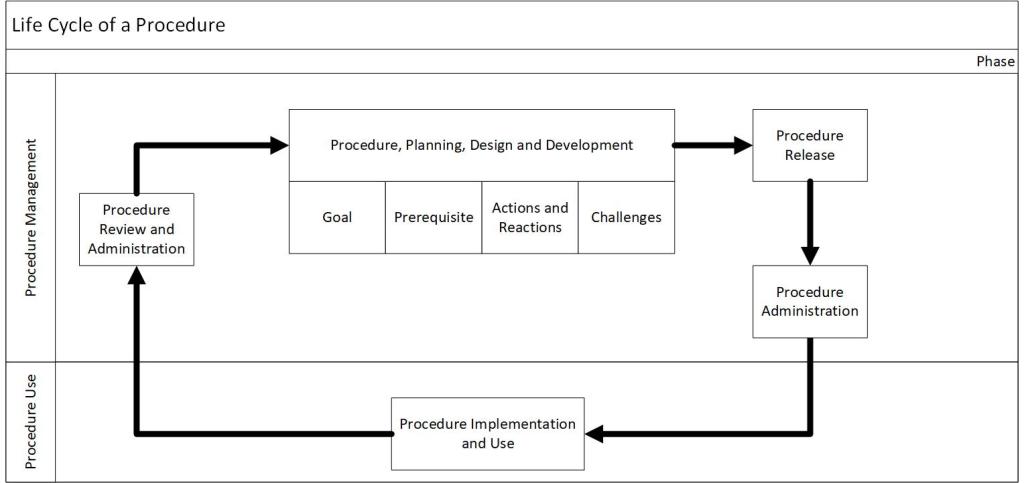
Good procedures, and we are not talking format so this can be paper documents to a mixed reality guide, provide these four categories of information:
Goal: The goal presented to the user as a state to be realized. This can be an end state or an intermediate state of the overall system.
Prerequisites: The condition for moving toward the desired state or goal. These are the conditions that must be satisfied so that the user can achieve the goal.
Actions and reactions: These states are reached through actions of the user and the reactions of the system. They may have milestones or sub-goals. It involves the description of (a series of) action steps.
Unwanted: These are the states to be avoided (e.g., errors, malfunctions, injuries). It provides guidelines on what to avoid for successful and safe execution of procedure and may include warning, caution, or instruction for solving a potential problem.
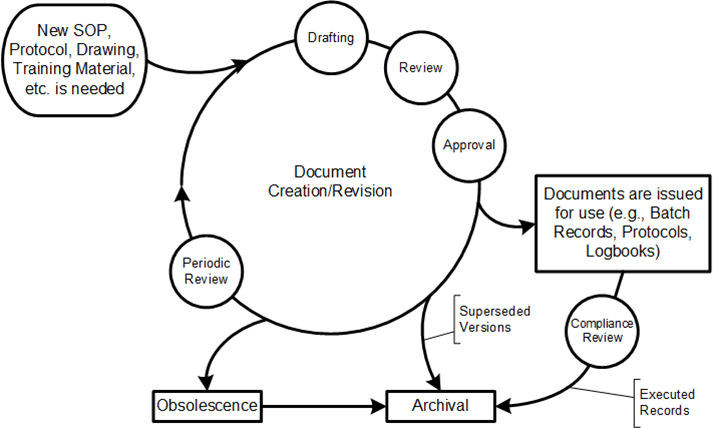
Procedures have a lifecycle through which they are developed, administered, used, reviewed, and updated. In the post “Document Management” I discussed the document management lifecycle.
I want to focus specifically on procedures by covering five distinct phases: procedure plan, design and development, procedure authorization, procedure administration, procedure implementation and use, and procedure review and maintenance.
Identifying whether a procedure is necessary; collecting required information; producing instructions and information on the work, regulatory compliance, process and personnel safety; a walkthrough to ensure quality and potential compliance of the procedure
“New SOP is needed” Drafting
Procedure Authorization
Procedure review; publishing the final document; revision control; the approval process.
Risk Management often devolves into a check-the-box, non-valued activity in an organization. While many organizations ensure they have the right processes in place, they still end up not protecting themselves against risk effectively. A lot of our organizations struggle to understand risk and apply this mindset in productive ways.
As quality professionals we should be applying the same improvement tools to our risk management processes as we do anything else.
To improve a process, we first need to understand the value from the process. Risk management is the identification, evaluation, and prioritization of risks (defined in ISO 31000 as the effect of uncertainty on objectives) followed by coordinated and economical application of resources to minimize, monitor, and control the probability or impact of unfortunate events or to maximize the realization of opportunities.
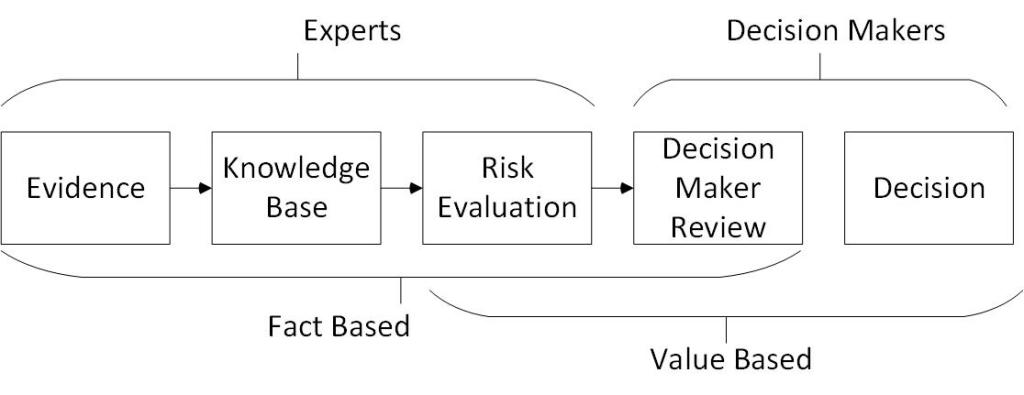
Risk management then is an application of decision quality to reduce uncertainty on objectives. We can represent the process this way:
The risk evaluation is the step where the knowledge base is evaluated, and a summary judgment is reached on the risks and uncertainties involved in the case under investigation. This evaluation must take the values of the decision-makers into account and a careful understanding has to be had on just what the practical burden of proof is in the particular decision.
Does Risk Management then create value for those perceived by the stakeholders? Can we apply a value stream approach and look to reduce wastes? Some common ones include:
Waste in Risk Management
Example
Reflects
Defective Information
“The things that hurts you is never in a risk matrix” “You have to deliver a risk matrix, but how you got there doesn’t matter”
Missing stakeholder viewpoints, poor Risk Management process, lack of considering multiple sources of uncertainty, poor input data, lack of sharing information
Overproduction
“if it is just a checklist sitting somewhere, then people don’t use it, and it becomes a wasted effort”
Missing standardization, serial processing and creation of similar documents, reports are not used after creation
Stockpiling Information
“we’re uncertain what are the effect of the risk as this early stage, I think it would make more sense to do after”
Documented risk lay around unutilized during a project, change or operations
Unnecessary movement of people
“It can be time consuming walking around to get information about risk”
Lack of documentation, risks only retrievable by going around asking employees
Rework
“Time spend in risk identification is always little in the beginning of a project because everybody wants to start and then do the first part as quickly as possible.”
The documents were supposed to be updated and re-evaluated, but was not, thus becoming partially obsolete over time
Common wastes in Risk Management
Once we understand waste in risk management we can identify when it happens and engage in improvement activities. We should do this based on the principles of decision quality and very aware of the role uncertainty applies.
References
Anjum, Rani Lill, and Elena Rocca. “From Ideal to Real Risk: Philosophy of Causation Meets Risk Analysis.” Risk Analysis, vol. 39, no. 3, 19 Sept. 2018, pp. 729–740, 10.1111/risa.13187.
Hansson, Sven Ove, and Terje Aven. “Is Risk Analysis Scientific?” Risk Analysis, vol. 34, no. 7, 11 June 2014, pp. 1173–1183, 10.1111/risa.12230
Walker, Warren E., et al. “Deep Uncertainty.” Encyclopedia of Operations Research and Management Science, 2013, pp. 395–402, 10.1007/978-1-4419-1153-7_1140
Willumsen, Pelle, et al. “Value Creation through Project Risk Management.” International Journal of Project Management, Feb. 2019, 10.1016/j.ijproman.2019.01.007
Talk about strategy, risk management, or change; it is inevitable that the acronym VUCA — short for volatility, uncertainty, complexity, and ambiguity — will come up. VUCA is a catchall for “Hey, it’s crazy out there!” And like many catch-all’s it is misleading, VUCA conflates four distinct types of challenges that demand four distinct types of responses. VUCA can quickly become a crutch, a way to throw off the hard work of strategy and planning—after all, you can’t prepare for a VUCA world, right?
The mistake folks often make here is treating these four traits as a single idea, which leads to poorer decision making.
VUCA really isn’t a tool. It’s a checklist of four things that hopefully your system is paying attention to. All four represent distinct elements that make our environment and organization harder to grasp and control.
One of the dangers in any organization is that the hard-won know-how of our experts remains locked in their brains and is not shared. To beat this tendency, knowledge management should be a continuous activity in any quality system. So why not start by documenting your own knowledge as an expert?
Subject
Answer these Questions
Things to clarify
Foundational Knowledge
What reference materials do you use?
How do you track technical trends?
Should a knowledge recipient own any of these reference materials? What are the best websites? Are there particular journals that you fi nd useful? What about associations?
Technical/Scientific
What kinds of problems do people come to you to solve?
What are the biggest risks in the project, process, or system you manage?
Can you describe a problem brought to you recently? What technical mistakes is a novice likely to make in that project or process?
Professional Network
Whom do you ask about technology trends and innovation?
Whom do you contact for information about government regulations?
What is this go-to person’s complete contact information? What medium does he or she prefer (email versus telephone)? What is his or her background? How do you know this person?
Organizational
Who are the major stakeholders in the project, process, or system you manage?
What are the biggest mistakes newcomers make in trying to get projects going here?
What are the positions of the major stakeholders? Where are there competing priorities? Can you give me an example of a newcomer mistake and suggest how to avoid such mistakes?
Interpersonal
Regarding team leadership, what criteria do you use to select team members?
How do you ensure the team is connected to the overall business strategy?
On a general level, how do you motivate people who report to you?
Why do you use these particular criteria? Have you ever chosen unwisely? What communication strategies are most effective? Can you give an example of what has really helped?
Once you’ve documented this knowledge, identify who else needs to know it, and then ensure the knowledge is transferred.
Our goal should always be to reduce ignorance. Many unknown unknowns are just things no one has bothered to find out. What we need to do is ensure our processes and systems are constructed so that they recognize unknowns.
There are six factors that need to be explored to find the unknown unknowns.
Complexity: A complex process/system/project contains many interacting elements that increase the variety of its possible behaviors and results. Complexity increases with the number, variety, and lack of robustness of the elements of the process, system or project.
Complicatedness: A complicated process/system/project involves many points of failure, the ease of finding necessary elements and identifying cause-and-effect relationships; and the experts/participants aptitudes and experiences.
Dynamism: The volatility or the propensity of elements and relationships to change.
Equivocality: Knowledge management is a critical enabler of product and project life cycle management. If the information is not crisp and specific, then the people who receive it will be equivocal and won’t be able to make firm decisions. Although imprecise information itself can be a known unknown, equivocality increases both complexity and complicatedness.
Perceptive barriers: Mindlessness. This factor includes a lot of our biases, including an over-reliance on past experiences and traditions, the inability to detect weak signals and ignoring input that is inconvenient or unappealing.
Organizational pathologies: Organizations have problems, culture can have weaknesses. These structural weaknesses allow unknown unknowns to remain hidden.
Interrogating Knowable Unknown Unknowns
The way to address these six factors is to evaluate and challenge by using the following approaches:
Interviewing
Interviews with stakeholders, subject matter experts and other participants can be effective tools for uncovering lurking problems and issues. Interviewers need to be careful not to be too enthusiastic about the projects they’re examining and not asking “yes or no” questions. The best interviews probe deep and wide.
Build Knowledge by Decomposing the System/Process/Project
Standard root cause analysis tools apply here, break it down and interrogate all the subs.
Identifying the goals, context, activities and cause-effect relationships
Breaking the domains into smaller elements — such as processes, tasks and stakeholders
Examining the complexity and uncertainty of each element to identify the major risks (known unknowns) that needed managing and the knowledge gaps that pointed to areas of potential unknown unknowns.
Analyze Scenarios
Construct several different future outlooks and test them out (mock exercises are great). This approach accepts uncertainty, tries to understand it and builds it into the your knowledge base and reasoning. Rather than being predictions, scenarios are coherent and credible alternative futures built on dynamic events and conditions that are subject to change.
Communicate Frequently and Effectively
Regularly and systematically reviewing decision-making and communication processes, including the assumptions that are factored into the processes, and seeking to remove information asymmetries, can help to anticipate and uncover known unknowns. Management Review is part of this, but not the only component. Effective and frequent communication is essential for adaptability and agility. However, this doesn’t necessarily mean communicating large volumes of information, which can cause information overload. Rather, the key is knowing how to reach the right people at the right times. Some important aspects include:
Candor: Timely and honest communication of missteps, anomalies and missing competencies. Offer incentives for candor to show people that there are advantages to owning up to errors or mistakes in time for management to take action. It is imperative to eliminate any perverse incentives that induce people to ignore emerging risks.
Cultivate an Alert Culture: A core part of a quality culture should be an alert culture made up of people who strive to illuminate rather than hide potential problems. Alertness is built by: 1) emphasizing systems thinking; 2) seek to include and build a wide range of experiential expertise — intuitions, subtle understandings and finely honed reflexes gained through years of intimate interaction with a particular natural, social or technological system; and 3) learn from surprising outcomes.
By working to evaluate and challenge, to truly understand our systems and processes, our risk management activities will be more effective and truly serve to make our systems resilient.