Environmental contamination results from the ingress of contaminants from the surrounding production areas or even from outside environments
Cross-contamination is defined as contamination of a starting material, intermediate product or finished product with another starting material or product during production.
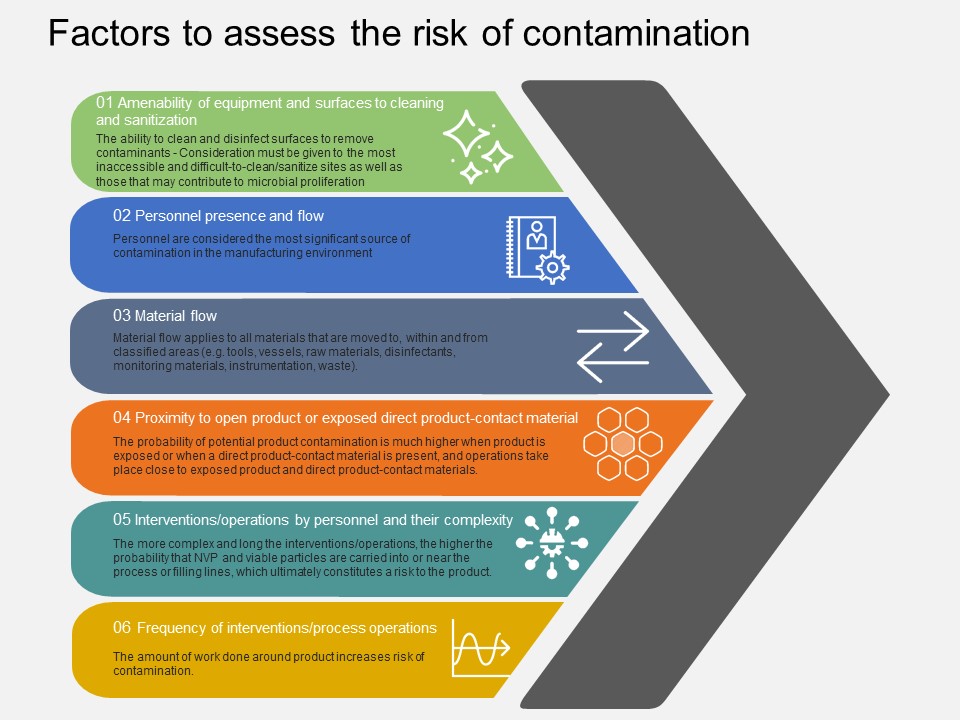
Whether performing risk assessments or impact assessments there are six factors to consider in order to determine environmental impact and to inform contamination control.
Amenability of equipment and surfaces to cleaning and sanitization
Personnel presence and flow
Material flow
Proximity to open product or exposed direct product-contact material
Interventions/operations by personnel and their complexity
Maybe you’ve been there too, you need to take a risk-based approach to determine environmental monitoring, so you go to a HAACP or FMEA and realize those tools just do not work to provide information to determine how to distribute monitoring to best verify that processes are operating under control.
What you want to do is build a heat map showing the relative probability of contamination in a defined area or room| covering six areas:
Amenability of equipment and surfaces to cleaning and sanitization
Personnel presence and flow
Material flow
Proximity to open product or exposed direct product-contact material
Interventions/operations by personnel and their complexity
Frequency of interventions/process operations.
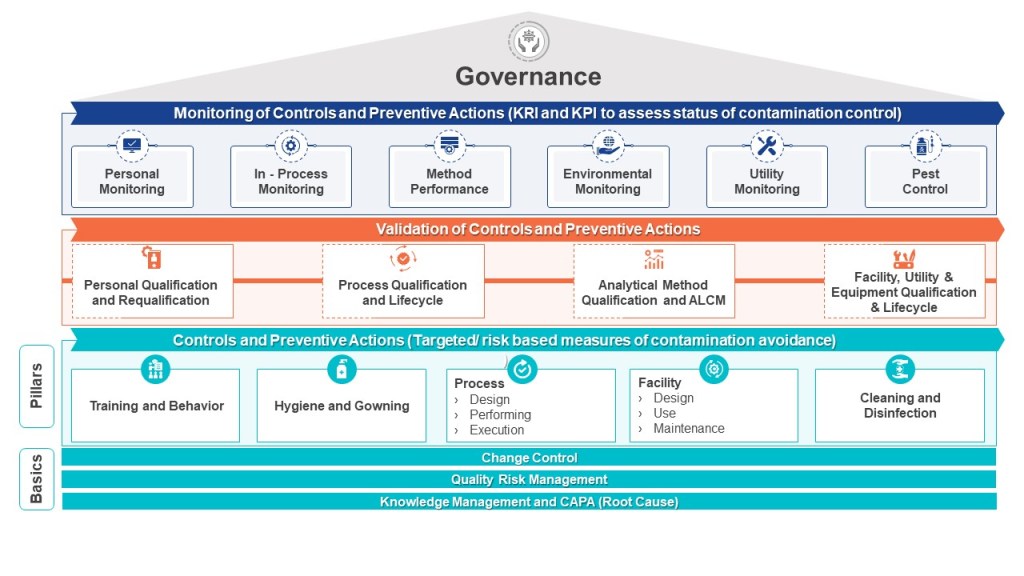
This approach builds off of the design activities and is part of a set of living risk assessments that inform the environmental monitoring part of your contamination control strategy.
Often characterized by reference
to the potential event
and consequences or combination of these
Often expressed in terms of a
combination of the consequences of an event (including in changes in
circumstances) and the associated likelihood of the occurrence
Hazard, harm and risk
Hazard
Harm
Risk
Enabling state that leads to the possibility of harm
Injury or damage
Probability of harm from a situation triggered by the hazard.
Hazard harm and risk
A hazard is defined in ISO 12100 as “The potential source of harm.” This definition is carried through other ISOs and regulatory guidances. The hazard is what could go wrong, our “What If…”, it is when we start engaging the outcome identification loop to query uncertainty about the future.
Harm are those injuries or damages I should care about.
Every risk assessment is really asking “What could go wrong,” and then answering two questions:
If it did go wrong how bad is it – the Harm
And how likely is it to go wrong – Probability.
Risk is then the combination of those things as a magnitude or priority.
Risk assessment tools break down into two major camps. Those that start with the hazards, asking how something can fail; and those that start with the harms, asking what bad things do we want to avoid.
Risk can be associated with a number of different types of consequences, impacting different objectives. The types of consequences to be analyzed are decided when planning the assessment. The context statement is checked to ensure that the consequences to be analyzed align with the purpose of the assessment and the decisions to be made. This can be revisited during the assessment as more is learned.
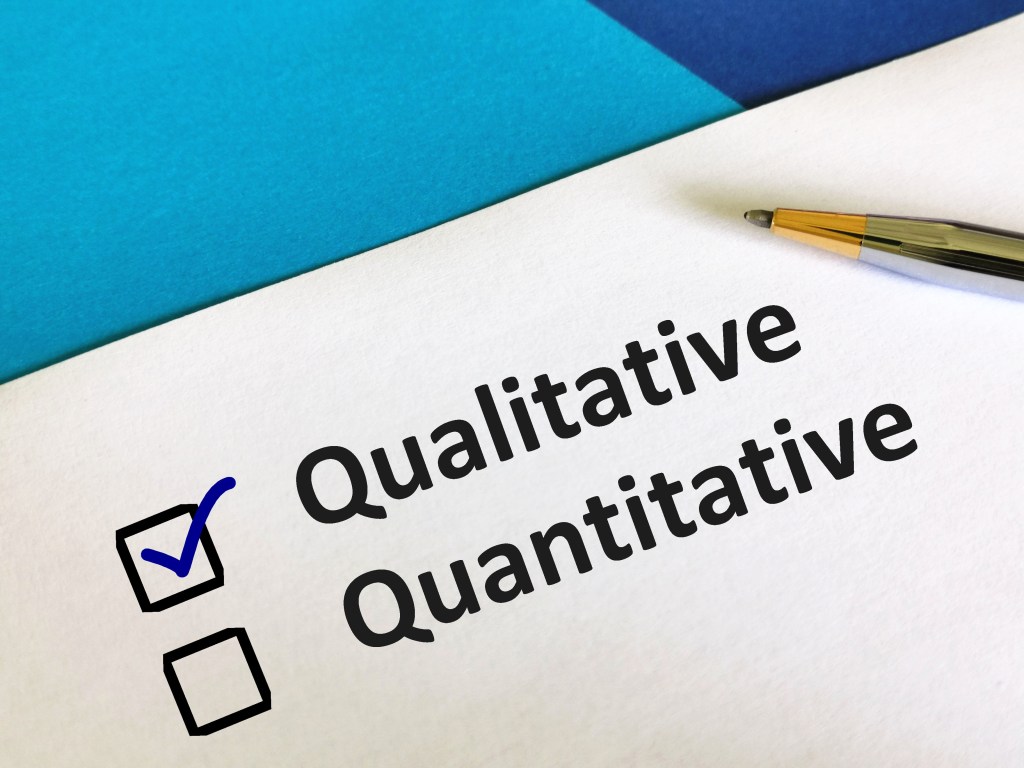
Methods used in analyzing risks can be qualitative, semiquantitative, or quantitative. The decision here will be on the intended use, the availability of reliable data, and the decision-making needs of the organization. In ICH Q9 this is also the level of formality.
Risk
Is….
The combination of the probability of the occurrence of the harm
and the severity of that harm.
The effect of uncertainty on objectives
Often characterized by reference to the potential event and
consequences or combination of these
Often expressed in terms of a combination of the consequences of
an event (including in changes in circumstances) and the associated
likelihood of the occurrence
Qualitative assessments define consequence (or severity), likelihood, and level of risk by significance levels, such as “high,” “medium,” or “low.” They work best when supporting analysis that have a narrow application or are within another quality system, such as change control.
Qualitative
Below is a good way to break down consequences and likelihood for a less formal assessment.