
Validation, Disposition and Change Control

A colleague asks “How do you manage changes and disposition when doing long-term validation or specification setting in multiple markets?”

Process map for change control, validation, regulatory and disposition

Perhaps it is a cleaning validation or a major process change or a new filter or raw material. You need to be able to disposition products against a change control to some markets but not all.

It is important to realize that changes become effective multiple times. Looking back on the post “Changes become Effective” we are managing after change-in-use where the regulatory approval is not being simultaneously gated and product will be sent to market on a case-by-case basis.

The change control contains a corresponding regulatory assessment with required variations for all impacted markets and a disposition strategy aligned with validation activities. With action items (e.g. work, tasks) in the change control for ongoing evaluation of lots impacted by study.

That disposition strategy might include evaluation of data vs acceptance criteria for each lot via checklist (or another tool) included in disposition packet, or an evaluation of data through change control task and disposition references change control. They are pretty similar in results and it more ends up being a record management preference.
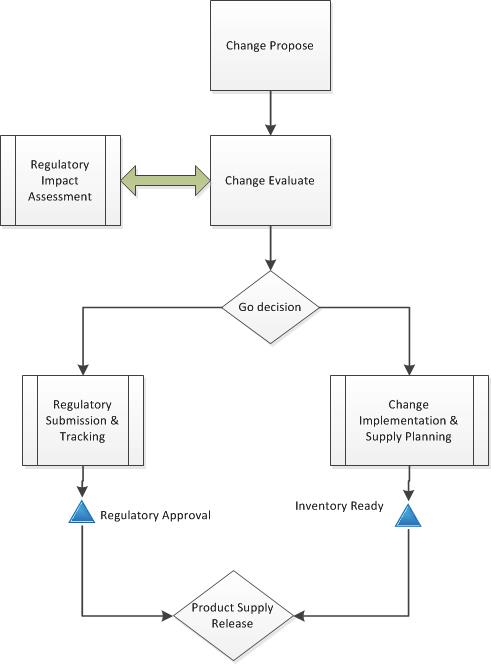
High level match between regulatory and inventory

Value of the ASQ

If I were to ask a hundred of my peers “How did you get into quality,” I would probably hear 100 different stories (with of course some commonalities). And yet, quality is definitely a distinct set of expertise and practice.

When I try to describe my job, I often find myself breaking down what I do into categories (I’m a project manager, a trainer, a problem solver, risk manager, a facilitator, a puzzle solver, a detective, etc). some of these are professional paths on their own, others not so much.

It is for this reason that I am a huge fan of the ASQ’s Quality Body of Knowledge, as it does a good job of uniting what we do. Sure, it’s not perfect but it is an excellent framework to build an understanding of just what a quality professional can bring to the table, as well as great development path.

One of the many things I love about this is the ability to learn from folks no matter what their industry. This cross-pollination is vital to innovation. And having the QBOK there gives a framework for common discussions.

With the QBOK goes a technical knowledge bolt-on. For example, in my case pharmaceuticals (strong) and medical devices (average).

The ASQ certification board I believe gets it wrong by calling these specific technical certifications “Leadership.” There is nothing leadership centric by getting the CPGP, for example.

I think we’re better breaking these certifications into QBOK core (e.g. quality improvement associate, quality process analyst, manager of quality), specific skills (e.g. six sigma, haccp, quality auditor, reliability and calibration) and then industry specific (e.g. CPGP, biomedical auditor)

As the ASQ goes through its current transformation, I hope the leadership and members remember the strength of the QBOK, work to enshrine it in everything the organization does, and continues to refine it. This is the value of my ASQ membership.


ASQ – Pharmaceutical GMP Professional Certification

The ASQ’s CPGP certification is a very broad body of knowledge that covers regulatory agencies, to facilities and utilities, to testing, to release. In short, about every aspect of a GMP facility.

I am maybe the only person I know in the field who has this certification. I don’t know the details, but uptake does not seem as high as other certifications I am aware of. Yesterday at lunch I ended up discussing this with a few colleagues. We discussed a few options:

  1. The certification is not well known. Most of my colleagues were not aware of it.
  2. Many pharmaceutical GMP professionals are more directed at the PDA and ISPE. The ASQ is well known, but perhaps not as important when considering options.
  3. This certification is a generalist. There was a general opinion that many quality professionals tend to be specialized and might not feel comfortable stretching their wings.

Is there value in this BoK? Definitely. I found this certification much harder than the CMQ/OE, and as a result, I’m prouder of having it. The major question is how can we make this more valuable to the field. This is certainly a question I’ll be asking next week in Seattle.