Overcoming Subjectivity in Risk Management and Decision Making Requires a Culture of Quality and Excellence

Risk assessments, problem solving and making good decisions need teams, but any team has challenges in group think it must overcome. Ensuring your facilitators, team leaders and sponsors are aware and trained on these biases will help lead to deal with subjectivity, understand uncertainty and drive to better outcomes. But no matter how much work you do there, it won’t make enough of a difference until you’ve built a culture of quality and excellence.

The mindsets we are trying to build into our culture will strive to overcome a few biases in our teams that lead to subjectivity.

Bias Toward Fitting In

We have a natural desire to want to fit in. This tendency leads to two challenges:

Challenge : Believing we need to conform. Early in life, we realize that there are tangible benefits to be gained from following social and organizational norms and rules. As a result, we make a significant effort to learn and adhere to written and unwritten codes of behavior at work. But here’s the catch: Doing so limits what we bring to the organization.

Challenge : Failure to use one’s strengths. When employees conform to what they think the organization wants, they are less likely to be themselves and to draw on their strengths. When people feel free to stand apart from the crowd, they can exercise their signature strengths (such as curiosity, love for learning, and perseverance), identify opportunities for improvement, and suggest ways to exploit them. But all too often, individuals are afraid of rocking the boat.

We need to use several methods to combat the bias toward fitting in. These need to start at the cultural level. Risk management, problem solving and decision making only overcome biases when embedded in a wider, effective culture.

Encourage people to cultivate their strengths. To motivate and support employees, some companies allow them to spend a certain portion of their time doing work of their own choosing. Although this is a great idea, we need to build our organization to help individuals apply their strengths every day as a normal part of their jobs.

Managers need to help individuals identify and develop their fortes—and not just by discussing them in annual performance reviews. Annual performance reviews are horribly ineffective. Just by using “appreciation jolt”, positive feedback., can start to improve the culture. It’s particularly potent when friends, family, mentors, and coworkers share stories about how the person excels. These stories trigger positive emotions, cause us to realize the impact that we have on others, and make us more likely to continue capitalizing on our signature strengths rather than just trying to fit in.

Managers should ask themselves the following questions: Do I know what my employees’ talents and passions are? Am I talking to them about what they do well and where they can improve? Do our goals and objectives include making maximum use of employees’ strengths?

Increase awareness and engage workers. If people don’t see an issue, you can’t expect them to speak up about it.  

Model good behavior. Employees take their cues from the managers who lead them.

Bias Toward Experts

This is going to sound counter-intuitive, especially since expertise is so critical. Yet our biases about experts can cause a few challenges.

Challenge : An overly narrow view of expertise. Organizations tend to define “expert” too narrowly, relying on indicators such as titles, degrees, and years of experience. However, experience is a multidimensional construct. Different types of experience—including time spent on the front line, with a customer or working with particular people—contribute to understanding a problem in detail and creating a solution.

A bias toward experts can also lead people to misunderstand the potential drawbacks that come with increased time and practice in the job. Though experience improves efficiency and effectiveness, it can also make people more resistant to change and more likely to dismiss information that conflicts with their views.

Challenge : Inadequate frontline involvement. Frontline employees—the people directly involved in creating, selling, delivering, and servicing offerings and interacting with customers—are frequently in the best position to spot and solve problems. Too often, though, they aren’t empowered to do so.

The following tactics can help organizations overcome weaknesses of the expert bias.

Encourage workers to own problems that affect them. Make sure that your organization is adhering to the principle that the person who experiences a problem should fix it when and where it occurs. This prevents workers from relying too heavily on experts and helps them avoid making the same mistakes again. Tackling the problem immediately, when the relevant information is still fresh, increases the chances that it will be successfully resolved. Build a culture rich with problem-solving and risk management skills and behaviors.

Give workers different kinds of experience. Recognize that both doing the same task repeatedly (“specialized experience”) and switching between different tasks (“varied experience”) have benefits. Yes, Over the course of a single day, a specialized approach is usually fastest. But over time, switching activities across days promotes learning and kept workers more engaged. Both specialization and variety are important to continuous learning.

Empower employees to use their experience. Organizations should aggressively seek to identify and remove barriers that prevent individuals from using their expertise. Solving the customer’s problems in innovative, value-creating ways—not navigating organizational impediments— should be the challenging part of one’s job.

In short we need to build the capability to leverage all level of experts, and not just a few in their ivory tower.

These two biases can be overcome and through that we can start building the mindsets to deal effectively with subjectivity and uncertainty. Going further, build the following as part of our team activities as sort of a quality control checklist:

  1. Check for self-interest bias
  2. Check for the affect heuristic. Has the team fallen in love with its own output?
  3. Check for group think. Were dissenting views explored adequately?
  4. Check for saliency bias. Is this routed in past successes?
  5. Check for confirmation bias.
  6. Check for availability bias
  7. Check for anchoring bias
  8. Check for halo effect
  9. Check for sunk cost fallacy and endowment effect
  10. Check for overconfidence, planning fallacy, optimistic biases, competitor neglect
  11. Check for disaster neglect. Have the team conduct a post-mortem: Imagine that the worst has happened and develop a story about its causes.
  12. Check for loss aversion

Uncertainty and Subjectivity in Risk Management

The July-2019 monthly gift to members of the ASQ is a lot of material on Failure Mode and Effect Analysis (FMEA). Reading through the material got me to thinking of subjectivity in risk management.

Risk assessments have a core of the subjective to them, frequently including assumptions about the nature of the hazard, possible exposure pathways, and judgments for the likelihood that alternative risk scenarios might occur. Gaps in the data and information about hazards, uncertainty about the most likely projection of risk, and incomplete understanding of possible scenarios contribute to uncertainties in risk assessment and risk management. You can go even further and say that risk is socially constructed, and that risk is at once both objectively verifiable and what we perceive or feel it to be. Then again, the same can be said of most of science.

Risk is a future chance of loss given exposure to a hazard. Risk estimates, or qualitative ratings of risk, are necessarily projections of future consequences. Thus, the true probability of the risk event and its consequences cannot be known in advance. This creates a need for subjective judgments to fill-in information about an uncertain future. In this way risk management is rightly seen as a form of decision analysis, a form of making decisions against uncertainty.

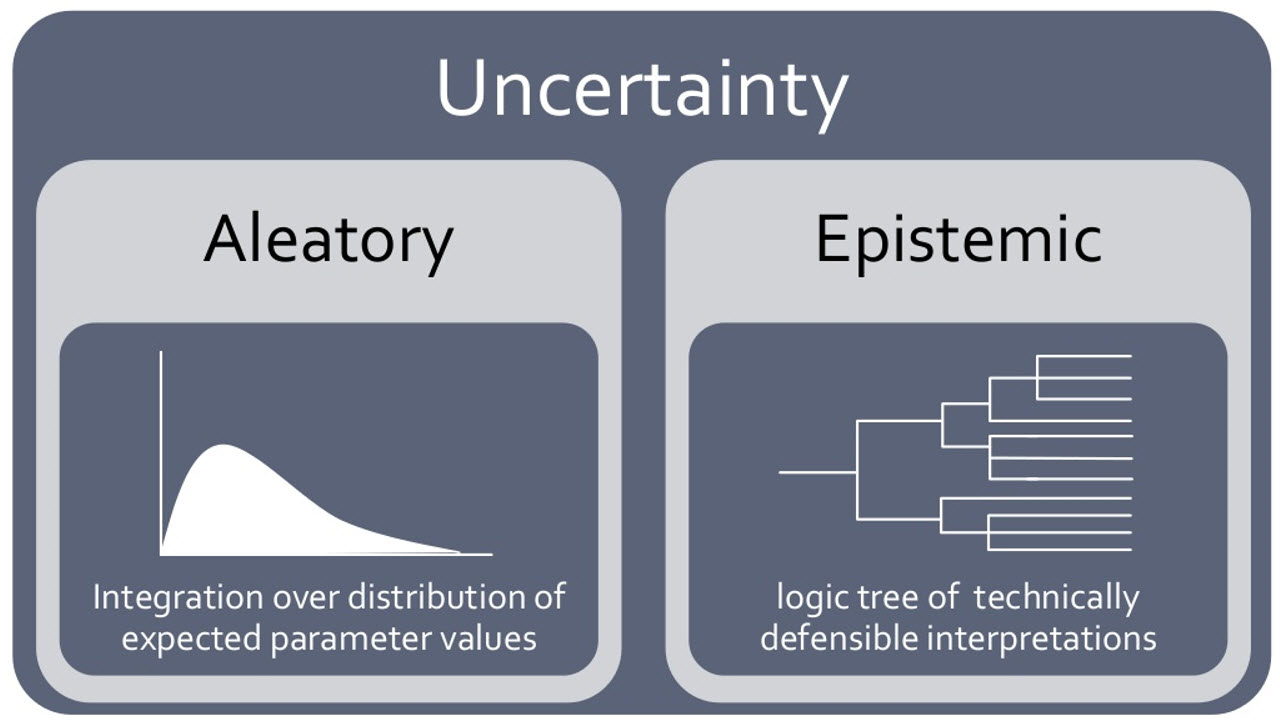
Everyone has a mental picture of risk, but the formal mathematics of risk analysis are inaccessible to most, relying on probability theory with two major schools of thought: the frequency school and the subjective probability school. The frequency school says probability is based on a count of the number of successes divided by total number of trials. Uncertainty that is ready characterized using frequentist probability methods is “aleatory” – due to randomness (or random sampling in practice). Frequentist methods give an estimate of “measured” uncertainty; however, it is arguably trapped in the past because it does not lend itself to easily to predicting future successes.

In risk management we tend to measure uncertainty with a combination of frequentist and subjectivist probability distributions. For example, a manufacturing process risk assessment might begin with classical statistical control data and analyses. But projecting the risks from a process change might call for expert judgments of e.g. possible failure modes and the probability that failures might occur during a defined period. The risk assessor(s) bring prior expert knowledge and, if we are lucky, some prior data, and start to focus the target of the risk decision using subjective judgments of probabilities.

Some have argued that a failure to formally control subjectivity — in relation to probability judgments – is the failure of risk management. This was an argument that some made during WCQI, for example. Subjectivity cannot be eliminated nor is it an inherent limitation. Rather, the “problem with subjectivity” more precisely concerns two elements:

  1. A failure to recognize where and when subjectivity enters and might create problems in risk assessment and risk-based decision making; and
  2. A failure to implement controls on subjectivity where it is known to occur.

Risk is about the chance of adverse outcomes of events that are yet to occur, subjective judgments of one form or another will always be required in both risk assessment and risk management decision-making.

We control subjectivity in risk management by:

  • Raising awareness of where/when subjective judgments of probability occur in risk assessment and risk management
  • Identifying heuristics and biases where they occur
  • Improving the understanding of probability among the team and individual experts
  • Calibrating experts individually
  • Applying knowledge from formal expert elicitation
  • Use expert group facilitation when group probability judgments are sought

Each one of these is it’s own, future, post.

Self Awareness and Problem Solving

We often try to solve problems as if we are outside them. When people describe a problem you will see them pointing away from themselves – you hear the word “them” a lot. “They” are seen as the problem. However, truly hard problems are system problems, and if you are part of the system (hint – you are) then you are part of the problem.

Being inside the problem means we have to understand bias and our blind spots – both as individuals, as teams and as organizations.

Understanding our blind spots

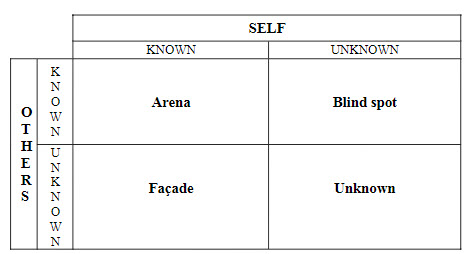
An easy tool to start thinking about this is the Johari window, a technique that helps people better understand their relationship with themselves and others. There are two axis, others and self. This forms four quadrants:

  • Arena – What is known by both self and others. It is also often referred to as the Public Area.
  • Blind spot – This region deals with knowledge unknown to self but visible to others, such as shortcomings or annoying habits.
  • Façade – This includes the features and knowledge of the individual which are not known to others. I prefer when this is called the Hidden. It was originally called facade because it can include stuff that is untrue but for the individual’s claim.
  • Unknown – The characteristics of the person that are unknown to both self and others.
The original Johari Window (based on Luft, 1969)

An example of a basic Johari Window (my own) can be found here.

Users are advised to reduce the area of ‘blind spot’ and ‘unknown’, while expand the ‘arena’. The premise is that the lesser the hidden personality, the better the person becomes in relating with other people.

The use of Johari Window is popular among business coaches as a cognitive tool to understand intrapersonal and interpersonal relationships. There isn’t much value of this tool as an empirical framework and it hasn’t held up to academic rigor. Still, like many such things it can bring to light the central point that we need to understand our hidden biases.

Another good tool to start understanding biases is a personal audit.

Using the Johari Window for Teams

Teams and organizations have blind spots, think of them as negative input factors or as procedural negatives.

The Johari Window can also be applied to knowledge transparency, and it fits nicely to the concepts of tacit and explicit knowledge bringing to light knowledge-seeking and knowledge-sharing behavior. For example, the ‘arena’ can simply become the ‘unknown’ if there is no demand or offer pertaining to the knowledge to be occupied by the recipient or to be shared by the owner, respectively.

The Johari Window transforms with the the four quadrants changing to:

  • Arena What the organization knows it knows. Contains knowledge available to the team as well as related organizations. Realizing such improvements is usually demanded by network partners and should be priority for implementation.
  • Façade What the organization does know it knows. Knowledge that is only available to parts of the focal organization. Derived improvements are unexpected, but beneficial for the organization and its collaborations.
  • Blind SpotWhat the organization knows it does not know. Knowledge only available to other organizations – internal and external. This area should be investigated with highest priority, to benefit from insights and to maintain effectiveness.
  • Unknown What the organization does not know it does not know, and what the organization believes it knows but does not actually know. Knowledge about opportunities for improvement that is not available to anyone. Its identification leads to the Façade sector.

We are firmly in the land of uncertainty, ignorance and surprise, and we are starting to perform a risk based approach to our organization blind spots. At the heart, knowledge management, problem solving and risk management are all very closely intertwined.