Quality-as-Imagined versus Quality-as-Done

Assumptions about how work is carried out is often very different from the reality of the work. This is the difference between work-as-imagined and work-as-done. Assumptions about work as imagined often turn out to be wrong because they are based on a fundamental misunderstanding. Steven Shorrock on Humanistic Systems has been doing a great series on proxies for work-as-done that I recommend you read for more details.

The complexity of our organizations implies a certain level of inevitable unexpected variability and thus a gap between Work-as-Imagined and Work-as-Done. Work-as-Imagined reflects how work is understood by those who are separated from it by time or space; it is an over-simplified version of what is actually going on. Work-as-Done takes account of what it means to function effectively, despite resource-constrained circumstances. The analysis of the gap between Work-As-Imagined and Work-as-Done usually indicates that performance variability is present in both desired and undesired outcomes and, therefore, successful outcomes do not necessarily occur because people are behaving according to Work-as-Imagined.

The same concept applies to the nature and implications of the gap between the prescribed quality practices and policies, Quality-as-Imagined, and the way they are deployed in practice, Quality-as-Done.

This gap should be no surprise. Our organizations are complex systems, and complexity can give rise to unintended consequences.

The interesting thing is that quality can drive a reduction of that gap, solving for complexity.

The Influence of Complexity on Quality
Dynamic InteractionsWide DiversityUnexpected VariabilityResilience
SocialInteractions between employeesEmployees with varying skill levels
Employee turnover
Diversity of functions performed by employees
(e.g. multiskilling)
Errors when operating equipment and tools
Unexpected behaviors
Absenteeism
Variability in human labor demand
Unexpected outcomes from
social interactions (e.g. conflicts and alliances)
Employees’ ability to
anticipate risks
Critical analysis of data
Informal agreements between workers to distribute the workload
TechnicalInteractions between production resources
Interactions due to tightly coupled operations (e.g. time constraints, low inventories, capacity constraints)
Product diversity
Diversity of quality requirements
Diversity of client requirements
Technical disruptions
Resource availability (e.g. maintenance staff)
Variability in production times (e.g. cycle time, lead time)
Dimensional variability (e.g. potential for defects)
Inspection readiness
Corrective, preventive and predictive measures
Work OrganizationInteractions between information sources
Interactions between functions
Interactions between processes
Interactions between performance indicators
Diversity in managerial controls
Diversity in relationships with external agents
Diversity of rules and procedures
Variability in the hiring of new workers
Changing priorities (e.g. frequent rescheduling due to unexpected conditions)
Variability in timing and
accuracy of information
Negotiation, partnership and bargaining power with suppliers and clients
Investments on new resources
Multidisciplinary problem-solving meetings
External EnvironmentInteractions between the organization, suppliers, and clients
Interactions with regulatory bodies
Diversity in suppliers
Diversity in clients
Variability in Demand/Need
Variability in logistics
Capacity and slack management
Examples of Complexity Impact

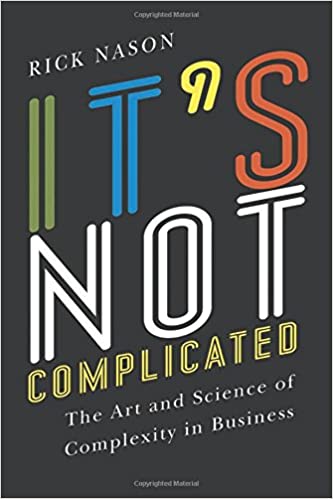
Quality Book Shelf – It’s Not Complicated

It’s Not Complicated: The Art and Science of Complexity in Business by Rick Nason

Nason states at the beginning of the book: “Engineers, scientists, and ecologists have been thinking in terms of complexity for fifty years, and it is time that the business community considered some of the valuable and interesting lessons the field has to offer.”

This book is a great introduction to the concept of complexity, and I think it should be required reading.

Complexity generally occurs whenever and wherever there are human interactions.” 

“It is thinking, creativity, and risk taking that lead to sustainable competitive advantage.” 

Over-reliance on data can be dangerous, and Nason goes into detail on how US Secretary of Defense, Robert McNamara disastrously managed the Vietnam War with spreadsheets: “You cannot collect data on things that are unknown … even if the factors are known, the precision needed for the data to be useful for a complex problem would not be achievable.”

None of us are as smart as all of us, and nature trumps us all. Nason refers to Orgel’s Second Rule that, “evolution is smarter than you are and that events in the business [human] world turn out to be more creative and clever than the best minds can imagine.” In addition, serendipity plays a critical role: “Complicated systems allow us the illusion that luck or serendipity played at best a limited role in our success and thus, that whatever success we have is almost exclusively the result of our own skills and effort.”

I could basically cut-and-paste quotes all day.

As someone who feels we overuse complicated and complex as synonyms, I recommend this book to all as a way to get familiar with the core concepts. I sort of wish he would write the companion volume, “No, that’s not complex.”

Complex Problems, a rant

Inevitably you will sit in on a meeting and hear someone say “We need to find the root cause of this complex problem.”

If you are me, you possibly think one of two things:

  1. Complex problems don’t have root causes. In fact, they don’t even have clear cause-effect paths
  2. That’s not complex. It’s complicated.

Occasionally, I think both.

In my post “The difference between complex and complicated” I went into detail on the differences between the two.

Does it matter? Mostly not, but sometimes very much so. The approach you bring to the two can be very different, and if you think you are tackling the wrong type of problem you could spend some time banging against a wall.

For an example:

  • Wanting to reduce cycle time for release of product is a complicated problem. You can reduce the problems and solve for them (e.g. tackle deviation cycle time, specific areas of deviations, processing in the lab, capacity in the value stream, etc)
  • Ensuring a robust and resilient supply chain is a complex problem. This problem is multifunctional and the system is open.

It is for this reason I continue to use Art Smalley’s Four Types of Problems. This gives a nice setup of language for talking about problems in the organization.

We definitely need a School-House-Rock style song for this, or good rap.

Pandemics and the failure to think systematically

As it turns out, the reality-based, science-friendly communities and information sources many of us depend on also largely failed. We had time to prepare for this pandemic at the state, local, and household level, even if the government was terribly lagging, but we squandered it because of widespread asystemic thinking: the inability to think about complex systems and their dynamics. We faltered because of our failure to consider risk in its full context, especially when dealing with coupled risk—when multiple things can go wrong together. We were hampered by our inability to think about second- and third-order effects and by our susceptibility to scientism—the false comfort of assuming that numbers and percentages give us a solid empirical basis. We failed to understand that complex systems defy simplistic reductionism.

Zeynep Tufekci, “What Really Doomed Americas Coronovirus Response” published 24-Mar-2020 in the Atlantic

On point analysis. Hits many of the themes of this blog, including system thinking, complexity and risk and makes some excellent points that all of us in quality should be thinking deeply upon.

COVID-19 is not a black swan. Pandemics like this have been well predicted. This event is a different set of failures, that on a hopefully smaller scale most of us are unfortunately familiar with in our organizations.

I certainly didn’t break out of the mainstream narrative. I traveled in February, went to a conference and then held a small event on the 29th.

The article stresses the importance of considering the trade-offs between resilience, efficiency, and redundancy within the system, and how the second- and third-order impacts can reverberate. It’s well worth reading for the analysis of the growth of COVID-19, and more importantly our reaction to it, from a systems perspective.

VUCA – Accented Just Right It is a Profanity

Talk about strategy, risk management, or change; it is inevitable that the acronym VUCA — short for volatility, uncertainty, complexity, and ambiguity — will come up. VUCA is a catchall for “Hey, it’s crazy out there!” And like many catch-all’s it is misleading, VUCA conflates four distinct types of challenges that demand four distinct types of responses. VUCA can quickly become a crutch, a way to throw off the hard work of strategy and planning—after all, you can’t prepare for a VUCA world, right?

The mistake folks often make here is treating these four traits as a single idea, which leads to poorer decision making.

VUCA really isn’t a tool. It’s a checklist of four things that hopefully your system is paying attention to. All four represent distinct elements that make our environment and organization harder to grasp and control.