Industry 5.0, seriously?

This morning, an article landed in my inbox with the headline: “Why MES Remains the Digital Backbone, Even in Industry 5.0.” My immediate reaction? “You have got to be kidding me.” Honestly, that was also my second, third, and fourth reaction—each one a little more exasperated than the last. Sometimes, it feels like this relentless urge to slap a new number on every wave of technology is exactly why we can’t have nice things.

Curiosity got the better of me, though, and I clicked through. To my surprise, the article raised some interesting points. Still, I couldn’t help but wonder: do we really need another numbered revolution?

So, what exactly is Industry 5.0—and why is everyone talking about it? Let’s dig in.

The Origins and Evolution of Industry 5.0: From Japanese Society 5.0 to European Industrial Policy

The concept of Industry 5.0 emerged from a complex interplay of Japanese technological philosophy and European industrial policy, representing a fundamental shift from purely efficiency-driven manufacturing toward human-centric, sustainable, and resilient production systems. While the term “Industry 5.0” was formally coined by the European Commission in 2021, its intellectual foundations trace back to Japan’s Society 5.0 concept introduced in 2016, which envisioned a “super-smart society” that integrates cyberspace and physical space to address societal challenges. This evolution reflects a growing recognition that the Fourth Industrial Revolution’s focus on automation and digitalization, while transformative, required rebalancing to prioritize human welfare, environmental sustainability, and social resilience alongside technological advancement.

The Japanese Foundation: Society 5.0 as Intellectual Precursor

The conceptual roots of Industry 5.0 can be traced directly to Japan’s Society 5.0 initiative, which was first proposed in the Fifth Science and Technology Basic Plan adopted by the Japanese government in January 2016. This concept emerged from intensive deliberations by expert committees administered by the Ministry of Education, Culture, Sports, Science and Technology (MEXT) and the Ministry of Economy, Trade and Industry (METI) since 2014. Society 5.0 was conceived as Japan’s response to the challenges of an aging population, economic stagnation, and the need to compete in the digital economy while maintaining human-centered values.

The Japanese government positioned Society 5.0 as the fifth stage of human societal development, following the hunter-gatherer society (Society 1.0), agricultural society (Society 2.0), industrial society (Society 3.0), and information society (Society 4.0). This framework was designed to address Japan’s specific challenges, including rapid population aging, social polarization, and depopulation in rural areas. The concept gained significant momentum when it was formally presented by former Prime Minister Shinzo Abe in 2019 and received robust support from the Japan Business Federation (Keidanren), which saw it as a pathway to economic revitalization.

International Introduction and Recognition

The international introduction of Japan’s Society 5.0 concept occurred at the CeBIT 2017 trade fair in Hannover, Germany, where the Japanese Business Federation presented this vision of digitally transforming society as a whole. This presentation marked a crucial moment in the global diffusion of ideas that would later influence the development of Industry 5.0. The timing was significant, as it came just six years after Germany had introduced the Industry 4.0 concept at the same venue in 2011, creating a dialogue between different national approaches to industrial and societal transformation.

The Japanese approach differed fundamentally from the German Industry 4.0 model by emphasizing societal transformation beyond manufacturing efficiency. While Industry 4.0 focused primarily on smart factories and cyber-physical systems, Society 5.0 envisioned a comprehensive integration of digital technologies across all aspects of society to create what Keidanren later termed an “Imagination Society”. This broader vision included autonomous vehicles and drones serving depopulated areas, remote medical consultations, and flexible energy systems tailored to specific community needs.

European Formalization and Policy Development

The formal conceptualization of Industry 5.0 as a distinct industrial paradigm emerged from the European Commission’s research and innovation activities. In January 2021, the European Commission published a comprehensive 48-page white paper titled “Industry 5.0 – Towards a sustainable, human-centric and resilient European industry,” which officially coined the term and established its core principles. This document resulted from discussions held in two virtual workshops organized in July 2020, involving research and technology organizations and funding agencies across Europe.

The European Commission’s approach to Industry 5.0 represented a deliberate complement to, rather than replacement of, Industry 4.0. According to the Commission, Industry 5.0 “provides a vision of industry that aims beyond efficiency and productivity as the sole goals, and reinforces the role and the contribution of industry to society”. This formulation explicitly placed worker wellbeing at the center of production processes and emphasized using new technologies to provide prosperity beyond traditional economic metrics while respecting planetary boundaries.

Policy Integration and Strategic Objectives

The European conceptualization of Industry 5.0 was strategically aligned with three key Commission priorities: “An economy that works for people,” the “European Green Deal,” and “Europe fit for the digital age”. This integration demonstrates how Industry 5.0 emerged not merely as a technological concept but as a comprehensive policy framework addressing multiple societal challenges simultaneously. The approach emphasized adopting human-centric technologies, including artificial intelligence regulation, and focused on upskilling and reskilling European workers to prepare for industrial transformation.

The European Commission’s framework distinguished Industry 5.0 by its explicit focus on three core values: sustainability, human-centricity, and resilience. This represented a significant departure from Industry 4.0’s primary emphasis on efficiency and productivity, instead prioritizing environmental responsibility, worker welfare, and system robustness against external shocks such as the COVID-19 pandemic. The Commission argued that this approach would enable European industry to play an active role in addressing climate change, resource preservation, and social stability challenges.

Conceptual Evolution and Theoretical Development

From Automation to Human-Machine Collaboration

The evolution from Industry 4.0 to Industry 5.0 reflects a fundamental shift in thinking about the role of humans in automated production systems. While Industry 4.0 emphasized machine-to-machine communication, Internet of Things connectivity, and autonomous decision-making systems, Industry 5.0 reintroduced human creativity and collaboration as central elements. This shift emerged from practical experiences with Industry 4.0 implementation, which revealed limitations in purely automated approaches and highlighted the continued importance of human insight, creativity, and adaptability.

Industry 5.0 proponents argue that the concept represents an evolution rather than a revolution, building upon Industry 4.0’s technological foundation while addressing its human and environmental limitations. The focus shifted toward collaborative robots (cobots) that work alongside human operators, combining the precision and consistency of machines with human creativity and problem-solving capabilities. This approach recognizes that while automation can handle routine and predictable tasks effectively, complex problem-solving, innovation, and adaptation to unexpected situations remain distinctly human strengths.

Academic and Industry Perspectives

The academic and industry discourse around Industry 5.0 has emphasized its role as a corrective to what some viewed as Industry 4.0’s overly technology-centric approach. Scholars and practitioners have noted that Industry 4.0’s focus on digitalization and automation, while achieving significant efficiency gains, sometimes neglected human factors and societal impacts. Industry 5.0 emerged as a response to these concerns, advocating for a more balanced approach that leverages technology to enhance rather than replace human capabilities.

The concept has gained traction across various industries as organizations recognize the value of combining technological sophistication with human insight. This includes applications in personalized manufacturing, where human creativity guides AI systems to produce customized products, and in maintenance operations, where human expertise interprerets data analytics to make complex decisions about equipment management416. The approach acknowledges that successful industrial transformation requires not just technological advancement but also social acceptance and worker engagement.

Timeline and Key Milestones

The development of Industry 5.0 can be traced through several key phases, beginning with Japan’s internal policy deliberations from 2014 to 2016, followed by international exposure in 2017, and culminating in European formalization in 2021. The COVID-19 pandemic played a catalytic role in accelerating interest in Industry 5.0 principles, as organizations worldwide experienced the importance of resilience, human adaptability, and sustainable practices in maintaining operations during crisis conditions.

The period from 2017 to 2020 saw growing academic and industry discussion about the limitations of purely automated approaches and the need for more human-centric industrial models. This discourse was influenced by practical experiences with Industry 4.0 implementation, which revealed challenges in areas such as worker displacement, skill gaps, and environmental sustainability. The European Commission’s workshops in 2020 provided a formal venue for consolidating these concerns into a coherent policy framework.

Contemporary Developments and Future Trajectory

Since the European Commission’s formal introduction of Industry 5.0 in 2021, the concept has gained international recognition and adoption across various sectors. The approach has been particularly influential in discussions about sustainable manufacturing, worker welfare, and industrial resilience in the post-pandemic era. Organizations worldwide are beginning to implement Industry 5.0 principles, focusing on human-machine collaboration, environmental responsibility, and system robustness.

The concept continues to evolve as practitioners gain experience with its implementation and as new technologies enable more sophisticated forms of human-machine collaboration. Recent developments have emphasized the integration of artificial intelligence with human expertise, the application of circular economy principles in manufacturing, and the development of resilient supply chains capable of adapting to global disruptions. These developments suggest that Industry 5.0 will continue to influence industrial policy and practice as organizations seek to balance technological advancement with human and environmental considerations.

Evaluating Industry 5.0 Concepts

While I am naturally suspicious of version numbers on frameworks, and certainly exhausted by the Industry 4.0/Quality 4.0 advocates, the more I read about industry 5.0 the more the core concepts resonated with me. Industry 5.0 challenges manufacturers to reshape how they think about quality, people, and technology. And this resonates on what has always been the fundamental focus of this blog: robust Quality Units, data integrity, change control, and the organizational structures needed for true quality oversight.

Human-Centricity: From Oversight to Empowerment

Industry 5.0’s defining feature is its human-centric approach, aiming to put people back at the heart of manufacturing. This aligns closely with my focus on decision-making, oversight, and continuous improvement.

Collaboration Between Humans and Technology

I frequently address the pitfalls of siloed teams and the dangers of relying solely on either manual or automated systems for quality management. Industry 5.0’s vision of human-machine collaboration—where AI and automation support, but don’t replace, expert judgment—mirrors this blog’s call for integrated quality systems.

Proactive, Data-Driven Quality

To say that a central theme in my career has been how reactive, paper-based, or poorly integrated systems lead to data integrity issues and regulatory citations would be an understatement. Thus, I am fully aligned with the advocacy for proactive, real-time management utilizing AI, IoT, and advanced analytics. This continued shift from after-the-fact remediation to predictive, preventive action directly addresses the recurring compliance gaps we continue to struggle with. This blog’s focus on robust documentation, risk-based change control, and comprehensive batch review finds a natural ally in Industry 5.0’s data-driven, risk-based quality management systems.

Sustainability and Quality Culture

Another theme on this blog is the importance of management support and a culture of quality—elements that Industry 5.0 elevates by integrating sustainability and social responsibility into the definition of quality itself. Industry 5.0 is not just about defect prevention; it’s about minimizing waste, ensuring ethical sourcing, and considering the broader impact of manufacturing on people and the planet. This holistic view expands the blog’s advocacy for independent, well-resourced Quality Units to include environmental and social governance as core responsibilities. Something I perhaps do not center as much in my practice as I should.

Democratic Leadership

The principles of democratic leadership explored extensively on this blog provide a critical foundation for realizing the human-centric aspirations of Industry 5.0. Central to the my philosophy is decentralizing decision-making and fostering psychological safety—concepts that align directly with Industry 5.0’s emphasis on empowering workers through collaborative human-machine ecosystems. By advocating for leadership models that distribute authority to frontline employees and prioritize transparency, this blog’s framework mirrors Industry 5.0’s rejection of rigid hierarchies in favor of agile, worker-driven innovation. The emphasis on equanimity—maintaining composed, data-driven responses to quality challenges—resonates with Industry 5.0’s vision of resilient systems where human judgment guides AI and automation. This synergy is particularly evident in the my analysis of decentralized decision-making, which argues that empowering those closest to operational realities accelerates problem-solving while building ownership—a necessity for Industry 5.0’s adaptive production environments. The European Commission’s Industry 5.0 white paper explicitly calls for this shift from “shareholder to stakeholder value,” a transition achievable only through the democratic leadership practices championed in the blog’s critique of Taylorist management models. By merging technological advancement with human-centric governance, this blog’s advocacy for flattened hierarchies and worker agency provides a blueprint for implementing Industry 5.0’s ideals without sacrificing operational rigor.

Convergence and Opportunity

While I have more than a hint of skepticism about the term Industry 5.0, I acknowledge its reliance on the foundational principles that I consider crucial to quality management. By integrating robust organizational quality structures, empowered individuals, and advanced technology, manufacturers can transcend mere compliance to deliver sustainable, high-quality products in a rapidly evolving world. For quality professionals, the implication is clear: the future is not solely about increased automation or stricter oversight but about more intelligent, collaborative, and, importantly, human-centric quality management. This message resonates deeply with me, and it should with you as well, as it underscores the value and importance of our human contribution in this process.

Key Sources on Industry 5.0

Here is a curated list of foundational and authoritative sources for understanding Industry 5.0, including official reports, academic articles, and expert analyses that I found most helpful when evaluating the concept of Industry 5.0:

Operational Stability

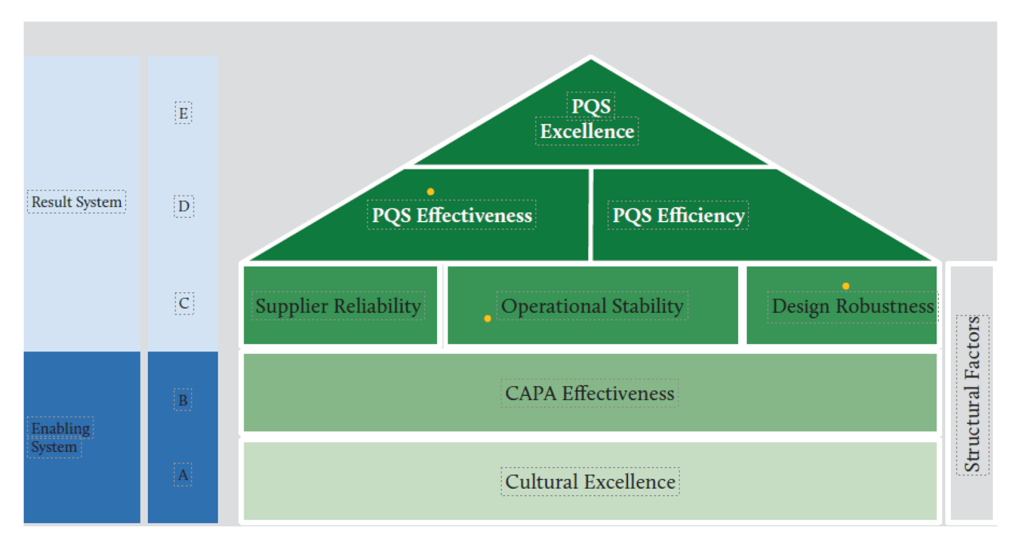
At the heart of achieving consistent pharmaceutical quality lies operational stability—a fundamental concept that forms the critical middle layer in the House of Quality model. Operational stability serves as the bridge between cultural foundations and the higher-level outcomes of effectiveness, efficiency, and excellence. This critical positioning makes it worthy of detailed examination, particularly as regulatory bodies increasingly emphasize Quality Management Maturity (QMM) as a framework for evaluating pharmaceutical operations.

he image is a diagram in the shape of a house, illustrating a framework for PQS (Pharmaceutical Quality System) Excellence. The house is divided into several colored sections:

The roof is labeled "PQS Excellence."

Below the roof, two sections are labeled "PQS Effectiveness" and "PQS Efficiency."

Underneath, three blocks are labeled "Supplier Reliability," "Operational Stability," and "Design Robustness."

Below these, a larger block spans the width and is labeled "CAPA Effectiveness."

The base of the house is labeled "Cultural Excellence."

On the left side, two vertical sections are labeled "Enabling System" (with sub-levels A and B) and "Result System" (with sub-levels C, D, and E).

On the right side, a vertical label reads "Structural Factors."

The diagram uses different shades of green and blue to distinguish between sections and systems.

Understanding Operational Stability in Pharmaceutical Manufacturing

Operational stability represents the state where manufacturing and quality processes exhibit consistent, predictable performance over time with minimal unexpected variations. It refers to the capability of production systems to maintain control within defined parameters regardless of routine challenges that may arise. In pharmaceutical manufacturing, operational stability encompasses everything from batch-to-batch consistency to equipment reliability, from procedural adherence to supply chain resilience.

The essence of operational stability lies in its emphasis on reliability and predictability. A stable operation delivers consistent outcomes not by chance but by design—through robust systems that can withstand normal operating stresses without performance degradation. Pharmaceutical operations that achieve stability demonstrate the ability to maintain critical quality attributes within specified limits while accommodating normal variability in inputs such as raw materials, human operations, and environmental conditions.

According to the House of Quality model for pharmaceutical quality frameworks, operational stability occupies a central position between cultural foundations and higher-level performance outcomes. This positioning is not accidental—it recognizes that stability is both dependent on cultural excellence below it and necessary for the efficiency and effectiveness that lead to excellence above it.

The Path to Obtaining Operational Stability

Achieving operational stability requires a systematic approach that addresses several interconnected dimensions. This pursuit begins with establishing robust processes designed with sufficient control mechanisms and clear operating parameters. Process design should incorporate quality by design principles, ensuring that processes are inherently capable of consistent performance rather than relying on inspection to catch deviations.

Standard operating procedures form the backbone of operational stability. These procedures must be not merely documented but actively maintained, followed, and continuously improved. This principle applies broadly—authoritative documentation precedes execution, ensuring alignment and clarity.

Equipment reliability programs represent another critical component in achieving operational stability. Preventive maintenance schedules, calibration programs, and equipment qualification processes all contribute to ensuring that physical assets support rather than undermine stability goals. The FDA’s guidance on pharmaceutical CGMP regulation emphasizes the importance of the Facilities and Equipment System, which ensures that facilities and equipment are suitable for their intended use and maintained properly.

Supplier qualification and management play an equally important role. As pharmaceutical manufacturing becomes increasingly globalized, with supply chains spanning multiple countries and organizations, the stability of supplied materials becomes essential for operational stability. “Supplier Reliability” appears in the House of Quality model at the same level as operational stability, underscoring their interconnected nature1. Robust supplier qualification programs, ongoing monitoring, and collaborative relationships with key vendors all contribute to supply chain stability that supports overall operational stability.

Human factors cannot be overlooked in the pursuit of operational stability. Training programs, knowledge management systems, and appropriate staffing levels all contribute to consistent human performance. The establishment of a “zero-defect culture” underscores the importance of human factors in achieving true operational stability.

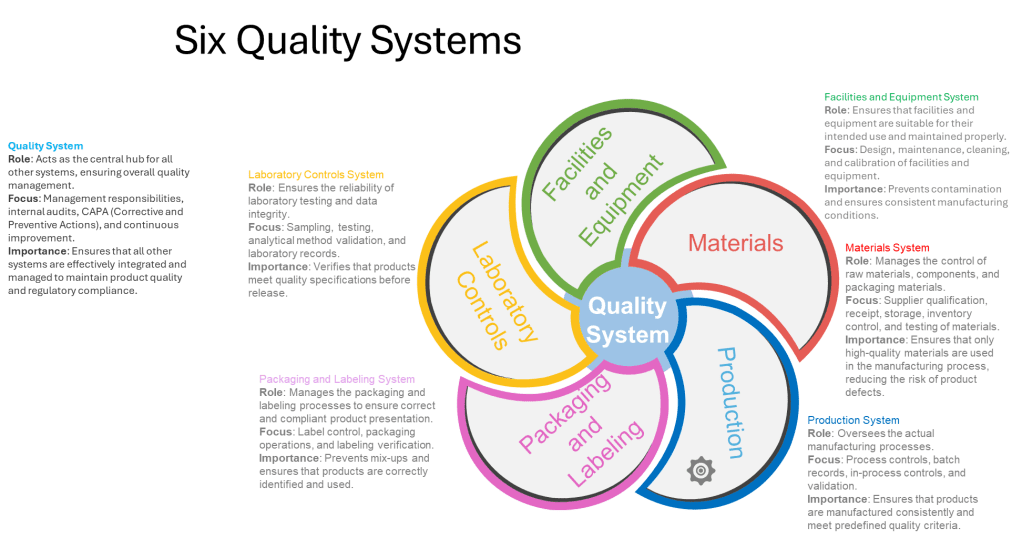
Main Content Overview:
The document outlines six key quality systems essential for effective quality management in regulated industries, particularly pharmaceuticals and related fields. Each system is described with its role, focus areas, and importance.

Detailed Alt Text
1. Quality System

Role: Central hub for all other systems, ensuring overall quality management.

Focus: Management responsibilities, internal audits, CAPA (Corrective and Preventive Actions), and continuous improvement.

Importance: Integrates and manages all systems to maintain product quality and regulatory compliance.

2. Laboratory Controls System

Role: Ensures reliability of laboratory testing and data integrity.

Focus: Sampling, testing, analytical method validation, and laboratory records.

Importance: Verifies products meet quality specifications before release.

3. Packaging and Labeling System

Role: Manages packaging and labeling to ensure correct and compliant product presentation.

Focus: Label control, packaging operations, and labeling verification.

Importance: Prevents mix-ups and ensures correct product identification and use.

4. Facilities and Equipment System

Role: Ensures facilities and equipment are suitable and maintained for intended use.

Focus: Design, maintenance, cleaning, and calibration.

Importance: Prevents contamination and ensures consistent manufacturing conditions.

5. Materials System

Role: Manages control of raw materials, components, and packaging materials.

Focus: Supplier qualification, receipt, storage, inventory control, and testing.

Importance: Ensures only high-quality materials are used, reducing risk of defects.

6. Production System

Role: Oversees manufacturing processes.

Focus: Process controls, batch records, in-process controls, and validation.

Importance: Ensures consistent manufacturing and adherence to quality criteria.

Image Description:
A diagram (not shown here) likely illustrates the interconnection of the six quality systems, possibly with the "Quality System" at the center and the other five systems branching out, indicating their relationship and integration within an overall quality management framework

Measuring Operational Stability: Key Metrics and Approaches

Measurement forms the foundation of any improvement effort. For operational stability, measurement approaches must capture both the state of stability and the factors that contribute to it. The pharmaceutical industry utilizes several key metrics to assess operational stability, ranging from process-specific measurements to broader organizational indicators.

Process capability indices (Cp, Cpk) provide quantitative measures of a process’s ability to meet specifications consistently. These statistical measures compare the natural variation in a process against specified tolerances. A process with high capability indices demonstrates the stability necessary for consistent output. These measures help distinguish between common cause variations (inherent to the process) and special cause variations (indicating potential instability).

Deviation rates and severity classification offer another window into operational stability. Tracking not just the volume but the nature and significance of deviations provides insight into systemic stability issues. The following table outlines how different deviation patterns might be interpreted:

Deviation PatternStability ImplicationRecommended Response
Low frequency, low severityGood operational stabilityContinue monitoring, seek incremental improvements
Low frequency, high severityCritical vulnerability despite apparent stabilityRoot cause analysis, systemic preventive actions
High frequency, low severityDegrading stability, risk of normalization of devianceProcess review, operator training, standard work reinforcement
High frequency, high severityFundamental stability issuesComprehensive process redesign, management system review

Equipment reliability metrics such as Mean Time Between Failures (MTBF) and Overall Equipment Effectiveness (OEE) provide visibility into the physical infrastructure supporting operations. These measures help identify whether equipment-related issues are undermining otherwise well-designed processes.

Batch cycle time consistency represents another valuable metric for operational stability. In stable operations, the time required to complete batch manufacturing should fall within a predictable range. Increasing variability in cycle times often serves as an early warning sign of degrading operational stability.

Right-First-Time (RFT) batch rates measure the percentage of batches that proceed through the entire manufacturing process without requiring rework, deviation management, or investigation. High and consistent RFT rates indicate strong operational stability.

Leveraging Operational Stability for Organizational Excellence

Once achieved, operational stability becomes a powerful platform for broader organizational excellence. Robust operational stability delivers substantial business benefits that extend throughout the organization.

Resource optimization represents one of the most immediate benefits. Stable operations require fewer resources dedicated to firefighting, deviation management, and rework. This allows for more strategic allocation of both human and financial resources. As noted in the St. Gallen reports “organizations with higher levels of cultural excellence, including employee engagement and continuous improvement mindsets supports both quality and efficiency improvements.”

Stable operations enable focused improvement efforts. Rather than dispersing improvement resources across multiple priority issues, organizations can target specific opportunities for enhancement. This focused approach yields more substantial gains and allows for the systematic building of capabilities over time.

Regulatory confidence grows naturally from demonstrated operational stability. Regulatory agencies increasingly look beyond mere compliance to assess the maturity of quality systems. The FDA’s Quality Management Maturity (QMM) program explicitly recognizes that mature quality systems are characterized by consistent, reliable processes that ensure quality objectives and promote continual improvement.

Market differentiation emerges as companies leverage their operational stability to deliver consistently high-quality products with reliable supply. In markets where drug shortages have become commonplace, the ability to maintain stable supply becomes a significant competitive advantage.

Innovation capacity expands when operational stability frees resources and attention previously consumed by basic operational problems. Organizations with stable operations can redirect energy toward innovation in products, processes, and business models.

Operational Stability within the House of Quality Model

The House of Quality model places operational stability in a pivotal middle position. This architectural metaphor is instructive—like the middle floors of a building, operational stability both depends on what lies beneath it and supports what rises above it. Understanding this positioning helps clarify operational stability’s role in the broader quality management system.

Cultural excellence lies at the foundation of the House of Quality. This foundation provides the mindset, values, and behaviors necessary for sustained operational stability. Without this cultural foundation, attempts to establish operational stability will likely prove short-lived. At a high level of quality management maturity, organizations operate optimally with clear signals of alignment, where quality and risk management stem from and support the organization’s objectives and values.

Above operational stability in the House of Quality model sit Effectiveness and Efficiency, which together lead to Excellence at the apex. This positioning illustrates that operational stability serves as the essential platform enabling both effectiveness (doing the right things) and efficiency (doing things right). Research from the St. Gallen reports found that “plants with more effective quality systems also tend to be more efficient in their operations,” although “effectiveness only explained about 4% of the variation in efficiency scores.”

The House of Quality model also places Supplier Reliability and Design Robustness at the same level as Operational Stability. This horizontal alignment stems from these three elements work in concert as the critical middle layer of the quality system. Collectively, they provide the stable platform necessary for higher-level performance.

ElementRelationship to Operational StabilityJoint Contribution to Upper Levels
Supplier ReliabilityProvides consistent input materials essential for operational stabilityEnables predictable performance and resource optimization
Operational StabilityCreates consistent process performance regardless of normal variationsEstablishes the foundation for systematic improvement and performance optimization
Design RobustnessEnsures processes and products can withstand variation without quality impactReduces the resource burden of controlling variation, freeing capacity for improvement

The Critical Middle: Why Operational Stability Enables PQS Effectiveness and Efficiency

Operational stability functions as the essential bridge between cultural foundations and higher-level performance outcomes. This positioning highlights its critical role in translating quality culture into tangible quality performance.

Operational stability enables PQS effectiveness by creating the conditions necessary for systems to function as designed. The PQS effectiveness visible in the upper portions of the House of Quality depends on reliable execution of core processes. When operations are unstable, even well-designed quality systems fail to deliver their intended outcomes.

Operational stability enables efficiency by reducing wasteful activities associated with unstable processes. Without stability, efficiency initiatives often fail to deliver sustainable results as resources continue to be diverted to managing instability.

The relationship between operational stability and the higher levels of the House of Quality follows a hierarchical pattern. Attempts to achieve efficiency without first establishing stability typically result in fragile systems that deliver short-term gains at the expense of long-term performance. Similarly, effectiveness cannot be sustained without the foundation of stability. The model implies a necessary sequence: first cultural excellence, then operational stability (alongside supplier reliability and design robustness), followed by effectiveness and efficiency, ultimately leading to excellence.

Balancing Operational Stability with Innovation and Adaptability

While operational stability provides numerous benefits, it must be balanced with innovation and adaptability to avoid organizational rigidity. There is a potential negative consequences of an excessive focus on efficiency, including reduced resilience and flexibility which can lead to stifled innovation and creativity.

The challenge lies in establishing sufficient stability to enable consistent performance while maintaining the adaptability necessary for continuous improvement and innovation. This balance requires thoughtful design of stability mechanisms, ensuring they control critical quality attributes without unnecessarily constraining beneficial innovation.

Process characterization plays an important role in striking this balance. By thoroughly understanding which process parameters truly impact critical quality attributes, organizations can focus stability efforts where they matter most while allowing flexibility elsewhere. This selective approach to stability creates what might be called “bounded flexibility”—freedom to innovate within well-understood boundaries.

Change management systems represent another critical mechanism for balancing stability with innovation. Well-designed change management ensures that innovations are implemented in a controlled manner that preserves operational stability. ICH Q10 specifically identifies Change Management Systems as a key element of the Pharmaceutical Quality System, emphasizing its importance in maintaining this balance.

Measuring Quality Management Maturity through Operational Stability

Regulatory agencies increasingly recognize operational stability as a key indicator of Quality Management Maturity (QMM). The FDA’s QMM program evaluates organizations across multiple dimensions, with operational performance being a central consideration.

Organizations can assess their own QMM level by examining the nature and pattern of their operational stability. The following table presents a maturity progression framework related to operational stability:

Maturity LevelOperational Stability CharacteristicsEvidence Indicators
Reactive (Level 1)Unstable processes requiring constant interventionHigh deviation rates, frequent batch rejections, unpredictable cycle times
Controlled (Level 2)Basic stability achieved through rigid controls and extensive oversightLow deviation rates but high oversight costs, limited process understanding
Predictive (Level 3)Processes demonstrate inherent stability with normal variation understoodStatistical process control effective, leading indicators utilized
Proactive (Level 4)Stability maintained through systemic approaches rather than individual effortsRoot causes addressed systematically, culture of ownership evident
Innovative (Level 5)Stability serves as platform for continuous improvement and innovationStability metrics consistently excellent, resources focused on value-adding activities

This maturity progression aligns with the FDA’s emphasis on QMM as “the state attained when drug manufacturers have consistent, reliable, and robust business processes to achieve quality objectives and promote continual improvement”.

Practical Approaches to Building Operational Stability

Building operational stability requires a comprehensive approach addressing process design, organizational capabilities, and management systems. Several practical methods have proven particularly effective in pharmaceutical manufacturing environments.

Statistical Process Control (SPC) provides a systematic approach to monitoring processes and distinguishing between common cause and special cause variation. By establishing control limits based on natural process variation, SPC helps identify when processes are operating stably within expected variation versus when they experience unusual variation requiring investigation. This distinction prevents over-reaction to normal variation while ensuring appropriate response to significant deviations.

Process validation activities establish scientific evidence that a process can consistently deliver quality products. Modern validation approaches emphasize ongoing process verification rather than point-in-time demonstrations, aligning with the continuous nature of operational stability.

Root cause analysis capabilities ensure that when deviations occur, they are investigated thoroughly enough to identify and address underlying causes rather than symptoms. This prevents recurrence and systematically improves stability over time. The CAPA (Corrective Action and Preventive Action) system plays a central role in this aspect of building operational stability.

Knowledge management systems capture and make accessible the operational knowledge that supports stability. By preserving institutional knowledge and making it available when needed, these systems reduce dependence on individual expertise and create more resilient operations. This aligns with ICH Q10’s emphasis on “expanding the body of knowledge”.

Training and capability development ensure that personnel possess the necessary skills to maintain operational stability. Investment in operator capabilities pays dividends through reduced variability in human performance, often a significant factor in overall operational stability.

Operational Stability as the Engine of Quality Excellence

Operational stability occupies a pivotal position in the House of Quality model—neither the foundation nor the capstone, but the essential middle that translates cultural excellence into tangible performance outcomes. Its position reflects its dual nature: dependent on cultural foundations for sustainability while enabling the effectiveness and efficiency that lead to excellence.

The journey toward operational stability is not merely technical but cultural and organizational. It requires systematic approaches, appropriate metrics, and balanced objectives that recognize stability as a means rather than an end. Organizations that achieve robust operational stability position themselves for both regulatory confidence and market leadership.

As regulatory frameworks evolve toward Quality Management Maturity models, operational stability will increasingly serve as a differentiator between organizations. Those that establish and maintain strong operational stability will find themselves well-positioned for both compliance and competition in an increasingly demanding pharmaceutical landscape.

The House of Quality model provides a valuable framework for understanding operational stability’s role and relationships. By recognizing its position between cultural foundations and performance outcomes, organizations can develop more effective strategies for building and leveraging operational stability. The result is a more robust quality system capable of delivering not just compliance but true quality excellence that benefits patients, practitioners, and the business itself.

Integrating Elegance into Quality Systems: The Third Dimension of Excellence

Quality systems often focus on efficiency—doing things right—and effectiveness—doing the right things. However, as industries evolve and systems grow more complex, a third dimension is essential to achieving true excellence: elegance. Elegance in quality systems is not merely about simplicity but about creating solutions that are intuitive, sustainable, and seamlessly integrated into organizational workflows.

Elegance elevates quality systems by addressing complexity in a way that reduces friction while maintaining sophistication. It involves designing processes that are not only functional but also intuitive and visually appealing, encouraging engagement rather than resistance. For example, an elegant deviation management system might replace cumbersome, multi-step forms with guided tools that simplify root cause analysis while improving accuracy. By integrating such elements, organizations can achieve compliance with less effort and greater satisfaction among users.

When viewed through the lens of the Excellence Triad, elegance acts as a multiplier for both efficiency and effectiveness. Efficiency focuses on streamlining processes to save time and resources, while effectiveness ensures those processes align with organizational goals and regulatory requirements. Elegance bridges these two dimensions by creating systems that are not only efficient and effective but also enjoyable to use. For instance, a visually intuitive risk assessment matrix can enhance both the speed of decision-making (efficiency) and the accuracy of risk evaluations (effectiveness), all while fostering user engagement through its elegant design.

To imagine how elegance can be embedded into a quality system, consider this high-level example of an elegance-infused quality plan aimed at increasing maturity within 18 months. At its core, this plan emphasizes simplicity and sustainability while aligning with organizational objectives. The plan begins with a clear purpose: to prioritize patient safety through elegant simplicity. This guiding principle is operationalized through metrics such as limiting redundant documents and minimizing the steps required to report quality events.

The implementation framework includes cross-functional quality circles tasked with redesigning one process each quarter using visual heuristics like symmetry and closure. These teams also conduct retrospectives to evaluate the cognitive load of procedures and the aesthetic clarity of dashboards, ensuring that elegance remains a central focus. Documentation is treated as a living system, with cognitive learning driven and video micro-procedures replacing lengthy procedures and tools scoring documents to ensure they remain user-friendly.

The roadmap for maturity integrates elegance at every stage. At the standardized level, efficiency targets include achieving 95% on-time CAPA closures, while elegance milestones focus on reducing document complexity scores across SOPs. As the organization progresses to predictive maturity, AI-driven risk forecasts enhance efficiency, while staff adoption rates reflect the intuitive nature of the systems in place. Finally, at the optimizing stage, zero repeat audits signify peak efficiency and effectiveness, while voluntary adoption of quality tools by R&D teams underscores the system’s elegance.

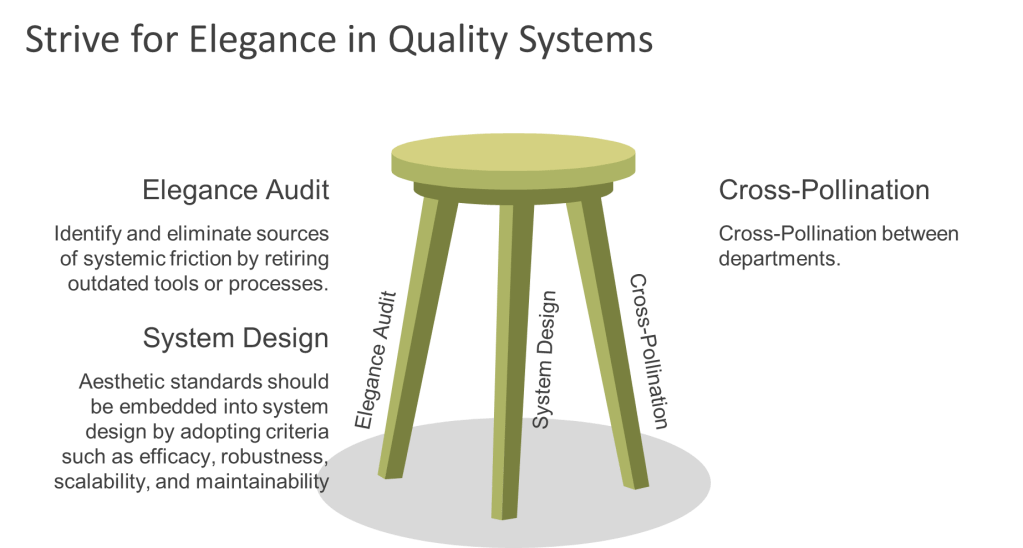
To cultivate elegance within quality systems, organizations can adopt three key strategies. First, they should identify and eliminate sources of systemic friction by retiring outdated tools or processes. For example, replacing blame-centric forms with learning logs can transform near-miss reporting into an opportunity for growth rather than criticism. Second, aesthetic standards should be embedded into system design by adopting criteria such as efficacy, robustness, scalability, and maintainability. Training QA teams as system gardeners who can further enhance this approach. Finally, cross-pollination between departments can foster innovation; for instance, involving designers in QA processes can lead to more visually engaging outcomes.

By embedding elegance into their quality systems alongside efficiency and effectiveness, organizations can move from mere survival to thriving excellence. Compliance becomes an intuitive outcome of well-designed processes rather than a burdensome obligation. Innovation flourishes in frictionless environments where tools invite improvement rather than resistance. Organizations ready to embrace this transformative approach should begin by conducting an “Elegance Audit” of their most cumbersome processes to identify opportunities for improvement. Through these efforts, excellence becomes not just a goal but a natural state of being for the entire system.

PQS Efficiency – Is Efficiency Good?

I do love a house metaphor or visualization, almost as I like a good tree, and this visualization of the house of quality is one I often return to. I want to turn to the question of efficiency, as it is often one I hear stressed by many leaders, and frankly I think the use can get a little off-kilter.

We can define efficiency as the “productivity of a process and the utilization of resources.” The St Gallen reports commissioned by the FDA as part of the quality metrics initiative finds that efficiency and effectiveness in pharmaceutical quality systems are positively correlated, though the relationship is not as strong as some may expect.

The study analyzed data from over 60 pharmaceutical manufacturing plants found a slight positive correlation between measures of quality system effectiveness and efficiency. This indicates that plants with more effective quality systems also tend to be more efficient in their operations. However, effectiveness only explained about 4% of the variation in efficiency scores, suggesting other factors play a major role as well.

To dig deeper, the researchers separated plants into four groups based on their levels of quality effectiveness and efficiency. The top performing group excelled in both areas, while the lowest group struggled with both. Interestingly, there were also groups that performed well in one area but not the other. This reveals that effectiveness and efficiency, while related, are distinct capabilities that must be built separately.

What really set apart the top performers was their higher implementation of operational excellence practices across areas like total productive maintenance, quality management, and just-in-time production. They also tended to have more empowered employees and a stronger culture of continuous improvement. This suggests that building these foundational capabilities is key to achieving both quality and efficiency.

The research provides evidence that quality and efficiency can be mutually reinforcing when the right systems and culture are in place. However, it also shows this is not automatic – companies must be intentional about developing both in tandem. Those that focus solely on efficiency without building quality maturity may struggle to sustain performance in the long run. The most successful manufacturers find ways to make quality a driver of operational excellence, not a constraint on it.

Dangers of an Excessive Focus on Efficiency

An excessive focus on efficiency in organizations can further lead to several unintended negative consequences:

Reduced Resilience and Flexibility

Prioritizing efficiency often involves streamlining processes, reducing redundancies, and optimizing resource allocation. While this can boost short-term productivity, it can also make organizations less resilient to unexpected disruptions.

Stifled Innovation and Creativity

Efficiency-driven environments tend to emphasize standardization and predictability, which can hinder innovation. When resources are tightly controlled and risk-aversion is high, there’s little room for experimentation and creative problem-solving. This can leave companies vulnerable to being outpaced by more innovative competitors.

Employee Burnout and Disengagement

Pushing for ever-increasing efficiency can lead to work environments where employees are constantly pressured to do more with less. This approach can increase stress levels, leading to burnout, reduced morale, and ultimately, lower overall productivity. Overworked employees may struggle with work-life balance and experience health issues, potentially resulting in higher turnover rates.

Compromised Quality

There’s often a delicate balance between efficiency and quality. In the pursuit of faster and cheaper ways of doing things, organizations may inadvertently compromise on product or service quality. Over time, this can erode brand reputation and customer loyalty.

Short-term Focus at the Expense of Long-term Success

An overemphasis on efficiency can lead to a myopic focus on short-term gains while neglecting long-term strategic objectives. This can result in missed opportunities for sustainable growth and innovation.

Resource Dilution and Competing Priorities

When organizations try to be efficient across too many initiatives simultaneously, it can lead to resource dilution. This often results in many projects being worked on, but few being completed effectively or on time. Competing priorities can also lead to different departments working at cross-purposes, potentially canceling out each other’s efforts.

Loss of Human Connection and Engagement

Prioritizing task efficiency over human connection can have significant negative impacts on workplace culture and employee engagement. A lack of connection in the workplace can chip away at healthy mindsets and organizational culture.

Reduced Adaptability to Change

Highly efficient systems are often optimized for specific conditions. When those conditions change, such systems may struggle to adapt. This can leave organizations vulnerable in rapidly changing business environments.

To mitigate these risks, organizations should strive for a balance between efficiency and other important factors such as resilience, innovation, and employee well-being. This may involve maintaining some redundancies, allowing for periods of “productive inefficiency,” and fostering a culture that values both productivity and human factors.

Quality and Efficiency

Building efficiency from quality, often referred to as “Good Quality – Good Business”, is best tackled by:

  1. Reduced waste and rework: By focusing on quality, companies can reduce defects, errors, and the need for rework. This directly improves efficiency by reducing wasted time, materials, and labor.
  2. Improved processes: Quality initiatives often involve analyzing and optimizing processes. These improvements can lead to more streamlined operations and better resource utilization.
  3. Enhanced reliability: High-quality products and processes tend to be more reliable. This reliability can reduce downtime, maintenance costs, and other inefficiencies.
  4. Cultural excellence: Organizations with a higher levels of cultural excellence, including employee engagement and continuous improvement mindsets supports both quality and efficiency improvements.

The important thing to remember is efficiency that does not help the worker, that does not build resilience, is not efficiency at all.

Pandemics and the failure to think systematically

As it turns out, the reality-based, science-friendly communities and information sources many of us depend on also largely failed. We had time to prepare for this pandemic at the state, local, and household level, even if the government was terribly lagging, but we squandered it because of widespread asystemic thinking: the inability to think about complex systems and their dynamics. We faltered because of our failure to consider risk in its full context, especially when dealing with coupled risk—when multiple things can go wrong together. We were hampered by our inability to think about second- and third-order effects and by our susceptibility to scientism—the false comfort of assuming that numbers and percentages give us a solid empirical basis. We failed to understand that complex systems defy simplistic reductionism.

Zeynep Tufekci, “What Really Doomed Americas Coronovirus Response” published 24-Mar-2020 in the Atlantic

On point analysis. Hits many of the themes of this blog, including system thinking, complexity and risk and makes some excellent points that all of us in quality should be thinking deeply upon.

COVID-19 is not a black swan. Pandemics like this have been well predicted. This event is a different set of failures, that on a hopefully smaller scale most of us are unfortunately familiar with in our organizations.

I certainly didn’t break out of the mainstream narrative. I traveled in February, went to a conference and then held a small event on the 29th.

The article stresses the importance of considering the trade-offs between resilience, efficiency, and redundancy within the system, and how the second- and third-order impacts can reverberate. It’s well worth reading for the analysis of the growth of COVID-19, and more importantly our reaction to it, from a systems perspective.