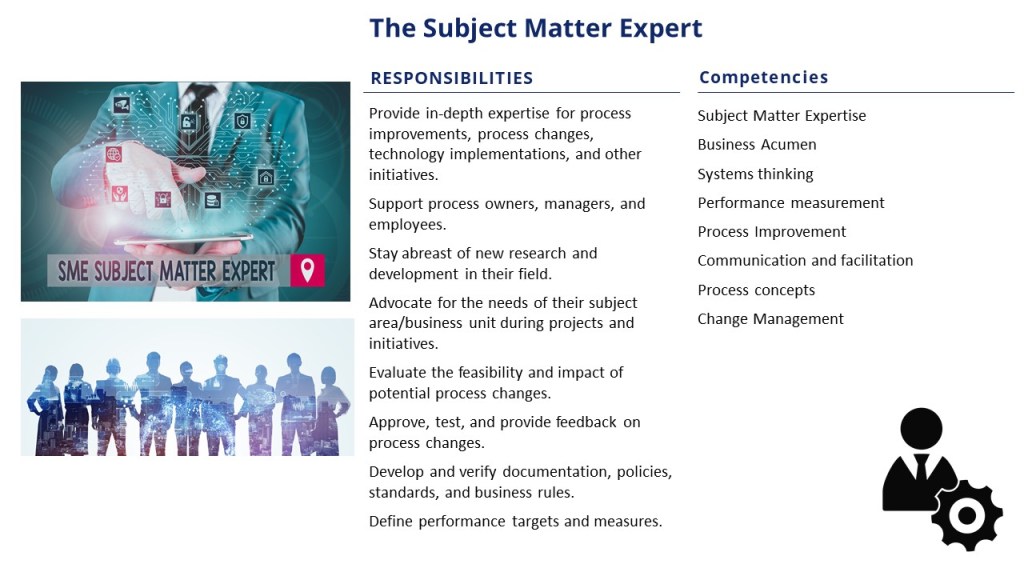
Subject matter experts have explicit knowledge from formal education and embedded in reports, manuals, websites, memos, and other corporate documents. But their implicit and tacit knowledge, based on their experience, is perhaps the source of their greatest value — whether the subject-matter expert with decades of experience who is lightning fast with a diagnosis and almost always spot-on or the manager whose team everyone wants to be on because she’s so good at motivating and mentoring.
Experts, no matter the domain, tend to have very similar attributes. Understanding these attributes allows us to start understanding how we build expertise.
Dimension
Experts Demonstrate
Cognitive
Critical know-how and “know-what”
Managerial, technical, or both; superior, experience-based techniques and processes; extraordinary factual knowledge
Swift recognition of a phenomenon, situation, or process that has been encountered before
Behavioral
Networking (“Known-who”)
Building and maintaining an extensive network of professionally important individuals
Interpersonal
Ability to deal with individuals, including motivating and leading them; comfort with intellectual disagreement
Communication
Ability to construct, tailor, and deliver messages through one or more media to build logical and persuasive arguments
Diagnosis and cue seeking
Ability to actively identify cues in a situation that would confirm or challenge a familiar pattern; ability to distinguish signal from noise
Physical
Sensory
Ability to diagnose, interpret, or predict through appropriate senses
Attributes of an Expert
One of the critical parts of being a subject matter expert is being able to help others absorb knowledge and gain wisdom through learn-by-doing techniques— guided practice, observation, problem solving, and experimentation.
Think of this as an apprenticeship program that provides deliberate practice with expert feedback, which is fundamental to the development of expertise.
Do your organizations have this sort of organized way to train an expert? How does it work?
One of the dangers in any organization is that the hard-won know-how of our experts remains locked in their brains and is not shared. To beat this tendency, knowledge management should be a continuous activity in any quality system. So why not start by documenting your own knowledge as an expert?
Subject
Answer these Questions
Things to clarify
Foundational Knowledge
What reference materials do you use?
How do you track technical trends?
Should a knowledge recipient own any of these reference materials? What are the best websites? Are there particular journals that you fi nd useful? What about associations?
Technical/Scientific
What kinds of problems do people come to you to solve?
What are the biggest risks in the project, process, or system you manage?
Can you describe a problem brought to you recently? What technical mistakes is a novice likely to make in that project or process?
Professional Network
Whom do you ask about technology trends and innovation?
Whom do you contact for information about government regulations?
What is this go-to person’s complete contact information? What medium does he or she prefer (email versus telephone)? What is his or her background? How do you know this person?
Organizational
Who are the major stakeholders in the project, process, or system you manage?
What are the biggest mistakes newcomers make in trying to get projects going here?
What are the positions of the major stakeholders? Where are there competing priorities? Can you give me an example of a newcomer mistake and suggest how to avoid such mistakes?
Interpersonal
Regarding team leadership, what criteria do you use to select team members?
How do you ensure the team is connected to the overall business strategy?
On a general level, how do you motivate people who report to you?
Why do you use these particular criteria? Have you ever chosen unwisely? What communication strategies are most effective? Can you give an example of what has really helped?
Once you’ve documented this knowledge, identify who else needs to know it, and then ensure the knowledge is transferred.
Risk assessments, problem solving and making good decisions need teams, but any team has challenges in group think it must overcome. Ensuring your facilitators, team leaders and sponsors are aware and trained on these biases will help lead to deal with subjectivity, understand uncertainty and drive to better outcomes. But no matter how much work you do there, it won’t make enough of a difference until you’ve built a culture of quality and excellence.
The mindsets we are trying to build into our culture will strive to overcome a few biases in our teams that lead to subjectivity.
Bias Toward Fitting In
We have a natural desire to want to fit in. This tendency
leads to two challenges:
Challenge #1: Believing we need to conform. Early in life, we realize that there are tangible benefits to be gained from following social and organizational norms and rules. As a result, we make a significant effort to learn and adhere to written and unwritten codes of behavior at work. But here’s the catch: Doing so limits what we bring to the organization.
Challenge #2: Failure to use one’s strengths. When employees conform to what they think the organization wants, they are less likely to be themselves and to draw on their strengths. When people feel free to stand apart from the crowd, they can exercise their signature strengths (such as curiosity, love for learning, and perseverance), identify opportunities for improvement, and suggest ways to exploit them. But all too often, individuals are afraid of rocking the boat.
We need to use several methods to combat the bias toward
fitting in. These need to start at the cultural level. Risk management, problem
solving and decision making only overcome biases when embedded in a wider,
effective culture.
Encourage people to
cultivate their strengths. To motivate and support employees, some
companies allow them to spend a certain portion of their time doing work of
their own choosing. Although this is a great idea, we need to build our organization
to help individuals apply their strengths every day as a normal part of their
jobs.
Managers need to help individuals identify and develop their
fortes—and not just by discussing them in annual performance reviews. Annual
performance reviews are horribly ineffective. Just by using “appreciation jolt”,
positive feedback., can start to improve the culture. It’s particularly potent when
friends, family, mentors, and coworkers share stories about how the person
excels. These stories trigger positive emotions, cause us to realize the impact
that we have on others, and make us more likely to continue capitalizing on our
signature strengths rather than just trying to fit in.
Managers should ask themselves the following questions: Do I
know what my employees’ talents and passions are? Am I talking to them about
what they do well and where they can improve? Do our goals and objectives
include making maximum use of employees’ strengths?
Increase awareness
and engage workers. If people don’t see an issue, you can’t expect them to speak
up about it.
Model good behavior.
Employees take their cues from the managers who lead them.
Bias Toward Experts
This is going to sound counter-intuitive, especially since expertise is so critical. Yet our biases about experts can cause a few challenges.
Challenge #1: An
overly narrow view of expertise. Organizations tend to define “expert” too narrowly,
relying on indicators such as titles, degrees, and years of experience.
However, experience is a multidimensional construct. Different types of experience—including
time spent on the front line, with a customer or working with particular
people—contribute to understanding a problem in detail and creating a solution.
A bias toward experts can also lead people to misunderstand the
potential drawbacks that come with increased time and practice in the job.
Though experience improves efficiency and effectiveness, it can also make
people more resistant to change and more likely to dismiss information that
conflicts with their views.
Challenge #2:
Inadequate frontline involvement. Frontline employees—the people directly involved
in creating, selling, delivering, and servicing offerings and interacting with customers—are
frequently in the best position to spot and solve problems. Too often, though,
they aren’t empowered to do so.
The following tactics can help organizations overcome weaknesses
of the expert bias.
Encourage workers to
own problems that affect them. Make sure that your organization is adhering
to the principle that the person who experiences a problem should fix it when
and where it occurs. This prevents workers from relying too heavily on experts
and helps them avoid making the same mistakes again. Tackling the problem
immediately, when the relevant information is still fresh, increases the
chances that it will be successfully resolved. Build a culture rich with
problem-solving and risk management skills and behaviors.
Give workers
different kinds of experience. Recognize that both doing the same task
repeatedly (“specialized experience”) and switching between different tasks
(“varied experience”) have benefits. Yes, Over the course of a single day, a
specialized approach is usually fastest. But over time, switching activities across
days promotes learning and kept workers more engaged. Both specialization and variety
are important to continuous learning.
Empower employees to use their experience. Organizations should aggressively seek to identify and remove barriers that prevent individuals from using their expertise. Solving the customer’s problems in innovative, value-creating ways—not navigating organizational impediments— should be the challenging part of one’s job.
In short we need to build the capability to leverage all level of experts, and not just a few in their ivory tower.
These two biases can be overcome and through that we can start building the mindsets to deal effectively with subjectivity and uncertainty. Going further, build the following as part of our team activities as sort of a quality control checklist:
Check for self-interest bias
Check for the affect heuristic. Has the team fallen in love with its own output?
Check for group think. Were dissenting views explored adequately?
Check for saliency bias. Is this routed in past successes?
Check for confirmation bias.
Check for availability bias
Check for anchoring bias
Check for halo effect
Check for sunk cost fallacy and endowment effect
Check for overconfidence, planning fallacy, optimistic biases, competitor neglect
Check for disaster neglect. Have the team conduct a post-mortem: Imagine that the worst has happened and develop a story about its causes.