

The Epistemic Interactions of Knowledge Management

The first four phases of knowledge management are all about identifying and creating meaning and then making that meaning usable. Knowledge management is a set of epistemic actions, creating knowledge through interaction. This interaction is a way of creating a partnership between what happens in the head with everything in the world – Work-as-Imagined and Work-as-Done.

There are really four themes to a set of epistemic actions:

  • Foraging: Locating resources that will lead to understanding
  • Tuning: Adjusting resources to align with desired understanding
  • Externalizing: Moving resources out of the head and into the world
  • Constructing: Forming new knowledge structures in the world

These epistemic actions are all about moving from Work-as-Imagined through Work-as-Prescribed to enable Work-as-Done.

Knowledge Management is really about the embodiment of information, knowledge, and even wisdom through these epistemic actions to apply change upon the world.
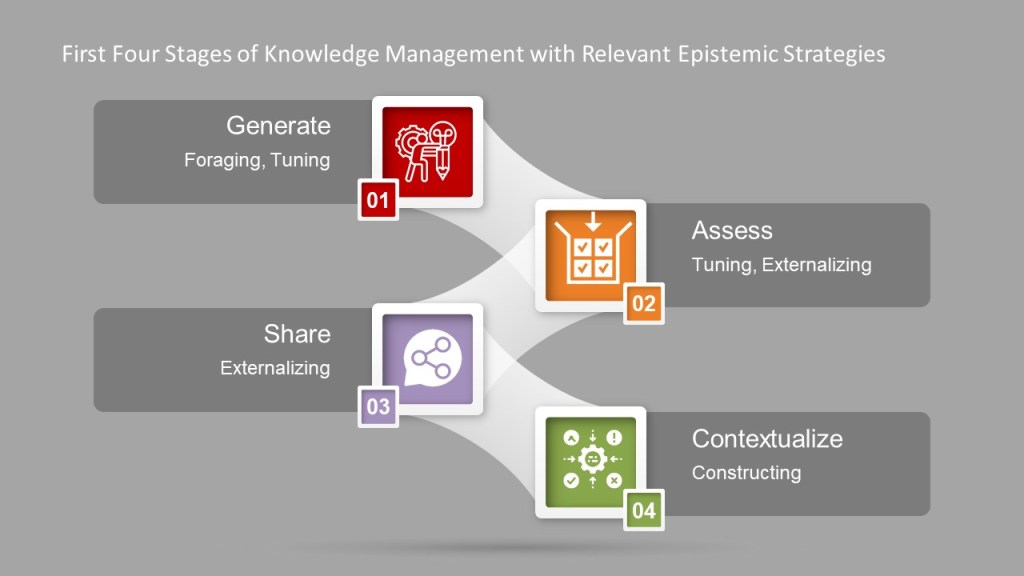
Four Themes Mapped to Firts 4 Phases of Knowledge Management

Theme

Epistemic Interaction

Means

Foraging

Locating resources that will lead to understanding

Searching


Searching happens when you need information and believe it exists somewhere.

Searching depends on how we articulate or information needs.

Probing


“Tell me more.” Probing happens when the information you have isn’t quite enough. You are probing when you take the next step, move to the next level, and obtain more salient specifics. Probing is about drilling down and saying “show, explain, and reveal more about this.”

We can probe to reveal new patterns, structures and relationships. It brings to light new information that helps us to reconsider what we already know.

Animating


Animating is when we initiate and control motion in an information source. It includes learning-by-doing.

Collecting

Collecting is how we gather foraged information and tuck it away for future use.

Tuning

Adjusting resources to align with desired understanding

Collecting


Cloning


Cloning lets us take information from one situation and use it in another.

Cutting


Cutting is the way we say “this matters”, that “I need this part, but not the rest.”

Filtering

Filtering reduces complexity by reducing clutter to expose salient details.

Externalizing

Moving resources out of the head and into the world

Annotating


Annotating is how we add context to information. How we adapt and modify the information to the needed context.

Linking

Connecting bits of information together. Forming conceptual maps.

Generating

Introducing new knowledge into the world.

Chunking

Grouping idenpendent yet related information together.

Constructing

Forming new knowledge structures in the world

Chunking


Composing

Producing a new, separate structure from the information that has its own meaning and purpose.

Fragmenting

Taking information and breaking it apart into usable components.

Rearranging

The art of creating meaningful order.

Repicturing

Changing the way the information is represented to create understanding.


Tacit and Explicit Knowledge

Nonaka classified knowledge as explicit and tacit. This concept has become the center piece of knowledge management and fundamental concept in process improvement.

Explicit knowledge is documented and accepted knowledge. Tacit knowledge stems more from experience and is more undocumented in nature. In spite of being difficult to interpret and transfer, tacit knowledge is regarded as the root of all organizational knowledge.

Tacit knowledge, unlike its explicit counterpart, mostly consists of perceptions and is often unstructured and non-documented in nature. Therefore, mental models, justification of beliefs, heuristics, judgments, “gut feelings” and the communication skills of the individual can influence the quality of tacit knowledge.

The process of creation of knowledge begins with the creation and sharing of tacit knowledge, which stems from socialization, facilitation of experience and interactive capacity of individuals with their coworkers.

Creation and Sharing of Knowledge

Knowledge creation involved organizations and it’s individual transcending the boundaries of the old to the new by acquiring new knowledge, which is considered to be mostly tacit in nature. The key to tacit knowledge sharing lies in the willingness and capacity of individuals to share what they know (knowledge donation) and to use what they learn (knowledge collection).

Knowledge quality is the acquisition of useful and innovative knowledge and is the degree to which people are satisfied with the quality of the shared knowledge and find it useful in accomplishing their activities. The quality of knowledge can be measured by frequency, usefulness and innovativeness, and can be innovative or new for the system or organization. However, if the knowledge is not beneficial to achieving the objective of the objective of the organization then it does not fulfill the criteria of knowledge quality. There are six attributes to knowledge quality: adaptability, innovativeness, applicability, expandability, justifiability and authenticity,

Sources

  • Kaser, P.A. and Miles, R.E. (2002), “Understanding knowledge activists’ successes and failures”, Long Range Planning, Vol. 35 No. 1, pp. 9-28.
  • Kucharska, W. and Dabrowski, J. (2016), “Tacit knowledge sharing and personal branding: how to derive innovation from project teams”, in Proceedings of the11th European Conference on Innovation and Entrepreneurship ECIE, pp. 435-443.
  • Nonaka, I. (1994), “A dynamic theory of organizational knowledge creation”, Organizational Science, Vol. 5 No. 1, pp. 14-37.
  • Nonaka, I. and Takeuchi, H. (1995), The Knowledge-Creating Company, Oxford University Press, New York, NY.
  • Nonaka, I. and Toyama, R. (2003), “The knowledge-creating theory revisited: knowledge creation as a synthesizing process”, Knowledge Management Research and Practice, Vol. 1 No. 1, pp. 2-10.
  • Nonaka, I. and Von Krogh, G. (2009), “Perspective—tacit knowledge and knowledge conversion: controversy and advancement in organizational knowledge creation theory”, Organization Science, Vol. 20 No. 3, pp. 635-652
  • Riege, A. (2005), “Three-dozen knowledge-sharing barriers managers must consider”, Journal of Knowledge Management, Vol. 9 No. 3, pp. 18-35.
  • Smedlund, A. (2008), “The knowledge system of a firm: social capital for explicit, tacit and potential knowledge”, Journal of Knowledge Management, Vol. 12 No. 1, pp. 63-77.
  • Spender, J.C. (1996), “Making knowledge the basis of a dynamic theory of the firm”, Strategic Management Journal, Vol. 17 No. S2, pp. 45-62.
  • Soo, C.W., Devinney, T.M. and Midgley, D.F. (2004), “The role of knowledge quality in firm performance”, In Tsoukas, H. and Mylonopoulus, N. (Eds), Organizations as Knowledge Systems. Knowledge, Learning and Dynamic Capabilities, Palgrave Macmillan, London, pp. 252-275.
  • Sorenson, O., Rivkin, J.W. and Fleming, L. (2006), “Complexity, networks and knowledge flow”, Research Policy, Vol. 35 No. 7, pp. 994-1017.
  • Waheed, M. and Kaur, K. (2016), “Knowledge quality: a review and a revised conceptual model”, Information Development, Vol. 32 No. 3, pp. 271-284.
  • Wang, Z. and Wang, N. (2012), “Knowledge sharing, innovation and firm performance”, Expert Systems with Applications, Vol. 39 No. 10, pp. 8899-8908.