
PDCA and OODA

PDCA (and it’s variants) are a pretty tried and true model for process improvement. In the PDCA model a plan is structured in four steps: P (plan) D (do) C (check) A (act). The intention is create a structured cycle that allows the process to flow in accordance with the objectives to be achieved (P), execute what was planned (D), check whether the objectives were achieved with emphasis on the verification of what went right and what went wrong (C) and identify factors of success or failure to feed a new process of planning (A).

Conceptually, the organization will be a fast turning wheel of endlessly learning from mistakes and seeking to maximize processes in order to remain forever in pursuit of strategic objectives, endlessly searching for the maximum efficiency and effectiveness of the system.

The OODA Loop

The OODA loop or cycle was designed by John R. Boyd and consists of a cycle of four phases:
Observe, Orient, Decide and Act (OODA).

  • Observe: Based on implicit guidance and control, observations are made regarding unfolding circumstances, outside information, and dynamic interaction with the environment (including the result of prior actions).
  • Orient: Observations from the prior stage are deconstructed into separate component
    pieces; then synthesized and analyzed in several contexts such as cultural traditions, genetic
    heritage, and previous experiences; and then combined together for the purposes of
    analysis and synthesis to inform the next phase.
  • Decide: In this phase, hypotheses are evaluated, and a decision is made.
  • Act: Based on the decision from the prior stage, action is taken to achieve a desired effect
    or result
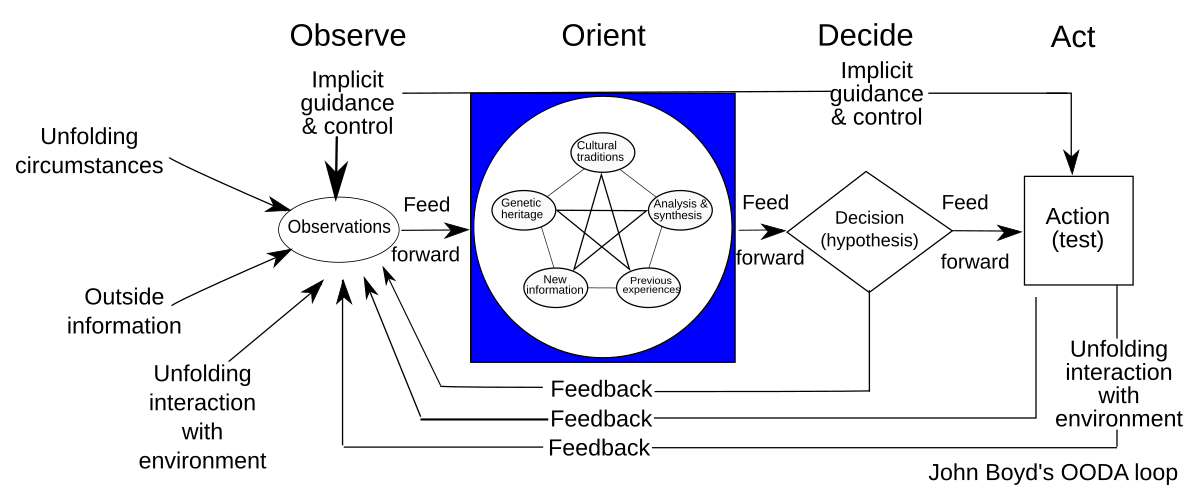
While similar to the PDCA improvement of a known system making it more effective, efficient or effective (depending on the effect to be expected), the OODA strives to model a framework for situational awareness.

Boyd’s concentration on the specific set of circumstances relevant to military situations had for years meant the OODA loop has not received a lot of wide spread interest. I’ve been seeing a lot of recent adaptations of the OODA loop try to expand to address the needs of operating in volatile, uncertain, complex and ambiguous (VUCA) situations. I especially like seeing it as part of resilience and business continuity.

Enhanced Decision-Making Speed and Agility

    The OODA loop enables organizations to make faster, more informed decisions in rapidly changing environments. By continuously cycling through the observe-orient-decide-act process, organizations can respond more quickly to market crises, threats, and emerging opportunities.

    Improved Situational Awareness

      The observation and orientation phases help organizations maintain a comprehensive understanding of their operating environment. This enhanced situational awareness allows us to identify trends, threats, and opportunities more effectively.

      Better Adaptability to Change

        The iterative nature of the OODA loop promotes continuous learning and adaptation. This fosters a culture of flexibility and responsiveness, enabling organizations to adjust their strategies and operations as circumstances evolve.

        Enhanced Crisis Management

          In high-pressure situations or crises, the OODA loop provides a structured approach for rapid, effective decision-making. This can be invaluable for managing unexpected challenges or emergencies.

          Improved Team Coordination and Communication

            The OODA process encourages clear communication and coordination among team members as they move through each phase. This can lead to better team cohesion and more effective execution of strategies.

            Data-Driven Culture

              The OODA loop emphasizes the importance of observation and orientation based on current data. This promotes a data-driven culture where decisions are made based on real-time information rather than outdated assumptions.

              Continuous Improvement

                The cyclical nature of the OODA loop supports ongoing refinement of processes and strategies. Each iteration provides feedback that can be used to improve future observations, orientations, decisions, and actions.

                Complementary Perspectives

                PDCA is typically used for long-term, systematic improvement projects, while OODA is better suited for rapid decision-making in dynamic environments. Using both allows organizations to address both strategic and tactical needs.

                Integration Points

                1. Observation and Planning
                  • OODA’s “Observe” step can feed into PDCA’s “Plan” phase by providing real-time situational awareness.
                  • PDCA’s structured planning can enhance OODA’s orientation process.
                2. Execution
                  • PDCA’s “Do” phase can incorporate OODA loops for quick adjustments during implementation.
                  • OODA’s “Act” step can trigger a new PDCA cycle for more comprehensive improvements.
                3. Evaluation
                  • PDCA’s “Check” phase can use OODA’s observation techniques for more thorough assessment.
                  • OODA’s rapid decision-making can inform PDCA’s “Act” phase for faster course corrections.
                ASQ Audit Conference – Day 1 Morning

                Day 1 of the 2019 Audit Conference.

                Grace Duffy is the keynote speaker. I’ve known Grace for years and consider her a mentor and I’m always happy to hear her speak. Grace has been building on a theme around her Modular Kaizen approach and the use of the OODA Loop, and this presentation built nicely on what she presented at the Lean Six Sigma Conference in Phoenix, at WCQI and in other places.

                Audits as a form of sustainability is an important point to stress, and hopefully this will be a central theme throughout the conference.

                The intended purpose is to build on a systems view for preparation for an effective audit and using the OODA loop to approach evolutionary and revolutionary change approaches.

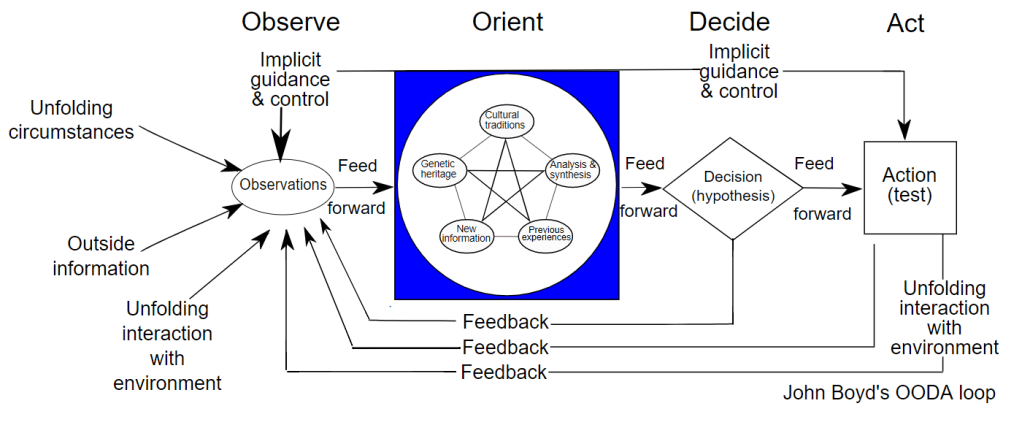
                John Boyd’s OODA loop

                Grace starts with a brief overview of system and process and then from vision to strategy to daily, and how that forms a mobius strip of macro, meso, micro and individual. She talks a little about the difference between Deming and Juran’s approaches and does a little what-if thinking about how Lean would have devoted if Juran had gone to Japan instead of Deming.

                Breaking down OODA (Observe, Orient, Decide Act) as “Where am I and where is the organization” and then feed into decision making. Stresses how Orient discusses culture and discusses understanding the culture. Her link to Lean is a little tenuous in my mind.

                She then discusses Tom Pearson’s knowledge management model with: Local Action; Management Action; Exploratory Analysis; Knowledge Building; Complex Systems; Knowledge Management; Scientific Creativity. Units all this with system thinking and psychology.  “We’re going to share shamelessly because that’s how we learn.” “If we can’t have fun with this stuff it’s no good.”

                Uniting the two, she describes the knowledge management model as part of Orient.

                Puts revolutionary and evolutionary change in light of Juran’s Breakthrough versus Continuous Improvement. From here she covers modular kaizen, starting with incremental change versus process redesign. From there she breaks it down into a DMAIC model and goes into how much she loves the measure. She discusses how the human brain is better at connections, which is a good reinforce of the OODA model.

                Breaks down a culture model of Culture/Beliefs, Visions/Goals and Activities/Plans-and-actions influenced by external events and how evolutionary improvements stem out of compatibility with those. OODA is the tool to help determine that compatibility.

                Discusses briefly on how standardization fits into systems and pushes a look from a stability.

                Goes back to the culture model but now adds idea generation and quality test with decisions off of it that lead to revolutionary improvements. Links back to OODA.

                Then quickly covers DMAIC versus DMADV and how that is another way of thinking about these concepts.

                Covers Gina Wickman’s concept of visionary and integrator from Traction.

                Ties back OODA to effective auditing: focus on patterns and not just numbers, Grasp the bigger picture, be adaptive.

                This is a big sprawling topic for a key note and at times it felt like a firehose.. Keynotes often benefit from a lot more laser focus. OODA alone would have been enough. My head is reeling, and I feel comfortable with this material. Grace is an amazing, passionate educator and she finds this material exciting. I hope most of the audience picked that up in this big gulp approach. This system approach, building on culture and strategy is critical.

                OODA as an audit tool is relevant, and it is a tool I think we should be teaching better. Might be a good tool to do for TWEF as it ties into the team/workplace excellence approach. OODA and situational awareness are really united in my mind and that deserves a separate post.

                Concurrent Sessions

                After the keynote there are the breakout sessions. As always, I end up having too many options and must make some decisions. Can never complain about having too many options during a conference.

                First Impressions: The Myth of the Objective & Impartial Audit

                First session is “First Impressions: The Myth of the Objective & Impartial Audit” by William Taraszewski. I met Bill back at the 2018 World Conference of Quality Improvement.

                Bill starts by discussing how subjectivity and first impressions and how that involves audits from the very start.

                Covers the science of first impressions, point to research of bias and how negative behavior weighs more than positive and how this can be contextual. Draws from Amy Cuddy’s work and lays a good foundation of Trust and Competence and the importance in work and life in general.

                Brings this back to ISO 19011:2018 “Guidelines for auditing management systems” and clause 7.2 determining auditor competence placing personal behavior over knowledge and skills.

                Brings up video auditing and the impressions generated from video vs in-person are pretty similar but the magnitude of the bad impressions are greater and the magnitude of positive is lower. That was an interesting point and I will need to follow-up with that research.

                Moves to discussing impartiality in context of ISO 19011:2018, pointing out the halo and horn effects.

                Discusses prejudice vs experience as an auditor and covers confirmation bias and how selective exposure and selective perception fits into our psychology with the need to be careful since negative outweighs.

                Moves into objective evidence and how it fits into an audit.

                Provides top tips for good auditor first impressions with body language and eye contact. Most important, how to check your attitude.

                This was a good fundamental on the topics that reinforces some basics and goes back to the research. Quality as a profession really needs to understand how objectivity and impartiality are virtually impossible and how we can overcome bias.

                Auditing Risk Management

                Barry Craner presented on :Are you ready for an audit of your risk management system?”

                Starts with how risk management is here to stay and how it is in most industries. The presenter is focused on medical devices but the concepts are very general.

                “As far possible” as a concept is discussed and residual risk. Covers this at a high level.

                Covers at a high level the standard risk management process (risk identification, risk analysis, risk control, risk monitoring, risk reporting) asking the question is “RM system acceptable? Can you describe and defend it?”

                Provides an example of a risk management file sequence that matches the concept of living risk assessments. This is a flow that goes from Preliminary Hazard analysis to Fault Tree Analysis (FTA) to FMEA. With the focus on medical devices talks about design and process for both the FTA and the FMEA. This is all from the question “Can you describe and defend your risk management program?”

                In laying out the risk management program focused in on personnel qualification being pivotal. Discusses answering the question “Are these ready for audit?” When discussing the plan asks the questions “Is your risk management plan: documented and reasonable; ready to audit; and, SOP followed by your company?”

                When discussing risk impact breaks it down to “Is the risk acceptable or not.” Goes on to discuss how important it is to defend the scoring rubric, asking the question”Well defined, can we defend?”

                Goes back and discusses some basic concepts of hazard and harm. Asks the questions “Did you do this hazard assessment with enough thoroughness? Were the right hazards identified?” Recommends building a example of hazards table. This is good advice. From there answer the question “Do your hazard analses yield reasonable, useful information? Do you use it?”

                Provides a nice example of how to build a mitigation plan out of a fault tree analysis.

                Discussion on FMEAs faultered on detection, probably could have gone into controls a lot deeper here.

                With both the PTA and FMEA discussed how the results needs to be defendable.

                Risk management review, with the right metrics are discussed at a high level. This easily can be a session on its own.

                Asks the question “Were there actionable tasks? Progress on these tasks?”

                It is time to stop having such general overviews at conferences, especially at a conference which are not targeted to junior personnel.