
Viral Risk Management

While rare, viral contamination events can have severe consequences, potentially impacting product quality, patient safety, and company reputation. And while a consent decree is a good way to grow your skills, I tend to prefer to avoid causing one to happen.

Luckily, regulatory bodies have provided comprehensive guidelines, with ICH Q5A(R2) being a cornerstone document. Let’s explore the best practices for viral risk management in biotech, drawing from ICH Q5A and other relevant guidances.

The Three Pillars of Viral Safety

ICH Q5A outlines three complementary approaches to control potential viral contamination:

  1. Selection and testing of cell lines and raw materials
  2. Assessment of viral clearance capacity in production processes
  3. Testing of the product at appropriate stages for contaminating viruses

These pillars form the foundation of a robust viral safety strategy.

Cell Line and Raw Material Control

  • Thoroughly document the origin and history of cell lines
  • Implement comprehensive testing programs for cell banks, including master and working cell banks
  • Carefully assess and control animal-derived raw materials
  • Consider using chemically-defined or animal-free raw materials where possible
  • Implement stringent change control and quality agreements with raw material suppliers

Viral Clearance Capacity

  • Design manufacturing processes with multiple orthogonal viral clearance steps
  • Validate the effectiveness of viral clearance steps using model viruses
  • Aim for a cumulative viral reduction factor of at least 4 log10 per the USP guidelines
  • Consider both dedicated viral inactivation steps (e.g., low pH treatment) and removal steps (e.g., nanofiltration)
  • For continuous manufacturing, assess the impact of process dynamics on viral clearance

In-Process and Final Product Testing

  • Develop a comprehensive testing strategy for in-process materials and final product
  • Utilize state-of-the-art detection methods, including PCR and next-generation sequencing (NGS)
  • Consider replacing traditional in vivo assays with molecular methods where appropriate
  • Implement a testing program that covers a broad spectrum of potential viral contaminants

Risk-Based Approach

The revised ICH Q5A(R2) emphasizes a risk-based approach to viral safety. This involves:

  • Conducting thorough risk assessments of the entire manufacturing process
  • Identifying critical control points for viral contamination
  • Implementing appropriate mitigation strategies based on risk levels
  • Continuously monitoring and updating the risk assessment as new information becomes available

Prior knowledge, including “in-house” experience, plays a crucial role in viral risk assessment and management for biopharmaceutical manufacturing. Here’s how it can be effectively utilized:

Leveraging Historical Data

  • Review past viral contamination events or near-misses within the organization
  • Analyze trends in raw material quality and supplier performance
  • Evaluate the effectiveness of previous risk mitigation strategies

Process Design and Optimization

  • Apply lessons learned from previous manufacturing campaigns to improve process robustness
  • Use historical data to identify critical control points for viral contamination
  • Optimize viral clearance steps based on past validation studies

Cell Line Susceptibility

  • Use accumulated data on cell line susceptibility to various viruses to inform risk assessments
  • Apply knowledge of cell line behavior under different conditions to enhance contamination detection

Risk Assessment Approach

The risk assessment process should take a holistic approach, focusing on:

  • Raw material sourcing and testing
    • Identifying high-risk materials, especially animal-derived components
    • Assessing chemically-undefined components like hydrolysates and peptones
    • Evaluating materials produced or stored in non-controlled environments
  • Cell substrate selection and characterization
    • Documenting the derivation and source history of the cell line
    • Testing cell banks extensively for adventitious agents
    • Assessing the cell line’s susceptibility to various viruses
  • Process design for viral clearance
    • Designing manufacturing processes with multiple orthogonal viral clearance steps
  • Facility design and operations
    • Implementing robust cleaning and sanitization procedures
    • Ensuring proper facility layout and air handling systems to prevent contamination spread
  • Personnel training and practices
    • Training on proper gowning procedures and personal protective equipment (PPE) usage
    • Policies on illness reporting and exclusion of sick employees from critical areas

Preparedness and Response

While prevention is key, being prepared for a potential contamination event is crucial:

  • Develop a comprehensive viral contamination response plan[6]
  • Regularly practice and update the response plan through mock drills
  • Establish clear communication channels and decision-making processes
  • Prepare strategies for containment, decontamination, and facility restart

Continuous Improvement

Viral risk management is an ongoing process:

  • Stay updated on emerging technologies and regulatory guidance
  • Participate in industry forums and share best practices
  • Invest in employee training and awareness programs
  • Continuously evaluate and improve viral safety strategies

By implementing these best practices and adhering to regulatory guidances like ICH Q5A, we can strive to significantly mitigate the risk of viral contamination. While no approach can guarantee absolute safety, a comprehensive, risk-based strategy that leverages cutting-edge technologies and emphasizes preparedness will go a long way in protecting patients, products, and the industry as a whole.
Best Practices for Managing the Life-Cycle of Single-Use Systems

Single-use systems (SUS) have become increasingly prevalent in biopharmaceutical manufacturing due to their flexibility, reduced contamination risk, and cost-effectiveness. The thing is, management of the life-cycle of single-use systems becomes critical and is an area organizations can truly screw up by cutting corners. To do it right requires careful collaboration between all stakeholders in the supply chain, from raw material suppliers to end users.

Design and Development

Apply Quality by Design (QbD) principles from the outset by focusing on process understanding and the design space to create controlled and consistent manufacturing processes that result in high-quality, efficacious products. This approach should be applied to SUS design.

ASTM E3051 “Standard guide for specification, design, verification, and application of SUS in pharmaceutical and biopharmaceutical manufacturing” provides an excellent framework for the design process.

Make sure to conduct thorough risk assessments, considering potential failure modes and effects throughout the SUS life-cycle.

Engage end-users early to understand their specific requirements and process constraints. A real mistake in organizations is not involving the end-users early enough. From the molecule steward to manufacturing these users are critical.

    Raw Material and Component Selection

    Carefully evaluate and qualify raw materials and components. Work closely with suppliers to understand material properties, extractables/leachables profiles, and manufacturing processes.

    Develop comprehensive specifications for critical materials and components. ASTM E3244 is handy place to look for guidance on raw material qualification for SUS.

    Manage the Supplier through Manufacturing and Assembly

    Implementing robust supplier qualification and auditing programs and establish change control agreements with suppliers to be notified of any changes that could impact SUS performance or quality. It is important the supplier have a robust quality management system and that they apply Good Manufacturing Practices (GMP) through their facilities. Ensure they have in place appropriate controls to

    • Validate sterilization processes
    • Conduct routine bioburden and endotoxin testing
    • Design packaging to protect SUS during transportation and storage. Shipping methods need to protect against physical damage and temperature excursions
    • Establish appropriate storage conditions and shelf-life based on stability studies
    • Provide appropriate labeling and traceability
    • Have appropriate inventory controls. Ideally select suppliers who understand the importance of working with you for collaborative planning, forecasting and replenishment (CPFR)

    Testing and Qualification

    Develop a comprehensive testing strategy, including integrity testing and conduct extractables and leachables studies following industry guidelines. Evaluate the suppliers shipping and transportation studies to evaluate SUS robustness and determine if you need additional studies.

      Implementation and Use

      End users should have appropriate and comprehensive documentation and training to end users on proper handling, installation, and use of SUS. These procedures should include how to perform pre-use integrity testing at the point of use as well as how to perform thorough in-process and final inspections.

      Consider implementing automated visual inspection systems and other appropriate monitoring.

      Implement appropriate environmental monitoring programs in SUS manufacturing areas. While the dream of manufacturing outdoors is a good one, chances are we aren’t even close yet. Don’t short this layer of control.

        Continuous Improvement

        Ensure you have appropriate mechanisms in place to gather data on SUS performance and any issues encountered during use. Share relevant information across the supply chain to drive improvements.

        Conduct periodic audits of suppliers and manufacturing facilities.

        Stay updated on evolving regulatory guidance and industry best practices. There is still a lot changing in this space.

        Good Engineering Practices Under ASTM E2500

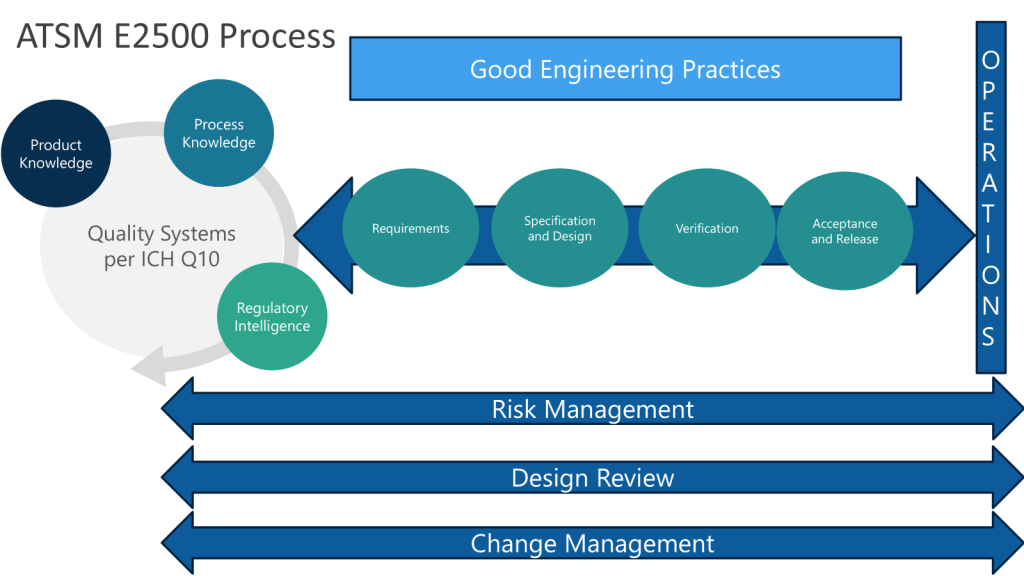
        ASTM E2500 recognizes that Good Engineering Practices (GEP) are essential for pharmaceutical companies to ensure the consistent and reliable design, delivery, and operation of engineered systems in a manner suitable for their intended purpose.

        Key Elements of Good Engineering Practices

        1. Risk Management: Applying systematic processes to identify, assess, and control risks throughout the lifecycle of engineered systems. This includes quality risk management focused on product quality and patient safety.
        2. Cost Management: Estimating, budgeting, monitoring and controlling costs for engineering projects and operations. This helps ensure projects deliver value and stay within budget constraints.
        3. Organization and Control: Establishing clear organizational structures, roles and responsibilities for engineering activities. Implementing monitoring and control mechanisms to track performance.
        4. Innovation and Continual Improvement: Fostering a culture of innovation and continuous improvement in engineering processes and systems.
        5. Lifecycle Management: Applying consistent processes for change management, issue management, and document control throughout a system’s lifecycle from design to decommissioning.
        6. Project Management: Following structured approaches for planning, executing and controlling engineering projects.
        7. Design Practices: Applying systematic processes for requirements definition, design development, review and qualification.
        8. Operational Support: Implementing asset management, calibration, maintenance and other practices to support systems during routine operations.

        Key Steps for Implementation

        • Develop and document GEP policies, procedures and standards tailored to the company’s needs
        • Establish an Engineering Quality Process (EQP) to link GEP to the overall Pharmaceutical Quality System
        • Provide training on GEP principles and procedures to engineering staff
        • Implement risk-based approaches to focus efforts on critical systems and processes
        • Use structured project management methodologies for capital projects
        • Apply change control and issue management processes consistently
        • Maintain engineering documentation systems with appropriate controls
        • Conduct periodic audits and reviews of GEP implementation
        • Foster a culture of quality and continuous improvement in engineering
        • Ensure appropriate interfaces between engineering and quality/regulatory functions

        The key is to develop a systematic, risk-based approach to GEP that is appropriate for the company’s size, products and operations. When properly implemented, GEP provides a foundation for regulatory compliance, operational efficiency and product quality in pharmaceutical manufacturing.

        Invest in a Living, Breathing Engineering Quality Process (EQP)

        The EQP establishes the formal connection between GEP and the Pharmaceutical Quality System it resides within, serving as the boundary between Quality oversight and engineering activities, particularly for implementing Quality Risk Management (QRM) based integrated Commissioning and Qualification (C&Q).

        It should also provide an interface between engineering activities and other systems like business operations, health/safety/environment, or other site quality systems.

        Based on the information provided in the document, here is a suggested table of contents for an Engineering Quality Process (EQP):

        Table of Contents – Engineering Quality Process (EQP)

        1. Introduction
          1.1 Purpose
          1.2 Scope
          1.3 Definitions
        2. Application and Context
          2.1 Relationship to Pharmaceutical Quality System (PQS)
          2.2 Relationship to Good Engineering Practice (GEP)
          2.3 Interface with Quality Risk Management (QRM)
        3. EQP Elements
          3.1 Policies and Procedures for the Asset Lifecycle and GEPs
          3.2 Risk Assessment
          3.3 Change Management
          3.4 Document Control
          3.5 Training
          3.6 Auditing
        4. Deliverables
          4.1 GEP Documentation
          4.2 Risk Assessments
          4.3 Change Records
          4.4 Training Records
          4.5 Audit Reports
        5. Roles and Responsibilities
          5.1 Engineering
          5.2 Quality
          5.3 Operations
          5.4 Other Stakeholders
        6. EQP Implementation
          6.1 Establishing the EQP
          6.2 Maintaining the EQP
          6.3 Continuous Improvement
        7. References
        8. Appendices

        Risk Assessments as part of Design and Verification

        Facility design and manufacturing processes are complex, multi-stage operations, fraught with difficulty. Ensuring the facility meets Good Manufacturing Practice (GMP) standards and other regulatory requirements is a major challenge. The complex regulations around biomanufacturing facilities require careful planning and documentation from the earliest design stages. 

        Which is why consensus standards like ASTM E2500 exist.

        Central to these approaches are risk assessment, to which there are three primary components:

        • An understanding of the uncertainties in the design (which includes materials, processing, equipment, personnel, environment, detection systems, feedback control)
        • An identification of the hazards and failure mechanisms
        • An estimation of the risks associated with each hazard and failure

        Folks often get tied up on what tool to use. Frankly, this is a phase approach. We start with a PHA for design, an FMEA for verification and a HACCP/Layers of Control Analysis for Acceptance. Throughout we use a bow-tie for communication.

        AspectBow-TiePHA (Preliminary Hazard Analysis)FMEA (Failure Mode and Effects Analysis)HACCP (Hazard Analysis and Critical Control Points)
        Primary FocusVisualizing risk pathwaysEarly hazard identificationPotential failure modesSystematically identify, evaluate, and control hazards that could compromise product safety
        Timing in ProcessAny stageEarly developmentAny stage, often designThroughout production
        ApproachCombines causes and consequencesTop-downBottom-upSystematic prevention
        ComplexityModerateLow to moderateHighModerate
        Visual RepresentationCentral event with causes and consequencesTabular formatTabular formatFlow diagram with CCPs
        Risk QuantificationCan include, not requiredBasic risk estimationRisk Priority Number (RPN)Not typically quantified
        Regulatory AlignmentLess common in pharmaAligns with ISO 14971Widely accepted in pharmaLess common in pharma
        Critical PointsIdentifies barriersDoes not specifyIdentifies critical failure modesIdentifies Critical Control Points (CCPs)
        ScopeSpecific hazardous eventSystem-level hazardsComponent or process-level failuresProcess-specific hazards
        Team RequirementsCross-functionalLess detailed knowledge neededDetailed system knowledgeFood safety expertise
        Ongoing ManagementCan be used for monitoringOften updated periodicallyRegularly updatedContinuous monitoring of CCPs
        OutputVisual risk scenarioList of hazards and initial risk levelsPrioritized list of failure modesHACCP plan with CCPs
        Typical Use in PharmaRisk communicationEarly risk identificationDetailed risk analysisProduct Safety/Contamination Control

        At BOSCON this year I’ll be talking about this fascinating detail, perhaps too much detail.

        Conducting A Hazard and Operability Study (HAZOP)

        A Hazard and Operability Study (HAZOP) is a structured and systematic examination of a complex planned or existing process or operation to identify and evaluate problems that may represent risks to product, personnel or equipment. The primary goal of a HAZOP is to ensure that risks are managed effectively by identifying potential hazards and operability problems and developing appropriate mitigation strategies.

        Why Use HAZOP?

        Biotech facilities involve intricate processes that can be prone to various risks, including contamination, equipment failure, and process deviations. Implementing a HAZOP can:

        • Risk Identification and Mitigation: HAZOPs help identify potential hazards associated with biotech processes, such as contamination risks, equipment malfunctions, and deviations from standard operating procedures. By identifying these risks, facilities can implement mitigation strategies to prevent accidents and ensure safety.
        • Process Optimization: Through the systematic analysis of processes, HAZOPs can identify inefficiencies and areas for improvement, leading to optimized operations and enhanced productivity.

        Part of a Continuum of Risk Tools

        A HAZOP (Hazard and Operability) study differs from other risk assessment methods in a few key ways:

        1. Systematic examination of process deviations: HAZOP uses a very structured approach of examining potential deviations from the intended design and operation of a process, using guidewords like “more”, “less”, “no”, “reverse”, etc. This systematic approach helps identify hazards that may be missed by other methods.
        2. Focus on operability issues: The HAZOP examines operability problems that could impact process efficiency or product quality.
        3. Node-by-node analysis: The process is broken down into nodes or sections that are analyzed individually, allowing for very thorough examination.
        4. Qualitative analysis: Unlike quantitative risk assessment methods, HAZOP is primarily qualitative, focusing on identifying potential hazards rather than quantifying risk levels. HAZOPs do not typically assign numerical scores or rankings to risks.
        5. Consideration of causes and consequences: For each deviation, the team examines possible causes, consequences, and existing safeguards before recommending additional actions.
        6. Applicable to complex processes: The structured approach makes HAZOP well-suited for analyzing complex processes with many variables and potential interactions.
        MethodDescriptionStrengthsLimitations
        HAZOP (Hazard and Operability Study)Systematic examination of process/operation to identify potential hazards and operability problems– Very thorough and structured approach
        – Examines deviations from design intent
        – Team-based
        – Time consuming
        – Primarily qualitative
        FMEA (Failure Mode and Effects Analysis)Systematic method to identify potential failure modes and their effects– Quantitative risk prioritization
        – Proactive approach
        – Can be used on products and processes
        – Does not consider combinations of failures
        – Can be subjective
        HACCP (Hazard Analysis and Critical Control Points)Systematic approach to food safety hazards– Focus on prevention
        – Identifies critical control points
        – Requires prerequisite programs in place
        PHA (Preliminary Hazard Analysis)Early stage hazard identification technique– Can be used early in design process
        – Relatively quick to perform
        – Identifies major hazards
        – Not very detailed
        – Qualitative only
        – May miss some hazards
        Bow-Tie AnalysisCombines fault tree and event tree analysis– Visual representation of risk pathways
        – Shows preventive and mitigative controls
        – Good communication tool
        – Does not show detailed failure logic
        – Can oversimplify complex scenarios
        – Time consuming for multiple hazards

        Key differences:

        • HAZOP focuses on deviations from design intent, while FMEA looks at potential failure modes
        • HACCP is specific to identify hazards and is commonly used in food safety, while the others are more general risk assessment tools
        • PHA is used early in design, while the others are typically used on existing systems
        • Bow-Tie provides a visual risk pathway, while the others use more tabular formats
        • FMEA and HAZOP tend to be the most thorough and time-intensive methods

        The choice of method depends on the specific application, stage of design, and level of detail required. Often a combination of methods may be used.

        Instructions for Conducting a HAZOP

        Preparation

          • Assemble a multidisciplinary team comprising appropriate experts
          • Define the scope of the HAZOP study, including the specific processes or operations to be analyzed.
          • Gather and review all relevant documentation, such as process flow diagrams, piping and instrumentation diagrams, and standard operating procedures.

          Execution

            • Divide the Process into Nodes: Break down the process into manageable sections or nodes. Each node typically represents a specific part of the process, such as a piece of equipment or a process step.
            • Identify Deviations: For each node, guidewords are applied to identify potential deviations from the intended design or operation. Common guidewords include:
              • No: Complete absence of a process parameter (e.g., no flow).
              • More: Quantitative increase (e.g., more pressure).
              • Less: Quantitative decrease (e.g., less temperature).
              • As well as: Presence of additional elements (e.g., contamination).
              • Part of: Partial completion of an action (e.g., partial mixing).
              • Reverse: Logical opposite of the intended action (e.g., reverse flow).
            • Analyze Causes and Consequences: Determine the possible causes of each deviation and analyze the potential consequences on safety, environment, and operations. This involves considering various factors such as equipment failure, human error, environmental conditions, or procedural issues that could lead to the deviation.
              • Use of Experience and Knowledge: The team relies on their collective experience and knowledge of the process, equipment, and industry standards to hypothesize potential causes. This may include reviewing historical data, previous incidents, and near misses.
            • Recommend Actions: Develop recommendations for mitigating identified risks, such as changes to the process, additional controls, or procedural modifications.

            Documentation and Follow-Up

              • Document all findings, including identified hazards, potential consequences, and recommended actions.
              • Assign responsibilities for implementing recommendations and establish timelines for completion.
              • Conduct follow-up reviews to ensure that recommended actions have been implemented effectively and that the process remains safe and operable.

              Review and Update

                • Regularly review and update the HAZOP study to account for changes in processes, equipment, or regulations.
                • Ensure continuous improvement by incorporating lessons learned from past incidents or near misses.
                • Iterative Process: The process is iterative, with the team revisiting and refining their analysis as more information becomes available or as the understanding of the process deepens.
                NodeGuidewordParameterDeviationCauseConsequenceSafeguardsRecommendationsActions
                Specific section or equipment being analyzedGuideword applied (e.g. No, More, Less, Reverse, etc.)Process parameter being examined (e.g. Flow, Temperature, Pressure, etc.)How the parameter deviates from design intent when guideword is appliedPossible reasons for the deviationPotential results if deviation occursExisting measures to prevent or mitigate the deviationSuggested additional measures to control the riskSpecific tasks assigned to implement recommendations