Subject Matter Experts Role in Knowledge Management – a Competency Approach

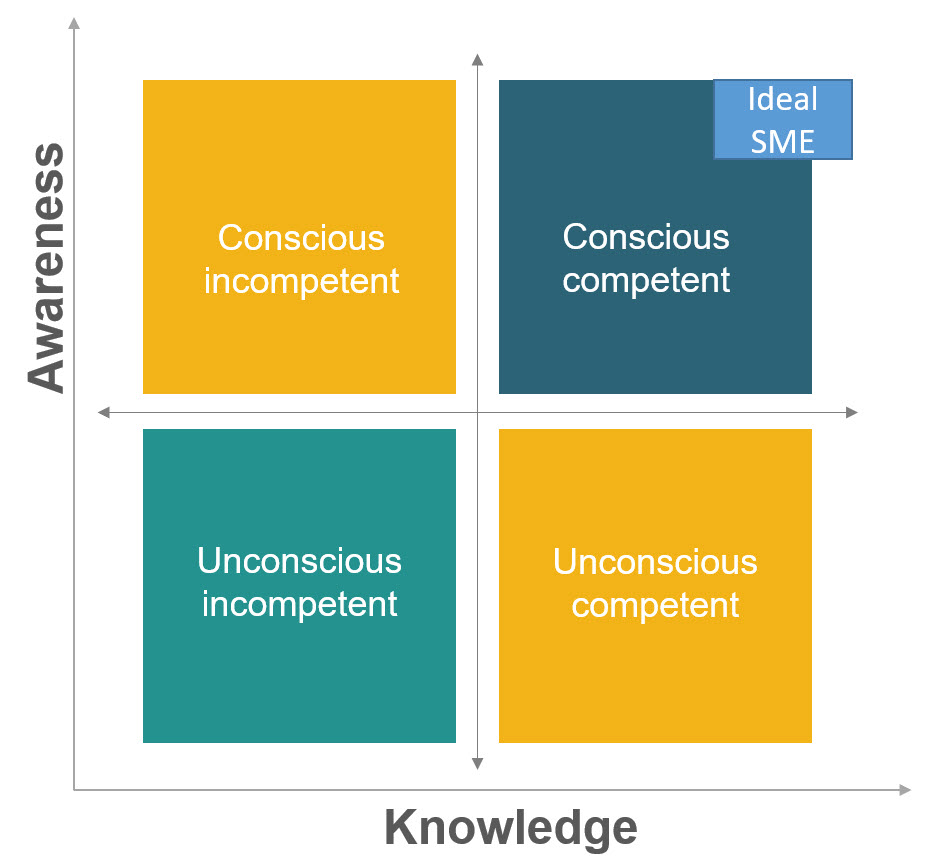
A Subject Matter Experts (SME) is a fascinating creature, both those within an organization and those considered a SME outside their organization – for example by a professional society.

A SME is engaged in knowledge management activities, what we want is for those activities to be a explicit and systematic management of the processes of creating, gathering, validating, categorizing, archiving, disseminating, leveraging, and using knowledge – whether for improving the organization and the individuals in it or the broader profession.

The thing is, this is another skill set for most SMEs. There will be SMEs out there who can do this from practice, but we need to be more deliberate in providing the skills. To provide the skills we must understand what we need to teach, which is where a competency model is valuable.

For the purpose of this post I’ll use the same three levels the ASQ Human Development and Leadership technical community uses for their competency framework:

  • Basic: Possesses general, conceptual knowledge or awareness of this concept OR a limited ability to perform this skill. Needs reference materials to complete tasks related to this concept.
  • Intermediate: Able to apply knowledge of this concept in work OR can perform this skill consistently with minimal guidance.
  • Advanced:  Provides expert advice and make sound judgments using knowledge of this concept OR provides consultation and leadership to others using this skill. Can foster greater understanding of this concept among colleagues and stakeholders.
CompetencyLevel to build towards
Knowledge of principles of knowledge management, for example conceptualizing, managing, preserving, and/or maintaining organizational knowledge.Advanced
Knowledge of methods and techniques for capturing and codifying knowledge, for example storytelling, data mining, cognitive mapping, decision trees, and/or knowledge taxonomies.Advanced
Knowledge of methods and techniques for disseminating and/or sharing knowledge across individuals, groups, and organizations.Advanced
Skill in designing and implementing knowledge management strategy.Intermediate
Skill in identifying the quality, authenticity, accuracy, impartiality, and/or relevance of information from various sources, for example databases, print and online media, speeches and presentations, and observations.Advanced
Skill in organizing and synthesizing information from multiple sources, for example databases, print and online media, speeches and presentations, and observations.Advanced
Skill in curating instructional content, tools, and resources, for example researching, evaluating, selecting, and/or assembling publicly available online courseware.Basic
Skill in identifying the type and amount of information needed to support the development of others in the topic.Advanced
Skill in developing, managing, facilitating, and/or supporting knowledge networks and communities of practiceAdvanced

We need to recognize that not every SME will get to this level, or have the time to consistently apply it. This is why it is important to have knowledge management experts to support, nurture and step in where needed to assist.


Experts think differently

Research on expertise has identified the following differences between expert performers and beginners

  • Experts have larger and more integrative knowledge units, and their represen­tations of information are more functional and abstract than those of novices, whose knowledge base is more fragmentary. For example, a beginning piano player reads sheet music note by note, whereas a concert pianist is able to see the whole row or even several rows of music notation at the same time.
  • When solving problems, experts may spend more time on the initial prob­lem evaluation and planning than novices. This enables them to form a holistic and in-depth understanding of the task and usually to reach a solution more swiftly than beginners.
  • Basic functions related to tasks or the job are automated in experts, whereas beginners need to pay attention to these functions. For instance, in a driving Basic functions related to tasks or the job are automated in experts, whereas beginners need to pay attention to these functions. For instance, in a driving school, a young driver focuses his or her attention on controlling devices and pedals, while an experienced driver performs basic strokes automatically. For this reason, an expert driver can observe and anticipate traffic situations better than a beginning driver.
  • Experts outperform novices in their metacognitive and reflective thinking. In other words, they make sharp observations of their own ways of think­ing, acting, and working, especially in non-routine situations when auto­ mated activities are challenged. Beginners’ knowledge is mainly explicit and they are dependent on learned rules. In addition to explicit knowledge, experts have tacit or implicit knowledge that accumulates with experience. This kind of knowledge makes it possible to make fast decisions on the basis of what is often called intuition.
  • In situations where something has gone wrong or when experts face totally new problems but are not required to make fast decisions, they critically reflect on their actions. Unlike beginners, experienced professionals focus their thinking not only on details but rather on the totality consisting of the details.
  • Experts’ thinking is more holistic than the thinking of novices. It seems that the quality of thinking is associated with the quality and amount of knowledge. With a fragmentary knowledge base, a novice in any field may remain on lower levels of thinking: things are seen as black and white, without any nuances. In contrast, more experienced colleagues with a more organized and holistic know­ledge base can access more material for their thinking, and, thus, may begin to explore different perspectives on matters and develop more relativistic views concerning certain problems. At the highest levels of thinking, an individual is able to reconcile different perspectives, either by forming a synthesis or by inte­grating different approaches or views.
LevelPerformance
BeginnerFollows simple directions
NovicePerforms using memory of facts and simple rules
CompetentMakes simple judgmentsfor typical tasksMay need help withcomplex or unusual tasksMay lack speed andflexibility
ProficientPerformance guided by deeper experience Able to figure out the most critical aspects of a situation Sees nuances missed by less-skilled performers Flexible performance
ExpertPerformance guided by extensive practice and easily retrievable knowledge and skillsNotices nuances, connections, and patterns Intuitive understanding based on extensive practice Able to solve difficult problems, learn quickly, and find needed resources
Levels of Performance

Sources

  • Clark, R. 2003. Building Expertise: Cognitive Methods for Training and Performance Improvement, 2nd ed. Silver Spring, MD: International Society for Performance Improvement.
  • Ericsson, K.A. 2016. Peak: Secrets From the New Science of Expertise. Boston: Houghton Mifflin Harcourt
  • Kallio, E, ed. Development of Adult Thinking : Interdisciplinary Perspectives on Cognitive Development and Adult Learning. Taylor & Francis Group, 2020.

.

The Subject Matter Expert

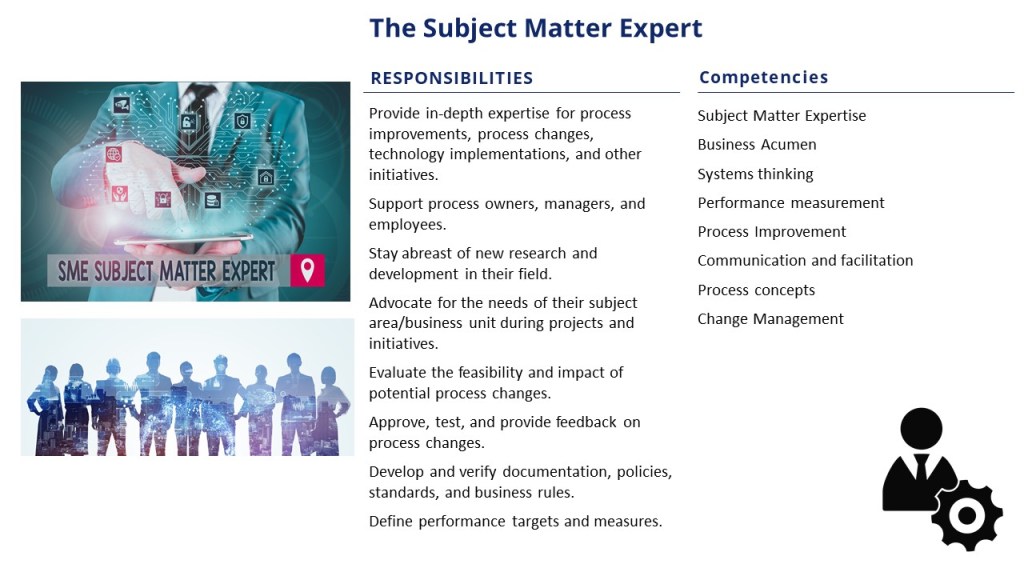
A subject matter expert (SME) is typically an expert on a division of a process, such as a specific tool, technology, or set of process steps. A process may have multiple subject matter experts associated with it, each with varying degrees of understanding of the over-arching process.

SMEs should have depth in their subject area. A great way to identify them is to look for individuals who have a proven track record as formal or informal mentors. To be effective, the SME must be approachable and able to show others the “how” and “why” behind their work. Building expertise, and thus building SMEs, is a fundamental part of a learning organization.

The archetype SMEs has the following attributes:

  • Are really, really smart and know more about their subjects than anybody else in your universe
  • Are willing, able, and looking forward to serving as experts
  • Can tell you what they know in a logical way
  • Understand why it is important for other people to know what they know
  • Are approachable and often fun to work with
  • Love to teach their subjects and make great presenters or facilitators
  • Stay current in their areas of expertise
  • Know when to refer you to someone else
  • Possess situational awareness
The Subject Matter Expert

Subject matter experts are a huge part of knowledge capture.

SME’s help drive Innovation through their strong knowledge of what-was and what-is in order to provide a solid foundation to comprehend what-could-be.