A concept map of Churchman’s general systems approach.
— Read on csl4d.wordpress.com/2019/07/27/a-concept-map-of-churchmans-general-systems-approach/
Great overview of Churchman’s approach. Highly recommended reading.
A concept map of Churchman’s general systems approach.
— Read on csl4d.wordpress.com/2019/07/27/a-concept-map-of-churchmans-general-systems-approach/
Great overview of Churchman’s approach. Highly recommended reading.
Mindsets are lenses or frames of mind that orient individuals to particular sets of associations and expectations. Mindsets help individuals make sense of complex information by offering them simple schematics about themselves and objects in their world. For employees, mindsets provide scaffolding for understanding the broad nature of their work. Mindsets can be intentionally and adaptively changed through targeted interventions, so the goal is to build the processes to assess, monitor and shape as part of our quality systems.
Attitudes are the beliefs and feelings that drive individuals’ intentions and actions. Attitudes are the lens through which individuals make sense of their surroundings and impart consistency to guide their behavior .
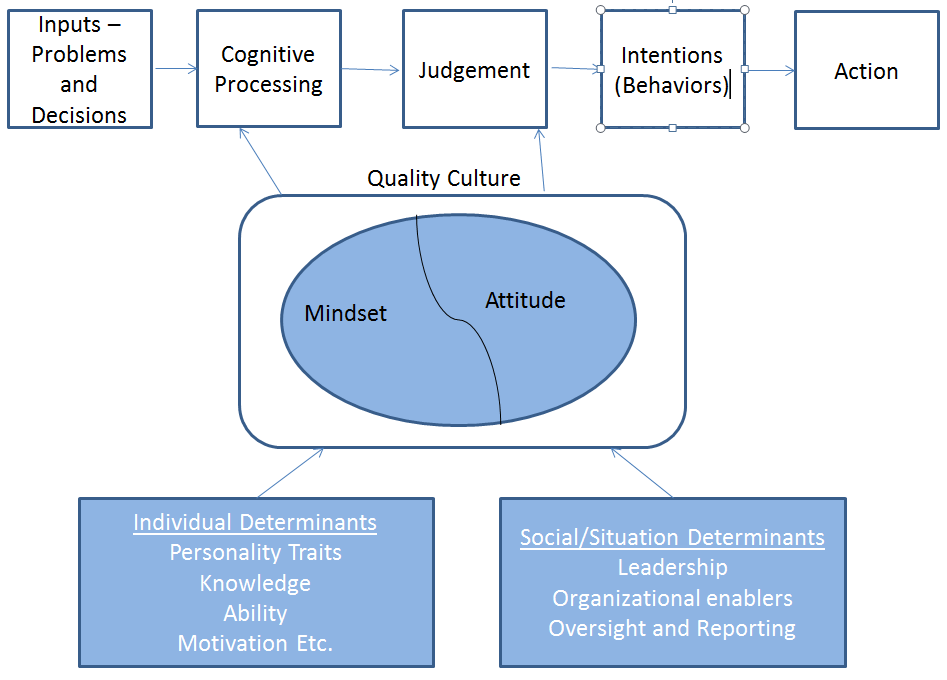
Mindset influences attitudes, which influence behaviors, which influence actions, which influence results, which influence performance. And performance leas to changes in mindsets, and is a continuous improvement loop.
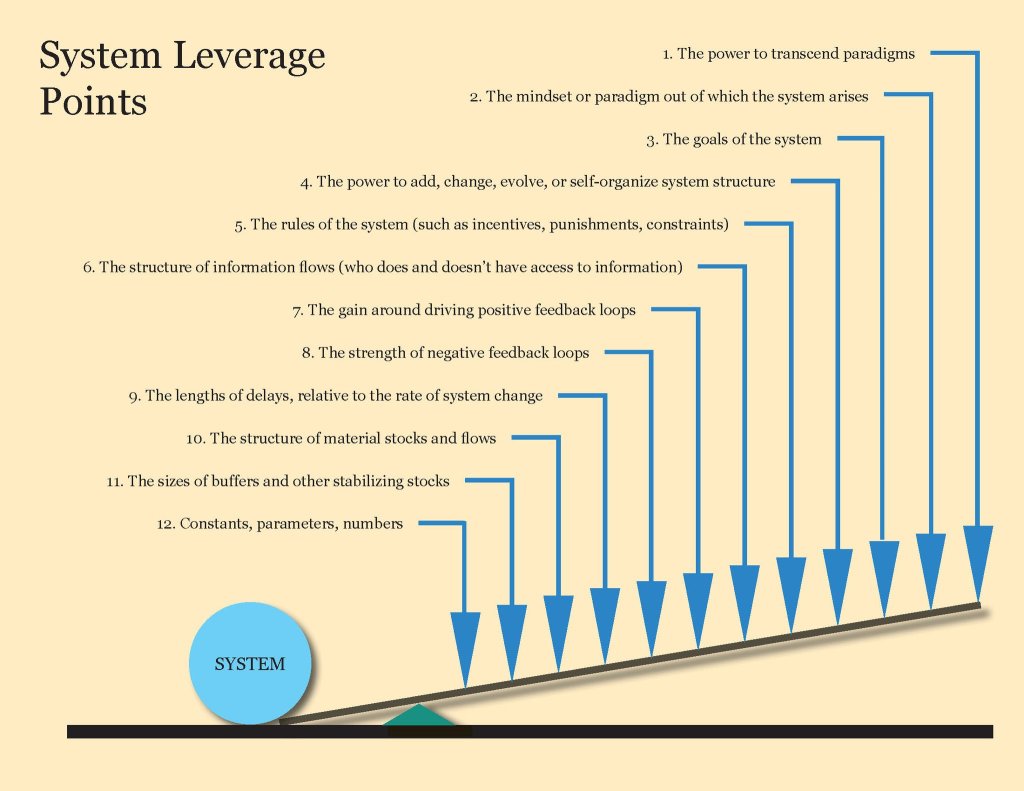
Since behaviors drive the actions we want to see, they are often a great pivot point. By thinking and working on mindsets and attitudes we are targeting the fourth and second leverage points.
Another way to think about this is we are developing habits. The same three factors apply:
Habits are contagious within social contexts, but scaling positive pressure on an organization level is a big challenge.
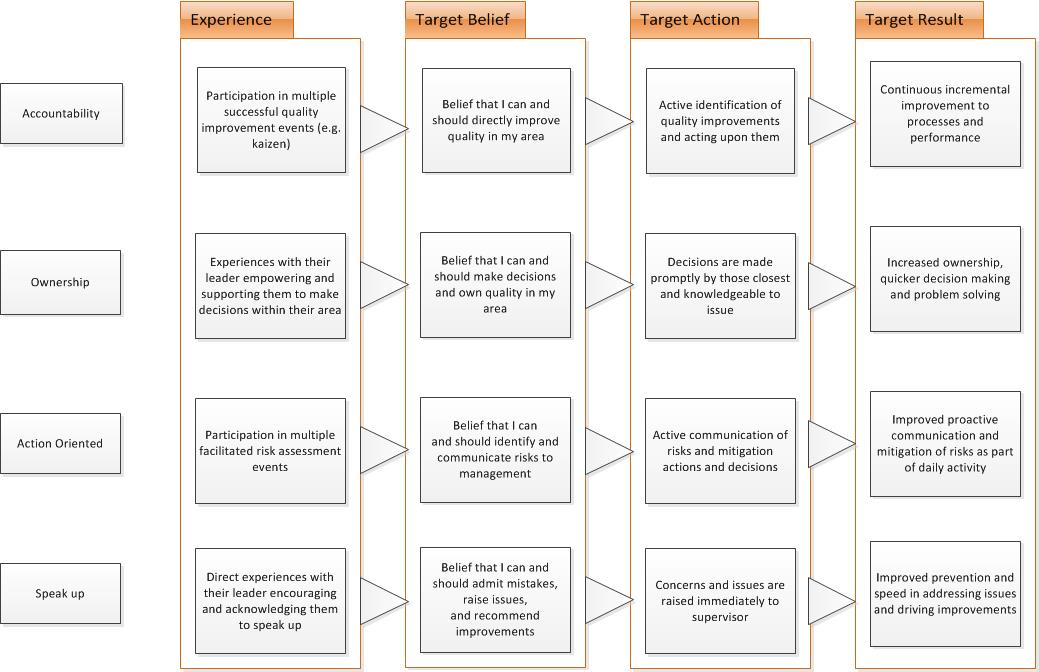
Another way to view this is in the framework of experiences, build beliefs, which lead to actions and give us results. By building this into our systems we can make sure the appropriate processes are in place to make sure these new habits stick. Building a quality culture is a multi-year journey requiring incremental, layered and additive formation.
This formation comes through building the mindsets that lead to the behaviors we want to see. Following the ISPE’s recommendations there are four good behaviors we can target (these are not the only ones nor are they exhaustive).
Creating a high level action plan of experience -> Target Belief -> Target Action ->Target Result might look like this:
Cultivating expertise, in short learning, is critical to building a quality culture. Yet, the urgency of work easily trumps learning. It can be difficult to carve out time for learning in the inexorable flow of daily tasks. We are all experienced with the way learning ends up being in the lowest box on the 2×2 Eisenhower matrix, or however you like to prioritize your tasks.
For learning to really happen, it must fit around and align itself to our working days. We need to build our systems so that learning is an inevitable result of doing work. There are also things we as individuals can practice to make learning happen.
Practice mindfulness. As you go about your daily job be present and aware, using it as an opportunity to ability to learn and develop. Don’t just sit in on that audit; notice and learn the auditor’s tactics and techniques as you engage with her. Ask product managers about product features; ask experts about industry trends; ask peers for feedback on your presentation skills. These kinds of inquiries are learning experiences and most peers love to tell you what they know.
Keep a to-learn list. Keep a list of concepts, thoughts, practices, and vocabulary you want to explore and then later later explore them when you have a few moments to reflect. Try to work a few off the list, maybe during your commute or at other times when you have space to reflect.
Build learning into your calendar. Many of us schedule email time, time for project updates, time to do administrative work. Make sure you dedicate time for learning.
Share meaningfully. Share with others, but just don’t spread links. Discuss why you are sharing it, what you learned and why you think it is important. This blog is a good example of that.
Make sure our learning and knowledge management systems are built into everything we do. Make them easy to use. Ensure content is shared internally and leads to continuous improvement.
Ensure learning is valued.
Plan for short-term wins. There is no nirvana, no perfect state. Ensure you have lots of little victories and shareable moments. Plan for this as part of your schedules and cycles.
Learning is a very effective lever for system improvement. At the very least it gives us the power to “add, change, evolve or self-organize system structure” (lever 4) and can also start giving us ways to change the paradigm (lever 2) and eventually even transcend paradigms (lever 1).
“If it Isn’t Written Down, then it Didn’t Happen” is a guiding principle of the quality profession.
There are four major types of writing in quality: instructional, informational, persuasive and transactional. When evaluated against the three major document types instructional is a functional document, informational is a report and transactional is a record. This is not to say that all transactional business writing should be considered a record, the traditional argument against emails in quality systems for example.
It is important to understand these differences as they require differences in writing style, format and grammar. An SOP (instructional/functional) is very different that an informational/report). When building your writing competencies it is important to remember these are different (with a common foundation).
We utilize reports in our quality systems (and everywhere else) to act, to communicate information, to capture work completed, to record incidents, to finalize projects and recommendations, and to act as an archive. A well written report allows the reader to easily grasp the content and, if applicable, make informed decision. Report writing is a cornerstone of a CAPA system (from incident identification to root cause through CAPA completion and effectiveness review), validation, risk management and so much more.
In short, reports are our stories, they form the narrative. And how we tell that narrative determines how we think of an issue, and how we will continue to thing of it in the future.
We tend to mix and match two modes in our report writing — Story thought and system:
We tend to lean more heavily on system thought in quality,the roots of the discipline and the configuration of our organizations make us predisposed to the system thought mode. This means that over time, best practices accumulate that favor system thought, and many of our our partners (regulatory agencies, standard setting bodies, etc) favor the measurable and the reducible. However, by favoring the system thought mode we are at jeopardy of missing how human beings function in our organizations and how our organizations need to deal with society. And we make mistakes. Me make bad decisions. We fail to deal with the truly complicated problems.
It is time to learn how to utilize story though more in quality.
Sonja Blignaut on More Beyond wrote a good post “All that jazz … making coherence coherent” on coherence where she states at the end “In order to remain competitive and thrive in the new world of work, we need to focus our organization design, leadership and strategic efforts on the complex contexts and create the conditions for coherence. “
Ms. Blignaut defines coherence mainly through analogy and metaphor, so I strongly recommend reading the original post.
In my post “Forget the technology, Quality 4.0 is all about thinking” I spelled out some principles of system design.
| Principle | Description |
| Balance | The system creates value for the multiple stakeholders. While the ideal is to develop a design that maximizes the value for all the key stakeholders, the designer often has to compromise and balance the needs of the various stakeholders. |
| Congruence | The degree to which the system components are aligned and consistent with each other and the other organizational systems, culture, plans, processes, information, resource decisions, and actions. |
| Convenience | The system is designed to be as convenient as possible for the participants to implement (a.k.a. user friendly). System includes specific processes, procedures, and controls only when necessary. |
| Coordination | System components are interconnected and harmonized with the other (internal and external) components, systems, plans, processes, information, and resource decisions toward common action or effort. This is beyond congruence and is achieved when the individual components of a system operate as a fully interconnected unit. |
| Elegance | Complexity vs. benefit — the system includes only enough complexity as is necessary to meet the stakeholder’s needs. In other words, keep the design as simple as possible and no more while delivering the desired benefits. It often requires looking at the system in new ways. |
| Human | Participants in the system are able to find joy, purpose and meaning in their work. |
| Learning | Knowledge management, with opportunities for reflection and learning (learning loops), is designed into the system. Reflection and learning are built into the system at key points to encourage single- and double-loop learning from experience to improve future implementation and to systematically evaluate the design of the system itself. |
| Sustainability | The system effectively meets the near- and long-term needs of the current stakeholders without compromising the ability of future generations of stakeholders to meet their own needs. |
I used the term congruence to summarize the point Ms. Blignaut is reaching with alignment and coherence. I love her putting these against the Cynefin framework, it makes a great of sense to see alignment for the obvious domain and the need for coherence driving from complexity.
So what might a drive for coherence look like? Well if we start with coherence being the long-range order (the jazz analogy) we are building systems that build order through their function – they learn and are sustainable.
To apply this in the framework of ICHQ10 or the US FDA’s “Guidance for Industry Quality Systems Approach to Pharmaceutical CGMP Regulations” one way to drive for coherence is to use similar building blocks across our systems: risk management, data integrity, and knowledge management are all examples of that.