A 2025 Retrospective for Investigations of a Dog

If the history of pharmaceutical quality management were written as a geological timeline, 2025 would hopefully mark the end of the Holocene of Compliance—a long, stable epoch where “following the procedure” was sufficient to ensure survival—and the beginning of the Anthropocene of Complexity.

For decades, our industry has operated under a tacit social contract. We agreed to pretend that “compliance” was synonymous with “quality.” We agreed to pretend that a validated method would work forever because we proved it worked once in a controlled protocol three years ago. We agreed to pretend that “zero deviations” meant “perfect performance,” rather than “blind surveillance.” We agreed to pretend that if we wrote enough documents, reality would conform to them.

If I had my wish 2025 would be the year that contract finally dissolved.

Throughout the year—across dozens of posts, technical analyses, and industry critiques on this blog—I have tried to dismantle the comfortable illusions of “Compliance Theater” and show how this theater collides violently with the unforgiving reality of complex systems.

The connecting thread running through every one of these developments is the concept I have returned to obsessively this year: Falsifiable Quality.

This Year in Review is not merely a summary of blog posts. It is an attempt to synthesize the fragmented lessons of 2025 into a coherent argument. The argument is this: A quality system that cannot be proven wrong is a quality system that cannot be trusted.

If our systems—our validation protocols, our risk assessments, our environmental monitoring programs—are designed only to confirm what we hope is true (the “Happy Path”), they are not quality systems at all. They are comfort blankets. And 2025 was the year we finally started pulling the blanket off.

The Philosophy of Doubt

(Reflecting on: The Effectiveness Paradox, Sidney Dekker, and Gerd Gigerenzer)

Before we dissect the technical failures of 2025, let me first establish the philosophical framework that defined this year’s analysis.

In August, I published The Effectiveness Paradox: Why ‘Nothing Bad Happened’ Doesn’t Prove Your Quality System Works.” It became one of the most discussed posts of the year because it attacked the most sacred metric in our industry: the trend line that stays flat.

We are conditioned to view stability as success. If Environmental Monitoring (EM) data shows zero excursions for six months, we throw a pizza party. If a method validation passes all acceptance criteria on the first try, we commend the development team. If a year goes by with no Critical deviations, we pay out bonuses.

But through the lens of Falsifiable Quality—a concept heavily influenced by the philosophy of Karl Popper, the challenging insights of Deming, and the safety science of Sidney Dekker, whom we discussed in November—these “successes” look suspiciously like failures of inquiry.

The Problem with Unfalsifiable Systems

Karl Popper famously argued that a scientific theory is only valid if it makes predictions that can be tested and proven false. “All swans are white” is a scientific statement because finding one black swan falsifies it. “God is love” is not, because no empirical observation can disprove it.

In 2025, I argued that most Pharmaceutical Quality Systems (PQS) are designed to be unfalsifiable.

  • The Unfalsifiable Alert Limit: We set alert limits based on historical averages + 3 standard deviations. This ensures that we only react to statistical outliers, effectively blinding us to gradual drift or systemic degradation that remains “within the noise.”
  • The Unfalsifiable Robustness Study: We design validation protocols that test parameters we already know are safe (e.g., pH +/- 0.1), avoiding the “cliff edges” where the method actually fails. We prove the method works where it works, rather than finding where it breaks.
  • The Unfalsifiable Risk Assessment: We write FMEAs where the conclusion (“The risk is acceptable”) is decided in advance, and the RPN scores are reverse-engineered to justify it.

This is “Safety Theater,” a term Dekker uses to describe the rituals organizations perform to look safe rather than be safe.

Safety-I vs. Safety-II

In November’s post Sidney Dekker: The Safety Scientist Who Influences How I Think About Quality, I explored Dekker’s distinction between Safety-I (minimizing things that go wrong) and Safety-II (understanding how things usually go right).

Traditional Quality Assurance is obsessed with Safety-I. We count deviations. We count OOS results. We count complaints. When those counts are low, we assume the system is healthy.
But as the LeMaitre Vascular warning letter showed us this year (discussed in Part III), a system can have “zero deviations” simply because it has stopped looking for them. LeMaitre had excellent water data—because they were cleaning the valves before they sampled them. They were measuring their ritual, not their water.

Falsifiable Quality is the bridge to Safety-II. It demands that we treat every batch record not as a compliance artifact, but as a hypothesis test.

  • Hypothesis: “The contamination control strategy is effective.”
  • Test: Aggressive monitoring in worst-case locations, not just the “representative” center of the room.
  • Result: If we find nothing, the hypothesis survives another day. If we find something, we have successfully falsified the hypothesis—which is a good thing because it reveals reality.

The shift from “fearing the deviation” to “seeking the falsification” is a cultural pivot point of 2025.

The Epistemological Crisis in the Lab (Method Validation)

(Reflecting on: USP <1225>, Method Qualification vs. Validation, and Lifecycle Management)

Nowhere was the battle for Falsifiable Quality fought more fiercely in 2025 than in the analytical laboratory.

The proposed revision to USP <1225> Validation of Compendial Procedures (published in Pharmacopeial Forum 51(6)) arrived late in the year, but it serves as the perfect capstone to the arguments I’ve been making since January.

For forty years, analytical validation has been the ultimate exercise in “Validation as an Event.” You develop a method. You write a protocol. You execute the protocol over three days with your best analyst and fresh reagents. You print the report. You bind it. You never look at it again.

This model is unfalsifiable. It assumes that because the method worked in the “Work-as-Imagined” conditions of the validation study, it will work in the “Work-as-Done” reality of routine QC for the next decade.

The Reportable Result: Validating Decisions, Not Signals

The revised USP <1225>—aligned with ICH Q14(Analytical Procedure Development) and USP <1220> (The Lifecycle Approach)—destroys this assumption. It introduces concepts that force falsifiability into the lab.

The most critical of these is the Reportable Result.

Historically, we validated “the instrument” or “the measurement.” We proved that the HPLC could inject the same sample ten times with < 1.0% RSD.

But the Reportable Result is the final value used for decision-making—the value that appears on the Certificate of Analysis. It is the product of a complex chain: Sampling -> Transport -> Storage -> Preparation -> Dilution -> Injection -> Integration -> Calculation -> Averaging.

Validating the injection precision (the end of the chain) tells us nothing about the sampling variability (the beginning of the chain).

By shifting focus to the Reportable Result, USP <1225> forces us to ask: “Does this method generate decisions we can trust?”

The Replication Strategy: Validating “Work-as-Done”

The new guidance insists that validation must mimic the replication strategy of routine testing.
If your SOP says “We report the average of 3 independent preparations,” then your validation must evaluate the precision and accuracy of that average, not of the individual preparations.

This seems subtle, but it is revolutionary. It prevents the common trick of “averaging away” variability during validation to pass the criteria, only to face OOS results in routine production because the routine procedure doesn’t use the same averaging scheme.

It forces the validation study to mirror the messy reality of the “Work-as-Done,” making the validation data a falsifiable predictor of routine performance, rather than a theoretical maximum capability.

Method Qualification vs. Validation: The June Distinction

I wrote Method Qualification and Validation,” clarifying a distinction that often confuses the industry.

  • Qualification is the “discovery phase” where we explore the method’s limits. It is inherently falsifiable—we want to find where the method breaks.
  • Validation has traditionally been the “confirmation phase” where we prove it works.

The danger, as I noted in that post, is when we skip the falsifiable Qualification step and go straight to Validation. We write the protocol based on hope, not data.

USP <1225> essentially argues that Validation must retain the falsifiable spirit of Qualification. It is not a coronation; it is a stress test.

The Death of “Method Transfer” as We Know It

In a Falsifiable Quality system, a method is never “done.” The Analytical Target Profile (ATP)—a concept from ICH Q14 that permeates the new thinking—is a standing hypothesis: “This method measures Potency within +/- 2%.”

Every time we run a system suitability check, every time we run a control standard, we are testing that hypothesis.

If the method starts drifting—even if it still passes broad system suitability limits—a falsifiable system flags the drift. An unfalsifiable system waits for the OOS.

The draft revision of USP <1225> is a call to arms. It asks us to stop treating validation as a “ticket to ride”—a one-time toll we pay to enter GMP compliance—and start treating it as a “ticket to doubt.” Validation gives us permission to use the method, but only as long as the data continues to support the hypothesis of fitness.

The Reality Check (The “Unholy Trinity” of Warning Letters)

Philosophy and guidelines are fine, but in 2025, reality kicked in the door. The regulatory year was defined by three critical warning letters—SanofiLeMaitre, and Rechon—that collectively dismantled the industry’s illusions of control.

It began, as these things often do, with a ghost from the past.

Sanofi Framingham: The Pendulum Swings Back

(Reflecting on: Failure to Investigate Critical Deviations and The Sanofi Warning Letter)

The year opened with a shock. On January 15, 2025, the FDA issued a warning letter to Sanofi’s Framingham facility—the sister site to the legacy Genzyme Allston landing, whose consent decree defined an entire generation of biotech compliance and of my career.

In my January analysis (Failure to Investigate Critical Deviations: A Cautionary Tale), I noted that the FDA’s primary citation was a failure to “thoroughly investigate any unexplained discrepancy.”

This is the cardinal sin of Falsifiable Quality.

An “unexplained discrepancy” is a signal from reality. It is the system telling you, “Your hypothesis about this process is wrong.”

  • The Falsifiable Response: You dive into the discrepancy. You assume your control strategy missed something. You use Causal Reasoning (the topic of my May post) to find the mechanism of failure.
  • The Sanofi Response: As the warning letter detailed, they frequently attributed failures to “isolated incidents” or superficial causes without genuine evidence.

This is the “Refusal to Falsify.” By failing to investigate thoroughly, the firm protects the comfortable status quo. They choose to believe the “Happy Path” (the process is robust) over the evidence (the discrepancy).

The Pendulum of Compliance

In my companion post (Sanofi Warning Letter”), I discussed the “pendulum of compliance.” The Framingham site was supposed to be the fortress of quality, built on the lessons of the Genzyme crisis.

The failure at Sanofi wasn’t a lack of SOPs; it was a lack of curiosity.

The investigators likely had checklists, templates, and timelines (Compliance Theater), but they lacked the mandate—or perhaps the Expertise —to actually solve the problem.

This set the thematic stage for the rest of 2025. Sanofi showed us that “closing the deviation” is not the same as fixing the problem. This insight led directly into my August argument in The Effectiveness Paradox: You can close 100% of your deviations on time and still have a manufacturing process that is spinning out of control.

If Sanofi was the failure of investigation (looking back), Rechon and LeMaitre were failures of surveillance (looking forward). Together, they form a complete picture of why unfalsifiable systems fail.

Reflecting on: Rechon Life Science and LeMaitre Vascular

Philosophy and guidelines are fine, but in September, reality kicked in the door.

Two warning letters in 2025—Rechon Life Science (September) and LeMaitre Vascular (August)—provided brutal case studies in what happens when “representative sampling” is treated as a buzzword rather than a statistical requirement.

Rechon Life Science: The Map vs. The Territory

The Rechon Life Science warning letter was a significant regulatory signal of 2025 regarding sterile manufacturing. It wasn’t just a list of observations; it was an indictment of unfalsifiable Contamination Control Strategies (CCS).

We spent 2023 and 2024 writing massive CCS documents to satisfy Annex 1. Hundreds of pages detailing airflows, gowning procedures, and material flows. We felt good about them. We felt “compliant.”

Then the FDA walked into Rechon and essentially asked: “If your CCS is so good, why does your smoke study show turbulence over the open vials?”

The warning letter highlighted a disconnect I’ve called “The Map vs. The Territory.”

  • The Map: The CCS document says the airflow is unidirectional and protects the product.
  • The Territory: The smoke study video shows air eddying backward from the operator to the sterile core.

In an unfalsifiable system, we ignore the smoke study (or film it from a flattering angle) because it contradicts the CCS. We prioritize the documentation (the claim) over the observation (the evidence).

In a falsifiable system, the smoke study is the test. If the smoke shows turbulence, the CCS is falsified. We don’t defend the CCS; we rewrite it. We redesign the line.

The FDA’s critique of Rechon’s “dynamic airflow visualization” was devastating because it showed that Rechon was using the smoke study as a marketing video, not a diagnostic tool. They filmed “representative” operations that were carefully choreographed to look clean, rather than the messy reality of interventions.

LeMaitre Vascular: The Sin of “Aspirational Data”

If Rechon was about air, LeMaitre Vascular (analyzed in my August post When Water Systems Fail) was about water. And it contained an even more egregious sin against falsifiability.

The FDA observed that LeMaitre’s water sampling procedures required cleaning and purging the sample valves before taking the sample.

Let’s pause and consider the epistemology of this.

  • The Goal: To measure the quality of the water used in manufacturing.
  • The Reality: Manufacturing operators do not purge and sanitize the valve for 10 minutes before filling the tank. They open the valve and use the water.
  • The Sample: By sanitizing the valve before sampling, LeMaitre was measuring the quality of the sampling process, not the quality of the water system.

I call this “Aspirational Data.” It is data that reflects the system as we wish it existed, not as it actually exists. It is the ultimate unfalsifiable metric. You can never find biofilm in a valve if you scrub the valve with alcohol before you open it.

The FDA’s warning letter was clear: “Sampling… must include any pathway that the water travels to reach the process.”

LeMaitre also performed an unauthorized “Sterilant Switcheroo,” changing their sanitization agent without change control or biocompatibility assessment. This is the hallmark of an unfalsifiable culture: making changes based on convenience, assuming they are safe, and never designing the study to check if that assumption is wrong.

The “Representative” Trap

Both warning letters pivot on the misuse of the word “representative.”

Firms love to claim their EM sampling locations are “representative.” But representative of what? Usually, they are representative of the average condition of the room—the clean, empty spaces where nothing happens.

But contamination is not an “average” event. It is a specific, localized failure. A falsifiable EM program places probes in the “worst-case” locations—near the door, near the operator’s hands, near the crimping station. It tries to find contamination. It tries to falsify the claim that the zone is sterile, asceptic or bioburden reducing.

When Rechon and LeMaitre failed to justify their sampling locations, they were guilty of designing an unfalsifiable experiment. They placed the “microscope” where they knew they wouldn’t find germs.

2025 taught us that regulators are no longer impressed by the thickness of the CCS binder. They are looking for the logic of control. They are testing your hypothesis. And if you haven’t tested it yourself, you will fail.

The Investigation as Evidence

(Reflecting on: The Golden Start to a Deviation InvestigationCausal ReasoningTake-the-Best Heuristics, and The Catalent Case)

If Rechon, LeMaitre, and Sanofi teach us anything, it is that the quality system’s ability to discover failure is more important than its ability to prevent failure.

A perfect manufacturing process that no one is looking at is indistinguishable from a collapsing process disguised by poor surveillance. But a mediocre process that is rigorously investigated, understood, and continuously improved is a path toward genuine control.

The investigation itself—how we respond to a deviation, how we reason about causation, how we design corrective actions—is where falsifiable quality either succeeds or fails.

The Golden Day: When Theory Meets Work-as-Done

In April, I published “The Golden Start to a Deviation Investigation,” which made a deceptively simple argument: The first 24 hours after a deviation is discovered are where your quality system either commits to discovering truth or retreats into theater.

This argument sits at the heart of falsifiable quality.

When a deviation occurs, you have a narrow window—what I call the “Golden Day”—where evidence is fresh, memories are intact, and the actual conditions that produced the failure still exist. If you waste this window with vague problem statements and abstract discussions, you permanently lose the ability to test causal hypotheses later.

The post outlined a structured protocol:

First, crystallize the problem. Not “potency was low”—but “Lot X234, potency measured at 87% on January 15th at 14:32, three hours after completion of blending in Vessel C-2.” Precision matters because only specific, bounded statements can be falsified. A vague problem statement can always be “explained away.”

Second, go to the Gemba. This is the antidote to “work-as-imagined” investigation. The SOP says the temperature controller should maintain 37°C +/- 2°C. But the Gemba walk reveals that the probe is positioned six inches from the heating element, the data logger is in a recessed pocket where humidity accumulates, and the operator checks it every four hours despite a requirement to check hourly. These are the facts that predict whether the deviation will recur.

Third, interview with cognitive discipline. Most investigations fail not because investigators lack information, but because they extract information poorly. Cognitive interviewing—developed by the FBI and the National Transportation Safety Board—uses mental reinstatement, multiple perspectives, and sequential reordering to access accurate recall rather than confabulated narrative. The investigator asks the operator to walk through the event in different orders, from different viewpoints, each time triggering different memory pathways. This is not “soft” technique; it is a mechanism for generating falsifiable evidence.

The Golden Day post makes it clear: You do not investigate deviations to document compliance. You investigate deviations to gather evidence about whether your understanding of the process is correct.

Causal Reasoning: Moving Beyond “What Was Missing”

Most investigation tools fail not because they are flawed, but because they are applied with the wrong mindset. In my May post “Causal Reasoning: A Transformative Approach to Root Cause Analysis,” I argued that pharmaceutical investigations are often trapped in “negative reasoning.”

Negative reasoning asks: “What barrier was missing? What should have been done but wasn’t?” This mindset leads to unfalsifiable conclusions like “Procedure not followed” or “Training was inadequate.” These are dead ends because they describe the absence of an ideal, not the presence of a cause.

Causal reasoning flips the script. It asks: “What was present in the system that made the observed outcome inevitable?”

Instead of settling for “human error,” causal reasoning demands we ask: What environmental cues made the action sensible to the operator at that moment? Were the instructions ambiguous? Did competing priorities make compliance impossible? Was the process design fragile?

This shift transforms the investigation from a compliance exercise into a scientific inquiry.

Consider the LeMaitre example:

  • Negative Reasoning: “Why didn’t they sample the true condition?” Answer: “Because they didn’t follow the intent of the sampling plan.”
  • Causal Reasoning: “What made the pre-cleaning practice sensible to them?” Answer: “They believed it ensured sample validity by removing valve residue.”

By understanding the why, we identify a knowledge gap that can be tested and corrected, rather than a negligence gap that can only be punished.

In September, “Take-the-Best Heuristic for Causal Investigation” provided a practical framework for this. Instead of listing every conceivable cause—a process that often leads to paralysis—the “Take-the-Best” heuristic directs investigators to focus on the most information-rich discriminators. These are the factors that, if different, would have prevented the deviation. This approach focuses resources where they matter most, turning the investigation into a targeted search for truth.

CAPA: Predictions, Not Promises

The Sanofi warning letter—analyzed in January—showed the destination of unfalsifiable investigation: CAPAs that exist mainly as paperwork.

Sanofi had investigation reports. They had “corrective actions.” But the FDA noted that deviations recurred in similar patterns, suggesting that the investigation had identified symptoms, not mechanisms, and that the “corrective” action had not actually addressed causation.

This is the sin of treating CAPA as a promise rather than a hypothesis.

A falsifiable CAPA is structured as an explicit prediction“If we implement X change, then Y undesirable outcome will not recur under conditions Z.”

This can be tested. If it fails the test, the CAPA itself becomes evidence—not of failure, but of incomplete causal understanding. Which is valuable.

In the Rechon analysis, this showed up concretely: The FDA’s real criticism was not just that contamination was found; it was that Rechon’s Contamination Control Strategy had no mechanism to falsify itself. If the CCS said “unidirectional airflow protects the product,” and smoke studies showed bidirectional eddies, the CCS had been falsified. But Rechon treated the falsification as an anomaly to be explained away, rather than evidence that the CCS hypothesis was wrong.

A falsifiable organization would say: “Our CCS predicted that Grade A in an isolator with this airflow pattern would remain sterile. The smoke study proves that prediction wrong. Therefore, the CCS is false. We redesign.”

Instead, they filmed from a different angle and said the aerodynamics were “acceptable.”

Knowledge Integration: When Deviations Become the Curriculum

The final piece of falsifiable investigation is what I call “knowledge integration.” A single deviation is a data point. But across the organization, deviations should form a curriculum about how systems actually fail.

Sanofi’s failure was not that they investigated each deviation badly (though they did). It was that they investigated them in isolation. Each deviation closed on its own. Each CAPA addressed its own batch. There was no organizational learning—no mechanism for a pattern of similar deviations to trigger a hypothesis that the control strategy itself was fundamentally flawed.

This is where the Catalent case study, analyzed in September’s “When 483s Reveal Zemblanity,” becomes instructive. Zemblanity is the opposite of serendipity: the seemingly random recurrence of the same failure through different paths. Catalent’s 483 observations were not isolated mistakes; they formed a pattern that revealed a systemic assumption (about equipment capability, about environmental control, about material consistency) that was false across multiple products and locations.

A falsifiable quality system catches zemblanity early by:

  1. Treating each deviation as a test of organizational hypotheses, not as an isolated incident.
  2. Trending deviation patterns to detect when the same causal mechanism is producing failures across different products, equipment, or operators.
  3. Revising control strategies when patterns falsify the original assumptions, rather than tightening parameters at the margins.

The Digital Hallucination (CSA, AI, and the Expertise Crisis)

(Reflecting on: CSA: The Emperor’s New Clothes, Annex 11, and The Expertise Crisis)

While we battled microbes in the cleanroom, a different battle was raging in the server room. 2025 was the year the industry tried to “modernize” validation through Computer Software Assurance (CSA) and AI, and in many ways, it was the year we tried to automate our way out of thinking.

CSA: The Emperor’s New Validation Clothes

In September, I published Computer System Assurance: The Emperor’s New Validation Clothes,” a critique of the the contortions being made around the FDA’s guidance. The narrative sold by consultants for years was that traditional Computer System Validation (CSV) was “broken”—too much documentation, too much testing—and that CSA was a revolutionary new paradigm of “critical thinking.”

My analysis showed that this narrative is historically illiterate.

The principles of CSA—risk-based testing, leveraging vendor audits, focusing on intended use—are not new. They are the core principles of GAMP5 and have been applied for decades now.

The industry didn’t need a new guidance to tell us to use critical thinking; we had simply chosen not to use the critical thinking tools we already had. We had chosen to apply “one-size-fits-all” templates because they were safe (unfalsifiable).

The CSA guidance is effectively the FDA saying: “Please read the GAMP5 guide you claimed to be following for the last 15 years.”

The danger of the “CSA Revolution” narrative is that it encourages a swing to the opposite extreme: “Unscripted Testing” that becomes “No Testing.”

In a falsifiable system, “unscripted testing” is highly rigorous—it is an expert trying to break the software (“Ad Hoc testing”). But in an unfalsifiable system, “unscripted testing” becomes “I clicked around for 10 minutes and it looked fine.”

The Expertise Crisis: AI and the Death of the Apprentice

This leads directly to the Expertise Crisis. In September, I wrote The Expertise Crisis: Why AI’s War on Entry-Level Jobs Threatens Quality’s Future.” This was perhaps the most personal topic I covered this year, because it touches on the very survival of our profession.

We are rushing to integrate Artificial Intelligence (AI) into quality systems. We have AI writing deviations, AI drafting SOPs, AI summarizing regulatory changes. The efficiency gains are undeniable. But the cost is hidden, and it is epistemological.

Falsifiability requires expertise.
To falsify a claim—to look at a draft investigation report and say, “No, that conclusion doesn’t follow from the data”—you need deep, intuitive knowledge of the process. You need to know what a “normal” pH curve looks like so you can spot the “abnormal” one that the AI smoothed over.

Where does that intuition come from? It comes from the “grunt work.” It comes from years of reviewing batch records, years of interviewing operators, years of struggling to write a root cause analysis statement.

The Expertise Crisis is this: If we give all the entry-level work to AI, where will the next generation of Quality Leaders come from?

  • The Junior Associate doesn’t review the raw data; the AI summarizes it.
  • The Junior Associate doesn’t write the deviation; the AI generates the text.
  • Therefore, the Junior Associate never builds the mental models necessary to critique the AI.

The Loop of Unfalsifiable Hallucination

We are creating a closed loop of unfalsifiability.

  1. The AI generates a plausible-sounding investigation report.
  2. The human reviewer (who has been “de-skilled” by years of AI reliance) lacks the deep expertise to spot the subtle logical flaw or the missing data point.
  3. The report is approved.
  4. The “hallucination” becomes the official record.

In a falsifiable quality system, the human must remain the adversary of the algorithm. The human’s job is to try to break the AI’s logic, to check the citations, to verify the raw data.
But in 2025, we saw the beginnings of a “Compliance Autopilot”—a desire to let the machine handle the “boring stuff.”

My warning in September remains urgent: Efficiency without expertise is just accelerated incompetence. If we lose the ability to falsify our own tools, we are no longer quality professionals; we are just passengers in a car driven by a statistical model that doesn’t know what “truth” is.

My post “The Missing Middle in GMP Decision Making: How Annex 22 Redefines Human-Machine Collaboration in Pharmaceutical Quality Assurance” goes a lot deeper here.

Annex 11 and Data Governance

In August, I analyzed the draft Annex 11 (Computerised Systems) in the post Data Governance Systems: A Fundamental Shift.”

The Europeans are ahead of the FDA here. While the FDA talks about “Assurance” (testing less), the EU is talking about “Governance” (controlling more). The new Annex 11 makes it clear: You cannot validate a system if you do not control the data lifecycle. Validation is not a test script; it is a state of control.

This aligns perfectly with USP <1225> and <1220>. Whether it’s a chromatograph or an ERP system, the requirement is the same: Prove that the data is trustworthy, not just that the software is installed.

The Process as a Hypothesis (CPV & Cleaning)

(Reflecting on: Continuous Process Verification and Hypothesis Formation)

The final frontier of validation we explored in 2025 was the manufacturing process itself.

CPV: Continuous Falsification

In March, I published Continuous Process Verification (CPV) Methodology and Tool Selection.”
CPV is the ultimate expression of Falsifiable Quality in manufacturing.

  • Traditional Validation (3 Batches): “We made 3 good batches, therefore the process is perfect forever.” (Unfalsifiable extrapolation).
  • CPV: “We made 3 good batches, so we have a license to manufacture, but we will statistically monitor every subsequent batch to detect drift.” (Continuous hypothesis testing).

The challenge with CPV, as discussed in the post, is that it requires statistical literacy. You cannot implement CPV if your quality unit doesn’t understand the difference between Cpk and Ppk, or between control limits and specification limits.

This circles back to the Expertise Crisis. We are implementing complex statistical tools (CPV software) at the exact moment we are de-skilling the workforce. We risk creating a “CPV Dashboard” that turns red, but no one knows why or what to do about it.

Cleaning Validation: The Science of Residue

In August, I tried to apply falsifiability to one of the most stubborn areas of dogma: Cleaning Validation.

In Building Decision-Making with Structured Hypothesis Formation, I argued that cleaning validation should not be about “proving it’s clean.” It should be about “understanding why it gets dirty.”

  • Traditional Approach: Swab 10 spots. If they pass, we are good.
  • Hypothesis Approach: “We hypothesize that the gasket on the bottom valve is the hardest to clean. We predict that if we reduce rinse time by 1 minute, that gasket will fail.”

By testing the boundaries—by trying to make the cleaning fail—we understand the Design Space of the cleaning process.

We discussed the “Visual Inspection” paradox in cleaning: If you can see the residue, it failed. But if you can’t see it, does it pass?

Only if you have scientifically determined the Visible Residue Limit (VRL). Using “visually clean” without a validated VRL is—you guessed it—unfalsifiable.

To: Jeremiah Genest
From: Perplexity Research
Subject: Draft Content – Single-Use Systems & E&L Section

Here is a section on Single-Use Systems (SUS) and Extractables & Leachables (E&L).

I have positioned this piece to bridge the gap between “Part III: The Reality Check” (Contamination/Water) and “Part V: The Process as a Hypothesis” (Cleaning Validation).

The argument here is that by switching from Stainless Steel to Single-Use, we traded a visible risk (cleaning residue) for an invisible one (chemical migration), and that our current approach to E&L is often just “Paper Safety”—relying on vendor data that doesn’t reflect the “Work-as-Done” reality of our specific process conditions.

The Plastic Paradox (Single-Use Systems and the E&L Mirage)

If the Rechon and LeMaitre warning letters were about the failure to control biological contaminants we can find, the industry’s struggle with Single-Use Systems (SUS) in 2025 was about the chemical contaminants we choose not to find.

We have spent the last decade aggressively swapping stainless steel for plastic. The value proposition was irresistible: Eliminate cleaning validation, eliminate cross-contamination, increase flexibility. We traded the “devil we know” (cleaning residue) for the “devil we don’t” (Extractables and Leachables).

But in 2025, with the enforcement reality of USP <665> (Plastic Components and Systems) settling in, we had to confront the uncomfortable truth: Most E&L risk assessments are unfalsifiable.

The Vendor Data Trap

The standard industry approach to E&L is the ultimate form of “Compliance Theater.”

  1. We buy a single-use bag.
  2. We request the vendor’s regulatory support package (the “Map”).
  3. We see that the vendor extracted the film with aggressive solvents (ethanol, hexane) for 7 days.
  4. We conclude: “Our process uses water for 24 hours; therefore, we are safe.”

This logic is epistemologically bankrupt. It assumes that the Vendor’s Model (aggressive solvents/short time) maps perfectly to the User’s Reality (complex buffers/long duration/specific surfactants).

It ignores the fact that plastics are dynamic systems. Polymers age. Gamma irradiation initiates free radical cascades that evolve over months. A bag manufactured in January might have a different leachable profile than a bag manufactured in June, especially if the resin supplier made a “minor” change that didn’t trigger a notification.

By relying solely on the vendor’s static validation package, we are choosing not to falsify our safety hypothesis. We are effectively saying, “If the vendor says it’s clean, we will not look for dirt.”

USP <665>: A Baseline, Not a Ceiling

The full adoption of USP <665> was supposed to bring standardization. And it has—it provides a standard set of extraction conditions. But standards can become ceilings.

In 2025, I observed a troubling trend of “Compliance by Citation.” Firms are citing USP <665> compliance as proof of absence of risk, stopping the inquiry there.

A Falsifiable E&L Strategy goes further. It asks:

  • “What if the vendor data is irrelevant to my specific surfactant?”
  • “What if the gamma irradiation dose varied?”
  • “What if the interaction between the tubing and the connector creates a new species?”

The Invisible Process Aid

We must stop viewing Single-Use Systems as inert piping. They are active process components. They are chemically reactive vessels that participate in our reaction kinetics.

When we treat them as inert, we are engaging in the same “Aspirational Thinking” that LeMaitre used on their water valves. We are modeling the system we want (pure, inert plastic), not the system we have (a complex soup of antioxidants, slip agents, and degradants).

The lesson of 2025 is that Material Qualification cannot be a paper exercise. If you haven’t done targeted simulation studies that mimic your actual “Work-as-Done” conditions, you haven’t validated the system. You’ve just filed the receipt.

The Mandate for 2026

As we look toward 2026, the path is clear. We cannot go back to the comfortable fiction of the pre-2025 era.

The regulatory environment (Annex 1, ICH Q14, USP <1225>, Annex 11) is explicitly demanding evidence of control, not just evidence of compliance. The technological environment (AI) is demanding that we sharpen our human expertise to avoid becoming obsolete. The physical environment (contamination, supply chain complexity) is demanding systems that are robust, not just rigid.

The mandate for the coming year is to build Falsifiable Quality Systems.

What does that look like practically?

  1. In the Lab: Implement USP <1225> logic now. Don’t wait for the official date. Validate your reportable results. Add “challenge tests” to your routine monitoring.
  2. In the Plant: Redesign your Environmental Monitoring to hunt for contamination, not to avoid it. If you have a “perfect” record in a Grade C area, move the plates until you find the dirt.
  3. In the Office: Treat every investigation as a chance to falsify the control strategy. If a deviation occurs that the control strategy said was impossible, update the control strategy.
  4. In the Culture: Reward the messenger. The person who finds the crack in the system is not a troublemaker; they are the most valuable asset you have. They just falsified a false sense of security.
  5. In Design: Embrace the Elegant Quality System (discussed in May). Complexity is the enemy of falsifiability. Complex systems hide failures; simple, elegant systems reveal them.

2025 was the year we stopped pretending. 2026 must be the year we start building. We must build systems that are honest enough to fail, so that we can build processes that are robust enough to endure.

Thank you for reading, challenging, and thinking with me this year. The investigation continues.

Equipment Lifecycle Management in the Eyes of the FDA

The October 2025 Warning Letter to Apotex Inc. is fascinating not because it reveals anything novel about FDA expectations, but because it exposes the chasm between what we know we should do and what we actually allow to happen on our watch. Evaluate it together with what we are seeing for Complete Response Letter (CRL) data, we can see that companies continue to struggle with the concept of equipment lifecycle management.

This isn’t about a few leaking gloves or deteriorated gaskets. This is about systemic failure in how we conceptualize, resource, and execute equipment management across the entire GMP ecosystem. Let me walk you through what the Apotex letter really tells us, where the FDA is heading next, and why your current equipment qualification program is probably insufficient.

The Apotex Warning Letter: A Case Study in Lifecycle Management Failure

The FDA’s Warning Letter to Apotex (WL: 320-26-12, October 31, 2025) reads like a checklist of every equipment lifecycle management failure I’ve witnessed in two decades of quality oversight. The agency cited 21 CFR 211.67(a) equipment maintenance failures, 21 CFR 211.192 inadequate investigations, and 21 CFR 211.113(b) aseptic processing deficiencies. But these citations barely scratch the surface of what actually went wrong.

The Core Failures: A Pattern of Deferral and Neglect

Between September 2023 and April 2025—18 months—Apotex experienced at least eight critical equipment failures during leak testing. Their personnel responded by retesting until they achieved passing results rather than investigating root causes. Think about that timeline. Eight failures over 18 months means a failure every 2-3 months, each one representing a signal that their equipment was degrading. When investigators finally examined the system, they found over 30 leaking areas. This wasn’t a single failure; this was systemic equipment deterioration that the organization chose to work around rather than address.

The letter documents white particle buildup on manufacturing equipment surfaces, particles along conveyor systems, deteriorated gasket seals, and discolored gloves. Investigators observed a six-millimeter glove breach that was temporarily closed with a cable tie before production continued. They found tape applied to “false covers” as a workaround. These aren’t just housekeeping issues—they’re evidence that Apotex had crossed from proactive maintenance into reactive firefighting, and then into dangerous normalization of deviation.

Most damning: Apotex had purchased upgraded equipment nearly a year before the FDA inspection but continued using the deteriorating equipment that was actively generating particles contaminating their nasal spray products. They had the solution in their possession. They chose not to implement it.

The Investigation Gap: Equipment Failures as Quality System Failures

The FDA hammered Apotex on their failure to investigate, but here’s what’s really happening: equipment failures are quality system failures until proven otherwise. When a leak happens , you don’t just replace whatever component leaked. You ask:

  • Why did this component fail when others didn’t?
  • Is this a batch-specific issue or a systemic supplier problem?
  • How many products did this breach potentially affect?
  • What does our environmental monitoring data tell us about the timeline of contamination?
  • Are our maintenance intervals appropriate?

Apotex’s investigators didn’t ask these questions. Their personnel retested until they got passing results—a classic example of “testing into compliance” that I’ve seen destroy quality cultures. The quality unit failed to exercise oversight, and management failed to resource proper root cause analysis. This is what happens when quality becomes a checkbox exercise rather than an operational philosophy.​

BLA CRL Trends: The Facility Equipment Crisis Is Accelerating

The Apotex warning letter doesn’t exist in isolation. It’s part of a concerning trend in FDA enforcement that’s becoming impossible to ignore. Facility inspection concerns dominate CRL justifications. Manufacturing and CMC deficiencies account for approximately 44% of all CRLs. For biologics specifically, facility-related issues are even more pronounced.​

The Biologics-Specific Challenge

Biologics license applications face unique equipment lifecycle scrutiny. The 2024-2025 CRL data shows multiple biosimilars rejected due to third-party manufacturing facility issues despite clean clinical data. Tab-cel (tabelecleucel) received a CRL citing problems at a contract manufacturing organization—the FDA rejected an otherwise viable therapy because the facility couldn’t demonstrate equipment control.​

This should terrify every biotech quality leader. The FDA is telling us: your clinical data is worthless if your equipment lifecycle management is suspect. They’re not wrong. Biologics manufacturing depends on consistent equipment performance in ways small molecule chemistry doesn’t. A 0.2°C deviation in a bioreactor temperature profile, caused by a poorly maintained chiller, can alter glycosylation patterns and change the entire safety profile of your product. The agency knows this, and they’re acting accordingly.

The Top 10 Facility Equipment Deficiencies Driving CRLs

Genesis AEC’s analysis of 200+ CRLs identified consistent equipment lifecycle themes:​

  1. Inadequate Facility Segregation and Flow (cross-contamination risks from poor equipment placement)
  2. Missing or Incomplete Commissioning & Qualification (especially HVAC, WFI, clean steam systems)
  3. Fire Protection and Hazardous Material Handling Deficiencies (equipment safety systems)
  4. Critical Utility System Failures (WFI loops with dead legs, inadequate sanitization)
  5. Environmental Monitoring System Gaps (manual data recording, lack of 21 CFR Part 11 compliance)
  6. Container Closure and Packaging Validation Issues (missing extractables/leachables data, CCI testing gaps)
  7. Inadequate Cleanroom Classification and Control (ISO 14644 and EU Annex 1 compliance failures)
  8. Lack of Preventive Maintenance and Asset Management (missing calibration records, unclear maintenance responsibilities)
  9. Inadequate Documentation and Change Control (HVAC setpoint changes without impact assessment)
  10. Sustainability and Environmental Controls Overlooked (temperature/humidity excursions affecting product stability)

Notice what’s not on this list? Equipment selection errors. The FDA isn’t seeing companies buy the wrong equipment. They’re seeing companies buy the right equipment and then fail to manage it across its lifecycle. This is a crucial distinction. The problem isn’t capital allocation—it’s operational execution.

FDA’s Shift to “Equipment Lifecycle State of Control”

The FDA has introduced a significant conceptual shift in how they discuss equipment management. The Apotex Warning Letter is part of the agency’s new emphasis on “equipment lifecycle state of control” . This isn’t just semantic gamesmanship. It represents a fundamental understanding that discrete qualification events are not enough and that continuous lifecycle management is long overdue.

What “State of Control” Actually Means

Traditional equipment qualification followed a linear path: DQ → IQ → OQ → PQ → periodic requalification. State of control means:

  • Continuous monitoring of equipment performance parameters, not just periodic checks
  • Predictive maintenance based on performance data, not just manufacturer-recommended intervals
  • Real-time assessment of equipment degradation signals (particle generation, seal wear, vibration changes)
  • Integrated change management that treats equipment modifications as potential quality events
  • Traceable decision-making about when to repair, refurbish, or retire equipment

The FDA is essentially saying: qualification is a snapshot; state of control is a movie. And they want to see the entire film, not just the trailer.

This aligns perfectly with the agency’s broader push toward Quality Management Maturity. As I’ve previously written about QMM, the FDA is moving away from checking compliance boxes and toward evaluating whether organizations have the infrastructure, culture, and competence to manage quality dynamically. Equipment lifecycle management is the perfect test case for this shift because equipment degradation is inevitable, predictable, and measurable. If you can’t manage equipment lifecycle, you can’t manage quality.​

Global Regulatory Convergence: WHO, EMA, and PIC/S Perspectives

The FDA isn’t operating in a vacuum. Global regulators are converging on equipment lifecycle management as a critical inspection focus, though their approaches differ in emphasis.

EMA: The Annex 15 Lifecycle Approach

EMA’s process validation guidance explicitly requires IQ, OQ, and PQ for equipment and facilities as part of the validation lifecycle. Unlike FDA’s three-stage process validation model, EMA frames qualification as ongoing throughout the product lifecycle. Their 2023 revision of Annex 15 emphasizes:​

  • Validation Master Plans that include equipment lifecycle considerations
  • Ongoing Process Verification that incorporates equipment performance data
  • Risk-based requalification triggered by changes, deviations, or trends
  • Integration with Product Quality Reviews (PQRs) to assess equipment impact on product quality

The EMA expects you to prove your equipment remains qualified through annual PQRs and continuous data review having been more explicit about a lifecycle approach for years.

PIC/S: The Change Management Imperative

PIC/S PI 054-1 on change management provides crucial guidance on equipment lifecycle triggers. The document explicitly identifies equipment upgrades as changes that require formal assessment, planning, and implementation controls. Critically, PIC/S emphasizes:​

  • Interim controls when equipment issues are identified but not yet remediated
  • Post-implementation monitoring to ensure changes achieve intended risk reduction
  • Documentation of rejected changes, especially those related to quality/safety hazard mitigation

The Apotex case is a PIC/S textbook violation: they identified equipment deterioration (hazard), purchased upgraded equipment (change proposal), but failed to implement it with appropriate interim controls or timeline management. The result was continued production with deteriorating equipment—exactly what PIC/S guidance is designed to prevent.

WHO: The Resource-Limited Perspective

WHO’s equipment lifecycle guidance, while focused on medical equipment in low-resource settings, offers surprisingly relevant insights for GMP facilities. Their framework emphasizes:​

  • Planning based on lifecycle cost, not just purchase price
  • Skill development and training as core lifecycle components
  • Decommissioning protocols that ensure data integrity and product segregation

The WHO model is refreshingly honest about resource constraints, which applies to many GMP facilities facing budget pressure. Their key insight: proper lifecycle management actually reduces total cost of ownership by 3-10x compared to run-to-failure approaches. This is the business case that quality leaders need to make to CFOs who view maintenance as a cost center.​

The Six-System Inspection Model: Where Equipment Lifecycle Fits

FDA’s Six-System Inspection Model—particularly the Facilities and Equipment System—provides the structural framework for understanding equipment lifecycle requirements. As I’ve previously written, this system “ensures that facilities and equipment are suitable for their intended use and maintained properly” with focus on “design, maintenance, cleaning, and calibration.”​

The Interconnectedness Problem

Here’s where many organizations fail: they treat the six systems as silos. Equipment lifecycle management bleeds across all of them:

  • Production System: Equipment performance directly impacts process capability
  • Laboratory Controls: Analytical equipment lifecycle affects data integrity
  • Materials System: Equipment changes can affect raw material compatibility
  • Packaging and Labeling: Equipment modifications require revalidation
  • Quality System: Equipment deviations trigger CAPA and change control

The Apotex warning letter demonstrates this interconnectedness perfectly. Their equipment failures (Facilities & Equipment) led to container-closure integrity issues (Packaging), which they failed to investigate properly (Quality), resulting in distributed product that was potentially adulterated (Production). The FDA’s response required independent assessments of investigations, CAPA, and change management—three separate systems all impacted by equipment lifecycle failures.

The “State of Control” Assessment Questions

If FDA inspectors show up tomorrow, here’s what they’ll ask about your equipment lifecycle management:

  1. Design Qualification: Do your User Requirements Specifications include lifecycle maintenance requirements? Are you specifying equipment with modular upgrade paths, or are you buying disposable assets?
  2. Change Management: When you purchase upgraded equipment, what triggers its implementation? Is there a formal risk assessment linking equipment deterioration to product quality? Or do you wait for failures?
  3. Preventive Maintenance: Are your PM intervals based on manufacturer recommendations, or on actual performance data? Do you have predictive maintenance programs using vibration analysis, thermal imaging, or particle counting?
  4. Decommissioning: When equipment reaches end-of-life, do you have formal retirement protocols that assess data integrity impact? Or does old equipment sit in corners of the cleanroom “just in case”?
  5. Training: Do your operators understand equipment lifecycle concepts? Can they recognize early degradation signals? Or do they just call maintenance when something breaks?

These aren’t theoretical questions. They’re directly from recent 483 observations and CRL deficiencies.​

The Business Case: Why Equipment Lifecycle Management Is Economic Imperative

Let’s be blunt: the pharmaceutical industry has treated equipment as a capital expense to be minimized, not an asset to be optimized. This is catastrophically wrong. The Apotex warning letter shows the true cost of this mindset:

  • Product recalls: Multiple ophthalmic and oral solutions recalled
  • Production suspension: Sterile manufacturing halted
  • Independent assessments: Required third-party evaluation of entire quality system
  • Reputational damage: Public warning letter, potential import alert
  • Opportunity cost: Products stuck in regulatory limbo while competitors gain market share

Contrast this with the investment required for proper lifecycle management:

  • Predictive maintenance systems: $50,000-200,000 for sensors and software
  • Enhanced training programs: $10,000-30,000 annually
  • Lifecycle documentation systems: $20,000-100,000 implementation
  • Total: Less than the cost of a single batch recall

The ROI is undeniable. Equipment lifecycle management isn’t a cost center—it’s risk mitigation with quantifiable financial returns.

The CFO Conversation

I’ve had this conversation with CFOs more times than I can count. Here’s what works:

Don’t say: “We need more maintenance budget.”

Say: “Our current equipment lifecycle risk exposure is $X million based on recent CRL trends and warning letters. Investing $Y in lifecycle management reduces that risk by Z% and extends asset utilization by 2-3 years, deferring $W million in capital expenditures.”

Bring data. Show them the Apotex letter. Show them the Tab-cel CRL. Show them the 51 CRLs driven by facility concerns. CFOs understand risk-adjusted returns. Frame equipment lifecycle management as portfolio risk management, not engineering overhead.

Practical Framework: Building an Equipment Lifecycle Management Program

Enough theory. Here’s the practical framework I’ve implemented across multiple DS facilities, refined through inspections, and validated against regulatory expectations.

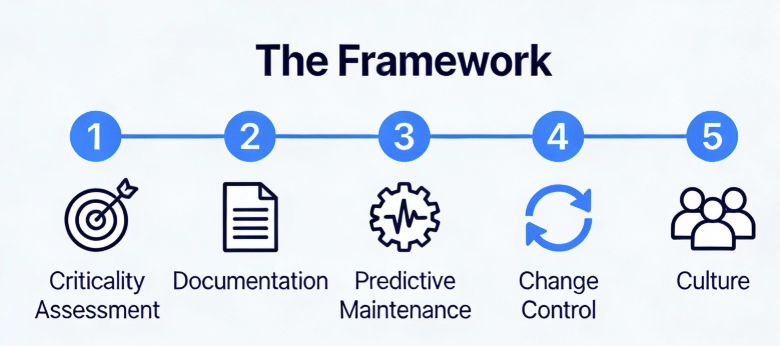
Phase 1: Asset Criticality Assessment

Not all equipment deserves equal lifecycle attention. Use a risk-based approach:

Criticality Class A (Direct Impact): Equipment whose failure directly impacts product quality, safety, or efficacy. Bioreactors, purification skids, sterile filling lines, environmental monitoring systems. These require full lifecycle management including continuous monitoring, predictive maintenance, and formal retirement protocols.

Criticality Class B (Indirect Impact): Equipment whose failure impacts GMP environment but not direct product attributes. HVAC units, WFI systems, clean steam generators. These require enhanced lifecycle management with robust PM programs and performance trending.

Criticality Class C (No Impact): Non-GMP equipment. Standard maintenance practices apply.

Phase 2: Lifecycle Documentation Architecture

Create a master equipment lifecycle file for each Class A and B asset containing:

  1. User Requirements Specification with lifecycle maintenance requirements
  2. Design Qualification including maintainability and upgrade path assessment
  3. Commissioning Protocol (IQ/OQ/PQ) with acceptance criteria that remain valid throughout lifecycle
  4. Maintenance Master Plan defining PM intervals, spare parts strategy, and predictive monitoring
  5. Performance Trending Protocol specifying parameters to monitor, alert limits, and review frequency
  6. Change Management History documenting all modifications with impact assessment
  7. Retirement Protocol defining end-of-life triggers and data migration requirements

As I’ve written about in my posts on GMP-critical systems, documentation must be living documents that evolve with the asset, not static files that gather dust after qualification.​

Phase 3: Predictive Maintenance Implementation

Move beyond manufacturer-recommended intervals to condition-based maintenance:

  • Vibration analysis for rotating equipment (pumps, agitators)
  • Thermal imaging for electrical systems and heat transfer equipment
  • Particle counting for cleanroom equipment and filtration systems
  • Pressure decay testing for sterile barrier systems
  • Oil analysis for hydraulic and lubrication systems

The goal is to detect degradation 6-12 months before failure, allowing planned intervention during scheduled shutdowns.

Phase 4: Integrated Change Control

Equipment changes must flow through formal change control with:

  • Technical assessment by engineering and quality
  • Risk evaluation using FMEA or similar tools
  • Regulatory assessment for potential prior approval requirements
  • Implementation planning with interim controls if needed
  • Post-implementation review to verify effectiveness

The Apotex case shows what happens when you skip the interim controls. They identified the need for upgraded equipment (change) but failed to implement the necessary bridge measures to ensure product quality while waiting for that equipment to come online. They allowed the “future state” (new equipment) to become an excuse for neglecting the “current state” (deteriorating equipment).

This is a failure of Change Management Logic. In a robust quality system, the moment you identify that equipment requires replacement due to performance degradation, you have acknowledged a risk. If you cannot replace it immediately—due to capital cycles, lead times, or qualification timelines—you must implement interim controls to mitigate that risk.

For Apotex, those interim controls should have been:

  • Reduced run durations to minimize stress on failing seals.
  • Increased sampling plans (e.g., 100% leak testing verification or enhanced AQLs).
  • Shortened maintenance intervals (replacing gaskets every batch instead of every campaign).
  • Enhanced environmental monitoring focused specifically on the degrade zones.

Instead, they did nothing. They continued business as usual, likely comforting themselves with the purchase order for the new machine. The FDA’s response was unambiguous: A purchase order is not a CAPA. Until the new equipment is qualified and operational, your legacy equipment must remain in a state of control, or production must stop. There is no regulatory “grace period” for deteriorating assets.

Phase 5: The Cultural Shift—From “Repair” to “Reliability”

The final and most difficult phase of this framework is cultural. You cannot write a SOP for this; you have to lead it.

Most organizations operate on a “Break-Fix” mentality:

  1. Equipment runs until it alarms or fails.
  2. Maintenance fixes it.
  3. Quality investigates (or papers over) the failure.
  4. Production resumes.

The FDA’s “Lifecycle State of Control” demands a “Predict-Prevent” mentality:

  1. Equipment is monitored for degradation signals (vibration, heat, particle counts).
  2. Maintenance intervenes before failure limits are reached.
  3. Quality reviews trends to confirm the intervention was effective.
  4. Production continues uninterrupted.

To achieve this, you need to change how you incentivize your teams. Stop rewarding “heroic” fixes at 2 AM. Start rewarding the boring, invisible work of preventing the failure in the first place. As I’ve written before regarding Quality Management Maturity (QMM), mature quality systems are quiet systems. Chaos is not a sign of hard work; it’s a sign of lost control.

Conclusion: The Choice Before Us

The warning letter to Apotex Inc. and the rising tide of facility-related CRLs are not random compliance noise. They are signal flares. The regulatory expectations for equipment management have fundamentally shifted from static qualification (Is it validated?) to dynamic lifecycle management (Is it in a state of control right now?).

The FDA, EMA, and PIC/S have converged on a single truth: You cannot assure product quality if you cannot guarantee equipment performance.

We are at an inflection point. The industry’s aging infrastructure, combined with the increasing complexity of biologic processes and the unforgiving nature of residue control, has created a perfect storm. We can no longer treat equipment maintenance as a lower-tier support function. It is a core GMP activity, equal in criticality to batch record review or sterility testing.

As Quality Leaders, we have two choices:

  1. The Apotex Path: Treat equipment upgrades as capital headaches to be deferred. Ignore the “minor” leaks and “insignificant” residues. Let the maintenance team bandage the wounds while we focus on “strategic” initiatives. This path leads to 483s, warning letters, CRLs, and the excruciating public failure of seeing your facility’s name in an FDA press release.
  2. The Lifecycle Path: Embrace the complexity. Resource the predictive maintenance programs. Validate the residue removal. Treat every equipment change as a potential risk to patient safety. Build a system where equipment reliability is the foundation of your quality strategy, not an afterthought.

The second path is expensive. It is technically demanding. It requires fighting for budget dollars that don’t have immediate ROI. But it allows you to sleep at night, knowing that when—not if—the FDA investigator asks to see your equipment maintenance history, you won’t have to explain why you used a cable tie to fix a glove port.

You’ll simply show them the data that proves you’re in control.

Choose wisely.

Evaluating the Periphery Cases of Regulatory Actions

I have written in the past that I do not treat all regulatory compliance actions with equal importance. Not every Form 483 or Warning Letter carries the same weight; their significance is determined by the nature of the company involved.

Take the April 2025 Warning Letter to Cosco International, for example. One might quickly react with, “Holy cow! No process validation or cleaning validation—how is this even possible?” This could spark an exhaustive discussion about why these regulations have been in place for 30 years and the urgent need for companies to comply. But frankly, nothing really valuable to a company that already realizes they need to do process validation.

Yet this Warning Letter highlights a fundamental misunderstanding among companies regarding the difference between a cosmetic and a drug. As someone who reads Warning Letters, this seems to be a fairly common problem.

Key Regulatory Distinctions

  • Cosmetics: Products intended solely for cleansing, beautifying, or altering the appearance without affecting bodily functions are regulated as cosmetics under the FDA. These are not required to undergo premarket approval, except for color additives.
  • Drugs: Products intended to diagnose, cure, mitigate, treat, or prevent disease or that affect the structure or function of the body (such as blocking sweat glands) are regulated as drugs. This includes antiperspirants, regardless of their application site.

So not really all that interesting from a biotech perspective, but a fascinating insight to some bad trends if I was on the consumer goods side of the profession.

But, as I discussed, there is value from reading these holistically, for what they tell us regulators are thinking. In this case, there is a nice little set of bullet points on what is bare minimum in cleaning validation.

When Investigation Excellence Meets Contamination Reality: Lessons from the Rechon Life Science Warning Letter

The FDA’s April 30, 2025 warning letter to Rechon Life Science AB serves as a great learning opportunity about the importance robust investigation systems to contamination control to drive meaningful improvements. This Swedish contract manufacturer’s experience offers profound lessons for quality professionals navigating the intersection of EU Annex 1‘s contamination control strategy requirements and increasingly regulatory expectations. It is a mistake to think that just because the FDA doesn’t embrace the prescriptive nature of Annex 1 the agency is not fully aligned with the intent.

This Warning Letter resonates with similar systemic failures at companies like LeMaitre Vascular, Sanofi and others. The Rechon warning letter demonstrates a troubling but instructive pattern: organizations that fail to conduct meaningful contamination investigations inevitably find themselves facing regulatory action that could have been prevented through better investigation practices and systematic contamination control approaches.

The Cascade of Investigation Failures: Rechon’s Contamination Control Breakdown

Aseptic Process Failures and the Investigation Gap

Rechon’s primary violation centered on a fundamental breakdown in aseptic processing—operators were routinely touching critical product contact surfaces with gloved hands, a practice that was not only observed but explicitly permitted in their standard operating procedures. This represents more than poor technique; it reveals an organization that had normalized contamination risks through inadequate investigation and assessment processes.

The FDA’s citation noted that Rechon failed to provide environmental monitoring trend data for surface swab samples, representing exactly the kind of “aspirational data” problem. When investigation systems don’t capture representative information about actual manufacturing conditions, organizations operate in a state of regulatory blindness, making decisions based on incomplete or misleading data.

This pattern reflects a broader failure in contamination investigation methodology: environmental monitoring excursions require systematic evaluation that includes all environmental data (i.e. viable and non-viable tests) and must include areas that are physically adjacent or where related activities are performed. Rechon’s investigation gaps suggest they lacked these fundamental systematic approaches.

Environmental Monitoring Investigations: When Trend Analysis Fails

Perhaps more concerning was Rechon’s approach to persistent contamination with objectionable microorganisms—gram-negative organisms and spore formers—in ISO 5 and 7 areas since 2022. Their investigation into eight occurrences of gram-negative organisms concluded that the root cause was “operators talking in ISO 7 areas and an increase of staff illness,” a conclusion that demonstrates fundamental misunderstanding of contamination investigation principles.

As an aside, ISO7/Grade C is not normally an area we see face masks.

Effective investigations must provide comprehensive evaluation including:

  • Background and chronology of events with detailed timeline analysis
  • Investigation and data gathering activities including interviews and training record reviews
  • SME assessments from qualified microbiology and manufacturing science experts
  • Historical data review and trend analysis encompassing the full investigation zone
  • Manufacturing process assessment to determine potential contributing factors
  • Environmental conditions evaluation including HVAC, maintenance, and cleaning activities

Rechon’s investigation lacked virtually all of these elements, focusing instead on convenient behavioral explanations that avoided addressing systematic contamination sources. The persistence of gram-negative organisms and spore formers over a three-year period represented a clear adverse trend requiring a comprehensive investigation approach.

The Annex 1 Contamination Control Strategy Imperative: Beyond Compliance to Integration

The Paradigm Shift in Contamination Control

The revised EU Annex 1, effective since August 2023 demonstrates the current status of regulatory expectations around contamination control, moving from isolated compliance activities toward integrated risk management systems. The mandatory Contamination Control Strategy (CCS) requires manufacturers to develop comprehensive, living documents that integrate all aspects of contamination risk identification, mitigation, and monitoring.

Industry implementation experience since 2023 has revealed that many organizations are faiing to make meaningful connections between existing quality systems and the Annex 1 CCS requirements. Organizations struggle with the time and resource requirements needed to map existing contamination controls into coherent strategies, which often leads to discovering significant gaps in their understanding of their own processes.

Representative Environmental Monitoring Under Annex 1

The updated guidelines place emphasis on continuous monitoring and representative sampling that reflects actual production conditions rather than idealized scenarios. Rechon’s failure to provide comprehensive trend data demonstrates exactly the kind of gap that Annex 1 was designed to address.

Environmental monitoring must function as part of an integrated knowledge system that combines explicit knowledge (documented monitoring data, facility design specifications, cleaning validation reports) with tacit knowledge about facility-specific contamination risks and operational nuances. This integration demands investigation systems capable of revealing actual contamination patterns rather than providing comfortable explanations for uncomfortable realities.

The Design-First Philosophy

One of Annex 1’s most significant philosophical shifts is the emphasis on design-based contamination control rather than monitoring-based approaches. As we see from Warning Letters, and other regulatory intelligence, design gaps are frequently being cited as primary compliance failures, reinforcing the principle that organizations cannot monitor or control their way out of poor design.

This design-first philosophy fundamentally changes how contamination investigations must be conducted. Instead of simply investigating excursions after they occur, robust investigation systems must evaluate whether facility and process designs create inherent contamination risks that make excursions inevitable. Rechon’s persistent contamination issues suggest their investigation systems never addressed these fundamental design questions.

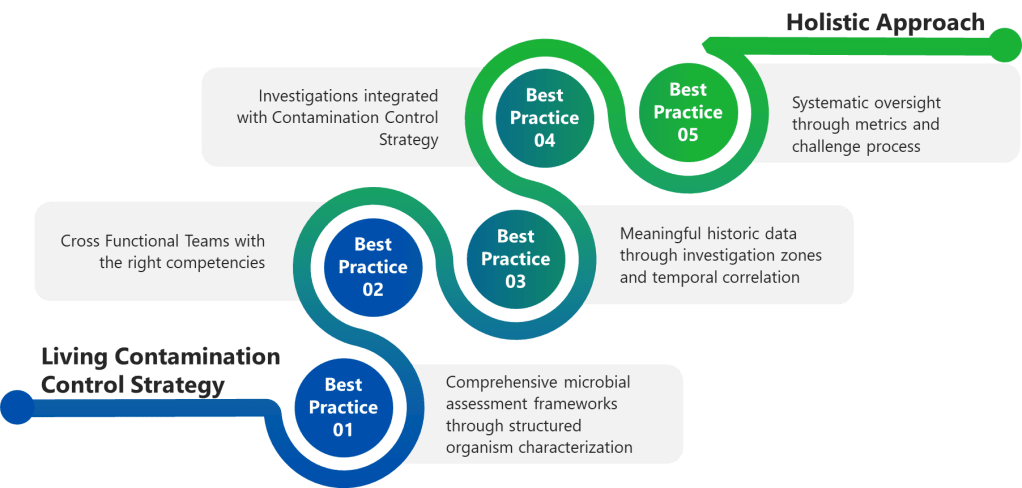
Best Practice 1: Implement Comprehensive Microbial Assessment Frameworks

Structured Organism Characterization

Effective contamination investigations begin with proper microbial assessments that characterize organisms based on actual risk profiles rather than convenient categorizations.

  • Complete microorganism documentation encompassing organism type, Gram stain characteristics, potential sources, spore-forming capability, and objectionable organism status. The structured approach outlined in formal assessment templates ensures consistent evaluation across different sample types (in-process, environmental monitoring, water and critical utilities).
  • Quantitative occurrence assessment using standardized vulnerability scoring systems that combine occurrence levels (Low, Medium, High) with nature and history evaluations. This matrix approach prevents investigators from minimizing serious contamination events through subjective assessments.
  • Severity evaluation based on actual manufacturing impact rather than theoretical scenarios. For environmental monitoring excursions, severity assessments must consider whether microorganisms were detected in controlled environments during actual production activities, the potential for product contamination, and the effectiveness of downstream processing steps.
  • Risk determination through systematic integration of vulnerability scores and severity ratings, providing objective classification of contamination risks that drives appropriate corrective action responses.

Rechon’s superficial investigation approach suggests they lacked these systematic assessment frameworks, focusing instead on behavioral explanations that avoided comprehensive organism characterization and risk assessment.

Best Practice 2: Establish Cross-Functional Investigation Teams with Defined Competencies

Investigation Team Composition and Qualifications

Major contamination investigations require dedicated cross-functional teams with clearly defined responsibilities and demonstrated competencies. The investigation lead must possess not only appropriate training and experience but also technical knowledge of the process and cGMP/quality system requirements, and ability to apply problem-solving tools.

Minimum team composition requirements for major investigations must include:

  • Impacted Department representatives (Manufacturing, Facilities) with direct operational knowledge
  • Subject Matter Experts (Manufacturing Sciences and Technology, QC Microbiology) with specialized technical expertise
  • Contamination Control specialists serving as Quality Assurance approvers with regulatory and risk assessment expertise

Investigation scope requirements must encompass systematic evaluation including background/chronology documentation, comprehensive data gathering activities (interviews, training record reviews), SME assessments, impact statement development, historical data review and trend analysis, and laboratory investigation summaries.

Training and Competency Management

Investigation team effectiveness depends on systematic competency development and maintenance. Teams must demonstrate proficiency in:

  • Root cause analysis methodologies including fishbone analysis, why-why questioning, fault tree analysis, and failure mode and effects analysis approaches suited to contamination investigation contexts.
  • Contamination microbiology principles including organism identification, source determination, growth condition assessment, and disinfectant efficacy evaluation specific to pharmaceutical manufacturing environments.
  • Risk assessment and impact evaluation capabilities that can translate investigation findings into meaningful product, process, and equipment risk determinations.
  • Regulatory requirement understanding encompassing both domestic and international contamination control expectations, investigation documentation standards, and CAPA development requirements.

The superficial nature of Rechon’s gram-negative organism investigation suggests their teams lacked these fundamental competencies, resulting in conclusions that satisfied neither regulatory expectations nor contamination control best practices.

Best Practice 3: Conduct Meaningful Historical Data Review and Comprehensive Trend Analysis

Investigation Zone Definition and Data Integration

Effective contamination investigations require comprehensive trend analysis that extends beyond simple excursion counting to encompass systematic pattern identification across related operational areas. As established in detailed investigation procedures, historical data review must include:

  • Physically adjacent areas and related activities recognition that contamination events rarely occur in isolation. Processing activities spanning multiple rooms, secondary gowning areas leading to processing zones, material transfer airlocks, and all critical utility distribution points must be included in investigation zones.
  • Comprehensive environmental data analysis encompassing all environmental data (i.e. viable and non-viable tests) to identify potential correlations between different contamination indicators that might not be apparent when examining single test types in isolation.
  • Extended historical review capabilities for situations where limited or no routine monitoring was performed during the questioned time frame, requiring investigation teams to expand their analytical scope to capture relevant contamination patterns.
  • Microorganism identification pattern assessment to determine shifts in routine microflora or atypical or objectionable organisms, enabling detection of contamination source changes that might indicate facility or process deterioration.

Temporal Correlation Analysis

Sophisticated trend analysis must correlate contamination events with operational activities, environmental conditions, and facility modifications that might contribute to adverse trends:

  • Manufacturing activity correlation examining whether contamination patterns correlate with specific production campaigns, personnel schedules, cleaning activities, or maintenance operations that might introduce contamination sources.
  • Environmental condition assessment including HVAC system performance, pressure differential maintenance, temperature and humidity control, and compressed air quality that could influence contamination recovery patterns.
  • Facility modification impact evaluation determining whether physical environment changes, equipment installations, utility upgrades, or process modifications correlate with contamination trend emergence or intensification.

Rechon’s three-year history of gram-negative and spore-former recovery represented exactly the kind of adverse trend requiring this comprehensive analytical approach. Their failure to conduct meaningful trend analysis prevented identification of systematic contamination sources that behavioral explanations could never address.

Best Practice 4: Integrate Investigation Findings with Dynamic Contamination Control Strategy

Knowledge Management and CCS Integration

Under Annex 1 requirements, investigation findings must feed directly into the overall Contamination Control Strategy, creating continuous improvement cycles that enhance contamination risk understanding and control effectiveness. This integration requires sophisticated knowledge management systems that capture both explicit investigation data and tacit operational insights.

  • Explicit knowledge integration encompasses formal investigation reports, corrective action documentation, trending analysis results, and regulatory correspondence that must be systematically incorporated into CCS risk assessments and control measure evaluations.
  • Tacit knowledge capture including personnel experiences with contamination events, operational observations about facility or process vulnerabilities, and institutional understanding about contamination source patterns that may not be fully documented but represent critical CCS inputs.

Risk Assessment Dynamic Updates

CCS implementation demands that investigation findings trigger systematic risk assessment updates that reflect enhanced understanding of contamination vulnerabilities:

  • Contamination source identification updates based on investigation findings that reveal previously unrecognized or underestimated contamination pathways requiring additional control measures or monitoring enhancements.
  • Control measure effectiveness verification through post-investigation monitoring that demonstrates whether implemented corrective actions actually reduce contamination risks or require further enhancement.
  • Monitoring program optimization based on investigation insights about contamination patterns that may indicate needs for additional sampling locations, modified sampling frequencies, or enhanced analytical methods.

Continuous Improvement Integration

The CCS must function as a living document that evolves based on investigation findings rather than remaining static until the next formal review cycle:

  • Investigation-driven CCS updates that incorporate new contamination risk understanding into facility design assessments, process control evaluations, and personnel training requirements.
  • Performance metrics integration that tracks investigation quality indicators alongside traditional contamination control metrics to ensure investigation systems themselves contribute to contamination risk reduction.
  • Cross-site knowledge sharing mechanisms that enable investigation insights from one facility to enhance contamination control strategies at related manufacturing sites.

Best Practice 5: Establish Investigation Quality Metrics and Systematic Oversight

Investigation Completeness and Quality Assessment

Organizations must implement systematic approaches to ensure investigation quality and prevent the superficial analysis demonstrated by Rechon. This requires comprehensive quality metrics that evaluate both investigation process compliance and outcome effectiveness:

  • Investigation completeness verification using a rubric or other standardized checklists that ensure all required investigation elements have been addressed before investigation closure. These must verify background documentation adequacy, data gathering comprehensiveness, SME assessment completion, impact evaluation thoroughness, and corrective action appropriateness.
  • Root cause determination quality assessment evaluating whether investigation conclusions demonstrate scientific rigor and logical connection between identified causes and observed contamination events. This includes verification that root cause analysis employed appropriate methodologies and that conclusions can withstand independent technical review.
  • Corrective action effectiveness verification through systematic post-implementation monitoring that demonstrates whether corrective actions achieved their intended contamination risk reduction objectives.

Management Review and Challenge Processes

Effective investigation oversight requires management systems that actively challenge investigation conclusions and ensure scientific rationale supports all determinations:

  • Technical review panels comprising independent SMEs who evaluate investigation methodology, data interpretation, and conclusion validity before investigation closure approval for major and critical deviations. I strongly recommend this as part of qualification and re-qualification activities.
  • Regulatory perspective integration ensuring investigation approaches and conclusions align with current regulatory expectations and enforcement trends rather than relying on outdated compliance interpretations.
  • Cross-functional impact assessment verifying that investigation findings and corrective actions consider all affected operational areas and don’t create unintended contamination risks in other facility areas.

CAPA System Integration and Effectiveness Tracking

Investigation findings must integrate with robust CAPA systems that ensure systematic improvements rather than isolated fixes:

  • Systematic improvement identification that links investigation findings to broader facility or process enhancement opportunities rather than limiting corrective actions to immediate excursion sources.
  • CAPA implementation quality management including resource allocation verification, timeline adherence monitoring, and effectiveness verification protocols that ensure corrective actions achieve intended risk reduction.
  • Knowledge management integration that captures investigation insights for application to similar contamination risks across the organization and incorporates lessons learned into training programs and preventive maintenance activities.

Rechon’s continued contamination issues despite previous investigations suggest their CAPA processes lacked this systematic improvement approach, treating each contamination event as isolated rather than symptoms of broader contamination control weaknesses.

A visual diagram presents a "Living Contamination Control Strategy" progressing toward a "Holistic Approach" through a winding path marked by five key best practices. Each best practice is highlighted in a circular node along the colored pathway.

Best Practice 01: Comprehensive microbial assessment frameworks through structured organism characterization.

Best Practice 02: Cross functional teams with the right competencies.

Best Practice 03: Meaningful historic data through investigation zones and temporal correlation.

Best Practice 04: Investigations integrated with Contamination Control Strategy.

Best Practice 05: Systematic oversight through metrics and challenge process.

The diagram represents a continuous improvement journey from foundational practices focused on organism assessment and team competency to integrating data, investigations, and oversight, culminating in a holistic contamination control strategy.

The Investigation-Annex 1 Integration Challenge: Building Investigation Resilience

Holistic Contamination Risk Assessment

Contamination control requires investigation systems that function as integral components of comprehensive strategies rather than reactive compliance activities.

Design-Investigation Integration demands that investigation findings inform facility design assessments and process modification evaluations. When investigations reveal design-related contamination sources, CCS updates must address whether facility modifications or process changes can eliminate contamination risks at their source rather than relying on monitoring and control measures.

Process Knowledge Enhancement through investigation activities that systematically build organizational understanding of contamination vulnerabilities, control measure effectiveness, and operational factors that influence contamination risk profiles.

Personnel Competency Development that leverages investigation findings to identify training needs, competency gaps, and behavioral factors that contribute to contamination risks requiring systematic rather than individual corrective approaches.

Technology Integration and Future Investigation Capabilities

Advanced Monitoring and Investigation Support Systems

The increasing sophistication of regulatory expectations necessitates corresponding advances in investigation support technologies that enable more comprehensive and efficient contamination risk assessment:

Real-time monitoring integration that provides investigation teams with comprehensive environmental data streams enabling correlation analysis between contamination events and operational variables that might not be captured through traditional discrete sampling approaches.

Automated trend analysis capabilities that identify contamination patterns and correlations across multiple data sources, facility areas, and time periods that might not be apparent through manual analysis methods.

Integrated knowledge management platforms that capture investigation insights, corrective action outcomes, and operational observations in formats that enable systematic application to future contamination risk assessments and control strategy optimization.

Investigation Standardization and Quality Enhancement

Technology solutions must also address investigation process standardization and quality improvement:

Investigation workflow management systems that ensure consistent application of investigation methodologies, prevent shortcuts that compromise investigation quality, and provide audit trails demonstrating compliance with regulatory expectations.

Cross-site investigation coordination capabilities that enable investigation insights from one facility to inform contamination risk assessments and investigation approaches at related manufacturing sites.

Building Organizational Investigation Excellence

Cultural Transformation Requirements

The evolution from compliance-focused contamination investigations toward risk-based contamination control strategies requires fundamental cultural changes that extend beyond procedural updates:

Leadership commitment demonstration through resource allocation for investigation system enhancement, personnel competency development, and technology infrastructure investment that enables comprehensive contamination risk assessment rather than minimal compliance achievement.

Cross-functional collaboration enhancement that breaks down organizational silos preventing comprehensive investigation approaches and ensures investigation teams have access to all relevant operational expertise and information sources.

Continuous improvement mindset development that views contamination investigations as opportunities for systematic facility and process enhancement rather than unfortunate compliance burdens to be minimized.

Investigation as Strategic Asset

Organizations that excel in contamination investigation develop capabilities that provide competitive advantages beyond regulatory compliance:

Process optimization opportunities identification through investigation activities that reveal operational inefficiencies, equipment performance issues, and facility design limitations that, when addressed, improve both contamination control and operational effectiveness.

Risk management capability enhancement that enables proactive identification and mitigation of contamination risks before they result in regulatory scrutiny or product quality issues requiring costly remediation.

Regulatory relationship management through demonstration of investigation competence and commitment to continuous improvement that can influence regulatory inspection frequency and focus areas.

The Cost of Investigation Mediocrity: Lessons from Enforcement

Regulatory Consequences and Business Impact

Rechon’s experience demonstrates the ultimate cost of inadequate contamination investigations: comprehensive regulatory action that threatens market access and operational continuity. The FDA’s requirements for extensive remediation—including independent assessment of investigation systems, comprehensive personnel and environmental monitoring program reviews, and retrospective out-of-specification result analysis—represent exactly the kind of work that should be conducted proactively rather than reactively.

Resource Allocation and Opportunity Cost

The remediation requirements imposed on companies receiving warning letters far exceed the resource investment required for proactive investigation system development:

  • Independent consultant engagement costs for comprehensive facility and system assessment that could be avoided through internal investigation capability development and systematic contamination control strategy implementation.
  • Production disruption resulting from regulatory holds, additional sampling requirements, and corrective action implementation that interrupts normal manufacturing operations and delays product release.
  • Market access limitations including potential product recalls, import restrictions, and regulatory approval delays that affect revenue streams and competitive positioning.

Reputation and Trust Impact

Beyond immediate regulatory and financial consequences, investigation failures create lasting reputation damage that affects customer relationships, regulatory standing, and business development opportunities:

  • Customer confidence erosion when investigation failures become public through warning letters, regulatory databases, and industry communications that affect long-term business relationships.
  • Regulatory relationship deterioration that can influence future inspection focus areas, approval timelines, and enforcement approaches that extend far beyond the original contamination control issues.
  • Industry standing impact that affects ability to attract quality personnel, develop partnerships, and maintain competitive positioning in increasingly regulated markets.

Gap Assessment Framework: Organizational Investigation Readiness

Investigation System Evaluation Criteria

Organizations should systematically assess their investigation capabilities against current regulatory expectations and best practice standards. This assessment encompasses multiple evaluation dimensions:

  • Technical Competency Assessment
    • Do investigation teams possess demonstrated expertise in contamination microbiology, facility design, process engineering, and regulatory requirements?
    • Are investigation methodologies standardized, documented, and consistently applied across different contamination scenarios?
    • Does investigation scope routinely include comprehensive trend analysis, adjacent area assessment, and environmental correlation analysis?
    • Are investigation conclusions supported by scientific rationale and independent technical review?
  • Resource Adequacy Evaluation
    • Are sufficient personnel resources allocated to enable comprehensive investigation completion within reasonable timeframes?
    • Do investigation teams have access to necessary analytical capabilities, reference materials, and technical support resources?
    • Are investigation budgets adequate to support comprehensive data gathering, expert consultation, and corrective action implementation?
    • Does management demonstrate commitment through resource allocation and investigation priority establishment?
  • Integration and Effectiveness Assessment
    • Are investigation findings systematically integrated into contamination control strategy updates and facility risk assessments?
    • Do CAPA systems ensure investigation insights drive systematic improvements rather than isolated fixes?
    • Are investigation outcomes tracked and verified to confirm contamination risk reduction achievement?
    • Do knowledge management systems capture and apply investigation insights across the organization?

From Investigation Adequacy to Investigation Excellence

Rechon Life Science’s experience serves as a cautionary tale about the consequences of investigation mediocrity, but it also illustrates the transformation potential inherent in comprehensive contamination control strategy implementation. When organizations invest in systematic investigation capabilities—encompassing proper team composition, comprehensive analytical approaches, effective knowledge management, and continuous improvement integration—they build competitive advantages that extend far beyond regulatory compliance.

The key insight emerging from regulatory enforcement patterns is that contamination control has evolved from a specialized technical discipline into a comprehensive business capability that affects every aspect of pharmaceutical manufacturing. The quality of an organization’s contamination investigations often determines whether contamination events become learning opportunities that strengthen operations or regulatory nightmares that threaten business continuity.

For quality professionals responsible for contamination control, the message is unambiguous: investigation excellence is not an optional enhancement to existing compliance programs—it’s a fundamental requirement for sustainable pharmaceutical manufacturing in the modern regulatory environment. The organizations that recognize this reality and invest accordingly will find themselves well-positioned not only for regulatory success but for operational excellence that drives competitive advantage in increasingly complex global markets.

The regulatory landscape has fundamentally changed, and traditional approaches to contamination investigation are no longer sufficient. Organizations must decide whether to embrace the investigation excellence imperative or face the consequences of continuing with approaches that regulatory agencies have clearly indicated are inadequate. The choice is clear, but the window for proactive transformation is narrowing as regulatory expectations continue to evolve and enforcement intensifies.

The question facing every pharmaceutical manufacturer is not whether contamination control investigations will face increased scrutiny—it’s whether their investigation systems will demonstrate the excellence necessary to transform regulatory challenges into competitive advantages. Those that choose investigation excellence will thrive; those that don’t will join Rechon Life Science and others in explaining their investigation failures to regulatory agencies rather than celebrating their contamination control successes in the marketplace.

When Water Systems Fail: Unpacking the LeMaitre Vascular Warning Letter

The FDA’s August 11, 2025 warning letter to LeMaitre Vascular reads like a masterclass in how fundamental water system deficiencies can cascade into comprehensive quality system failures. This warning letter offers lessons about the interconnected nature of pharmaceutical water systems and the regulatory expectations that surround them.

The Foundation Cracks

What makes this warning letter particularly instructive is how it demonstrates that water systems aren’t just utilities—they’re critical manufacturing infrastructure whose failures ripple through every aspect of product quality. LeMaitre’s North Brunswick facility, which manufactures Artegraft Collagen Vascular Grafts, found itself facing six major violations, with water system inadequacies serving as the primary catalyst.

The Artegraft device itself—a bovine carotid artery graft processed through enzymatic digestion and preserved in USP purified water and ethyl alcohol—places unique demands on water system reliability. When that foundation fails, everything built upon it becomes suspect.

Water Sampling: The Devil in the Details

The first violation strikes at something discussed extensively in previous posts: representative sampling. LeMaitre’s USP water sampling procedures contained what the FDA termed “inconsistent and conflicting requirements” that fundamentally compromised the representativeness of their sampling.

Consider the regulatory expectation here. As outlined in ISPE guideline, “sampling a POU must include any pathway that the water travels to reach the process”. Yet LeMaitre was taking samples through methods that included purging, flushing, and disinfection steps that bore no resemblance to actual production use. This isn’t just a procedural misstep—it’s a fundamental misunderstanding of what water sampling is meant to accomplish.

The FDA’s criticism centers on three critical sampling failures:

  • Sampling Location Discrepancies: Taking samples through different pathways than production water actually follows. This violates the basic principle that quality control sampling should “mimic the way the water is used for manufacturing”.
  • Pre-Sampling Conditioning: The procedures required extensive purging and cleaning before sampling—activities that would never occur during normal production use. This creates “aspirational data”—results that reflect what we wish our system looked like rather than how it actually performs.
  • Inconsistent Documentation: Failure to document required replacement activities during sampling, creating gaps in the very records meant to demonstrate control.

The Sterilant Switcheroo

Perhaps more concerning was LeMaitre’s unauthorized change of sterilant solutions for their USP water system sanitization. The company switched sterilants sometime in 2024 without documenting the change control, assessing biocompatibility impacts, or evaluating potential contaminant differences.

This represents a fundamental failure in change control—one of the most basic requirements in pharmaceutical manufacturing. Every change to a validated system requires formal assessment, particularly when that change could affect product safety. The fact that LeMaitre couldn’t provide documentation allowing for this change during inspection suggests a broader systemic issue with their change control processes.

Environmental Monitoring: Missing the Forest for the Trees

The second major violation addressed LeMaitre’s environmental monitoring program—specifically, their practice of cleaning surfaces before sampling. This mirrors issues we see repeatedly in pharmaceutical manufacturing, where the desire for “good” data overrides the need for representative data.

Environmental monitoring serves a specific purpose: to detect contamination that could reasonably be expected to occur during normal operations. When you clean surfaces before sampling, you’re essentially asking, “How clean can we make things when we try really hard?” rather than “How clean are things under normal operating conditions?”

The regulatory expectation is clear: environmental monitoring should reflect actual production conditions, including normal personnel traffic and operational activities. LeMaitre’s procedures required cleaning surfaces and minimizing personnel traffic around air samplers—creating an artificial environment that bore little resemblance to actual production conditions.

Sterilization Validation: Building on Shaky Ground

The third violation highlighted inadequate sterilization process validation for the Artegraft products. LeMaitre failed to consider bioburden of raw materials, their storage conditions, and environmental controls during manufacturing—all fundamental requirements for sterilization validation.

This connects directly back to the water system failures. When your water system monitoring doesn’t provide representative data, and your environmental monitoring doesn’t reflect actual conditions, how can you adequately assess the bioburden challenges your sterilization process must overcome?

The FDA noted that LeMaitre had six out-of-specification bioburden results between September 2024 and March 2025, yet took no action to evaluate whether testing frequency should be increased. This represents a fundamental misunderstanding of how bioburden data should inform sterilization validation and ongoing process control.

CAPA: When Process Discipline Breaks Down

The final violations addressed LeMaitre’s Corrective and Preventive Action (CAPA) system, where multiple CAPAs exceeded their own established timeframes by significant margins. A high-risk CAPA took 81 days instead of the required timeframe, while medium and low-risk CAPAs exceeded deadlines by 120-216 days.

This isn’t just about missing deadlines—it’s about the erosion of process discipline. When CAPA systems lose their urgency and rigor, it signals a broader cultural issue where quality requirements become suggestions rather than requirements.

The Recall That Wasn’t

Perhaps most concerning was LeMaitre’s failure to report a device recall to the FDA. The company distributed grafts manufactured using raw material from a non-approved supplier, with one graft implanted in a patient before the recall was initiated. This constituted a reportable removal under 21 CFR Part 806, yet LeMaitre failed to notify the FDA as required.

This represents the ultimate failure: when quality system breakdowns reach patients. The cascade from water system failures to inadequate environmental monitoring to poor change control ultimately resulted in a product safety issue that required patient intervention.

Gap Assessment Questions

For organizations conducting their own gap assessments based on this warning letter, consider these critical questions:

Water System Controls

  • Are your water sampling procedures representative of actual production use conditions?
  • Do you have documented change control for any modifications to water system sterilants or sanitization procedures?
  • Are all water system sampling activities properly documented, including any maintenance or replacement activities?
  • Have you assessed the impact of any sterilant changes on product biocompatibility?

Environmental Monitoring

  • Do your environmental monitoring procedures reflect normal production conditions?
  • Are surfaces cleaned before environmental sampling, and if so, is this representative of normal operations?
  • Does your environmental monitoring capture the impact of actual personnel traffic and operational activities?
  • Are your sampling frequencies and locations justified by risk assessment?

Sterilization and Bioburden Control

  • Does your sterilization validation consider bioburden from all raw materials and components?
  • Have you established appropriate bioburden testing frequencies based on historical data and risk assessment?
  • Do you have procedures for evaluating when bioburden testing frequency should be increased based on out-of-specification results?
  • Are bioburden results from raw materials and packaging components included in your sterilization validation?

CAPA System Integrity

  • Are CAPA timelines consistently met according to your established procedures?
  • Do you have documented rationales for any CAPA deadline extensions?
  • Is CAPA effectiveness verification consistently performed and documented?
  • Are supplier corrective actions properly tracked and their effectiveness verified?

Change Control and Documentation

  • Are all changes to validated systems properly documented and assessed?
  • Do you have procedures for notifying relevant departments when suppliers change materials or processes?
  • Are the impacts of changes on product quality and safety systematically evaluated?
  • Is there a formal process for assessing when changes require revalidation?

Regulatory Compliance

  • Are all required reports (corrections, removals, MDRs) submitted within regulatory timeframes?
  • Do you have systems in place to identify when product removals constitute reportable events?
  • Are all regulatory communications properly documented and tracked?

Learning from LeMaitre’s Missteps

This warning letter serves as a reminder that pharmaceutical manufacturing is a system of interconnected controls, where failures in fundamental areas like water systems can cascade through every aspect of operations. The path from water sampling deficiencies to patient safety issues is shorter than many organizations realize.

The most sobering aspect of this warning letter is how preventable these violations were. Representative sampling, proper change control, and timely CAPA completion aren’t cutting-edge regulatory science—they’re fundamental GMP requirements that have been established for decades.

For quality professionals, this warning letter reinforces the importance of treating utility systems with the same rigor we apply to manufacturing processes. Water isn’t just a raw material—it’s a critical quality attribute that deserves the same level of control, monitoring, and validation as any other aspect of your manufacturing process.

The question isn’t whether your water system works when everything goes perfectly. The question is whether your monitoring and control systems will detect problems before they become patient safety issues. Based on LeMaitre’s experience, that’s a question worth asking—and answering—before the FDA does it for you.