Future of work thought leadership….People First, Digital Second
Digital second is an interesting keynote theme (2 out of 4) and I appreciate the discussion on equitable futures and moving companies away from autocracy. Not sure anyone who speaks at large corporations is really all that committed to the concept. And I didn’t feel much more than lip service to the concept in this keynote.
Stressing reverse mentoring is good, something that all of us need to be building the tools to do better. Building it into technology integration is good.
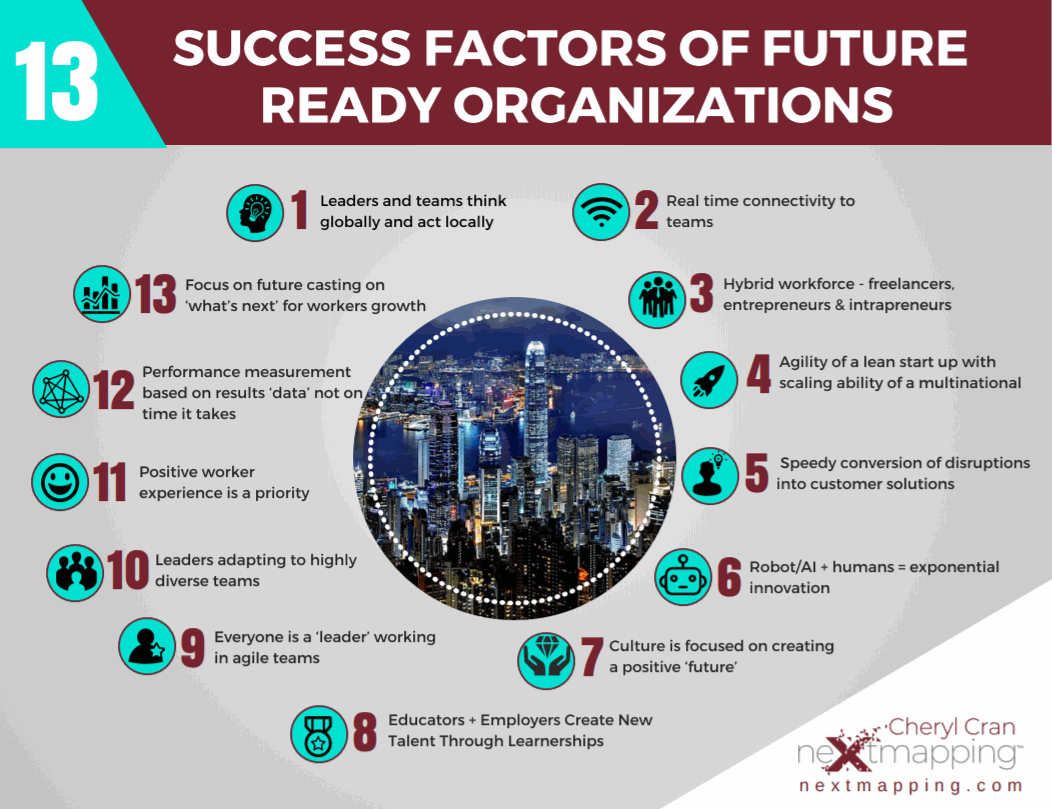
Basic sum-up is that Change Leadership Traits are:
Relational vs transactional
Focus on ‘people’ first
Highly adaptable to people
and situations
Coach approach
Creative solutions
Future focused
Transparent
Empowering
In short, any talk that thinks having a clip from “In Good Company” is a good idea for teaching agile thinking is problematic.
“Storytelling: The Forgotten Change Management Tool ” by Keith Houser
Storytelling is one of the critical jobs of a quality professional, and this was a great presentation. Another flip session with pre-work that a lot of folks didn’t do.
This was marked basic. And unlike a lot of stuff marked intermediate this felt like truly a best practice, pushing the envelope in many ways. Sure I apply these principles, but the discipline here is impressive.
I didn’t make it to the key note. I had a work conference
call so I will never learn the quality secrets of Anheuser-Busch.
“A Fresh Approach to Risk Assessment & FMEA: It’s all
about severity” by Beverly Daniels.
After yesterday’s Quality 4.0 session I was not going to miss this as the presenter has a blunt, to the point attitutde, that could be interesting and fun to watch.
Very R&R driven mindset, which is a little far away for me but one I find fascinating. Her approach is to get rid of probability and detection on an FMEA. How does she do that?
Create a function diagram and process maps as applicable
Create an input:output matrix
List functions
List failure modes: how a failure presents itself
List the effects of the failure modes
Determine severity of the failure modes at the local level and system level
Develop V&V, mitigation and control plans for all high severity failures.
Which means she’s just not using the risk assessment as a consolidation of decisions (hopefully using some other form of matrix) and always uses testing data for occurrence.
The speaker made the point about static FMEA’s a lot, I’m a big fan of living risk assessments, and I think that is an approach that needs more attention.
Some interesting ideas on probability and testing here, but buried under some strong rhetoric. Luckily she posted a longer write-up which I’ll need to consider more.
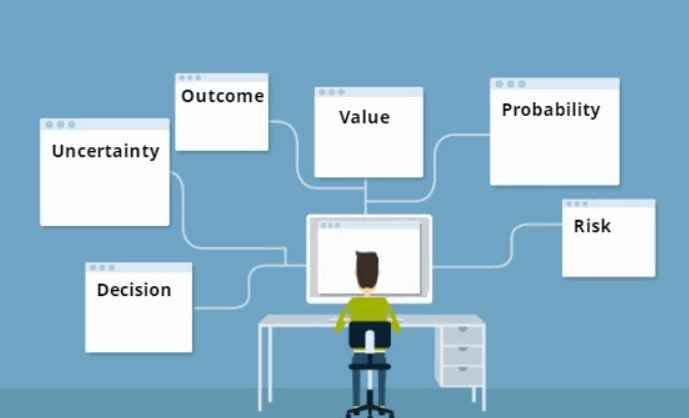
“Using Decision Analysis to Improve, Make or Break Decisions” by Kurt Stuke
Someday I’ll write-up more on why I find long credential porn intros annoying. My favorite intro is “Jeremiah Genest works for Sanofi and has 20 years of experience in quality.” Post my damn CV if you want, but seriously my words, my presentation and my references should speak for themselves.
I like the flip sessions, prepping prior is always good. The conference needs to do a better job letting people know about the prep work. The amount of confusion in this session was telling. The app does not even link to the prep work, only way is an email.
There is no 100% tool, glad he stresses that at the beginning, as we sometimes forget to do that in the profession.
“Whim leads to advocacy approach which means data looses its voice.”
Used KT as a way for decision analysis. Talking about the “must haves” and “nice-to-haves” Maybe it’s because of the proprietary nature of KT, but I feel their methodology is either someone folks are really familiar with or surprised by.
So this is again basic stuff. I’m not sure if this is what I am deciding to go to or if just where I am in my journey. At my table I was the only one really familiar with these tools.
Good presenter. Love the workshop approach. It was great watching and participating with my table-mates and seeing lightbulbs go off. However, this is a basic workshop and not intermediate.
Leading Teams: Conflict for Innovation and Change” by Carolann Wolfgang, Marilyn Monda and Lukas Cap.
The Human Development and Leadership Division is one of those divisions that I don’t get. Not because I disagree with the content, it’s just I don’t get what makes it different from the Quality Management or Team Excellence Divisions. This presentation by three of the member leaders didn’t make that any easier.
This workshop was an attempt to blend a few concepts, such as powerful questions, human explorers and curiosity types together and build a tool kit for team excellence. As such it wore its source material on it’s sleeves and skipped a few spots. A few specific observations:
The powerful questions are good
Why does this [point] matter to you?
What outcome would make it a success for you?
Is the way you think about the conflict useful, realistic or accurate?
What events or choices led to this conflict?
What other courses of action can you think of?
What if this obstacle was removed?
What is behind that thought, resistance or idea?
What are the priorities right now, in this conflict?
Using the Five Dimensions of Curiosity is very interesting. I think it can benefit from more thought on problems and how different curiosities lend themselves to different types of problems.
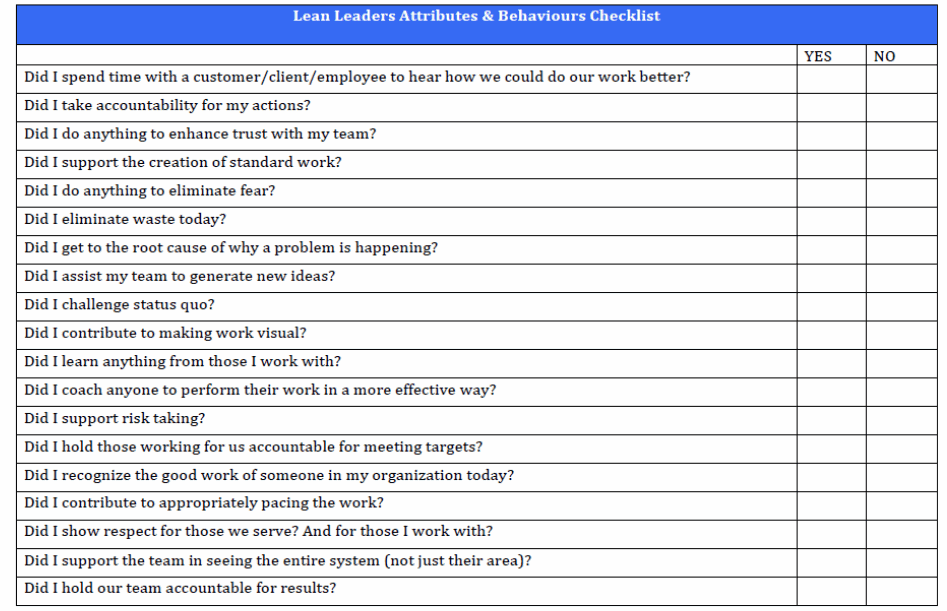
“System Transformation – Your role as a Lean Leader” by Erin Christiaens and Jaret Moch.
Super high level review of lean transformations and lean leadership. I find these workshops valuable to check-in against and hear what people are saying. Plus the rest of the 3 pm workshops didn’t engage me.
Focused almost exclusively on lean leadership standard work. Gave a few nice templates, and I do like workshops that give templates.
It is fascinating to hear people on different levels of the lean journey, or frankly any quality culture transformation. It is one of my favorite parts of attending conferences.
Provided by Lead2Lean Solutions
Afternoon Keynote – Tricia Wang
Praising statistical analysis at a quality conference is a good crowd pleaser. Way to bond with the audience.
My day 2 at WCQI is Day 1 of the conference proper. I’m going to try to live blog.
Morning keynote
Today’s morning keynote is the same futurist as at the LSS in Phoenix last month, Patrick Schwerdtfeger, and not only was I dismayed that it was they exact same I was reminded yet again how much I dislike futurists. I’m all about thinking of the future, but futurists seem to be particularly bad at it. It is all woowoo and bro-slapping and never ever a serious consideration of the impact of technology. Futurists are grifters.
These grifters profit by obscuring facts for personal gain.
They are working an angle, all of them: the health gurus and the life hackers
peddling easy solutions to difficult problems, the futurists who basically
state current trends as revelations. They are all trying to pull off the ultimate
con – persuading people they really matter.
They are selling themselves: their books, their podcasts,
their websites, their supplements, their claims to some secret knowledge about
how the world works. But I fundamentally doubt that anyone who gave 40 talks in
the last year has the bandwidth to do anything that really matters. It is all
snake-oil. And as quality professionals, individuals who are dedicated to
process and transparency and continuous improvement, we deserve better.
I’m not sure how these keynotes are selected but I think we
need to holistically view just what we want to be as a society and the pillars
we want for our conferences.
Anyone know a good article that evaluates futurists and life
hackers with the prosperity gospel? Seem like they are coming from a similar
place in the American psyche.
Ooh, artificial intelligence. Don’t get me wrong there is
real potential (maybe not the potential people feel like there is) but most
discussions on artificial intelligence is hype and bluster, and this
presentation is no different. Autonomous vehicles block chains. Hype and
bluster.
There is definitely people thinking this seriously, offering real insights and tools. We’re just not there. The speaker admits he gets 90% of his income from speaking. Pretty sure he isn’t actually doing that much. He might be an aggregator (as most of his slides with real content were attributed) but I keep struggling to see value here.
Gratuitous Steve Jobs picture.
After this there is some white space for vendor stuff.
At least I could multi-task and did some work.
Quality 4.0 Talks
I didn’t attend many of these last year because they were all standing and had a thrown together feeling. This year the ASQ seems to have upped the game. Shorter sessions can be good if the presentation is tight. At 15 minutes that is a hard bar to set.
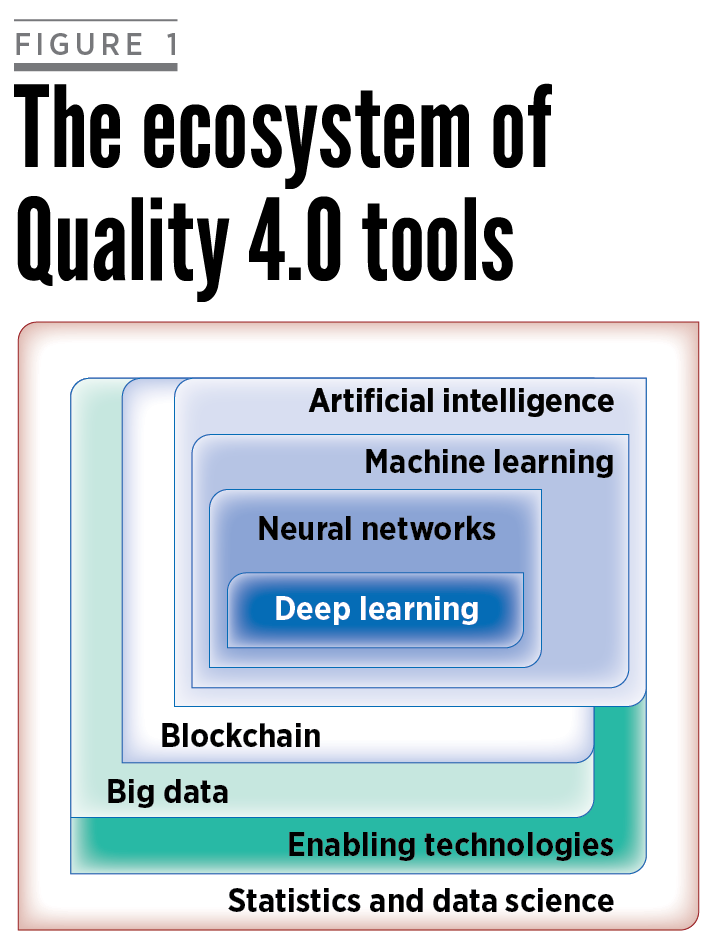
First up we have Nicole Radziwill on “Mapping Quality Problems to Machine Learning Solutions” Nicole’s very active in the software section, which under the new membership model I’ll start paying a lot more attention to.
In this short presentation Nicole focuses on hitting the points of her 2018 Quality Progress article. Talking about quality 4.0’s path from Taylorism as “discovery & learning.”
Hit on big data hubris and the importance of statistics and analysis. The importance of defining models before we use them.
From ” Let’s Get Digital” in Quality Progress
Covers machine learning problem types at a high level.
Prediction
Classification
Pattern Identification (Clustering)
Data Reduction
Anomaly Detection
Pathfinding
High level recommendations were domain expertise, statistical expertise, data quality and human bias.
Next up is Beverly Daniels on “Risk and Industry 4.0”
It is telling that so many of the talkers make Millennial jokes. As a Gen-Xer I am both annoyed because no one ever made Gen-Xer jokes (the boomers never even noticed we were at the conference) AND frustrated because this is something telling about the graying of the ASQ.
Quick review of risk as more than probability. Hit on human beings as eternally optimistic and thus horrible at determining probability. As this was a quick talk it left more questions than answers. Getting rid of probability from risk is something I need to think about more, but her points are aligned to my thoughts on uncertainty.
Focusing on impact and mitigation is interesting. I liked the line “All it does is make your management feel good about not making a decision.”
Thoughts from the pre-day at ASQ World Conference of Quality Improvement. May become a more meaty post.
Food, Drug and Cosmetic Division (FDC)
What separates this division for the biomedical division? The commonalities between food, drug, cosmetics and medical devices are more pronounced in the US with the common regulatory responsibilities. But I have trouble seeing the cosmetics industry more closely aligned to me than a medical device.
I think there is more commonality between cosmetics and type 1 and drugs and type 3 than there is often between drug and cosmetics. Though the drug to cosmetic or drug to food is a slippery slope.
The type of conferences the FDC division attends tend to be more focused on nutrients and OTC then cutting edge bio it feels like.
I’d love to see a SWOT, force-field analysis and definitely an X-matrix as they discuss strategic plan.
Yep, ASQ is not getting technology. Oh dear, I feel what they really want is a stack exchange (ASQ should totally have licensed stack exchange instead of whatever is powering my.ASQ)
Love to understand the decrease in CPGP. I think there is a a value statement the ASQ has failed to make.
Would like to learn more about the new CHA BoK. Will it recognize the greater value of the tool outside of food industry? Can it do that without weakening the BoK’s value for the food industry?
Still no training for the CPGP. Still volunteering and hoping to get called on. Part of forming that value statement will need to be good training.
Maybe I should be glad my attempts to volunteer this year never went anywhere. Lots of talk on expense reports and I am super bad at expense reports.
Pins. Between badges and ribbons and pins I feel like I am back in the boy scouts.
Business Meeting
Still not feeling the commitment to transparency that should be at the heart of a quality organization

 Investigations of a Dog