Review of Process/Procedure

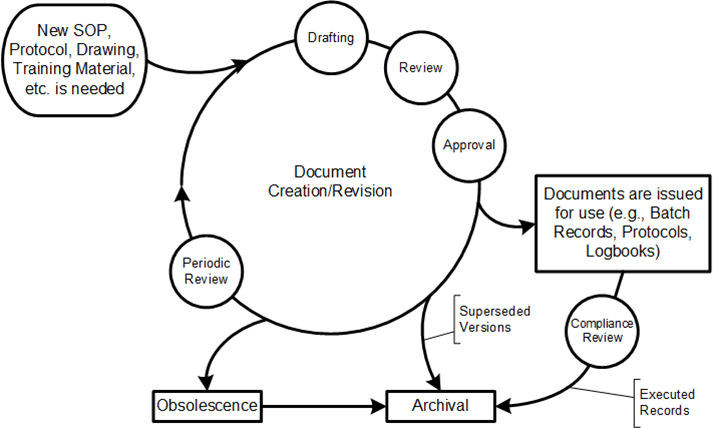
Review of documents are a critical part of the document management lifecycle.
Document Lifecycle

In the post Process/Procedure Lifecycle there are some fundamental stakeholders:

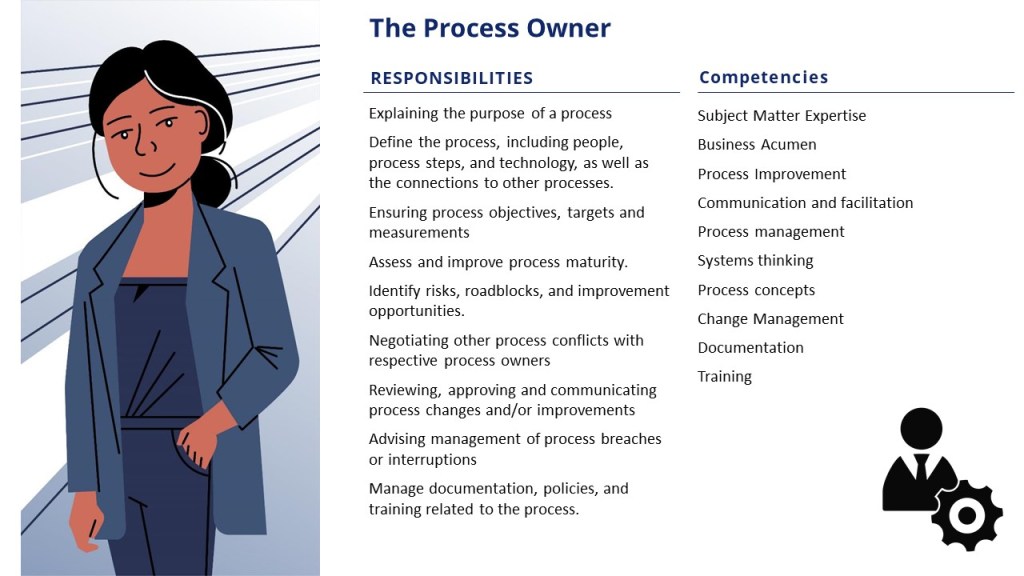
  • The Process Owner defines the process, including people, process steps, and technology, as well as the connections to other processes. They are accountable for change management, training, monitoring and control of the process and supporting procedure. The Process Owners owns the continuous improvement of the overall process.
  • Quality is ultimately responsible for the decisions made and that they align, at a minimum, with all regulatory requirements and internal standards.
  • Functional Area Management represents the areas that have responsibilities in the process and has a vested interest or concern in the ongoing performance of a process. This can include stakeholders who are process owners in upstream or downstream processes.
  • A Subject Matter Expert (SME) is typically an expert on a narrow division of a process, such as a specific tool, system, or set of process steps. A process may have multiple subject matter experts associated with it, each with varying degrees of understanding of the over-arching process.

A Risk Based Approach

The level of review of a new or revised process/procedure is guided by three fundamental risk questions:

  • What might go wrong with the associated process? (risk identification)
  • What is the likelihood that this will go wrong? (risk analysis)
  • What are the consequences? How severe are they if this goes wrong? (risk analysis)

Conducting risk identification is real about understanding how complicated and complex the associated process is. This looks at the following criteria:

  • Interconnectedness: the organization and interaction of system components and other processes
  • Repeatability: the amount of variance in the process
  • Information content: the amount of information needed to interact with the process

What Happens During a Review of Process and Procedure

The review of a process/procedure ensures that the proposed changes add value to the process and attain the outcome the organization wants. There are three levels of review (which can and often do happen simultaneously):

  • Functional review
  • Expert review by subject matter experts
  • Step-by-step real-world challenge

Functional review is the vetting of the process/procedure. Process stakeholders, including functional area management affected by the change has the opportunity to review the draft, suggest changes and agree to move forward.

Functional review supplies the lowest degree of assurance. This review looks for potential impact of the change on the function – usually focused on responsibilities – but does not necessarily assures a critical review.

In the case of expert review, the SMEs will review the draft for both positive and negative elements. On the positive side, they will look for the best practices, value-adding steps, flexibility in light of changing demands, scalability in light of changing output targets, etc. On the negative side, they will look for bottlenecks in the process, duplication of effort, unnecessary tasks, non-value-adding steps, role ambiguities (i.e. several positions responsible for a task, or no one responsible for a task), etc.

Expert review provides a higher degree of assurance because it is a compilation of expert opinion and it is focused on the technical content of the procedure.

The real-world challenge tests the process/procedure’s applicability by challenging it step-by-step in as much as possible the actual conditions of use. Tis involves selecting seasoned employee(s) within the scope of the draft procedure – not necessarily a SME – and comparing the steps as drafted with the actual activities. It is important to ascertain if they align. It is equally important to consider evidence of resistance, repetition and human factor problems.

Sometimes it can be more appropriate to do the real-world test as a tabletop or simulation exercise.

As sufficient reviews are obtained, the comments received are incorporated, as appropriate. Significant changes incorporated during the review process may require the procedure be re-routed for review, and may require the need to add additional reviews.

Repeat as a iterative process as necessary.

Design lifecycle

The process/procedure lifecycle can be seen as the iterative design lifecycle.

Design Thinking: Determine process needs.

  • Collect and document business requirements
  • Map current-state processes.
  • Observe and interview process workers.
  • Design process to-be.

Startup: Create process documentation, workflows, and support materials. Review and described above

Continuous Improvement: Use the process; Collect, analyze, and report; Improve

GxP New Hire Orientation

Leveraging the company’s new employee orientation program can help both compliance and quality by ensuring that a new hire (or transfer) understands the expectations for employee performance which:

  • Are covered by the GxP regulations, corporate policies and process/procedure
  • Are written and readily available to employees
  • Are mandatory

In a heavily regulated industry, like pharmaceuticals, this is especially important because an individual may not have experienced such regulation in their former position. Even within a regulated organization the level of regulatory experience will change as you move from one area to the next.

The new hire orientation process is not a once-and-done and should be long enough to truly make an impact on the individual’s performance.

This new hire program is seeing to engage new hires more rapidly within the quality culture to ensure that employee’s behavior aligns more rapidly with quality culture.

For example, the new hire orientation should reinforce that a pharmaceutical company is a regulated environment, responsible for products that can directly affect customers’ health and quality of life. Product failure could result in death or sickness. Working for an organization where products help preserve and sustain life comes with the responsibility to know one’s job and perform it correctly at all time.

New hire orientation must present the organization’s cultural imperative for quality – why is it important to fulfill the organization’s purpose or reason for being – and how has this been embedded into the organization’s culture. At heart new hire orientation should answer three questions:

  1. What does quality mean to you personally and how do you exhibit in the organization?
  2. What are the expectations for quality outcomes in the organization and how we judge that they have been met.
  3. How quality is embedded in the culture and daily work of the people in this organization and what represents good role model behaviors.

Content that does not immediately impact the new hire, or only impacts new hires in several departments or units, is better deferred until later training activities.

Topics that would be in that immediate review include:

  • What does it mean to work in a regulated environment
  • The role of the quality system
  • How to access process/procedure and complete training
  • Good documentation practices and data integrity (high level)
  • How to engage with regulatory stakeholders and other external partners (high level)

What other material would you cover?

Phase Appropriate GMPs

Throughout the regulations and guidances you will find something like this: “As with other aspects of the development program, documentation may be ‘less vigorous’ in early phases, but ‘they would still need to be adequate in order to allow for traceability of the manufacturing process.'”

Agencies, like the FDA, have consistently stated that phase 1 is less vigorous but starting in phase 2 you are fully GMP. These regulations are meant to ensure basic safety and documentation standards are met in the manufacture and testing of phase 1 clinical trial material and to encourage the design of quality into the process. It is expected that enhanced process controls and GMP standards will be employed as the material transitions into later clinical stages.

With the speed of development, and the fact early phase material can support commercialization, this phased in approach is an important balancing act in advanced therapeutics like cell and gene therapy.  It is crucial that manufacturers of phase 1 clinical trial material assess potential risks associated with their manufacturing process, facilities, equipment, methods, materials, etc. and the associated impact of these risks on the safety and quality of the material. All significant risks should then be mitigated, and appropriate controls implemented to reduce potential adverse impact for the patients and data generated.

Recognizing the difference between the elements of a strong quality system and what is needed for GMPs. Folks often confuse the two and have difficulties maturing quickly. The stuff in the orange? That’s system and is not GMP dependent.

Some GMP, such as clean room controls or starting materials controls should be robust from the beginning. Others, such as cleaning validation, are developed as you move through the phases.

Process Owners

Process owners are a fundamental and visible difference part of building a process oriented organizations and are crucial to striving for an effective organization. As the champion of a process, they take overall responsibility for process performance and coordinate all the interfaces in cross-functional processes.

Being a process owner should be the critical part of a person’s job, so they can shepherd the evolution of processes and to keep the organization always moving forward and prevent the reversion to less effective processes.

The Process Owner’s Role

The process owner plays a fundamental role in managing the interfaces between key processes with the objective of preventing horizontal silos and has overall responsibility of the performance of the end-to-end process, utilizing metrics to track, measure and monitor the status and drive continuous improvement initiatives. Process owners ensure that staff are adequately trained and allocated to processes. As this may result in conflicts arising between process owners, teams, and functional management it is critical that process owners exist in a wider community of practice with appropriate governance and senior leadership support.

Process owners are accountable for designing processes; day-to-day management of processes; and fostering process related learning.

Process owners must ensure that process staff are trained to have both organizational knowledge and process knowledge. To assist in staff training, processes, standards and procedures should be documented, maintained, and reviewed regularly.

Process Owners should be supported by the right infrastructure. You cannot be a SME on a end-to-end-process, provide governance and drive improvement and be expected to be a world class tech writer, training developer and technology implementer. The process owner leads and sets the direction for those activities.

The process owner sits in a central role as we build culture and drive for maturity.