Compassionate Accountability

Compassionate accountability involves maintaining a balance between showing empathy and understanding toward employees while holding them responsible for their tasks and performance. This approach fosters a supportive yet results-driven work environment.

Key Principles

Clear Expectations: Establishing clear expectations is foundational. Ensure that each team member understands their role, responsibilities, and goals. This clarity fosters a sense of direction and purpose, promoting accountability.

Compassionate Coaching: Provide frequent, low-impact coaching and feedback to help team members overcome challenges and grow. This approach allows leaders to offer support without taking away the team members’ ownership of responsibility.

Psychological Safety: Create an environment where team members feel safe taking risks, admitting mistakes, and learning from them. This fosters a culture of trust and collaboration, ultimately leading to better business outcomes.

Empathy and Understanding: Understand each team member’s unique needs, challenges, and aspirations. Use one-on-one meetings to build rapport and tailor your management approach to accommodate individual differences.

Constructive Feedback: Provide feedback constructively, focusing on growth rather than blame. This promotes a learning mindset and helps employees see mistakes as opportunities for development.

Lead by Example: Demonstrate the values and behaviors you expect from your team. In your actions, model compassion and accountability, showing that these qualities are not mutually exclusive but complementary.

    Practical Strategies

    Setting Clear Expectations

    • Communicate Goals and Roles: Clearly communicate goals, roles, and responsibilities to prevent misunderstandings and ensure that everyone knows what is expected of them.
    • Transparent Communication: Be transparent about the challenges and obstacles the team might face. Work together to brainstorm solutions and anticipate challenges.

    Providing Support and Feedback

    • Regular Check-ins: Conduct regular check-ins to understand your team members’ challenges and provide timely feedback. This helps in addressing issues before they escalate.
    • Celebrate Efforts and Results: Recognize and celebrate both efforts and results. This helps maintain motivation and reinforce positive behaviors.

    Fostering a Collaborative Environment

    • Encourage Collaboration: Foster a culture of collaboration and support among team members. Encourage them to help each other and share knowledge.
    • Joint Accountability: Create an environment of joint accountability where team members can rely on each other for help and show care for one another instead of blaming.

    Balancing Compassion and Accountability

    • Empathy as a Foundation: Use empathy to understand your team’s strengths and guide them toward growth. Empathy helps build trust and makes difficult conversations easier.
    • Accountability with Compassion: Hold team members accountable in a way that demonstrates care and support. This involves being honest about performance issues while providing the necessary support to overcome them.

    Continuous Improvement

    • Reflect and Adapt: Continuously reflect on your approach’s outcomes and adapt as necessary. Seek feedback from your team and be open to making changes that enhance compassion and accountability.
    Critical and Analytical Thinking

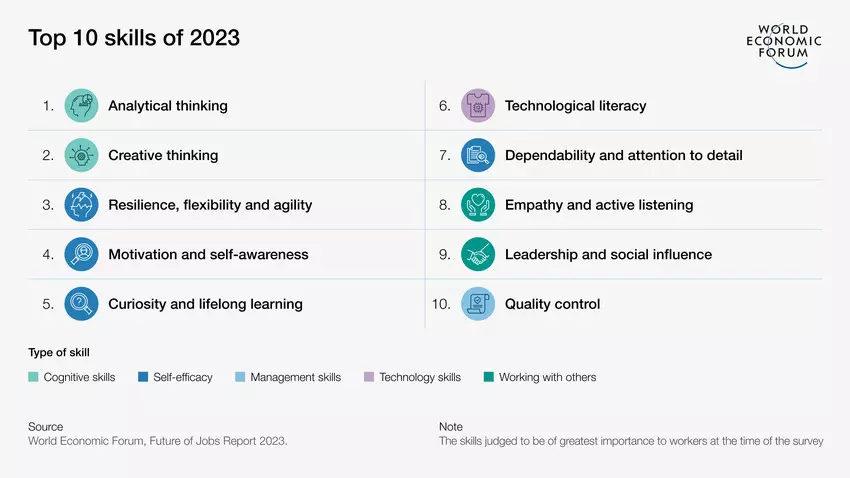
    According to the World Economic Forum’s Future of Jobs Report 2023, analytical and critical thinking are the 1st and 2nd most needed job skills (Quality Control is ).

    Analytical and critical thinking are two distinct cognitive processes often used interchangeably but have unique characteristics and purposes. Understanding the differences is essential as we hire and develop people.

    Analytical Thinking

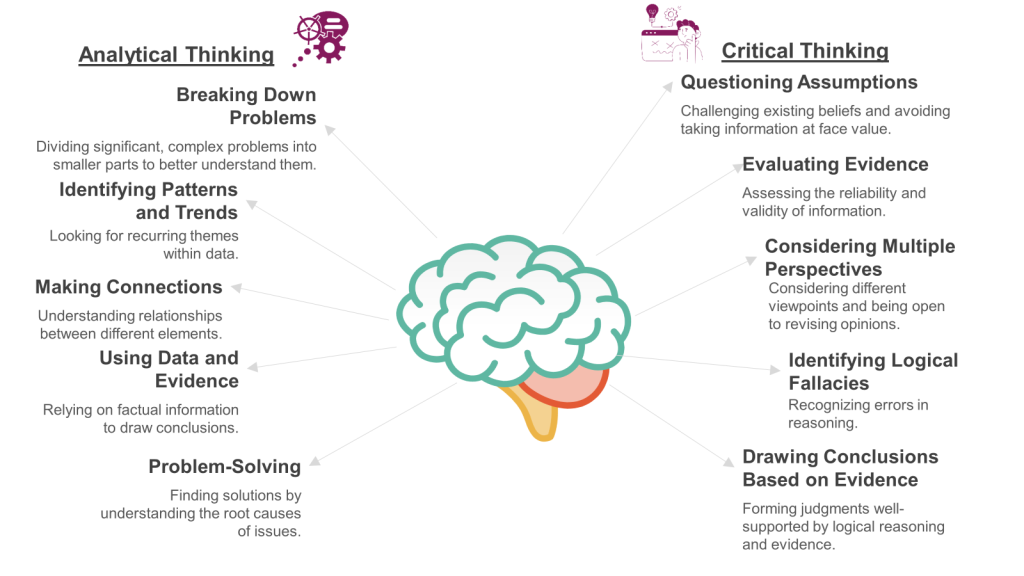
    Analytical thinking involves separating complex information into smaller, more manageable parts to understand the underlying structure and relationships. It is a linear, step-by-step process that examines each component individually to identify patterns, trends, and cause-and-effect relationships. The goal is to draw logical conclusions based on the available data.

    Key Aspects of Analytical Thinking:

    • Breaking Down Problems: Dividing significant, complex problems into smaller parts to better understand them.
    • Identifying Patterns and Trends: Looking for recurring themes within data.
    • Making Connections: Understanding relationships between different elements.
    • Using Data and Evidence: Relying on factual information to draw conclusions.
    • Problem-Solving: Finding solutions by understanding the root causes of issues.

    Steps in Analytical Thinking:

    1. Gathering Relevant Information: Collecting all necessary data.
    2. Breaking Down Data: Dividing information into smaller, manageable parts.
    3. Examining Components: Analyzing each part to understand its role and relationship to the whole.
    4. Identifying Patterns: Looking for trends and cause-and-effect relationships.
    5. Drawing Conclusions: Making logical deductions based on the analysis.

    Critical Thinking

    On the other hand, critical thinking is a broader cognitive process that involves evaluating information and making judgments based on evidence. It is more holistic and reflective, considering the context, assumptions, and biases behind the information. Critical thinking aims to form well-reasoned judgments and decisions by synthesizing, evaluating, and reflecting on information from various sources.

    Key Aspects of Critical Thinking:

    • Questioning Assumptions: Challenging existing beliefs and avoiding taking information at face value.
    • Evaluating Evidence: Assessing the reliability and validity of information.
    • Considering Multiple Perspectives: Considering different viewpoints and being open to revising opinions.
    • Identifying Logical Fallacies: Recognizing errors in reasoning.
    • Drawing Conclusions Based on Evidence: Forming judgments well-supported by logical reasoning and evidence.

    Steps in Critical Thinking:

    1. Gathering Relevant Information: Collecting all necessary data.
    2. Evaluating Information: Assessing the credibility and relevance of the information.
    3. Asking Questions: Probing more profoundly into the information to uncover hidden biases or unsupported claims.
    4. Formulating Ideas: Developing theories and ideas based on the evaluation.
    5. Considering Alternatives: Exploring different possibilities before reaching a conclusion.
    6. Testing Conclusions: Verifying if the evidence supports the conclusions.

    Differences Between Analytical and Critical Thinking

    Approach:

    • Analytical Thinking: Linear and focused, breaking down problems into smaller components.
    • Critical Thinking: Holistic and reflective, evaluating the credibility and relevance of information.

    Goal:

    • Analytical Thinking: Understand principles and identify patterns.
    • Critical Thinking: Evaluate credibility, question assumptions, and make informed decisions.

    Outcome:

    • Analytical Thinking: Logical conclusions based on data.
    • Critical Thinking: Well-reasoned judgments and decisions based on a comprehensive evaluation of information.

    While both analytical and critical thinking are essential for effective problem-solving and decision-making, they serve different purposes and involve distinct processes. Analytical thinking focuses on breaking down information to understand its components, whereas critical thinking involves evaluating and synthesizing information to form well-reasoned judgments. Integrating both types of thinking can lead to more robust and informed decision-making.

    Here is a table comparing analytical thinking and critical thinking based on the provided information:

    AspectAnalytical ThinkingCritical Thinking
    DefinitionBreaking down complex information into smaller parts to understand its structure.Evaluating information and making judgments based on evidence and reasoning.
    ApproachLinear, step-by-step process.Holistic, reflective, and considers multiple perspectives.
    GoalUnderstand principles, identify patterns, and find connections.Form well-reasoned judgments and decisions.
    Process– Gather relevant information
    – Break down data
    – Examine components
    – Identify patterns
    – Draw conclusions
    – Gather relevant information
    – Evaluate information
    – Ask questions
    – Formulate ideas
    – Consider alternatives
    – Test conclusions
    FocusFacts and evidence within the information.Evaluating credibility, questioning assumptions, and considering outside knowledge.
    OutcomeLogical conclusions based on data.Well-reasoned judgments and decisions.
    Use in Problem-SolvingUsed to break down and understand complex problems.Used to evaluate and make informed decisions about problems.
    Examples of UseAnalyzing reports and scientific data analysis.Evaluating arguments and making decisions.
    Traits– Logical
    – Detail-oriented
    – Systematic
    – Open-minded
    – Skeptical
    – Reflective
    key differences and characteristics of analytical and critical thinking

    Section 711 of FDASIA and Regulatory Obligations

    Too often, I see folks in pharma focus on 21 CFR Chapter 1, or at best all three chapters, maybe know the guidances and pay attention to little else. Unfortunately, that approach will often get one in trouble.

    Section 711 of the Food and Drug Administration Safety and Innovation Act (FDASIA) amended the Federal Food, Drug, and Cosmetic Act (FD&C Act) to enhance the safety and quality of the drug supply chain. Specifically Section 711 amends Section 501(a)(2)(B) of the FD&C Act by adding the following sentence:

    “For purposes of paragraph (a)(2)(B), the term ‘current good manufacturing practice’ includes the implementation of oversight and controls over the manufacture of drugs to ensure quality, including managing the risk of and establishing the safety of raw materials, materials used in the manufacturing of drugs, and finished drug products.”

    This amendment clarifies that current good manufacturing practice (CGMP) requirements for drugs include:

    1. Implementing oversight and controls over the entire manufacturing process to ensure quality.
    2. Managing the risks related to raw materials, other materials used in manufacturing, and finished drug products to establish their safety.

    In essence, Section 711 expands the FDA’s CGMP authority to explicitly cover supply chain management and drug manufacturers’ oversight of their suppliers and contract manufacturing operations. It also allows the FDA to enforce supply chain control requirements during inspections.

    The legislative history shows that Congress intended to significantly expand the FDA’s authority over the increasingly global drug supply chain through this provision. It allows the FDA to scrutinize how manufacturers select, qualify, and oversee suppliers of raw materials and contract manufacturers to ensure drug quality and safety.

    Please note that the FDA gets this expanded authority without revising 21CFR. That’s how it works; Congress can do that. Will we eventually see some 21 CFR updates? I have no idea.

    But what this does mean is that the FDA has the authority to:

    1. Inspect risk management for GMPs, and assume you have it. What does good risk management look like? The agency has adopted ICH Q9(r1) as guidance, so start there.
    2. Inspect your supplier management, which includes qualifying and overseeing suppliers and contract manufacturers.

    I’ve started to receive regulatory intelligence that this is coming up in inspections. Expect to be asked for the risk management evidence and for supplier qualification and oversight evidence.

    Aging in the Workforce – or Why All Those Years Matter

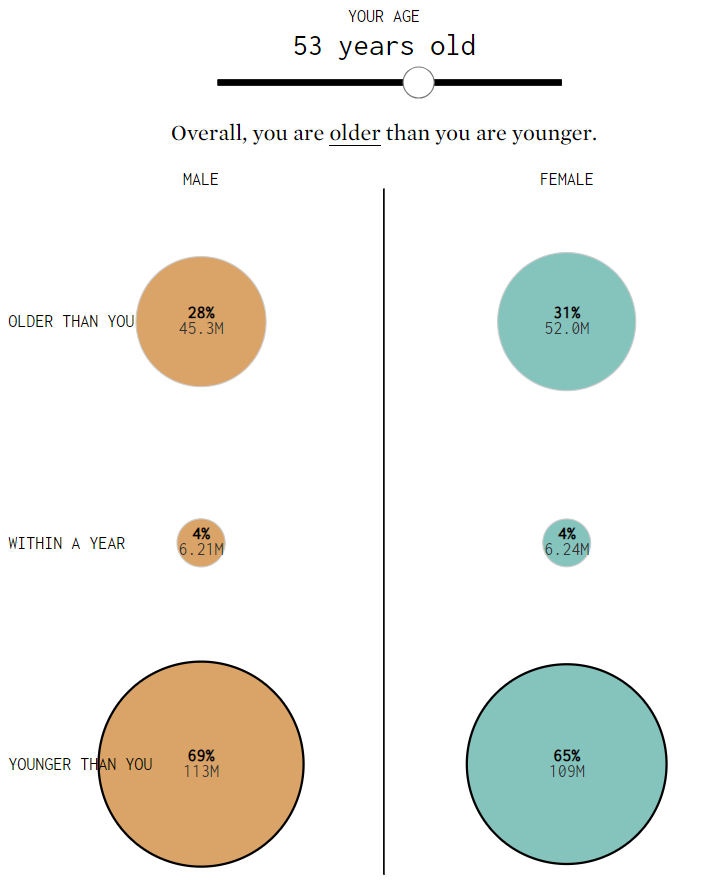
    Source: https://flowingdata.com/2024/06/18/older-or-younger-than-the-population/

    Wow, I’m older than a lot of people. When did that happen? (Shout out to my small cohort of fellow Gen-Xers!) So, in a bit of reflection, I want to discuss why I think aging in the quality profession is so critical.

    The quality profession is an experience-heavy field. While formal education can provide some necessary theoretical knowledge, the practical skills required for the quality profession can only be mastered through extensive hands-on experience, practical application of skills, and the ability to adapt to real-world challenges.

    Key characteristics

    1. Direct Experience: Students participate in activities that require them to apply what they have learned in a practical setting. An old adage is that you must do a job for three years before understanding it. However, you must keep going through the iterations since quality comprises multiple jobs. For example, my progress from deviation reviewer to eQMS implementation, to computer systems quality, to risk champion, to quality engineering, to change management process owner, to computer system implementor, to technology implementor, to validation quality, to operational excellence, to quality systems leader, to validation leader (and I am leaving a lot out). Layering and layering real experience again and again.
    2. Reflection: Reflection is a critical component of experiential learning. Most people don’t do that enough. The quality profession requires us to think about our experiences, analyze what we have learned, and consider how it applies to our work. Audits and inspections are interesting tools that can drive reflection when approached correctly.
    3. Active Participation: Quality professionals must be active agents in their learning process. They take initiative, make decisions, and are responsible for the outcomes of their actions. This active engagement helps to deepen their learning and develop critical thinking skills.
    4. Community Engagement: I joke about being able to tell what company some spent their formative years in. And that is not a good thing. Quality professionals need to seek out collaboration with the wider community members, often through professional organizations.
    5. Integration of Knowledge and Practice: Experiential fields bridge the gap between theoretical knowledge and practical application. Quality professionals must integrate what they have studied with real-world experiences, enhancing their understanding and retention of the material. And then do it again.

    The quality profession is a dynamic and interactive learning environment emphasizing learning by doing, reflecting, and applying knowledge in real-world contexts.