I think it is unfortunate that two of the world’s most influential regulatory agencies, the U.S. Food and Drug Administration (FDA) and the European Medicines Agency (EMA), have taken markedly different approaches to transparency in sharing Good Manufacturing Practice (GMP) observations and non-compliance information with the public.
The Foundation of Regulatory Transparency
FDA’s Transparency Initiative
The FDA’s commitment to transparency traces back to the Freedom of Information Act (FOIA) of 1966, which required federal agencies to provide information to the public upon request. However, the agency’s proactive transparency efforts gained significant momentum under President Obama’s Open Government Initiative. In June 2009, FDA Commissioner Dr. Margaret Hamburg launched the FDA’s Transparency Initiative, creating new webpages, establishing FDA-TRACK performance monitoring system, and proposing steps to provide greater public understanding of FDA decision-making.
EMA’s Evolution Toward Transparency
The EMA’s journey toward transparency has been more gradual and complex For many years, EU inspectorates did not publish results of their inspections, unlike the FDA’s long-standing practice of making Form 483s and Warning Letters publicly accessible. This changed significantly in 2014 when the EMA launched a new version of the EudraGMDP database that included, for the first time, the publication of statements of non-compliance with Good Manufacturing Practice.
The EMA’s approach to transparency reflects its commitment to transparency, efficiency, and public health protection through structured partnerships with agencies worldwide 1. However, the agency’s transparency policy has faced criticism for being “marred by too many failings,” particularly regarding pharmaceutical companies’ ability to redact clinical study reports.
FDA’s Comprehensive Data Infrastructure
The FDA operates several interconnected systems for sharing inspection and compliance information:
Form 483 Database and Public Access The FDA maintains extensive databases for Form 483 inspectional observations, which are publicly accessible through multiple channels. The agency’s Office of Inspections and Investigations provides spreadsheets summarizing inspection observations by fiscal year, broken down by product areas including biologics, drugs, devices, and other categories.
FDA Data Dashboard Launched as part of the agency’s transparency initiative, the FDA Data Dashboard presents compliance, inspection, and recall data in an easy-to-read graphical format. The dashboard provides data from FY 2009 onward and allows access to information on inspections, warning letters, seizures, injunctions, and recall statistics. The system is updated semi-annually and allows users to download information, manipulate data views, and export charts for analysis.
Warning Letters and Public Documentation All FDA-issued Warning Letters are posted on FDA.gov in redacted form to permit public access without requiring formal FOIA requests. This practice has been in place for many years, with warning letters being publicly accessible under the Freedom of Information Act.
The EMA’s primary transparency tool is the EudraGMDP database, which serves as the Community database on manufacturing, import, and wholesale-distribution authorizations, along with GMP and GDP certificates. A public version of the database has been available since 2011, providing access to information that is not commercially or personally confidential.
The EudraGMDP database contains several modules including Manufacturing Import Authorisation (MIA), GMP certificates, Wholesale Distribution Authorisation (WDA), and Active Product Ingredient Registration (API REG). The database is publicly accessible without login requirements and is maintained by the EMA with data populated by EEA national competent authorities.
Non-Compliance Reporting and Publication
A significant milestone in EMA transparency occurred in 2014 when the agency began publishing statements of non-compliance with GMP . These documents contain information about the nature of non-compliance and actions taken by issuing authorities to protect public health, aiming to establish coordinated responses by EU medicines regulators.
A major difference here is that the EMA removes non-compliance statements from EudraGMDP following successful compliance restoration. The EMA’s procedures explicitly provide for post-publication modifications of non-compliance information. Following publication, the lead inspectorate authority may modify non-compliance information entered in EudraGMDP, for example, following receipt of new information, with modified statements distributed to the rapid alert distribution list.
This is unfortunate, as it requires going to a 3rd party service to find historical data on a site.
Category
FDA
EMA
Volume of Published Information
Over 25,000 Form 483s in databases
83 non-compliance reports total (2007-2020)
Annual Inspection Volume
Every 483 observation is trackable at a high level
Limited data available
Database Update Frequency
Monthly updates to inspection databases
Updates as available from member states
Dashboard Updates
Semi-annual updates
Not applicable
Historical Data Availability
Form 483s and warning letters accessible for decades under FOIA
Multiple channels: direct database access, FOIA requests
Single portal: EudraGMDP database
Data Manipulation Capabilities
Users can download, manipulate data views, export charts
Basic search and view functionality
Login Requirements
No login required for public databases
No login required for EudraGMDP
Commercial Confidentiality
Redacted information
Commercially confidential information not published
Non-Compliance Statement Removal
Form 483s remain public permanently
Statements can be removed after successful remediation
While both the FDA and EMA have made significant strides in regulatory transparency, the FDA clearly shares more information about GMP observations and non-compliance issues. The FDA’s transparency advantage stems from its longer history of public disclosure under FOIA, more comprehensive database systems, higher volume of published enforcement actions, and more frequent updates to public information.
My next post will be on the recent changes at the FDA and what that means for ongoing transparency.
Hopefully, you’ve been following my journey through the ever-changing world of validation. In that case, you’ll recognize that our field is undergoing transformation under the dual drivers of digital transformation and shifting regulatory expectations. Halfway through 2025, we have another annual report from Kneat, and it is clear that while some of those core challenges remain, companies are reporting that new priorities are emerging—driven by the rapid pace of digital adoption and evolving compliance landscapes.
Audit Readiness Overtakes Compliance Burden as Top Challenge
The 2025 validation landscape reveals a striking reversal: audit readiness has dethroned compliance burden as the industry’s primary concern , marking a fundamental shift in how organizations prioritize regulatory preparedness. While compliance burden dominated in 2024—a reflection of teams grappling with evolving standards during active projects—this year’s data signals a maturation of validation programs. As organizations transition from project execution to operational stewardship, the scramble to pass audits has given way to the imperative to sustain readiness.
Why the Shift Matters
The surge in audit readiness aligns with broader quality challenges outlined in The Challenges Ahead for Quality (2023) , where data integrity and operational resilience emerged as systemic priorities.
Table: Top Validation Challenges (2022–2025)
Rank
2022
2023
2024
2025
1
Human resources
Human resources
Compliance burden
Audit readiness
2
Efficiency
Efficiency
Audit readiness
Compliance burden
3
Technological gaps
Technological gaps
Data integrity
Data integrity
This reversal mirrors a lifecycle progression. During active validation projects, teams focus on navigating procedural requirements (compliance burden). Once operational, the emphasis shifts to sustaining inspection-ready systems—a transition fraught with gaps in metadata governance and decentralized workflows. As noted in Health of the Validation Program, organizations often discover latent weaknesses in change control or data traceability only during audits, underscoring the need for proactive systems.
Next year it could flop back, to be honest these are just two sides of the same coin.
Operational Realities Driving the Change
The 2025 report highlights two critical pain points:
Documentation traceability : 69% of teams using digital validation tools cite automated audit trails as their top benefit, yet only 13% integrate these systems with project management platform . This siloing creates last-minute scrambles to reconcile disparate records.
Experience gaps : With 42% of professionals having 6–15 years of experience, mid-career teams lack the institutional knowledge to prevent audit pitfalls—a vulnerability exacerbated by retiring senior experts .
Organizations that treated compliance as a checkbox exercise now face operational reckoning, as fragmented systems struggle to meet the FDA’s expectations for real-time data access and holistic process understanding.
Similarly, teams that relied on 1 or 2 full-time employees, and leveraged contractors, also struggle with building and retaining expertise.
Strategic Implications
To bridge this gap, forward-thinking teams continue to adopt risk-adaptive validation models that align with ICH Q10’s lifecycle approach. By embedding audit readiness into daily work organizations can transform validation from a cost center to a strategic asset. As argued in Principles-Based Compliance, this shift requires rethinking quality culture: audit preparedness is not a periodic sprint but a byproduct of robust, self-correcting systems.
In essence, audit readiness reflects validation’s evolution from a tactical compliance activity to a cornerstone of enterprise quality—a theme that will continue to dominate the profession’s agenda and reflects the need to drive for maturity.
Digital Validation Adoption Reaches Tipping Point
Digital validation systems have seen a 28% adoption increase since 2024, with 58% of organizations now using these tools . By 2025, 93% of firms either use or plan to adopt digital validation, signaling and sector-wide transformation. Early adopters report significant returns: 63% meet or exceed ROI expectations, achieving 50% faster cycle times and reduced deviations. However, integration gaps persist, as only 13% connect digital validation with project management tools, highlighting siloed workflows.
None of this should be a surprise, especially since Kneat, a provider of an electronic validation management system, sponsored the report.
Table 2: Digital Validation Adoption Metrics (2025)
Metric
Value
Organizations using digital systems
58%
ROI expectations met/exceeded
63%
Integration with project tools
13%
For me, the real challenge here, as I explored in my post “Beyond Documents: Embracing Data-Centric Thinking“, is not just settling for paper-on-glass but to start thinking of your validation data as a larger lifecycle.
Leveraging Data-Centric Thinking for Digital Validation Transformation
The shift from document-centric to data-centric validation represents a paradigm shift in how regulated industries approach compliance, as outlined in Beyond Documents: Embracing Data-Centric Thinking. This transition aligns with the 2025 State of Validation Report’s findings on digital adoption trends and addresses persistent challenges like audit readiness and workforce pressures.
The Paper-on-Glass Trap in Validation
Many organizations remain stuck in “paper-on-glass” validation models, where digital systems replicate paper-based workflows without leveraging data’s full potential. This approach perpetuates inefficiencies such as:
Manual data extraction requiring hours to reconcile disparate records
Inflated validation cycles due to rigid document structures that limit adaptive testing
Increased error rates from static protocols that cannot dynamically respond to process deviations
Principles of Data-Centric Validation
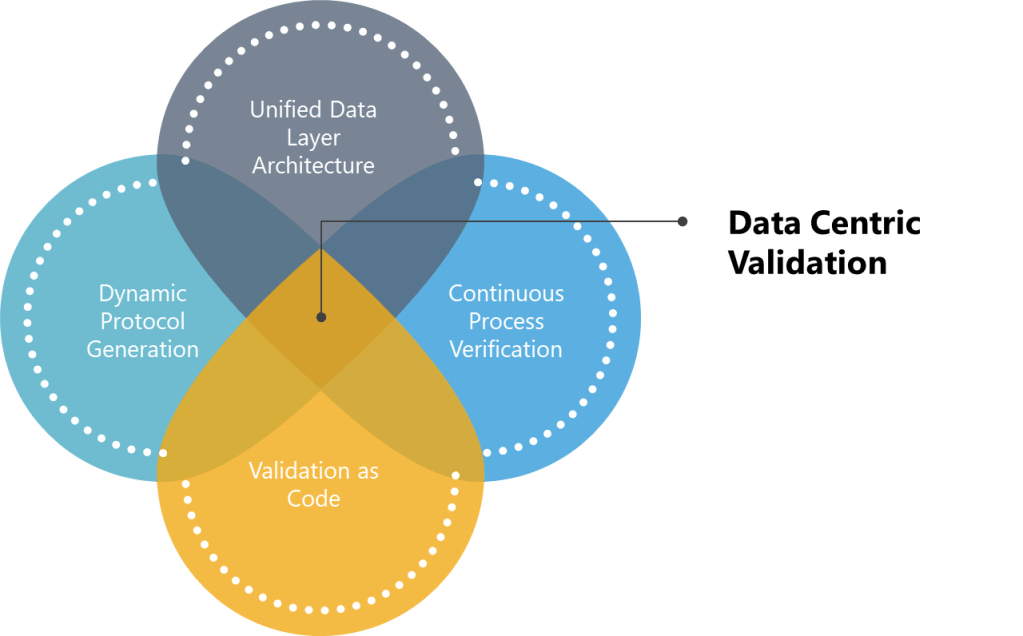
True digital transformation requires reimagining validation through four core data-centric principles:
Unified Data Layer Architecture: The adoption of unified data layer architectures marks a paradigm shift in validation practices, as highlighted in the 2025 State of Validation Report. By replacing fragmented document-centric models with centralized repositories, organizations can achieve real-time traceability and automated compliance with ALCOA++ principles. The transition to structured data objects over static PDFs directly addresses the audit readiness challenges discussed above, ensuring metadata remains enduring and available across decentralized teams.
Dynamic Protocol Generation: AI-driven dynamic protocol generation may reshape validation efficiency. By leveraging natural language processing and machine learning, the hope is to have systems analyze historical protocols and regulatory guidelines to auto-generate context-aware test scripts. However, regulatory acceptance remains a barrier—only 10% of firms integrate validation systems with AI analytics, highlighting the need for controlled pilots in low-risk scenarios before broader deployment.
Continuous Process Verification: Continuous Process Verification (CPV) has emerged as a cornerstone of the industry as IoT sensors and real-time analytics enabling proactive quality management. Unlike traditional batch-focused validation, CPV systems feed live data from manufacturing equipment into validation platforms, triggering automated discrepancy investigations when parameters exceed thresholds. By aligning with ICH Q10’s lifecycle approach, CPV transforms validation from a compliance exercise into a strategic asset.
Validation as Code: The validation-as-code movement, pioneered in semiconductor and nuclear industries, represents the next frontier in agile compliance. By representing validation requirements as machine-executable code, teams automate regression testing during system updates and enable Git-like version control for protocols. The model’s inherent auditability—with every test result linked to specific code commits—directly addresses the data integrity priorities ranked #1 by 63% of digital validation adopters.
Table 1: Document-Centric vs. Data-Centric Validation Models
Aspect
Document-Centric
Data-Centric
Primary Artifact
PDF/Word Documents
Structured Data Objects
Change Management
Manual Version Control
Git-like Branching/Merging
Audit Readiness
Weeks of Preparation
Real-Time Dashboard Access
AI Compatibility
Limited (OCR-Dependent)
Native Integration (eg, LLM Fine-Tuning)
Cross-System Traceability
Manual Matrix Maintenance
Automated API-Driven Links
Implementation Roadmap
Organizations progressing towards maturity should:
AI in Validation: Early Adoption, Strategic Potential
Artificial intelligence (AI) adoption and validation are still in the early stages, though the outlook is promising. Currently, much of the conversation around AI is driven by hype, and while there are encouraging developments, significant questions remain about the fundamental soundness and reliability of AI technologies.
In my view, AI is something to consider for the future rather than immediate implementation, as we still need to fully understand how it functions. There are substantial concerns regarding the validation of AI systems that the industry must address, especially as we approach more advanced stages of integration. Nevertheless, AI holds considerable potential, and leading-edge companies are already exploring a variety of approaches to harness its capabilities.
Workloads increased for 66% of teams in 2025, yet 39% operate with 1–3 members, exacerbating talent gaps . Mid-career professionals (42% with 6–15 years of experience) dominate the workforce, signaling a looming “experience gap” as senior experts retire. This echoes 2023 quality challenges, where turnover risks and knowledge silos threaten operational resilience. Outsourcing has become a critical strategy, with 70% of firms relying on external partners for at least 10% of validation work.
Organizations are shifting from reactive compliance to building “always-ready” systems.
From Firefighting to Future-Proofing: The Strategic Shift to “Always-Ready” Quality Systems
The industry’s transition from reactive compliance to “always-ready” systems represents a fundamental reimagining of quality management. This shift aligns with the Excellence Triad framework—efficiency, effectiveness, and elegance—introduced in my 2025 post on elegant quality systems, where elegance is defined as the seamless integration of intuitive design, sustainability, and user-centric workflows. Rather than treating compliance as a series of checkboxes to address during audits, organizations must now prioritize systems that inherently maintain readiness through proactive risk mitigation , real-time data integrity , and self-correcting workflows .
Elegance as the Catalyst for Readiness
The concept of “always-ready” systems draws heavily from the elegance principle, which emphasizes reducing friction while maintaining sophistication. .
Principles-Based Compliance and Quality
The move towards always-ready systems also reflects lessons from principles-based compliance , which prioritizes regulatory intent over prescriptive rules.
Cultural and Structural Enablers
Building always-ready systems demands more than technology—it requires a cultural shift. The 2021 post on quality culture emphasized aligning leadership behavior with quality values, a theme reinforced by the 2025 VUCA/BANI framework , which advocates for “open-book metrics” and cross-functional transparency to prevent brittleness in chaotic environments. F
Outcomes Over Obligation
Ultimately, always-ready systems transform compliance from a cost center into a strategic asset. As noted in the 2025 elegance post , organizations using risk-adaptive documentation practices and API-driven integrations report 35% fewer audit findings, proving that elegance and readiness are mutually reinforcing. This mirrors the semiconductor industry’s success with validation-as-code, where machine-readable protocols enable automated regression testing and real-time traceability.
By marrying elegance with enterprise-wide integration, organizations are not just surviving audits—they’re redefining excellence as a state of perpetual readiness, where quality is woven into the fabric of daily operations rather than bolted on during inspections.
Workforce Resilience in Lean Teams
The imperative for cross-training in digital tools and validation methodologies stems from the interconnected nature of modern quality systems, where validation professionals must act as “system gardeners” nurturing adaptive, resilient processes. This competency framework aligns with the principles outlined in Building a Competency Framework for Quality Professionals as System Gardeners, emphasizing the integration of technical proficiency, regulatory fluency, and collaborative problem-solving.
Competency: Digital Validation Cross-Training
Definition : The ability to fluidly navigate and integrate digital validation tools with traditional methodologies while maintaining compliance and fostering system-wide resilience.
Dimensions and Elements
1. Adaptive Technical Mastery
Elements :
Tool Agnosticism : Proficiency across validation platforms and core systems (eQMS, etc) with ability to map workflows between systems.
System Literacy : Competence in configuring integrations between validation tools and electronic systems, such as an MES.
CSA Implementation : Practical application of Computer Software Assurance principles and GAMP 5.
2. Regulatory-DNA Integration
Elements :
ALCOA++ Fluency : Ability to implement data integrity controls that satisfy FDA 21 CFR Part 11 and EU Annex 11.
Inspection Readiness : Implementation of inspection readiness principles
Risk-Based AI Validation : Skills to validate machine learning models per FDA 2024 AI/ML Validation Draft Guidance.
3. Cross-Functional Cultivation
Elements :
Change Control Hybridization : Ability to harmonize agile sprint workflows with ASTM E2500 and GAMP 5 change control requirements.
Knowledge Pollination : Regular rotation through manufacturing/QC roles to contextualize validation decisions.
Validation’s Role in Broader Quality Ecosystems
Data Integrity as a Strategic Asset
The axiom “we are only as good as our data” encapsulates the existential reality of regulated industries, where decisions about product safety, regulatory compliance, and process reliability hinge on the trustworthiness of information. The ALCOA++ framework— Attributable, Legible, Contemporary, Original, Accurate, Complete, Consistent, Enduring, and Available —provides the architectural blueprint for embedding data integrity into every layer of validation and quality systems. As highlighted in the 2025 State of Validation Report , organizations that treat ALCOA++ as a compliance checklist rather than a cultural imperative risk systemic vulnerabilities, while those embracing it as a strategic foundation unlock resilience and innovation.
Cultural Foundations: ALCOA++ as a Mindset, Not a Mandate
The 2025 validation landscape reveals a stark divide: organizations treating ALCOA++ as a technical requirement struggle with recurring findings, while those embedding it into their quality culture thrive. Key cultural drivers include:
Leadership Accountability : Executives who tie KPIs to data integrity metrics (eg, % of unattributed deviations) signal its strategic priority, aligning with Principles-Based Compliance.
Cross-Functional Fluency : Training validation teams in ALCOA++-aligned tools bridges the 2025 report’s noted “experience gap” among mid-career professionals .
Psychological Safety : Encouraging staff to report near-misses without fear—a theme in Health of the Validation Program —prevents data manipulation and fosters trust.
The Cost of Compromise: When Data Integrity Falters
The 2025 report underscores that 25% of organizations spend >10% of project budgets on validation—a figure that balloons when data integrity failures trigger rework. Recent FDA warning letters cite ALCOA++ breaches as root causes for:
Batch rejections due to unverified temperature logs (lack of original records).
Clinical holds from incomplete adverse event reporting (failure of Complete ).
Import bans stemming from inconsistent stability data across sites (breach of Consistent ).
Conclusion: ALCOA++ as the Linchpin of Trust
In an era where AI-driven validation and hybrid inspections redefine compliance, ALCOA++ principles remain the non-negotiable foundation. Organizations must evolve beyond treating these principles as static rules, instead embedding them into the DNA of their quality systems—as emphasized in Pillars of Good Data. When data integrity drives every decision, validation transforms from a cost center into a catalyst for innovation, ensuring that “being as good as our data” means being unquestionably reliable.
Future-Proofing Validation in 2025
The 2025 validation landscape demands a dual focus: accelerating digital/AI adoption while fortifying human expertise . Key recommendations include:
Prioritize Integration : Break down silos by connecting validation tools to data sources and analytics platforms.
Adopt Risk-Based AI : Start with low-risk AI pilots to build regulatory confidence.
Invest in Talent Pipelines : Address mid-career gaps via academic partnerships and reskilling programs.
As the industry navigates these challenges, validation will increasingly serve as a catalyst for quality innovation—transforming from a cost center to a strategic asset.

 Investigations of a Dog