The Deep Ownership Paradox: Why It Takes Years to Master What You Think You Already Know

When I encounter professionals who believe they can master a process in six months, I think of something the great systems thinker W. Edwards Deming once observed: “It is not necessary to change. Survival is not mandatory.” The professionals who survive—and more importantly, who drive genuine improvement—understand something that transcends the checkbox mentality: true ownership takes time, patience, and what some might call “stick-to-itness.”

The uncomfortable truth is that most of us confuse familiarity with mastery. We mistake the ability to execute procedures with the deep understanding required to improve them. This confusion has created a generation of professionals who move from role to role, collecting titles and experiences but never developing the profound process knowledge that enables breakthrough improvement. This is equally true on the consultant side.

The cost of this superficial approach extends far beyond individual career trajectories. When organizations lack deep process owners—people who have lived with systems long enough to understand their subtle rhythms and hidden failure modes—they create what I call “quality theater”: elaborate compliance structures that satisfy auditors but fail to serve patients, customers, or the fundamental purpose of pharmaceutical manufacturing.

The Science of Deep Ownership

Recent research in organizational psychology reveals the profound difference between surface-level knowledge and genuine psychological ownership. When employees develop true psychological ownership of their processes, something remarkable happens: they begin to exhibit behaviors that extend far beyond their job descriptions. They proactively identify risks, champion improvements, and develop the kind of intimate process knowledge that enables predictive rather than reactive management.

But here’s what the research also shows: this psychological ownership doesn’t emerge overnight. Studies examining the relationship between tenure and performance consistently demonstrate nonlinear effects. The correlation between tenure and performance actually decreases exponentially over time—but this isn’t because long-tenured employees become less effective. Instead, it reflects the reality that deep expertise follows a complex curve where initial competence gives way to periods of plateau, followed by breakthrough understanding that emerges only after years of sustained engagement.

Consider the findings from meta-analyses of over 3,600 employees across various industries. The relationship between organizational commitment and job performance shows a very strong nonlinear moderating effect based on tenure. The implications are profound: the value of process ownership isn’t linear, and the greatest insights often emerge after years of what might appear to be steady-state performance.

This aligns with what quality professionals intuitively know but rarely discuss: the most devastating process failures often emerge from interactions and edge cases that only become visible after sustained observation. The process owner who has lived through multiple product campaigns, seasonal variations, and equipment lifecycle transitions develops pattern recognition that cannot be captured in procedures or training materials.

The 10,000 Hour Reality in Quality Systems

Malcolm Gladwell’s popularization of the 10,000-hour rule has been both blessing and curse for understanding expertise development. While recent research has shown that deliberate practice accounts for only 18-26% of skill variation—meaning other factors like timing, genetics, and learning environment matter significantly—the core insight remains valid: mastery requires sustained, focused engagement over years, not months.

But the pharmaceutical quality context adds layers of complexity that make the expertise timeline even more demanding. Unlike chess players or musicians who can practice their craft continuously, quality professionals must develop expertise within regulatory frameworks that change, across technologies that evolve, and through organizational transitions that reset context. The “hours” of meaningful practice are often interrupted by compliance activities, reorganizations, and role changes that fragment the learning experience.

More importantly, quality expertise isn’t just about individual skill development—it’s about understanding systems. Deming’s System of Profound Knowledge emphasizes that effective quality management requires appreciation for a system, knowledge about variation, theory of knowledge, and psychology. This multidimensional expertise cannot be compressed into abbreviated timelines, regardless of individual capability or organizational urgency.

The research on mastery learning provides additional insight. True mastery-based approaches require that students achieve deep understanding at each level before progressing to the next. In quality systems, this means that process owners must genuinely understand the current state of their processes—including their failure modes, sources of variation, and improvement potential—before they can effectively drive transformation.

The Hidden Complexity of Process Ownership

Many of our organizations struggle with “iceberg phenomenon”: the visible aspects of process ownership—procedure compliance, metric reporting, incident response—represent only a small fraction of the role’s true complexity and value.

Effective process owners develop several types of knowledge that accumulate over time:

  • Tacit Process Knowledge: Understanding the subtle indicators that precede process upsets, the informal workarounds that maintain operations, and the human factors that influence process performance. This knowledge emerges through repeated exposure to process variations and cannot be documented or transferred through training.
  • Systemic Understanding: Comprehending how their process interacts with upstream and downstream activities, how changes in one area create ripple effects throughout the system, and how to navigate the political and technical constraints that shape improvement opportunities. This requires exposure to multiple improvement cycles and organizational changes.
  • Regulatory Intelligence: Developing nuanced understanding of how regulatory expectations apply to their specific context, how to interpret evolving guidance, and how to balance compliance requirements with operational realities. This expertise emerges through regulatory interactions, inspection experiences, and industry evolution.
  • Change Leadership Capability: Building the credibility, relationships, and communication skills necessary to drive improvement in complex organizational environments. This requires sustained engagement with stakeholders, demonstrated success in previous initiatives, and deep understanding of organizational dynamics.

Each of these knowledge domains requires years to develop, and they interact synergistically. The process owner who has lived through equipment upgrades, regulatory inspections, organizational changes, and improvement initiatives develops a form of professional judgment that cannot be replicated through rotation or abbreviated assignments.

The Deming Connection: Systems Thinking Requires Time

Deming’s philosophy of continuous improvement provides a crucial framework for understanding why process ownership requires sustained engagement. His approach to quality was holistic, emphasizing systems thinking and long-term perspective over quick fixes and individual blame.

Consider Deming’s first point: “Create constancy of purpose toward improvement of product and service.” This isn’t about maintaining consistency in procedures—it’s about developing the deep understanding necessary to identify genuine improvement opportunities rather than cosmetic changes that satisfy short-term pressures.

The PDCA cycle that underlies Deming’s approach explicitly requires iterative learning over multiple cycles. Each cycle builds on previous learning, and the most valuable insights often emerge after several iterations when patterns become visible and root causes become clear. Process owners who remain with their systems long enough to complete multiple cycles develop qualitatively different understanding than those who implement single improvements and move on.

Deming’s emphasis on driving out fear also connects to the tenure question. Organizations that constantly rotate process owners signal that deep expertise isn’t valued, creating environments where people focus on short-term achievements rather than long-term system health. The psychological safety necessary for honest problem-solving and innovative improvement requires stable relationships built over time.

The Current Context: Why Stick-to-itness is Endangered

The pharmaceutical industry’s current talent management practices work against the development of deep process ownership. Organizations prioritize broad exposure over deep expertise, encourage frequent role changes to accelerate career progression, and reward visible achievements over sustained system stewardship.

This approach has several drivers, most of them understandable but ultimately counterproductive:

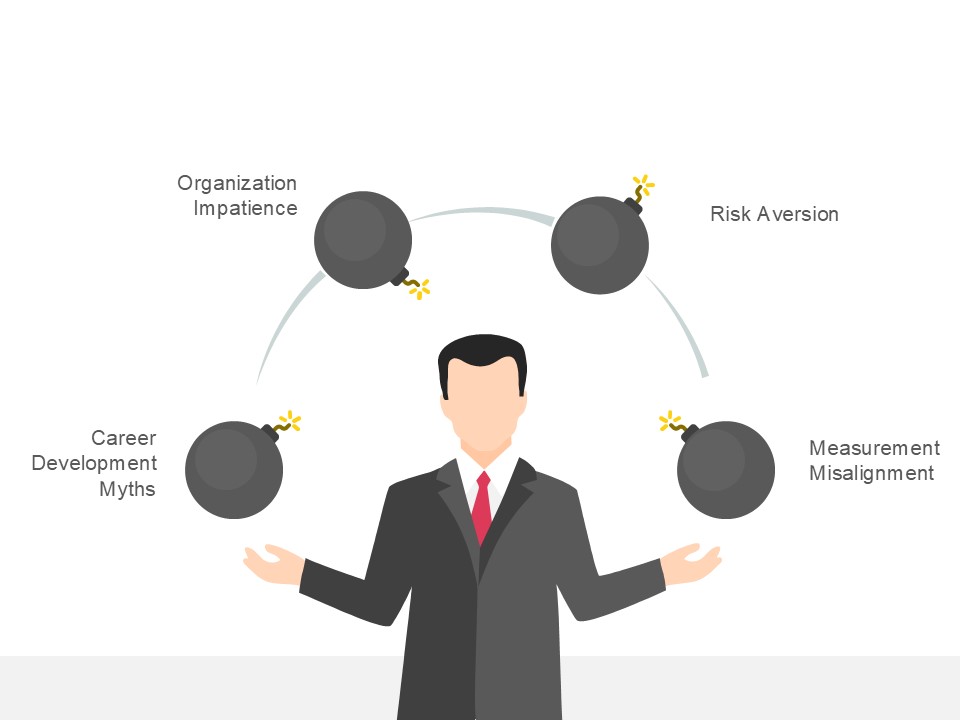
  • Career Development Myths: The belief that career progression requires constant role changes, preventing the development of deep expertise in any single area. This creates professionals with broad but shallow knowledge who lack the depth necessary to drive breakthrough improvement.
  • Organizational Impatience: Pressure to demonstrate rapid improvement, leading to premature conclusions about process owner effectiveness and frequent role changes before mastery can develop. This prevents organizations from realizing the compound benefits of sustained process ownership.
  • Risk Aversion: Concern that deep specialization creates single points of failure, leading to policies that distribute knowledge across multiple people rather than developing true expertise. This approach reduces organizational vulnerability to individual departures but eliminates the possibility of breakthrough improvement that requires deep understanding.
  • Measurement Misalignment: Performance management systems that reward visible activity over sustained stewardship, creating incentives for process owners to focus on quick wins rather than long-term system development.

The result is what I observe throughout the industry: sophisticated quality systems managed by well-intentioned professionals who lack the deep process knowledge necessary to drive genuine improvement. We have created environments where people are rewarded for managing systems they don’t truly understand, leading to the elaborate compliance theater that satisfies auditors but fails to protect patients.
Building Genuine Process Ownership Capability

Creating conditions for deep process ownership requires intentional organizational design that supports sustained engagement rather than constant rotation. This isn’t about keeping people in the same roles indefinitely—it’s about creating career paths that value depth alongside breadth and recognize the compound benefits of sustained expertise development.

Redefining Career Success: Organizations must develop career models that reward deep expertise alongside traditional progression. This means creating senior individual contributor roles, recognizing process mastery in compensation and advancement decisions, and celebrating sustained system stewardship as a form of leadership.

Supporting Long-term Engagement: Process owners need organizational support to sustain motivation through the inevitable plateaus and frustrations of deep system work. This includes providing resources for continuous learning, connecting them with external expertise, and ensuring their contributions are visible to senior leadership.

Creating Learning Infrastructure: Deep process ownership requires systematic approaches to knowledge capture, reflection, and improvement. Organizations must provide time and tools for process owners to document insights, conduct retrospective analyses, and share learning across the organization.

Building Technical Career Paths: The industry needs career models that allow technical professionals to advance without moving into management roles that distance them from process ownership. This requires creating parallel advancement tracks, appropriate compensation structures, and recognition systems that value technical leadership.

Measuring Long-term Value: Performance management systems must evolve to recognize the compound benefits of sustained process ownership. This means developing metrics that capture system stability, improvement consistency, and knowledge development rather than focusing exclusively on short-term achievements.

The Connection to Jobs-to-Be-Done

The Jobs-to-Be-Done tool I explored iprovides valuable insight into why process ownership requires sustained engagement. Organizations don’t hire process owners to execute procedures—they hire them to accomplish several complex jobs that require deep system understanding:

Knowledge Development: Building comprehensive understanding of process behavior, failure modes, and improvement opportunities that enables predictive rather than reactive management.

System Stewardship: Maintaining process health through minor adjustments, preventive actions, and continuous optimization that prevents major failures and enables consistent performance.

Change Leadership: Driving improvements that require deep technical understanding, stakeholder engagement, and change management capabilities developed through sustained experience.

Organizational Memory: Serving as repositories of process history, lessons learned, and contextual knowledge that prevents the repetition of past mistakes and enables informed decision-making.

Each of these jobs requires sustained engagement to accomplish effectively. The process owner who moves to a new role after 18 months may have learned the procedures, but they haven’t developed the deep understanding necessary to excel at these higher-order responsibilities.

The Path Forward: Embracing the Long View

We need to fundamentally rethink how we develop and deploy process ownership capability in pharmaceutical quality systems. This means acknowledging that true expertise takes time, creating organizational conditions that support sustained engagement, and recognizing the compound benefits of deep process knowledge.

The choice is clear: continue cycling process owners through abbreviated assignments that prevent the development of genuine expertise, or build career models and organizational practices that enable deep process ownership to flourish. In an industry where process failures can result in patient harm, product recalls, and regulatory action, only the latter approach offers genuine protection.

True process ownership isn’t something we implement because best practices require it. It’s a capability we actively cultivate because it makes us demonstrably better at protecting patients and ensuring product quality. When we design organizational systems around the jobs that deep process ownership accomplishes—knowledge development, system stewardship, change leadership, and organizational memory—we create competitive advantages that extend far beyond compliance.

Organizations that recognize the value of sustained process ownership and create conditions for its development will build capabilities that enable breakthrough improvement and genuine competitive advantage. Those that continue to treat process ownership as a rotational assignment will remain trapped in the cycle of elaborate compliance theater that satisfies auditors but fails to serve the fundamental purpose of pharmaceutical manufacturing.

Process ownership should not be something we implement because organizational charts require it. It should be a capability we actively develop because it makes us demonstrably better at the work that matters: protecting patients, ensuring product quality, and advancing the science of pharmaceutical manufacturing. When we embrace the deep ownership paradox—that mastery requires time, patience, and sustained engagement—we create the conditions for the kind of breakthrough improvement that our industry desperately needs.

In quality systems, as in life, the most valuable capabilities cannot be rushed, shortcuts cannot be taken, and true expertise emerges only through sustained engagement with the work that matters. This isn’t just good advice for individual career development—it’s the foundation for building pharmaceutical quality systems that genuinely serve patients and advance human health.

Further Reading

Kausar, F., Ijaz, M. U., Rasheed, M., Suhail, A., & Islam, U. (2025). Empowered, accountable, and committed? Applying self-determination theory to examine work-place procrastination. BMC Psychology13, 620. https://doi.org/10.1186/s40359-025-02968-7

Available at: https://pmc.ncbi.nlm.nih.gov/articles/PMC12144702/

Kim, A. J., & Chung, M.-H. (2023). Psychological ownership and ambivalent employee behaviors: A moderated mediation model. SAGE Open13(1). https://doi.org/10.1177/21582440231162535

Available at: https://journals.sagepub.com/doi/full/10.1177/21582440231162535

Wright, T. A., & Bonett, D. G. (2002). The moderating effects of employee tenure on the relation between organizational commitment and job performance: A meta-analysis. Journal of Applied Psychology87(6), 1183-1190. https://doi.org/10.1037/0021-9010.87.6.1183

Available at: https://pubmed.ncbi.nlm.nih.gov/12558224/
Beyond Malfunction Mindset: Normal Work, Adaptive Quality, and the Future of Pharmaceutical Problem-Solving

Beyond the Shadow of Failure

Problem-solving is too often shaped by the assumption that the system is perfectly understood and fully specified. If something goes wrong—a deviation, a batch out-of-spec, or a contamination event—our approach is to dissect what “failed” and fix that flaw, believing this will restore order. This way of thinking, which I call the malfunction mindset, is as ingrained as it is incomplete. It assumes that successful outcomes are the default, that work always happens as written in SOPs, and that only failure deserves our scrutiny.

But here’s the paradox: most of the time, our highly complex manufacturing environments actually succeed—often under imperfect, shifting, and not fully understood conditions. If we only study what failed, and never question how our systems achieve their many daily successes, we miss the real nature of pharmaceutical quality: it is not the absence of failure, but the presence of robust, adaptive work. Taking this broader, more nuanced perspective is not just an academic exercise—it’s essential for building resilient operations that truly protect patients, products, and our organizations.

Drawing from my thinking through zemblanity (the predictable but often overlooked negative outcomes of well-intentioned quality fixes), the effectiveness paradox (why “nothing bad happened” isn’t proof your quality system works), and the persistent gap between work-as-imagined and work-as-done, this post explores why the malfunction mindset persists, how it distorts investigations, and what future-ready quality management should look like.

The Allure—and Limits—of the Failure Model

Why do we reflexively look for broken parts and single points of failure? It is, as Sidney Dekker has argued, both comforting and defensible. When something goes wrong, you can always point to a failed sensor, a missed checklist, or an operator error. This approach—introducing another level of documentation, another check, another layer of review—offers a sense of closure and regulatory safety. After all, as long as you can demonstrate that you “fixed” something tangible, you’ve fulfilled investigational due diligence.

Yet this fails to account for how quality is actually produced—or lost—in the real world. The malfunction model treats systems like complicated machines: fix the broken gear, oil the creaky hinge, and the machine runs smoothly again. But, as Dekker reminds us in Drift Into Failure, such linear thinking ignores the drift, adaptation, and emergent complexity that characterize real manufacturing environments. The truth is, in complex adaptive systems like pharmaceutical manufacturing, it often takes more than one “error” for failure to manifest. The system absorbs small deviations continuously, adapting and flexing until, sometimes, a boundary is crossed and a problem surfaces.

W. Edwards Deming’s wisdom rings truer than ever: “Most problems result from the system itself, not from individual faults.” A sustainable approach to quality is one that designs for success—and that means understanding the system-wide properties enabling robust performance, not just eliminating isolated malfunctions.

Procedural Fundamentalism: The Work-as-Imagined Trap

One of the least examined, yet most impactful, contributors to the malfunction mindset is procedural fundamentalism—the belief that the written procedure is both a complete specification and an accurate description of work. This feels rigorous and provides compliance comfort, but it is a profound misreading of how work actually happens in pharmaceutical manufacturing.

Work-as-imagined, as elucidated by Erik Hollnagel and others, represents an abstraction: it is how distant architects of SOPs visualize the “correct” execution of a process. Yet, real-world conditions—resource shortages, unexpected interruptions, mismatched raw materials, shifting priorities—force adaptation. Operators, supervisors, and Quality professionals do not simply “follow the recipe”: they interpret, improvise, and—crucially—adjust on the fly.

When we treat procedures as authoritative descriptions of reality, we create the proxy problem: our investigations compare real operations against an imagined baseline that never fully existed. Deviations become automatically framed as problem points, and success is redefined as rigid adherence, regardless of context or outcome.

Complexity, Performance Variability, and Real Success

So, how do pharmaceutical operations succeed so reliably despite the ever-present complexity and variability of daily work?

The answer lies in embracing performance variability as a feature of robust systems, not a flaw. In high-reliability environments—from aviation to medicine to pharmaceutical manufacturing—success is routinely achieved not by demanding strict compliance, but by cultivating adaptive capacity.

Consider environmental monitoring in a sterile suite: The procedure may specify precise times and locations, but a seasoned operator, noticing shifts in people flow or equipment usage, might proactively sample a high-risk area more frequently. This adaptation—not captured in work-as-imagined—actually strengthens data integrity. Yet, traditional metrics would treat this as a procedural deviation.

This is the paradox of the malfunction mindset: in seeking to eliminate all performance variability, we risk undermining precisely those adaptive behaviors that produce reliable quality under uncertainty.

Why the Malfunction Mindset Persists: Cognitive Comfort and Regulatory Reinforcement

Why do organizations continue to privilege the malfunction mindset, even as evidence accumulates of its limits? The answer is both psychological and cultural.

Component breakdown thinking is psychologically satisfying—it offers a clear problem, a specific cause, and a direct fix. For regulatory agencies, it is easy to measure and audit: did the deviation investigation determine the root cause, did the CAPA address it, does the documentation support this narrative? Anything that doesn’t fit this model is hard to defend in audits or inspections.

Yet this approach offers, at best, a partial diagnosis and, at worst, the illusion of control. It encourages organizations to catalog deviations while blindly accepting a much broader universe of unexamined daily adaptations that actually determine system robustness.

Complexity Science and the Art of Organizational Success

To move toward a more accurate—and ultimately more effective—model of quality, pharmaceutical leaders must integrate the insights of complexity science. Drawing from the work of Stuart Kauffman and others at the Santa Fe Institute, we understand that the highest-performing systems operate not at the edge of rigid order, but at the “edge of chaos,” where structure is balanced with adaptability.

In these systems, success and failure both arise from emergent properties—the patterns of interaction between people, procedures, equipment, and environment. The most meaningful interventions, therefore, address how the parts interact, not just how each part functions in isolation.

This explains why traditional root cause analysis, focused on the parts, often fails to produce lasting improvements; it cannot account for outcomes that emerge only from the collective dynamics of the system as a whole.

Investigating for Learning: The Take-the-Best Heuristic

A key innovation needed in pharmaceutical investigations is a shift to what Hollnagel calls Safety-II thinking: focusing on how things go right as well as why they occasionally go wrong.

Here, the take-the-best heuristic becomes crucial. Instead of compiling lists of all deviations, ask: Among all contributing factors, which one, if addressed, would have the most powerful positive impact on future outcomes, while preserving adaptive capacity? This approach ensures investigations generate actionable, meaningful learning, rather than feeding the endless paper chase of “compliance theater.”

Building Systems That Support Adaptive Capability

Taking complexity and adaptive performance seriously requires practical changes to how we design procedures, train, oversee, and measure quality.

  • Procedure Design: Make explicit the distinction between objectives and methods. Procedures should articulate clear quality goals, specify necessary constraints, but deliberately enable workers to choose methods within those boundaries when faced with new conditions.
  • Training: Move beyond procedural compliance. Develop adaptive expertise in your staff, so they can interpret and adjust sensibly—understanding not just “what” to do, but “why” it matters in the bigger system.
  • Oversight and Monitoring: Audit for adaptive capacity. Don’t just track “compliance” but also whether workers have the resources and knowledge to adapt safely and intelligently. Positive performance variability (smart adaptations) should be recognized and studied.
  • Quality System Design: Build systematic learning from both success and failure. Examine ordinary operations to discern how adaptive mechanisms work, and protect these capabilities rather than squashing them in the name of “control.”

Leadership and Systems Thinking

Realizing this vision depends on a transformation in leadership mindset—from one seeking control to one enabling adaptive capacity. Deming’s profound knowledge and the principles of complexity leadership remind us that what matters is not enforcing ever-stricter compliance, but cultivating an organizational context where smart adaptation and genuine learning become standard.

Leadership must:

  • Distinguish between complicated and complex: Apply detailed procedures to the former (e.g., calibration), but support flexible, principles-based management for the latter.
  • Tolerate appropriate uncertainty: Not every problem has a clear, single answer. Creating psychological safety is essential for learning and adaptation during ambiguity.
  • Develop learning organizations: Invest in deep understanding of operations, foster regular study of work-as-done, and celebrate insights from both expected and unexpected sources.

Practical Strategies for Implementation

Turning these insights into institutional practice involves a systematic, research-inspired approach:

  • Start procedure development with observation of real work before specifying methods. Small scale and mock exercises are critical.
  • Employ cognitive apprenticeship models in training, so that experience, reasoning under uncertainty, and systems thinking become core competencies.
  • Begin investigations with appreciative inquiry—map out how the system usually works, not just how it trips up.
  • Measure leading indicators (capacity, information flow, adaptability) not just lagging ones (failures, deviations).
  • Create closed feedback loops for corrective actions—insisting every intervention be evaluated for impact on both compliance and adaptive capacity.

Scientific Quality Management and Adaptive Systems: No Contradiction

The tension between rigorous scientific quality management (QbD, process validation, risk management frameworks) and support for adaptation is a false dilemma. Indeed, genuine scientific quality management starts with humility: the recognition that our understanding of complex systems is always partial, our controls imperfect, and our frameworks provisional.

A falsifiable quality framework embeds learning and adaptation at its core—treating deviations as opportunities to test and refine models, rather than simply checkboxes to complete.

The best organizations are not those that experience the fewest deviations, but those that learn fastest from both expected and unexpected events, and apply this knowledge to strengthen both system structure and adaptive capacity.

Embracing Normal Work: Closing the Gap

Normal pharmaceutical manufacturing is not the story of perfect procedural compliance; it’s the story of people, working together to achieve quality goals under diverse, unpredictable, and evolving conditions. This is both more challenging—and more rewarding—than any plan prescribed solely by SOPs.

To truly move the needle on pharmaceutical quality, organizations must:

  • Embrace performance variability as evidence of adaptive capacity, not just risk.
  • Investigate for learning, not blame; study success, not just failure.
  • Design systems to support both structure and flexible adaptation—never sacrificing one entirely for the other.
  • Cultivate leadership that values humility, systems thinking, and experimental learning, creating a culture comfortable with complexity.

This approach will not be easy. It means questioning decades of compliance custom, organizational habit, and intellectual ease. But the payoff is immense: more resilient operations, fewer catastrophic surprises, and, above all, improved safety and efficacy for the patients who depend on our products.

The challenge—and the opportunity—facing pharmaceutical quality management is to evolve beyond compliance theater and malfunction thinking into a new era of resilience and organizational learning. Success lies not in the illusory comfort of perfectly executed procedures, but in the everyday adaptations, intelligent improvisation, and system-level capabilities that make those successes possible.

The call to action is clear: Investigate not just to explain what failed, but to understand how, and why, things so often go right. Protect, nurture, and enhance the adaptive capacities of your organization. In doing so, pharmaceutical quality can finally become more than an after-the-fact audit; it will become the creative, resilient capability that patients, regulators, and organizations genuinely want to hire.

The Risk-Based Electronic Signature Decision Framework

In my recent exploration of the Jobs-to-Be-Done tool I examined how customer-centric thinking could revolutionize our understanding of complex quality processes. Today, I want to extend that analysis to one of the most persistent challenges in pharmaceutical data integrity: determining when electronic signatures are truly required to meet regulatory standards and data integrity expectations.

Most organizations approach electronic signature decisions through what I call “compliance theater”—mechanically applying rules without understanding the fundamental jobs these signatures need to accomplish. They focus on regulatory checkbox completion rather than building genuine data integrity capability. This approach creates elaborate signature workflows that satisfy auditors but fail to serve the actual needs of users, processes, or the data integrity principles they’re meant to protect.

The cost of getting this wrong extends far beyond regulatory findings. When organizations implement electronic signatures incorrectly, they create false confidence in their data integrity controls while potentially undermining the very protections these signatures are meant to provide. Conversely, when they avoid electronic signatures where they would genuinely improve data integrity, they perpetuate manual processes that introduce unnecessary risks and inefficiencies.

The Electronic Signature Jobs Users Actually Hire

When quality professionals, process owners and system owners consider electronic signature requirements, what job are they really trying to accomplish? The answer reveals a profound disconnect between regulatory intent and operational reality.

The Core Functional Job

“When I need to ensure data integrity, establish accountability, and meet regulatory requirements for record authentication, I want a signature method that reliably links identity to action and preserves that linkage throughout the record lifecycle, so I can demonstrate compliance and maintain trust in my data.”

This job statement immediately exposes the inadequacy of most electronic signature decisions. Organizations often focus on technical implementation rather than the fundamental purpose: creating trustworthy, attributable records that support decision-making and regulatory confidence.

The Consumption Jobs: The Hidden Complexity

Electronic signature decisions involve numerous consumption jobs that organizations frequently underestimate:

  • Evaluation and Selection: “I need to assess when electronic signatures provide genuine value versus when they create unnecessary complexity.”
  • Implementation and Training: “I need to build electronic signature capability without overwhelming users or compromising data quality.”
  • Maintenance and Evolution: “I need to keep my signature approach current as regulations evolve and technology advances.”
  • Integration and Governance: “I need to ensure electronic signatures integrate seamlessly with my broader data integrity strategy.”

These consumption jobs represent the difference between electronic signature systems that users genuinely want to hire and those they grudgingly endure.

The Emotional and Social Dimensions

Electronic signature decisions involve profound emotional and social jobs that traditional compliance approaches ignore:

  • Confidence: Users want to feel genuinely confident that their signature approach provides appropriate protection, not just regulatory coverage.
  • Professional Credibility: Quality professionals want signature systems that enhance rather than complicate their ability to ensure data integrity.
  • Organizational Trust: Executive teams want assurance that their signature approach genuinely protects data integrity rather than creating administrative overhead.
  • User Acceptance: Operational staff want signature workflows that support rather than impede their work.

The Current Regulatory Landscape: Beyond the Checkbox

Understanding when electronic signatures are required demands a sophisticated appreciation of the regulatory landscape that extends far beyond simple rule application.

FDA 21 CFR Part 11: The Foundation

21 CFR Part 11 establishes that electronic signatures can be equivalent to handwritten signatures when specific conditions are met. However, the regulation’s scope is explicitly limited to situations where signatures are required by predicate rules—the underlying FDA regulations that mandate signatures for specific activities.

The critical insight that most organizations miss: Part 11 doesn’t create new signature requirements. It simply establishes standards for electronic signatures when signatures are already required by other regulations. This distinction is fundamental to proper implementation.

Key Part 11 requirements include:

  • Unique identification for each individual
  • Verification of signer identity before assignment
  • Certification that electronic signatures are legally binding equivalents
  • Secure signature/record linking to prevent falsification
  • Comprehensive signature manifestations showing who signed what, when, and why

EU Annex 11: The European Perspective

EU Annex 11 takes a similar approach, requiring that electronic signatures “have the same impact as hand-written signatures”. However, Annex 11 places greater emphasis on risk-based decision making throughout the computerized system lifecycle.

Annex 11’s approach to electronic signatures emphasizes:

  • Risk assessment-based validation
  • Integration with overall data integrity strategy
  • Lifecycle management considerations
  • Supplier assessment and management

GAMP 5: The Risk-Based Framework

GAMP 5 provides the most sophisticated framework for electronic signature decisions, emphasizing risk-based approaches that consider patient safety, product quality, and data integrity throughout the system lifecycle.

GAMP 5’s key principles for electronic signature decisions include:

  • Risk-based validation approaches
  • Supplier assessment and leverage
  • Lifecycle management
  • Critical thinking application
  • User requirement specification based on intended use

The Predicate Rule Reality: Where Signatures Are Actually Required

The foundation of any electronic signature decision must be a clear understanding of where signatures are required by predicate rules. These requirements fall into several categories:

  • Manufacturing Records: Batch records, equipment logbooks, cleaning records where signature accountability is mandated by GMP regulations.
  • Laboratory Records: Analytical results, method validations, stability studies where analyst and reviewer signatures are required.
  • Quality Records: Deviation investigations, CAPA records, change controls where signature accountability ensures proper review and approval.
  • Regulatory Submissions: Clinical data, manufacturing information, safety reports where signatures establish accountability for submitted information.

The critical insight: electronic signatures are only subject to Part 11 requirements when handwritten signatures would be required in the same circumstances.

The Eight-Step Electronic Signature Decision Framework

Applying the Jobs-to-Be-Done universal job map to electronic signature decisions reveals where current approaches systematically fail and how organizations can build genuinely effective signature strategies.

Step 1: Define Context and Purpose

What users need: Clear understanding of the business process, data integrity requirements, regulatory obligations, and decisions the signature will support.

Current reality: Electronic signature decisions often begin with technology evaluation rather than purpose definition, leading to solutions that don’t serve actual needs.

Best practice approach: Begin every electronic signature decision by clearly articulating:

  • What business process requires authentication
  • What regulatory requirements mandate signatures
  • What data integrity risks the signature will address
  • What decisions the signed record will support
  • Who will use the signature system and in what context

Step 2: Locate Regulatory Requirements

What users need: Comprehensive understanding of applicable predicate rules, data integrity expectations, and regulatory guidance specific to their process and jurisdiction.

Current reality: Organizations often apply generic interpretations of Part 11 or Annex 11 without understanding the specific predicate rule requirements that drive signature needs.

Best practice approach: Systematically identify:

  • Specific predicate rules requiring signatures for your process
  • Applicable data integrity guidance (MHRA, FDA, EMA)
  • Relevant industry standards (GAMP 5, ICH guidelines)
  • Jurisdictional requirements for your operations
  • Industry-specific guidance for your sector

Step 3: Prepare Risk Assessment

What users need: Structured evaluation of risks associated with different signature approaches, considering patient safety, product quality, data integrity, and regulatory compliance.

Current reality: Risk assessments often focus on technical risks rather than the full spectrum of data integrity and business risks associated with signature decisions.

Best practice approach: Develop comprehensive risk assessment considering:

  • Patient safety implications of signature failure
  • Product quality risks from inadequate authentication
  • Data integrity risks from signature system vulnerabilities
  • Regulatory risks from non-compliant implementation
  • Business risks from user acceptance and system reliability
  • Technical risks from system integration and maintenance

Step 4: Confirm Decision Criteria

What users need: Clear criteria for evaluating signature options, with appropriate weighting for different risk factors and user needs.

Current reality: Decision criteria often emphasize technical features over fundamental fitness for purpose, leading to over-engineered or under-protective solutions.

Best practice approach: Establish explicit criteria addressing:

  • Regulatory compliance requirements
  • Data integrity protection level needed
  • User experience and adoption requirements
  • Technical integration and maintenance needs
  • Cost-benefit considerations
  • Long-term sustainability and evolution capability

Step 5: Execute Risk Analysis

What users need: Systematic comparison of signature options against established criteria, with clear rationale for recommendations.

Current reality: Risk analysis often becomes feature comparison rather than genuine assessment of how different approaches serve the jobs users need accomplished.

Best practice approach: Conduct structured analysis that:

  • Evaluates each option against established criteria
  • Considers interdependencies with other systems and processes
  • Assesses implementation complexity and resource requirements
  • Projects long-term implications and evolution needs
  • Documents assumptions and limitations
  • Provides clear recommendation with supporting rationale

Step 6: Monitor Implementation

What users need: Ongoing validation that the chosen signature approach continues to serve its intended purposes and meets evolving requirements.

Current reality: Organizations often treat electronic signature implementation as a one-time decision rather than an ongoing capability requiring continuous monitoring and adjustment.

Best practice approach: Establish monitoring systems that:

  • Track signature system performance and reliability
  • Monitor user adoption and satisfaction
  • Assess continued regulatory compliance
  • Evaluate data integrity protection effectiveness
  • Identify emerging risks or opportunities
  • Measure business value and return on investment

Step 7: Modify Based on Learning

What users need: Responsive adjustment of signature strategies based on monitoring feedback, regulatory changes, and evolving business needs.

Current reality: Electronic signature systems often become static implementations, updated only when forced by system upgrades or regulatory findings.

Best practice approach: Build adaptive capability that:

  • Regularly reviews signature strategy effectiveness
  • Updates approaches based on regulatory evolution
  • Incorporates lessons learned from implementation experience
  • Adapts to changing business needs and user requirements
  • Leverages technological advances and industry best practices
  • Maintains documentation of changes and rationale

Step 8: Conclude with Documentation

What users need: Comprehensive documentation that captures the rationale for signature decisions, supports regulatory inspections, and enables knowledge transfer.

Current reality: Documentation often focuses on technical specifications rather than the risk-based rationale that supports the decisions.

Best practice approach: Create documentation that:

  • Captures the complete decision rationale and supporting analysis
  • Documents risk assessments and mitigation strategies
  • Provides clear procedures for ongoing management
  • Supports regulatory inspection and audit activities
  • Enables knowledge transfer and training
  • Facilitates future reviews and updates

The Risk-Based Decision Tool: Moving Beyond Guesswork

The most critical element of any electronic signature strategy is a robust decision tool that enables consistent, risk-based choices. This tool must address the fundamental question: when do electronic signatures provide genuine value over alternative approaches?

The Electronic Signature Decision Matrix

The decision matrix evaluates six critical dimensions:

Regulatory Requirement Level:

  • High: Predicate rules explicitly require signatures for this activity
  • Medium: Regulations require documentation/accountability but don’t specify signature method
  • Low: Good practice suggests signatures but no explicit regulatory requirement

Data Integrity Risk Level:

  • High: Data directly impacts patient safety, product quality, or regulatory submissions
  • Medium: Data supports critical quality decisions but has indirect impact
  • Low: Data supports operational activities with limited quality impact

Process Criticality:

  • High: Process failure could result in patient harm, product recall, or regulatory action
  • Medium: Process failure could impact product quality or regulatory compliance
  • Low: Process failure would have operational impact but limited quality implications

User Environment Factors:

  • High: Users are technically sophisticated, work in controlled environments, have dedicated time for signature activities
  • Medium: Users have moderate technical skills, work in mixed environments, have competing priorities
  • Low: Users have limited technical skills, work in challenging environments, face significant time pressures

System Integration Requirements:

  • High: Must integrate with validated systems, requires comprehensive audit trails, needs long-term data integrity
  • Medium: Moderate integration needs, standard audit trail requirements, medium-term data retention
  • Low: Limited integration needs, basic documentation requirements, short-term data use

Business Value Potential:

  • High: Electronic signatures could significantly improve efficiency, reduce errors, or enhance compliance
  • Medium: Moderate improvements in operational effectiveness or compliance capability
  • Low: Limited operational or compliance benefits from electronic implementation

Decision Logic Framework

Electronic Signature Strongly Recommended (Score: 15-18 points):
All high-risk factors align with strong regulatory requirements and favorable implementation conditions. Electronic signatures provide clear value and are essential for compliance.

Electronic Signature Recommended (Score: 12-14 points):
Multiple risk factors support electronic signature implementation, with manageable implementation challenges. Benefits outweigh costs and complexity.

Electronic Signature Optional (Score: 9-11 points):
Mixed risk factors with both benefits and challenges present. Decision should be based on specific organizational priorities and capabilities.

Alternative Controls Preferred (Score: 6-8 points):
Low regulatory requirements combined with implementation challenges suggest alternative controls may be more appropriate.

Electronic Signature Not Recommended (Score: Below 6 points):
Risk factors and implementation challenges outweigh potential benefits. Focus on alternative controls and process improvements.

Implementation Guidance by Decision Category

For Strongly Recommended implementations:

  • Invest in robust, validated electronic signature systems
  • Implement comprehensive training and competency programs
  • Establish rigorous monitoring and maintenance procedures
  • Plan for long-term system evolution and regulatory changes

For Recommended implementations:

  • Consider phased implementation approaches
  • Focus on high-value use cases first
  • Establish clear success metrics and monitoring
  • Plan for user adoption and change management

For Optional implementations:

  • Conduct detailed cost-benefit analysis
  • Consider pilot implementations in specific areas
  • Evaluate alternative approaches simultaneously
  • Maintain flexibility for future evolution

For Alternative Controls approaches:

  • Focus on strengthening existing manual controls
  • Consider semi-automated approaches (e.g., witness signatures, timestamp logs)
  • Plan for future electronic signature capability as conditions change
  • Maintain documentation of decision rationale for future reference

Practical Implementation Strategies: Building Genuine Capability

Effective electronic signature implementation requires attention to three critical areas: system design, user capability, and governance frameworks.

System Design Considerations

Electronic signature systems must provide robust identity verification that meets both regulatory requirements and practical user needs. This includes:

Authentication and Authorization:

  • Multi-factor authentication appropriate to risk level
  • Role-based access controls that reflect actual job responsibilities
  • Session management that balances security with usability
  • Integration with existing identity management systems where possible

Signature Manifestation Requirements:

Regulatory requirements for signature manifestation are explicit and non-negotiable. Systems must capture and display:

  • Printed name of the signer
  • Date and time of signature execution
  • Meaning or purpose of the signature (approval, review, authorship, etc.)
  • Unique identification linking signature to signer
  • Tamper-evident presentation in both electronic and printed formats

Audit Trail and Data Integrity:

Electronic signature systems must provide comprehensive audit trails that support both routine operations and regulatory inspections. Essential capabilities include:

  • Immutable recording of all signature-related activities
  • Comprehensive metadata capture (who, what, when, where, why)
  • Integration with broader system audit trail capabilities
  • Secure storage and long-term preservation of audit information
  • Searchable and reportable audit trail data

System Integration and Interoperability:

Electronic signatures rarely exist in isolation. Effective implementation requires:

  • Seamless integration with existing business applications
  • Consistent user experience across different systems
  • Data exchange standards that preserve signature integrity
  • Backup and disaster recovery capabilities
  • Migration planning for system upgrades and replacements

Training and Competency Development

User Training Programs:
Electronic signature success depends critically on user competency. Effective training programs address:

  • Regulatory requirements and the importance of signature integrity
  • Proper use of signature systems and security protocols
  • Recognition and reporting of signature system problems
  • Understanding of signature meaning and legal implications
  • Regular refresher training and competency verification

Administrator and Support Training:
System administrators require specialized competency in:

  • Electronic signature system configuration and maintenance
  • User account and role management
  • Audit trail monitoring and analysis
  • Incident response and problem resolution
  • Regulatory compliance verification and documentation

Management and Oversight Training:
Management personnel need understanding of:

  • Strategic implications of electronic signature decisions
  • Risk assessment and mitigation approaches
  • Regulatory compliance monitoring and reporting
  • Business continuity and disaster recovery planning
  • Vendor management and assessment requirements

Governance Framework Development

Policy and Procedure Development:
Comprehensive governance requires clear policies addressing:

  • Electronic signature use cases and approval authorities
  • User qualification and training requirements
  • System administration and maintenance procedures
  • Incident response and problem resolution processes
  • Periodic review and update procedures

Risk Management Integration:
Electronic signature governance must integrate with broader quality risk management:

  • Regular risk assessment updates reflecting system changes
  • Integration with change control and configuration management
  • Vendor assessment and ongoing monitoring
  • Business continuity and disaster recovery testing
  • Regulatory compliance monitoring and reporting

Performance Monitoring and Continuous Improvement:
Effective governance includes ongoing performance management:

  • Key performance indicators for signature system effectiveness
  • User satisfaction and adoption monitoring
  • System reliability and availability tracking
  • Regulatory compliance verification and trending
  • Continuous improvement process and implementation

Building Genuine Capability

The ultimate goal of any electronic signature strategy should be building genuine organizational capability rather than simply satisfying regulatory requirements. This requires a fundamental shift in mindset from compliance theater to value creation.

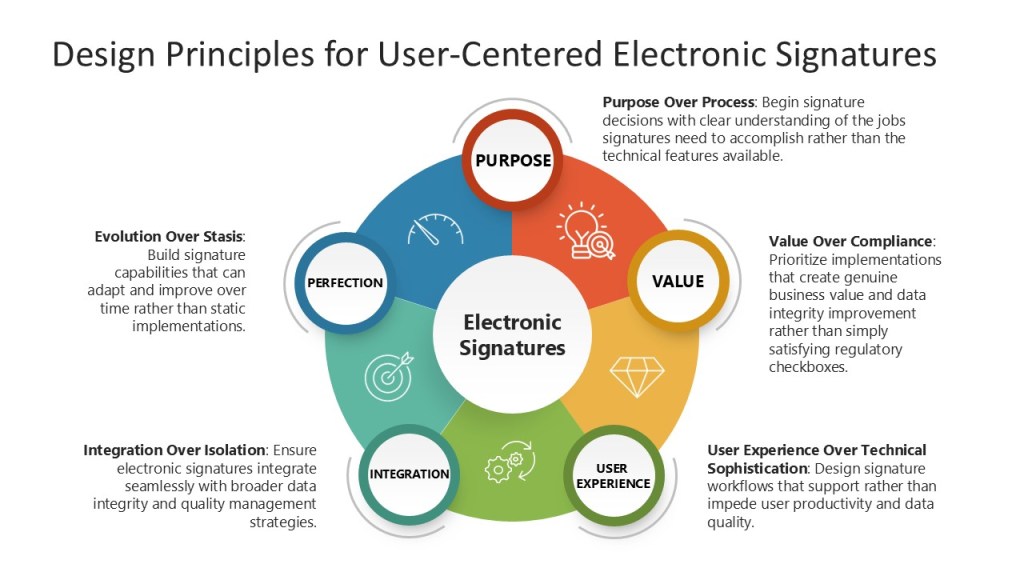
Design Principles for User-Centered Electronic Signatures

Purpose Over Process: Begin signature decisions with clear understanding of the jobs signatures need to accomplish rather than the technical features available.

Value Over Compliance: Prioritize implementations that create genuine business value and data integrity improvement rather than simply satisfying regulatory checkboxes.

User Experience Over Technical Sophistication: Design signature workflows that support rather than impede user productivity and data quality.

Integration Over Isolation: Ensure electronic signatures integrate seamlessly with broader data integrity and quality management strategies.

Evolution Over Stasis: Build signature capabilities that can adapt and improve over time rather than static implementations.

The image illustrates five design principles for user-centered electronic signatures in a circular infographic. At the center is the term "Electronic Signatures," surrounded by five labeled sections: Purpose, Value, User Experience, Integration, and Perfection. Each section contains a principle with supporting text:

Purpose Over Process: Emphasizes understanding the job requirements for signatures before technical features.

Value Over Compliance: Focuses on business value and data integrity, not just regulatory compliance.

User Experience Over Technical Sophistication: Encourages workflows that support productivity and data quality.

Integration Over Isolation: Stresses integrating electronic signatures with broader quality management strategies.

Evolution Over Stasis: Advocates capability improvements over static implementations. The design uses different colors for each principle and includes icons representing their themes.

Building Organizational Trust Through Electronic Signatures

Electronic signatures should enhance rather than complicate organizational trust in data integrity. This requires:

  • Transparency: Users should understand how electronic signatures protect data integrity and support business decisions.
  • Reliability: Signature systems should work consistently and predictably, supporting rather than impeding daily operations.
  • Accountability: Electronic signatures should create clear accountability and traceability without overwhelming users with administrative burden.
  • Competence: Organizations should demonstrate genuine competence in electronic signature implementation and management, not just regulatory compliance.

Future-Proofing Your Electronic Signature Approach

The regulatory and technological landscape for electronic signatures continues to evolve. Organizations need approaches that can adapt to:

  • Regulatory Evolution: Draft revisions to Annex 11, evolving FDA guidance, and new regulatory requirements in emerging markets.
  • Technological Advancement: Biometric signatures, blockchain-based authentication, artificial intelligence integration, and mobile signature capabilities.
  • Business Model Changes: Remote work, cloud-based systems, global operations, and supplier network integration.
  • User Expectations: Consumerization of technology, mobile-first workflows, and seamless user experiences.

The Path Forward: Hiring Electronic Signatures for Real Jobs

We need to move beyond electronic signature systems that create false confidence while providing no genuine data integrity protection. This happens when organizations optimize for regulatory appearance rather than user needs, creating elaborate signature workflows that nobody genuinely wants to hire.

True electronic signature strategy begins with understanding what jobs users actually need accomplished: establishing reliable accountability, protecting data integrity, enabling efficient workflows, and supporting regulatory confidence. Organizations that design electronic signature approaches around these jobs will develop competitive advantages in an increasingly digital world.

The framework presented here provides a structured approach to making these decisions, but the fundamental insight remains: electronic signatures should not be something organizations implement to satisfy auditors. They should be capabilities that organizations actively seek because they make data integrity demonstrably better.

When we design signature capabilities around the jobs users actually need accomplished—protecting data integrity, enabling accountability, streamlining workflows, and building regulatory confidence—we create systems that enhance rather than complicate our fundamental mission of protecting patients and ensuring product quality.

The choice is clear: continue performing electronic signature compliance theater, or build signature capabilities that organizations genuinely want to hire. In a world where data integrity failures can result in patient harm, product recalls, and regulatory action, only the latter approach offers genuine protection.

Electronic signatures should not be something we implement because regulations require them. They should be capabilities we actively seek because they make us demonstrably better at protecting data integrity and serving patients.

Recent Podcast Appearance: Risk Revolution

I’m excited to share that I recently had the opportunity to appear on the Risk Revolution podcast, joining host Valerie Mulholland for what turned out to be a provocative and deeply engaging conversation about the future of pharmaceutical quality management.

The episode, titled “Quality Theatre to Quality Science – Jeremiah Genest’s Playbook,” aired on September 28, 2025, and dives into one of my core arguments: that quality systems should be designed to fail predictably so we can learn purposefully. This isn’t about celebrating failure—it’s about building systems intelligent enough to fail in ways that generate learning rather than hiding in the shadows until catastrophic breakdown occurs.

Why This Conversation Matters

Valerie and I spent over an hour exploring what I call “intelligent failure”—a concept that challenges the feel-good metrics that dominate our industry dashboards. You know the ones I’m talking about: those green lights celebrating zero deviations that make everyone feel accomplished while potentially masking the unknowns lurking beneath the surface. As I argued in the episode, these metrics can hide systemic problems rather than prove actual control.

This discussion connects directly to themes I’ve been developing here on Investigations of a Dog, particularly my thoughts on the effectiveness paradox and the dangerous comfort of “nothing bad happened” thinking. The podcast gave me a chance to explore how zemblanity—the patterned recurrence of unfortunate events that we should have anticipated—manifests in quality systems that prioritize the appearance of control over genuine understanding.

The Perfect Platform for These Ideas

Risk Revolution proved to be the ideal venue for this conversation. Valerie brings over 25 years of hands-on experience across biopharmaceutical, pharmaceutical, medical device, and blood transfusion industries, but what sets her apart is her unique combination of practical expertise and cutting-edge research.

The podcast’s monthly format allows for the kind of deep, nuanced discussions that advance risk management maturity rather than recycling conference presentations. When I wrote about Valerie’s writing on the GI Joe Bias, I noted how her emphasis on systematic interventions rather than individual awareness represents exactly the kind of sophisticated thinking our industry needs. This podcast appearance let us explore these concepts in real-time conversation.

What made the discussion particularly engaging was Valerie’s ability to challenge my thinking while building on it. Her research-backed insights into cognitive bias management created a perfect complement to my practical experience with system failures and investigation patterns. We explored how quality professionals—precisely because of our expertise—become vulnerable to specific blind spots that systematic design can address.

Looking Forward

This Risk Revolution appearance represents more than just a podcast interview—it’s part of a broader conversation about advancing pharmaceutical quality management beyond surface-level compliance toward genuine excellence. The episode includes references to my blog work, the Deming philosophy, and upcoming industry conferences where these ideas will continue to evolve.

If you’re interested in how quality systems can be designed for intelligent learning rather than elegant hiding, this conversation offers both provocative challenges and practical frameworks. Fair warning: you might never look at a green dashboard the same way again.

The episode is available now, and I’d love to hear your thoughts on how we might move from quality theatre toward quality science in your own organization.