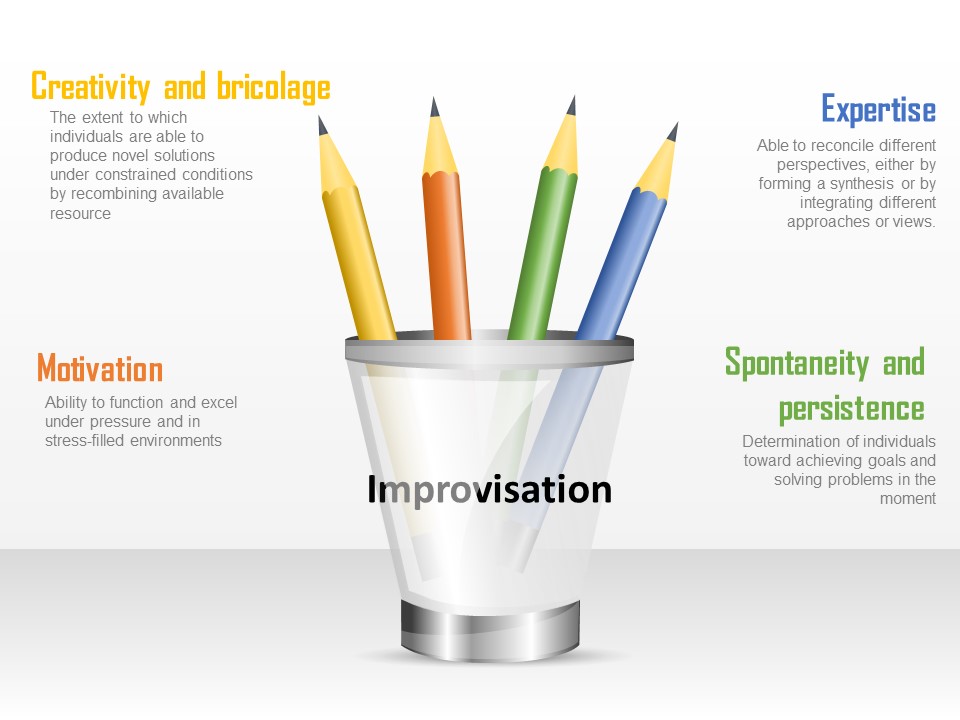
“Improvisation Takes Practice” in HBR is a great read. When I first read it, I chuckled at how it brings my gamer hobby and my quality practice together.
Employee creativity—the production of novel and useful solutions, procedures, products, and services—is critical to organizational success. I would argue, creativity drives excellence. Improvisation is a key employee behavior that drives creativity and innovation.
Improvisation is essential for navigating volatile, uncertain, and complex environments and dealing with unforeseen obstacles. Improvisation is also key to drawing distinctions, implementing new ideas, and converting knowledge and insights into action in real time. When confronted with critical and disruptive events, employees can resolve challenges by following existing protocols and procedures. In contrast, when faced with novel events, employees cannot rely on routines and conventions to respond. Rather, they will have to shift their focus to new perspectives, features, and behaviors.
The process of building expertise, when practices are assimilated, embodied, and rendered tacit, creates improvisational competence. Improvisation is an important source of action generating learning: people act to make events meaningful and situations understandable and, in the process, deepen their expertise through further learning, becoming reflective practitioners.
Today John English pointed out the April 2020 FDA 483 for the Baltimore site of Emergent. And it is a doozy in six pages. Thank you FOIA.
Observation 1: Appropriate controls are not exercised over computers or related systems to assure that changes in master production and control records or other records are instituted only by authorized personnel
This one is a real bellwether to me. The failure of the quality unit to ensure a robust computer system validation program was in place, to ensure data integrity. The fact that the three parts to the observation run the gamut from infrastructure to implementation to on-going use stands out that there are significant weaknesses in data integrity as an approach.
Observation 2: Established specifications, test procedures and laboratory control mechanisms are not followed and documented at the time of performance.
Part (b) indicates a failure to manage and track lab errors.
Also some concerns on chain of custody of samples are raised.
Observation 3: The responsibilities and procedures applicable to the quality control unit are not in writing and fully followed.
This observation raises some significant questions in how they manage OOS investigations.
Observation 4: Employees are not given training in the particular operations they perform as part of their function and current good manufacturing practices
Observation 5: Separate or defined areas to prevent contamination or mix-ups are deficient regarding operations related to the holding of rejected components before disposition
It is like the FDA saw exactly what was going to happen and did nothing to stop it.
Thoughts
This 483 chilled me to the bones reading it. Major failures in quality here. The fact that this was in April of 2020 raises significant concerns in my mind about how Emergent got any contracts for vaccine delivery.
I have written to my congressional representatives demanding hearings. We need to know who made what decisions when. The trust in our regulatory regime requires full transparency and introspection.
Effective organizations assign people to particular roles, such as Process Owners, to solve problems better and make choices faster. Yet, it is frighteningly easy it is to exclude the right people in problem-solving. Who plays what role is not always clear in organizations. In organizations where specialized knowledge and expertise are distributed widely the different parts of an organization can see different problems in the same situation. Ensuring that the right people are at the whiteboard to solve the problem.
The Who-What Matrix is a great tool to ensure the right people are involved.
By including a wider set of people, the Who-What Matrix assists in creating trust, commitment, and a sense of procedural justice, and thus, enhance the likelihood of success. The matrix can also integrate people across functions, hierarchy, business units, locations, and partner organizations.
Once the need to problem-solve is identified, the matrix can be used to determine what people and organizations should be involved in which roles in problem-solving and whose interests should betaken into account in the deliberations. Players may provide input (information, ideas, resources); be part of the solving process(formulating problem, gathering data, doing analyses, generating solution options, supporting the work), be among those making choices or executing them. Considering the interests of all players during problem-solving can lead to better choices and outcomes.
The aim is to use the framework’s categories to think broadly but be selective in deciding which players play what role. A lengthy collection of players can be so overwhelming as to lead to neglect. The same player can play more than one role, and roles played can change over time. Players can come and go as problem-solving proceeds and circumstances change.
By deliberately bringing people into problem-solving, we are showing how to give people a meaningful role in the learning culture.
Who-What Matrix
The roles breakdown as:
Input: Provide input, provide data gathering, data sources
Recommend: Evaluate problem, recommend solutions and path forward
Decide: Make the final decision and commit the organization to action
Perform: Be accountable for making the decision happen once made
Agree: Formally approve a decision, implies veto power
Outcome: Accountable for the outcome of problem solving, results over time
Nonaka classified knowledge as explicit and tacit. This concept has become the center piece of knowledge management and fundamental concept in process improvement.
Explicit knowledge is documented and accepted knowledge. Tacit knowledge stems more from experience and is more undocumented in nature. In spite of being difficult to interpret and transfer, tacit knowledge is regarded as the root of all organizational knowledge.
Tacit knowledge, unlike its explicit counterpart, mostly consists of perceptions and is often unstructured and non-documented in nature. Therefore, mental models, justification of beliefs, heuristics, judgments, “gut feelings” and the communication skills of the individual can influence the quality of tacit knowledge.
The process of creation of knowledge begins with the creation and sharing of tacit knowledge, which stems from socialization, facilitation of experience and interactive capacity of individuals with their coworkers.
Creation and Sharing of Knowledge
Knowledge creation involved organizations and it’s individual transcending the boundaries of the old to the new by acquiring new knowledge, which is considered to be mostly tacit in nature. The key to tacit knowledge sharing lies in the willingness and capacity of individuals to share what they know (knowledge donation) and to use what they learn (knowledge collection).
Knowledge quality is the acquisition of useful and innovative knowledge and is the degree to which people are satisfied with the quality of the shared knowledge and find it useful in accomplishing their activities. The quality of knowledge can be measured by frequency, usefulness and innovativeness, and can be innovative or new for the system or organization. However, if the knowledge is not beneficial to achieving the objective of the objective of the organization then it does not fulfill the criteria of knowledge quality. There are six attributes to knowledge quality: adaptability, innovativeness, applicability, expandability, justifiability and authenticity,
Sources
Kaser, P.A. and Miles, R.E. (2002), “Understanding knowledge activists’ successes and failures”, Long Range Planning, Vol. 35 No. 1, pp. 9-28.
Kucharska, W. and Dabrowski, J. (2016), “Tacit knowledge sharing and personal branding: how to derive innovation from project teams”, in Proceedings of the11th European Conference on Innovation and Entrepreneurship ECIE, pp. 435-443.
Nonaka, I. (1994), “A dynamic theory of organizational knowledge creation”, Organizational Science, Vol. 5 No. 1, pp. 14-37.
Nonaka, I. and Takeuchi, H. (1995), The Knowledge-Creating Company, Oxford University Press, New York, NY.
Nonaka, I. and Toyama, R. (2003), “The knowledge-creating theory revisited: knowledge creation as a synthesizing process”, Knowledge Management Research and Practice, Vol. 1 No. 1, pp. 2-10.
Nonaka, I. and Von Krogh, G. (2009), “Perspective—tacit knowledge and knowledge conversion: controversy and advancement in organizational knowledge creation theory”, Organization Science, Vol. 20 No. 3, pp. 635-652
Riege, A. (2005), “Three-dozen knowledge-sharing barriers managers must consider”, Journal of Knowledge Management, Vol. 9 No. 3, pp. 18-35.
Smedlund, A. (2008), “The knowledge system of a firm: social capital for explicit, tacit and potential knowledge”, Journal of Knowledge Management, Vol. 12 No. 1, pp. 63-77.
Spender, J.C. (1996), “Making knowledge the basis of a dynamic theory of the firm”, Strategic Management Journal, Vol. 17 No. S2, pp. 45-62.
Soo, C.W., Devinney, T.M. and Midgley, D.F. (2004), “The role of knowledge quality in firm performance”, In Tsoukas, H. and Mylonopoulus, N. (Eds), Organizations as Knowledge Systems. Knowledge, Learning and Dynamic Capabilities, Palgrave Macmillan, London, pp. 252-275.
Sorenson, O., Rivkin, J.W. and Fleming, L. (2006), “Complexity, networks and knowledge flow”, Research Policy, Vol. 35 No. 7, pp. 994-1017.
Waheed, M. and Kaur, K. (2016), “Knowledge quality: a review and a revised conceptual model”, Information Development, Vol. 32 No. 3, pp. 271-284.
Wang, Z. and Wang, N. (2012), “Knowledge sharing, innovation and firm performance”, Expert Systems with Applications, Vol. 39 No. 10, pp. 8899-8908.