This book does an amazing job of giving you the tools of transforming a boring management review into a compelling narrative. Following the step-by-step recommendations will give you a blueprint for effective telling the story of your organizations quality maturity and help you execute into action.
For example, this table is the start of an amazing section about crafting a narrative that then goes into an amazing discussion on structuring a slide presentation to get this done.
Argumentative Writing (Logical Approach)
Persuasive Writing (Emotional Appeal)
Writing a Recommendation (Blend of Both)
Purpose
Construct compelling evidence that your viewpoint is backed by the truth and is factual
Persuade the audience to agree with your perspective and take action on your viewpoint
Use the data available, plus intuition, to form a point of view that requires action from your organization
Approach
Deliver information from both sides of the issue by choosing one side as valid and causing others to doubt the counterclaim
Deliver information and opinions on only one side of the issue, and develop a strong connection with a target audience
Develop a story supported by evidence ad also include any counterarguments your audience may have, so tat they feel you have considered their perspective
Appeals
Use logical appears to support claims with solid examples, expert opinions, data, and facts. The goal is to be right, not necessarily take action
Use emotional appeals to convince others of your opinion and feelings, so the audience will move forward on your perspective
Structure the appeal as a story, support your recommendation with data and solid evidence that sticks by adding meaning
Tone
Professional, tactful, logical
Personal, passionate, emotional
Appropriate tone based on the audience
Another great takeaway is when Nancy presents results of her extensive analysis on word patterns in speeches, right down to the choice of effective verbs, conjunctions, adjectives, adverbs, interjections, and rhetorical questions. The choice of “process or performance verbs” is connected to whether the recommended course of action is continuity, change or termination.
This is a book that keeps giving.
I found it so invaluable that I bought a copy for everyone on my team.
ISO9001:2015 states “Top management shall review the organization’s quality management system, at planned intervals, to ensure its continuing suitability, adequacy, effectiveness and alignment with the strategic direction of the organization.”
Management review takes inputs of system performance and converts it to outputs that drive improvement.
Just about every standard and guidance aligns with the ISO9001:2015 structure.
The Use of PowerPoint in Management Review
Everyone makes fun of PowerPoint, and yet it is still with us. As a mechanism for formal communication it is the go-to form, and I do not believe that will change anytime soon.
One of the best pieces of research on PowerPoint and management review is Kaplan’s examination of PowerPoint slides used in a manufacturing firm. Kaplan found that generating slides was “embedded in the discursive practices of strategic knowledge production” and made up “part of the epistemic machinery that undergirds the know-ledge production culture.” Further, “the affordances of PowerPoint,” Kaplan pointed out, “enabled the difficult task of collaborating to negotiate meaning in an uncertain environment, creating spaces for discussion, making recombinations possible, [and] allowing for adjustments as ideas evolved”. She concluded that PowerPoint slide decks should be regarded not as merely effective or ineffective reports but rather as an essential part of strategic decision making.
Kaplan’s findings are not isolated, there is a broad wealth of relevant research in the fields of genre and composition studies as well as research on material objects that draw similar conclusions. Powerpoint, as a method of formal communication, can be effective.
Management Review as Formal Communication
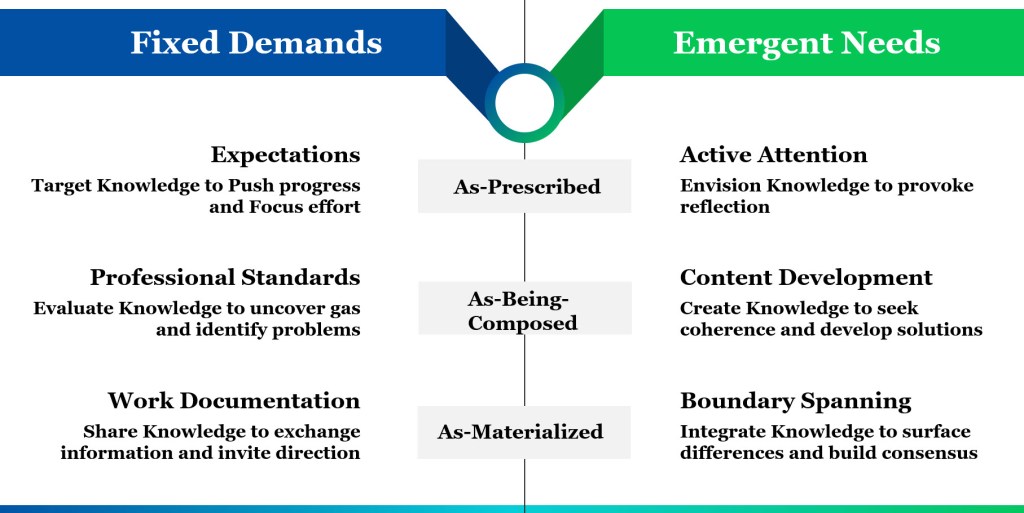
Management review is a formal communication and by understanding how these formal communications participate in the fixed and emergent conditions of knowledge work as prescribed, being-composed, and materialized-texts-in-use, we can understand how to better structure our knowledge sharing.
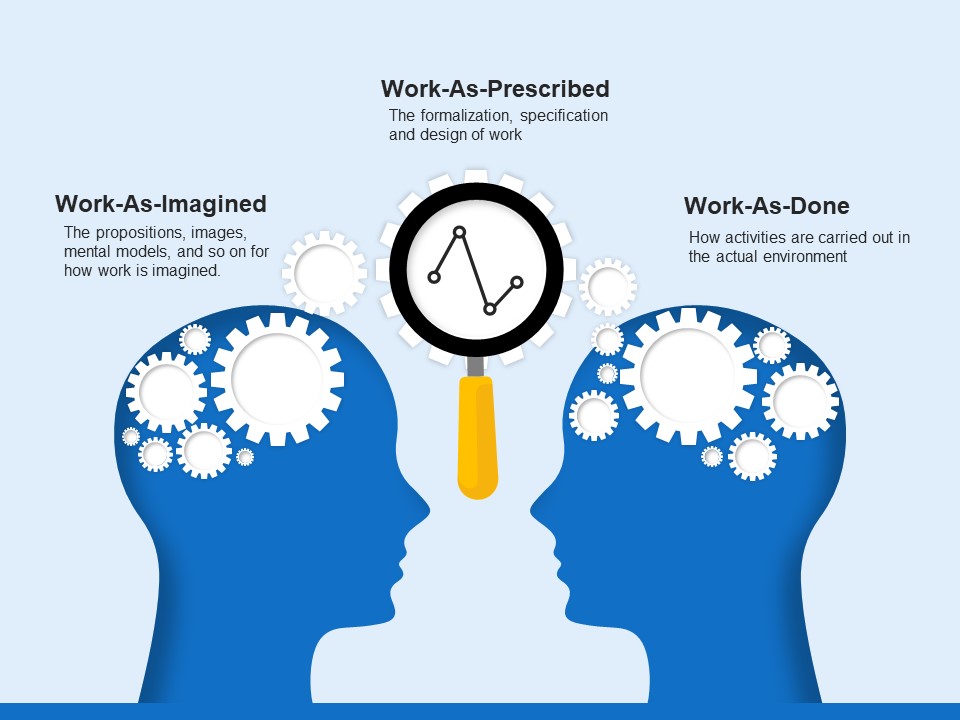
Management review mediates between Work-As-Imagined and Work-As-Done.
The quality management reviews have “fixity” and bring a reliable structure to the knowledge-work process by specifying what needs to become known and by when, forming a step-by-step learning process.
As-Being-Composed
Quality management always starts with a plan for activities, but in the process of providing analysis through management review, the organization learns much more about the topic, discovers new ideas, and uncover inconsistencies in our thinking that cause us to step back, refine, and sometimes radically change our plan. By engaging in the writing of these presentations we make the tacit knowledge explicit.
A successful management review imagines the audience who needs the information, asks questions, raises objections, and brings to the presentation a body of experience and a perspective that differs from that of the party line. Management review should be a process of dialogue that draws inferences and constructs relationships between ideas, apply logic to build complex arguments, reformulate ideas, reflects on what is already known, and comes to understand the material in a new way.
As-Materialized
Management review is a textually mediated conversation that enables knowledge integration within and across groups in, and outside of, the organization. The records of management review are focal points around which users can discuss what they have learned, discover diverse understandings, and depersonalize debate. Management review records drive the process of incorporating the different domain specific knowledge of various decision makers and experts into some form of systemic group knowledge and applies that knowledge to decision making and action.
Sources
Alvesson, M. (2004). Knowledge work and knowledge-intensive firms. Oxford University Press.
Bazerman, C. (2003). What is not institutionally visible does not count: The problem of making activity assessable, accountable, and plannable. In C. Bazerman & D. Russell (Eds.), Writing selves/writing societies: Research from activity perspectives (pp. 428–482). WAC Clearinghouse
Edmondson, A. C. (2012). Teaming: How organizations learn, innovate, and compete in the knowledge economy. Jossey-Bass
Kaplan, S. (2015). Strategy and PowerPoint: An inquiry into the epistemic culture and machinery of strategy making. Organization Science, 22, 320–346.
Levitin, D. J. (2014). The organized mind: Thinking straight in the age of information overload. Penguin
Mengis, J. (2007). Integrating knowledge through communication: The case of experts and decision makers. In Proceedings of the 2007 International Conference on Organizational Knowledge, Learning, and Capabilities (pp. 699–720). OLKC. Retrieved from https://warwick.ac.uk/fac/soc/wbs/conf/olkc/archive/olkc2/papers/mengis.pdf
Attributable is part of ALCOA that tells us that it should be possible to identify the individual or computerized system that performed the recorded task. The need to document who performed the task / function, is in part to demonstrate that the function was performed by trained and qualified personnel. This applies to changes made to records as well: corrections, deletions, changes, etc.
This means that records should be signed and dated using a unique identifier that is attributable to the author. Where author means the individual who created or recorded the data.
Understanding what role the individual is playing in the task is critical. There are basically six: Executor, Preparer, Checker, Verifier, Reviewer and Approver.
Written procedures with their step-by-step breakdown are a fundamental tool for ensuring quality through consistent execution of the work. As a standardized guideline for tasks, procedures serve many additional purposes: basis of training, ensuring regulatory requirements are met, ensuring documentation is prepared and handled correctly.
As written prescriptions of how work is to be performed, they can be based on abstract and often decontextualized expectations of work. The writers of the procedures are translating Work-as-Imagined. As a result, it is easy to write from a perspective of ideal and stable conditions for work and end up ignoring the nuances introduced by the users of procedures and the work environment.
The day-to-day activities where the procedures are implemented is Work-as-Done. Work-is-Done is filled with all the factors that influence the way tasks are carried out – spatial and physical conditions; human factors such as attention, memory, and fatigue; knowledge and skills.
Ensuring that our procedures translate from the abstraction of Work-as-Imagined to the realities of Work-as-Done as closely as possible is why we should engage in step-by-step real-world challenge as part of procedure review.
Work-as-Prescribed gives us the structure to take a more dynamic view of workers, the documents they follow, and the procedural and organizational systems in which they work. Deviations from Work-as-Prescribed point-of-view are not exclusively negative and are an ability to close the gap. This is a reason to closely monitor causes such as “inadequate procedure” and “failure to follow procedure” – they are indicators of a drift between Work-as-Prescribed and Work-as-Done. Management review will often highlight a disharmony with Work-As-Imagined.
The place where actions are performed in real-world operations is called, in safety thinking, the sharp-end. The blunt-end is management and those who imagine work, such as engineers, removed from doing the work.
Our goal is to shrink the gap between Work-as-Imagined and Work-as-Done through refining the best possible Work-as-Prescribed and reduce the differences between the sharp and the blunt ends. This is why we stress leadership behaviors like Gemba walks and ensure a good document change process that strives to give those who use procedure a greater voice and agency.
I went and did it. I now have a song on complex and complicated. A rap anthem to a subject I hold so dear. I bought this through Fiverr from Burtonm6, who was a joy to work with.
Lyrics below
Complicated and complex
these words are not synonyms/
people often misunderstand
i can break down for you
lets begin
problems that are complicated
gotta check how they originated/
from causes that can be addressed
piece by piece
individually distinguished/
yea
hope that you get the idea
cause and effect is linear
when we’re dealing with complicated
there’s more so listen here
learn the difference
ah yea we got to
I’m here to help yes i got you
remember
every input always has a proportionate output
now its time we move on to complex
lets learn what its about and how its so different
it deals with many causes that cant be distinguished
as individual
because it all intersects
and we must address as an entire system
and if you try to solve it then its not a one and done


 Investigations of a Dog