
Steven Shorrock writes about “Work-as-Observed” on his blog Humanistic Systems, as part of a great series on Work-as-Done. This is a nice framework for the activity of going to the Gemba, and I strongly recommend the entire series.

Steven Shorrock writes about “Work-as-Observed” on his blog Humanistic Systems, as part of a great series on Work-as-Done. This is a nice framework for the activity of going to the Gemba, and I strongly recommend the entire series.
The latest version (version 14) of the “How to do” Document – Interpretation of ICH Q7 Guide and “Review form” for APIs was published a few months back. It is intended to facilitate the implementation of the ICH Q7 Guideline and provides recommendations on interpretation.
In this version, the responsible Task Force of the Quality Group of APIC, which is a sector group of the European Chemical Industry Council (CEFIC), mainly made additions and updates in chapters 11 – Laboratory Controls, 15 – Complaints and Recalls, and in section 16 – Contract Manufacturers (incl. Laboratories).
The addition in section 11.11 for “Approval/rejection of materials” is pretty striaghtforward – have an SOP.
The changes in section 15 for recalls is pretty cosmetic.
I would re-read section 16 on contract manufacturers. Not much substantial here, but the rewrite makes it a good time to ensure compliance.
Interesting perspective on adapting what makes us successful as problem solvers as we move into more senior leadership positions. Resonates very well with some of my own challenges, so I stronly recommend listening to this episode.
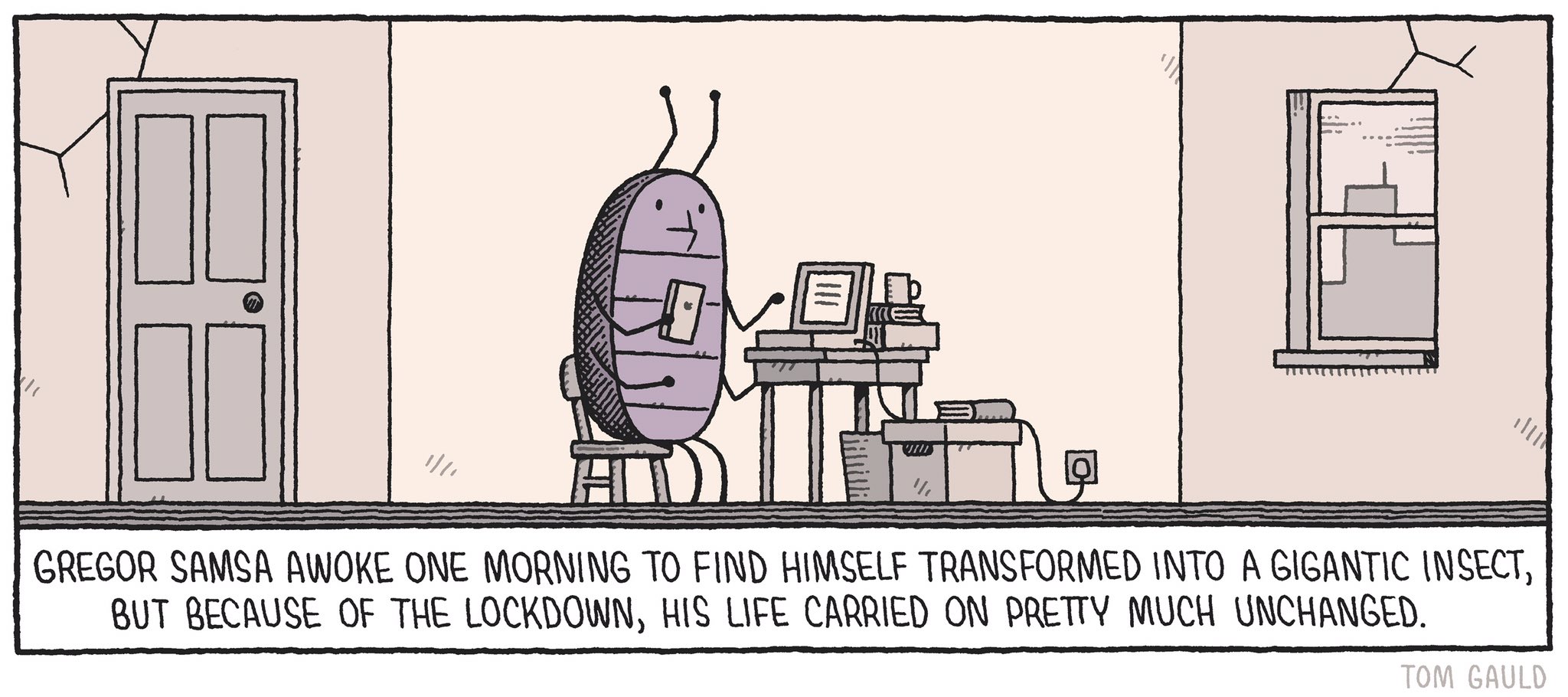
No advice here, I just wanted to share a comic I enjoyed that hit all the themes of this blog.
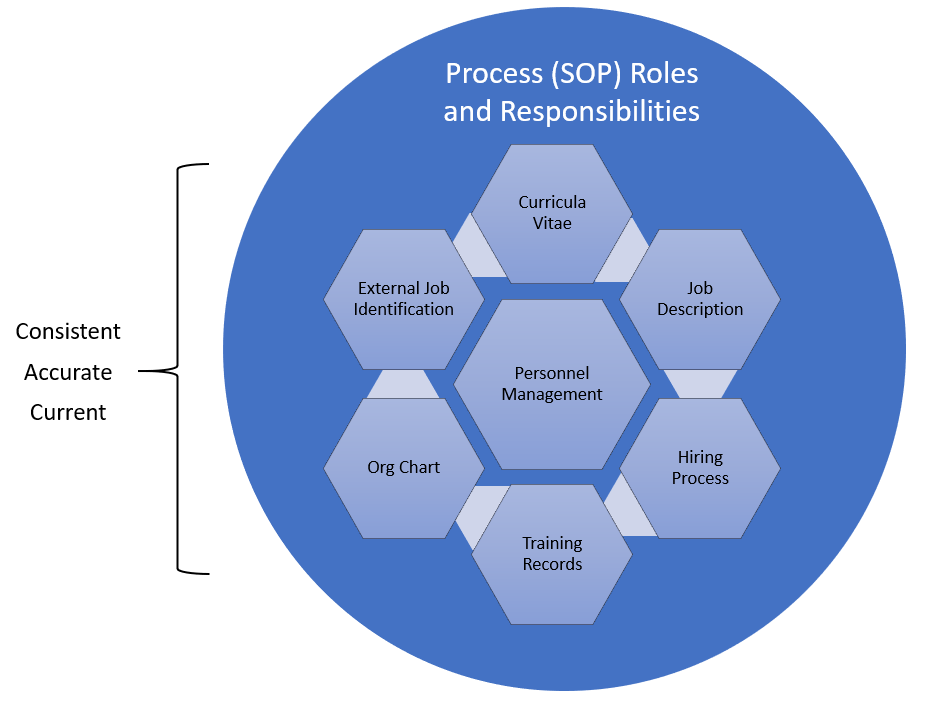
In the post “HR and Quality, joined at the hip” I covered some of the regulations that set the expectations in the pharmaceutical and medical device industries that employees have the appropriate education, experience and training to do their jobs. What is often called the personnel qualification triangle.
A job description is a written document that outlines the duties, responsibilities, contributions, behaviors, outcomes and required qualifications for a specific job in an organization. A good job description is a specification that results from a detailed job analysis. It is used in hiring and performance evaluation. It is also the starting point for determining a good GxP training plan.
In order to providing the specific knowledge, skills, abilities and behaviors that need to be addressed for each employee, the job description needs to specifically call out the roles in the processes an employee will play. Instead of providing broad statements like “participate in CAPAs” or “Manufacture product” it should be more specific such as “create and project manage CAPAs” or “Perform visual inspection.”
I challenge everyone to think broadly about the job description as a tool to drive excellence. Utilized throughout the life of employment, a job description is a powerful tool that can aid managers. Managers have a road map that can help them with their duties of planning, leading, organizing, controlling and staffing. With a road map, the complexities of the organization become easier.
The curricula vitae provides evidence that the employee is fit-for-purpose to the job description. The curricula vitae shows education and experience that demonstrates the possession of knowledge, skills, abilities and behaviors.
The training plan then lays out what the employee needs to bit fit-for-use, to be able to do all the roles in the job description. It includes all the process and role specific training, as well as filling in any gaps that might exist on the curricula vitae.
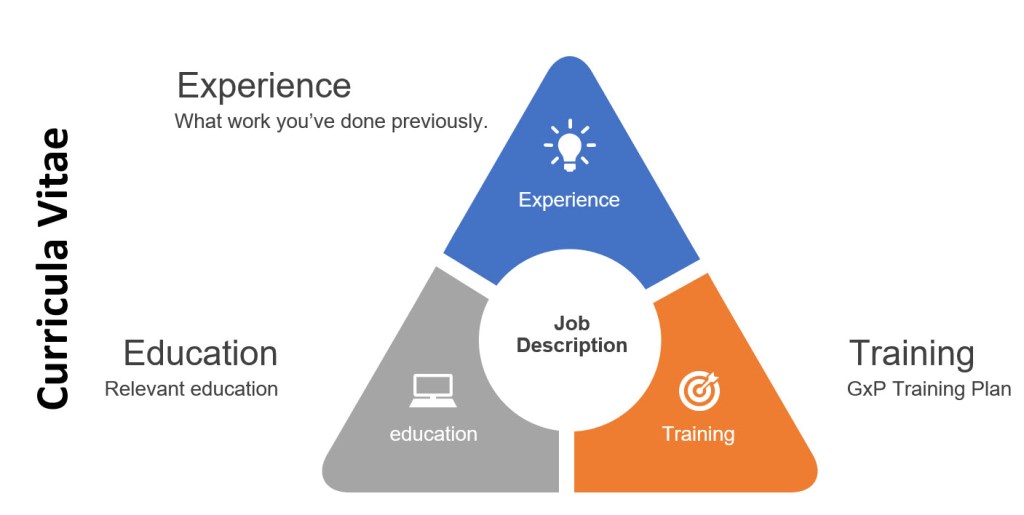
It is important to note that this may not be a fine equilateral triangle. Experience, for example, can often, but not always make up for education.
 Investigations of a Dog