Sometimes quality requires forgetting

DeHolan and Phillips introduced the concept of organizational forgetting to our concepts of knowledge management. While unintentional forgetting is something we usually want to avoid, there is a time when we want to intentionally forget.  Perhaps after a corporate merger we are combining systems or replacing systems. Perhaps it is the result of a large step forward in technology, or an out-right replacement. Some major cultural transformation comes along. And the last thing we want is for no-one to be able to forget the old. For those concepts to linger in our memory and our decisions. For that is a risk that can easily lead to deviations.
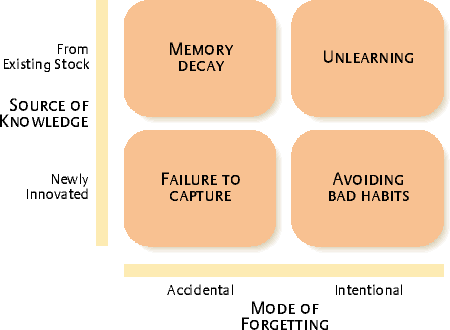
 

4529-si1-lo8

Take for example changes in document numbering. Fairly simple of the surface but remember that procedure number is the tag which we use in conversation. No-one ever gives the whole title; we throw around these tags left and right and for our own coded language (another topic worthy of a blog post). Then we change our numbering format and a year later everyone still uses the old number. And mistakes start creeping up. Or just the perception of mistakes builds. Or perhaps everyone still thinks in the manner of the old ERP’s logic, and forget to do crucial aspects of master data management when a change is made. You get the idea

This purposeful frogetting, an aspect of knowledge management (and change management) – that of the purposeful removal of knowledge — is a critical step in our systematic approach and an important part of our strategic toolkit. However, it is very difficult, as deeply embedded pieces of organizational knowledge are generally locked in place by various other pieces of organizational knowledge that depend on them, and removing one implies modifying the others as well. We need to develop the tools to dismantle the previous way of doing work — the unneeded routines and formerly dominant logics of our changed systems.

One of the best way to do this is to get rid of cues. All the little breadcrumbs left behind. If you want people to stop using old document numbers, ensure that no document folks would use on their daily basis has those numbers. However, this ideal model of radical elimination of all cues associated with the old routine seems rather unlikely in all changes from old to new . So when we are working on our change its important to select those cues that will have the biggest bang for our buck. Some general ideas to help inform this are:

  • Look for opportunities to drive out mix-messages – aim for consistency in message
  • Ensure there are positive reinforcements for use of the new routine
  • Actively constrain the to-be-forgotten activity. Reduce the time in two different processes. Do a radical transformation. Reduce the confusion.
  • Reward the individual for participating in the new way. The group can’t change faster than the sum of the individuals, so incentive the change.

When doing a change it is important to consider these as risks, and build into your change plan. Incorporate into your training. For the basis of your communications. Drive out the old, embrace the new. Otherwise you are just increasing the risks inherent in your new way of working. But like many aspects of change management, easy in concept, difficult in execution.
Master and Transactional Data Management

Mylan’s 483 observation states that changes were being made to a LIMS system outside of the site’s change control process.

This should obviously be read in light of data integrity requirements. And it looks like in this case there was no way to produce a list of changes, which is a big audit trail no-no.

It’s also an area where I’ve seen a lot of folks make miss-steps, and frankly, I’m not sure I’ve always got it right.

There is a real tendency to look at the use of our enterprise systems and want all actions and approvals to happen within the system. This makes sense, we want to reduce our touch points, but there are some important items to consider before moving ahead with that approach.

Changes control is about assessing, handling and releasing the change. Most importantly it is in light the validated and regulatory impact. It serves disposition. As such, it is a good thing to streamline our changes into one system. To ensure every change gets assessed equally, and then gets the right level of handling it needs, and has a proper release.

Allowing a computer system to balkanize your changes, in the end, doesn’t really simplify. And in this day of master data management, of heavily aligned and talking systems, to be nimble requires us to know with a high degree of certainty that when we apply a change we are applying it thoroughly.

The day of separated computer systems is long over. It is important that our change management system takes that into account and offers single-stop shopping.

Changes become effective

Change Effective, implementation, routine use…these are all terms that swirl in change control, and can mean several different things depending on your organization. So what is truly important to track?

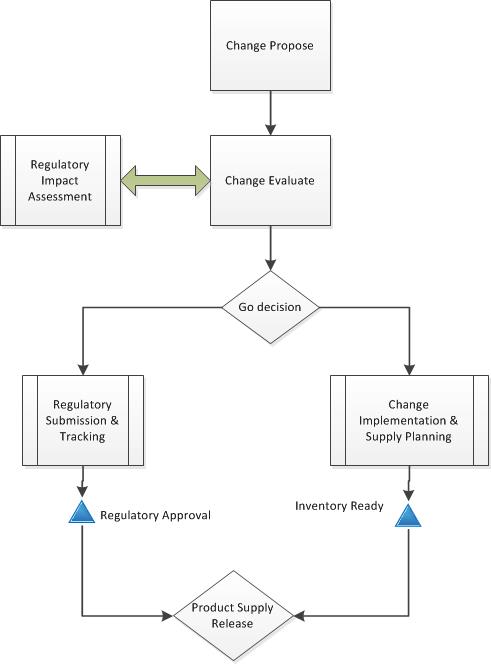
regulatory and change

Taking a look at the above process map I want to focus on three major points, what I like to call the three implementations:

  1. When the change is in use
  2. When the change is regulatory approved
  3. When product is sent to a market

The sequence of these dates will depend on the regulatory impact.

  Tell and Do Do and Tell Do and Report
Change in use After regulatory approval. When change is introduced to the ‘floor’ When change is introduced to the ‘floor’ When change is introduced to the ‘floor’
Regulatory approval Upon approvals After use, before send to market Upon reporting frequency (annual, within 6 months, within 1 year)
Sent to market After regulatory approval and change in use After regulatory approval and change in use After change in use

I’m using ‘floor’ very loosely here. “Change in use” is that point where everything you do is made, tested and/or released under the change. Perhaps it’s a batch record change. Everything that came before is clearly not under the change. Everything that came after clearly is.

You can have the same change fit into all three areas, and your change control system needs to be robust enough to manage this. This is where tracking regulatory approval per country/market is critical, and tracking when the product was first sent.

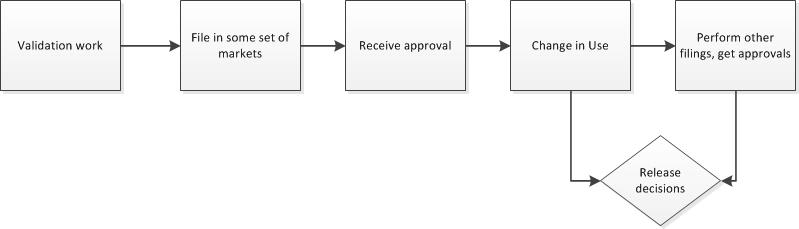
A complicated change can easily look like this (oversimplification).

building actions

Is this 1, 2 or 3 processes? More? Depends on so many factors, the critical part is building the connections and make sure your change control system both receives inputs and provides outputs. Depending on your company, the data map can get rather complicated.

29 questions to ask about your change management/change control system

While these questions are very pharma/biotech specific in places, they should serve as thought process for your own system checkup.

  1. Is there a written SOP covering the change control program that has been approved by the Quality Unit?
  2. Do procedures in place describe the actions to be taken if a change is proposed to a starting material, product component, process equipment, process environment (or site), method of production or testing or any other change that may affect product quality or reproducibility/robustness of the process?
  3. Does the SOP ensure that all GMP changes are reviewed and approved by the Quality Unit?
  4. If changes are classified as “major” or “minor,” do procedures clearly define the differences?
  5. Does your change management system include criteria for determining if changes are justified?
  6. Are proposed changes evaluated by expert teams (e.g. HSE, Regulatory, Quality…)?
  7. Is there a process for cancelling a change request prior to implementation? And Is a rationale for cancellation included?”
  8. Does your Change control management site procedure describe clearly the process to close a change request (After all regulatory approvals…)?
  9. Are any delays explained and documented?
  10. Is there a written requirement that change controls implemented during normal or routine maintenance activities be documented in the formal change control program?
  11. Is your change management system linked to other quality systems such as CAPA, validation, training?
  12. Does your change management system include criteria for determining if changes will require qualification/requalification, validation/revalidation and stability studies?
  13. Are “like for like” changes (changes where there is a direct replacement of a component with another that is exactly the same) clearly defined in all aspects (including material of construction, dimensions, functionality,,,) ? Are they adequately documented and commissioned to provide traceability and history?”
  14. Is there an allowance for emergency and temporary changes under described conditions in the procedures?
  15. Are the proposed changes evaluated relative to the marketing authorization and/or current product and process understanding?
  16. Does your change management system include criteria to evaluate whether changes affect a regulatory filling?
  17. Are appropriate regulatory experts involved? Does the regulatory affairs function evaluate and approve all changes that impact regulatory files?
  18. Are changes submitted/implemented in accordance with the regulatory requirements?
  19. Is there a defined system for the formalization, roles, and responsibilities for change control follow-up?
  20. Is the effective date of the change (completion date) recorded and when appropriate the first batch manufactured recorded?
  21. Is there a periodic check of the implementation of Change controls?
  22. Following the implementation, is there an evaluation of the change undertaken to confirm the change objectives were achieved and that there was no adverse impact on product quality?
  23. Is all documentation that provides evidence of change, and documentation of requirements, controlled and retained according to procedure?
  24. When necessary, are personnel trained before the implementation of the change?
  25. Are change controls defined with adequate target dates?
  26. If the change control goes beyond the target date, is there a new date attributed, evaluated and documented by Quality Assurance?
  27. Are there routine evaluations of the Change controls and trends (number, Change controls closure, trends as defined)?
  28. Are changes closed on due date ?
  29. Are the Change controls and follow-up formalized in a report and/or periodic meetings?

These sort of questions form a nice way to periodically checking up on your system performance and ensuring you are moving in the right direction.

Training assessment as part of change management

One of the key parts of any change (process improvement, project, etc) is preparing people to actually do the work effectively. Every change needs to train.

Building valid and reliable training at the right level for the change is critical. Training is valid when it is tied to the requirements of the job – the objectives; and when it includes evaluations that are linked to the skills and knowledge started in the objectives. Reliability means that the training clearly differentiates between those who can perform the task and those who cannot.

A lot of changes default to read-and-understand training. This quite bluntly is the bane of valid and reliable training with about zero value and would be removed from our toolkit if I had my way.

There are a lot of training models, but I hold there is no single or best method. The most effective and efficient combination of methods should be chosen depending on the training material to be covered and the specific needs of the target group.

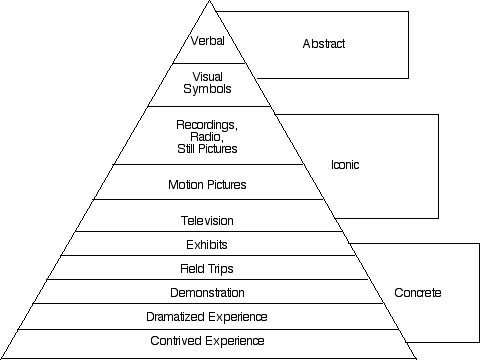
For my purposes I’ll draw from Edgar Dale’s Cone of Experience, which incorporates several theories related to instructional design and learning processes. Dale theorized that how a  learner retained information is based on what they “do” as opposed to what is “heard,” “read” or “observed.” This is often called experiential or action learning.

dalescone

Based on this understanding we can break the training types down. For example:

  • Structured discussions are Verbal and some Visual, and lives within the Abstract
  • Computer Based Trainings are mostly Iconic, with a few concrete
  • Instructor Led Trainings are a lot about Concrete
  • On-the-job training is all about the Concrete

Once we have our agreed upon training methods and understand what makes them a good training we can then determine what criteria of a change leads to the best outcome for training. Some example criteria include:

  • Is a change in knowledge or skills needed to execute the procedure?
  • Is the process or change complex? Are there multiple changes?
  • Criticality of Process and risk of performance error? What is the difficulty in detecting errors?
  • What is the identified audience (e.g., location, size, department, single site vs. multiple sites)?
  • Is the goal to change workers‘ conditioned behavior

This sort of questioning gets us to risk based thinking. We are determining where the biggest bang from our training is.

Building training is a different set of skills. I keep threatening a training peer with doing a podcast episode (probably more than one) on the subject (do I really want to do podcasts?).

The last thing I want to leave you is build training evaluations into this. Kilpatrick’s model is a favorite – Level 4 Results evaluations which tell us how effective our training was overtime actually makes a darn good effectiveness review. I strongly recommend building that into a change management process.