
EMA Publishes 2021 GCP Compliance Report

The EMA has published the Annual Report of the Good Clinical Practice (GCP) Inspectors Working Group (IWG) 2021.

Beyond wishing for an 11 month cycle of writing and approval on my annual reports, there is some valuable information there.

In 2021, three CHMP GCP inspections were conducted entirely remotely, and three inspections were conducted in a hybrid setting. A total of 286 deficiencies, comprising 24 critical, 152 major and 110 minor findings were recorded for the 27 CHMP requested inspections conducted in 2021. This represents an average of 10-11 findings per site inspected. The three top categories were: “General”, “Trial Management” and “Computer System”. An increase in findings related to computer systems (e. g. Audit Trail and Authorized Access, Computer Validation, Physical Security System and Backup) is noted compared to the last reports.

More information is available at EMA´s Good Clinical Practice Inspectors Working Group website.
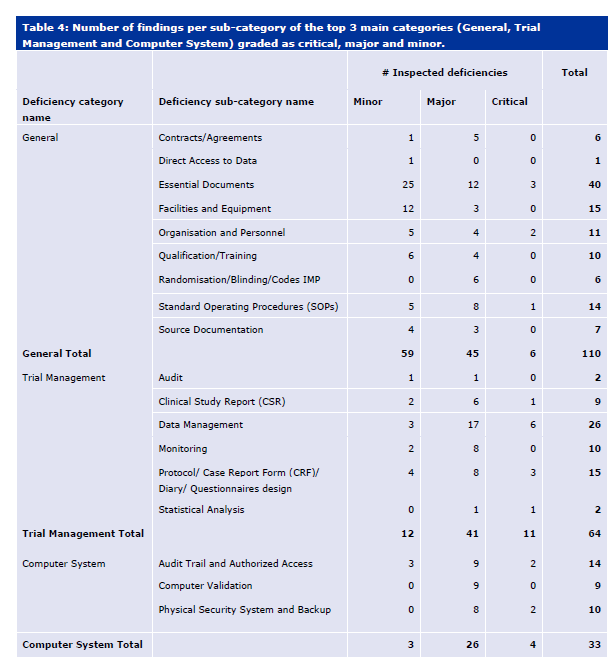
Under organisation and personel we see “Delegation of tasks to inappropriate team members.” This reinforces the needs for strong cv and job descriptions, and linking to both hiring and personnel qualification.

The computer systems observations are the greatest hits of data integrity, and should be a wakeup call to any company that treats GCP and GMP computer systems differently.

Let the 2022 annual GCP training development begin. And make sure you get that training done on time!

Sunscreen is a drug

Folks often forget that in the United States the active ingredient in sun screen is a drug and needs to meet appropriate quality system requirements. This Warning Letter to Kari Gran, Inc is a case in point.

The whole warning letter is a result of a company not realizing (or thinking they can get away with not having) the need for GMP compliance.

I’m not sure I would draw broader trends around data integrity or anything else from it.

Photo by Kindel Media on Pexels.com

Risk Assessments Do Not Replace Technical Knowledge

The US Food and Drug Administration (FDA) last month warned Indian generic drugmaker Lupin Limited over three good manufacturing practice (GMP) violations at its facility in Maharashtra, India that identified issues with the company’s written procedures for equipment cleaning, its written procedures for monitoring and controlling the performance of processing steps and the “failure to investigate all critical deviations.”

The FDA said the company “performed multiple risk assessments with the purpose to verify whether existing cleaning procedures and practices eliminate or reduce genotoxic impurities … generated through the manufacture of [redacted] drugs after you detected [redacted] impurities in your [active pharmaceutical ingredient] API.” The company also performed risk assessments to determine whether its cleaning procedures reduced the risk of cross-contamination of intermediates and API. However, FDA said the risk assessments “lacked data to support that existing equipment cleaning procedures are effective in removing [redacted] along with residual API from each respective piece of equipment to acceptable levels. “The identification of genotoxic impurities in quantities near their established limits suggests excursions are possible. All intermediates and API manufactured on non-dedicated equipment used to manufacture [redacted] drugs should be subject to validated sampling and analytical testing to ensure they are not contaminated with unacceptable levels of genotoxic impurities,” FDA said.

At heart this warning letter shows a major weakness in many company’s risk management approach, they use the risk assessment to replace technical inquiry, instead of as a tool to determine the appropriateness of technical understanding and as a way to manage the uncertainty around technical knowledge.

A significant point in the current Q9 draft is to deal with this issue, which we see happen again and again. Risk management cannot tell you whether your cleaning procedures are effective or not. Only a validated testing scheme can. Risk management looks at the aggregate and evaluates possibilities.

Computer Software Assurance Draft

The FDA published on 13-Sep-2022 the long-awaited draft of the guidance “Computer Software Assurance for Production and Quality System Software,” and you may, based on all the emails and posting be wondering just how radical a change this is.

It’s not. This guidance is just one big “calm down people” letter from the agency. They publish these sorts of guidance every now and then because we as an industry can sometimes learn the wrong lessons.

This guidance states:

  1. Determine intended use
  2. Perform a risk assessment
  3. Perform activities to the required level

I wrote about this approach in “Risk Based Data Integrity Assessment,” and it has existed in GAMP5 and other approaches for years.

So read the guidance, but don’t panic. You are either following it already or you just need to spend some time getting better at risk assessments and creating some matrix approaches.

Data Integrity Warning Letter

In July 2022, the U.S. FDA issued a Warning Letter to the U.S. American company “Jost Chemical Co.” after having inspected its site in January 2022. The warning letter listedfour significant areas:

  • Failure of your quality unit to ensure that quality-related complaints are investigated and resolved, and failure to extend investigations to other batches that may have been associated with a specific failure or deviation.”
  • “Failure to establish adequate written procedures for cleaning equipment and its release for use in manufacture of API.”
  • “Failure to ensure that all test procedures are scientifically sound and appropriate to ensure that your API conform to established standards of quality and purity, and failure to ensure laboratory data is complete and attributable.”
  • “Failure to exercise sufficient controls over computerized systems to prevent unauthorized access or changes to data, and failure to establish and follow written procedures for the operation and maintenance of your computerized systems.”

I offer them the above clip as a good mini-training. I recently watched the show, and my wife thought I was going to have several heart attacks.

In a serious nature, please do not short your efforts in data integrity.