When thinking about root cause analysis it is useful to think of whether the problem is stemming from a cultural level or when it may be coming from an operational. We can think of these problems as hazards stemming from three areas:
Culture/philosophy is the over-arching view of how the organization conducts business from top-level decision-makers on through the corporate culture of an organization.
Policies are the broad specifications of the manner in which operations are performed. This includes the end-to-end processes.
Policies lead to the development of process and procedures, which are specifications for a task or series of tasks to accomplish a predetermined goal leading to a high degree of consistency and uniformity in performance.
Hazards unrecognized (risks not known or correctly appraised)
Hazards forseen (risks anticipated but response not adequate)
Culture/Philosophy Quality not source of corporate pride Regulatory standards seen as maxima
Culture/Philosophy Quality seen as source of corporate pride Regulatory standards seen as minima
Policy Internal monitoring schemes inadequate (e.g. employee concerns not communicated upwards) Insufficient resources allocated to quality Managers insufficiently trained or equipped Reliance on other organization’s criteria (e.g. equipment manufacturer)
Policy Known deficiencies (e.g. equipment, maintenance) not addressed Defenses not adequately monitored Defenses compromised by other policies (e.g. adversarial employee relations, incentive systems, performance monitoring)
Procedures Documentation inadequate Inadequate, or Loop-hole in, controls Procedures conflict with one another or with organizational policy
This approach on problems avoids a focus on the individuals involved and avoids a blame culture, which will optimize learning culture. Blaming the individuals risks creating an unsafe culture and creates difficulties for speaking up which should be an espoused quality value. Focus on deficiencies in the system to truly address the problem.
In the post “Quality Culture is Fundamental to Actually Providing Quality” I discussed some of the elements of organizational culture and how it fits into conceptualizing a quality culture. I think it is important to discuss some of the complexities and how these complexities need to be solved through iterative experiments.
John Traphagan in his 2017 HBR article “We’re Thinking about Organizational Culture All Wrong” discusses how that the study of organizational culture commonly conveys the idea of culture as a unifying force that brings people together to work productively toward the attainment of organizational goals. The approach implies that organizational culture is understood as a collective project able to create unity and cohesion in some simple steps. But reality presents a quite different picture because today culture is not only about cohesiveness and unity. It is also about disagreement, discrepancy and disparities constantly testing the capacity of people to work together and benefit advancing common and ethical organizational goals in spite of individual differences.
Traphagan ends his article with a powerful statement that should be kept front and center in any culture initiative: “The idea that unity can be generated among employees by fixing or creating an organizational culture relies on a naïve assumption that culture unambiguously brings people together. But the reality of culture is that it represents a tremendously complex variable that can both bring people together and pull them apart — or do both at the same time.”
Because of the reality Traphagan discusses, we need to realize that work on culture is really about experiments. I’ll point you to another article in HBR by Stefan Thomke “Building a Culture of Experimentations“. This article emphasizes that the main obstacles obstructing change are lodged in the culture, in deep shared behaviors, beliefs and values that shape a culture over time and perpetuate in place without periodic or effectiveness assessment and in spite of obsolescent outcomes. Thomke writes that a successful culture of experimentation is built on five critical elements: cultivation of people’s curiosity, insisting that data trump educated opinions (avoiding guessing), democratize experimentation across organizational divisions, promoting ethical sensitivity in all functions and embracing a humane and agile leadership model.
Culture is a complex problem and the only true path for addressing is small scale experimentation iteratively applied with the end-goal of transformation.
For all I love the hard dimensions of quality (i.e. process, training, validation, management review, auditing, measurement of KPI) I also stress in my practice how the soft dimension of communication and employee participation, and teamwork are critical to bringing about a culture of excellence. Without a strong quality culture, people will not be ready to commit and involve themselves fully in building and supporting a robust quality management system. The goal is to align top management behavior and the emergent culture to be consistent over time with the quality system philosophy or people will become cynical. In short, organizational culture should be compatible with quality values.
Quality culture is justifiably the rage and it is not going anywhere. If you are not actively engaging with it you are losing one of your mechanisms for success.
Quality Culture really serves as a way to categorize an organizational culture that intends to enhance quality permanently. There are two distinct elements characterizing this culture:
A cultural/psychological element of shared values, beliefs, expectations, and commitment toward quality
A structural/managerial element with defined processes that enhance quality and aim at coordinating individual efforts.
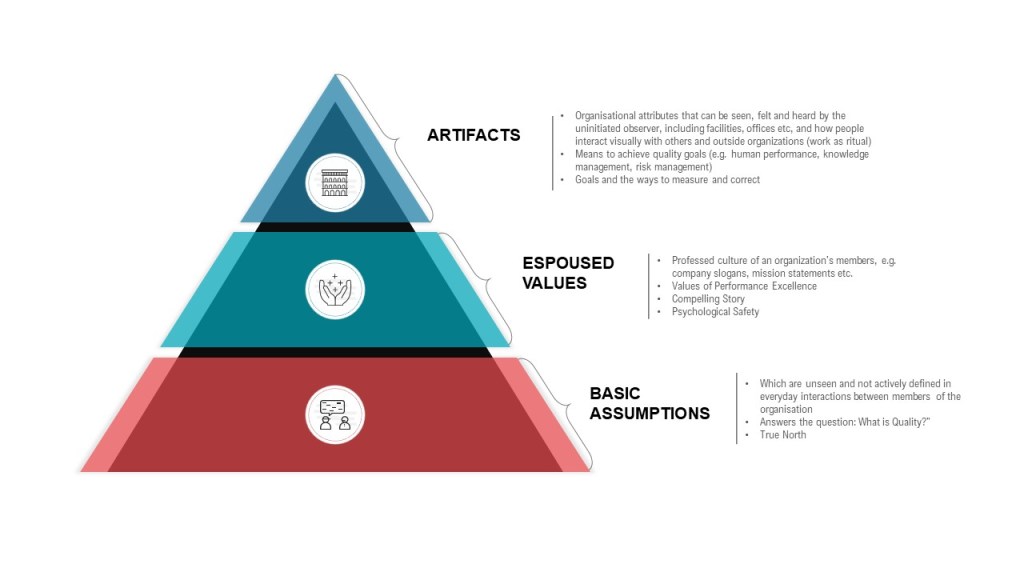
Edgar Schein’s Organizaitonal Culture Model
Schein’s model of organizational culture provides a valuable place to start in assessing quality culture:
The first basic quality assumption to tackle is to answer what do you mean by Quality?
Even amongst quality professionals, we do not all seem to be in agreement on what we mean by Quality. Hence all the presentations at conferences and part of the focus on Quality 4.0 (the other part of the focus is mistaken worship of technology – go back to Deming people!)
Route out the ambiguity that results in:
Uncontrollable fragmentation of quality thinking, discussion, and practices
Superficiality of quality-related information and communication
Conceptual confusion between the quality results and quality enablers, and between quality and many other related factors
Disintegration of the foundation of quality
I like to place front and center the definition of quality from ISO 9000: “degree to which a set of inherent characteristics of an object fulfils requirements.” This definition emphasizes the relative nature of quality (“degree”) that also highlights the subjective perception of quality. The object of quality is defined more generally than for the goods or service products only. The object has its inherent characteristics that consist of all of its features or attributes. “Requirement” means here needs and expectations, which may be related to all interested parties of the object and the interaction. This definition of quality is also compatible the prevailing understanding of quality in everyday language.
For an organization, the definition of quality relates to the organization’s stakeholders. With the definition, we can consider both the quality of the organization as a whole and the quality of the entities being exchanged between the organization and its stakeholders. Products produced and delivered to the organization’s customers are especially significant entities in this context.
Following through with ISO9000’s definition of Quality management implying how the personal, organizational, or societal resources and activities or processes are managed with regard to quality, we are able to the framework for basic quality assumptions in an organization.
Herein usually lies your True North, a term used a lot, that recognizes that quality is a journey: there is no absolute destination point and we will never achieve perfection. Think of True North not as a destination, but as a term used to describe the ideal state of perfection that your organization should be continually striving for.
In espoused quality values we take the shared concept of quality and expand it to performance excellence as an integrated approach to the organizational performance management that results in:
the delivery of ever-improving value to customers and stakeholders, contributing to organizational sustainability
the improvement of overall organizational effectiveness and capabilities
Organizational and personal learning.
We need to have a compelling story around these values.
A compelling story is a narrative that charts a change over time, showing how potential solutions fit into the espoused values. This story can generate more engagement from listeners than any burning platform ever will. By telling a compelling story, you clarify the motivation to develop discontent with the status quo. Let the story show the organization where you have come from and where you might go. The story must be consistent and adopted by all leaders in the organization. The leadership team should weave in the compelling story at all opportunities. They should ask their teams constantly, “What’s next?” “How can we make that even better?” “How did you improve your area today?”
Compelling stories often build on dissatisfaction by positioning against competitors. In the life science sector, it can be more effective to enshrine the patient in the center of the compelling story. People will support change when they see and experience a purposeful connection to an organization’s mission. The compelling story drives that.
Espoused values require strong and constant communication.
Espoused values have more levers for change than basic assumptions. While I placed True North down in assumptions, in all honestly it will for a central part of that compelling story and drive the adoption of the espoused values.
In the post “Driving towards a Culture of Excellence” I provided elements of a high-performing culture that count as artifacts of quality, stemming from the values.
Leveraging the company’s new employee orientation program can help both compliance and quality by ensuring that a new hire (or transfer) understands the expectations for employee performance which:
Are covered by the GxP regulations, corporate policies and process/procedure
Are written and readily available to employees
Are mandatory
In a heavily regulated industry, like pharmaceuticals, this is especially important because an individual may not have experienced such regulation in their former position. Even within a regulated organization the level of regulatory experience will change as you move from one area to the next.
The new hire orientation process is not a once-and-done and should be long enough to truly make an impact on the individual’s performance.
This new hire program is seeing to engage new hires more rapidly within the quality culture to ensure that employee’s behavior aligns more rapidly with quality culture.
For example, the new hire orientation should reinforce that a pharmaceutical company is a regulated environment, responsible for products that can directly affect customers’ health and quality of life. Product failure could result in death or sickness. Working for an organization where products help preserve and sustain life comes with the responsibility to know one’s job and perform it correctly at all time.
New hire orientation must present the organization’s cultural imperative for quality – why is it important to fulfill the organization’s purpose or reason for being – and how has this been embedded into the organization’s culture. At heart new hire orientation should answer three questions:
What does quality mean to you personally and how do you exhibit in the organization?
What are the expectations for quality outcomes in the organization and how we judge that they have been met.
How quality is embedded in the culture and daily work of the people in this organization and what represents good role model behaviors.
Content that does not immediately impact the new hire, or only impacts new hires in several departments or units, is better deferred until later training activities.
Topics that would be in that immediate review include:
What does it mean to work in a regulated environment
The role of the quality system
How to access process/procedure and complete training

 Investigations of a Dog