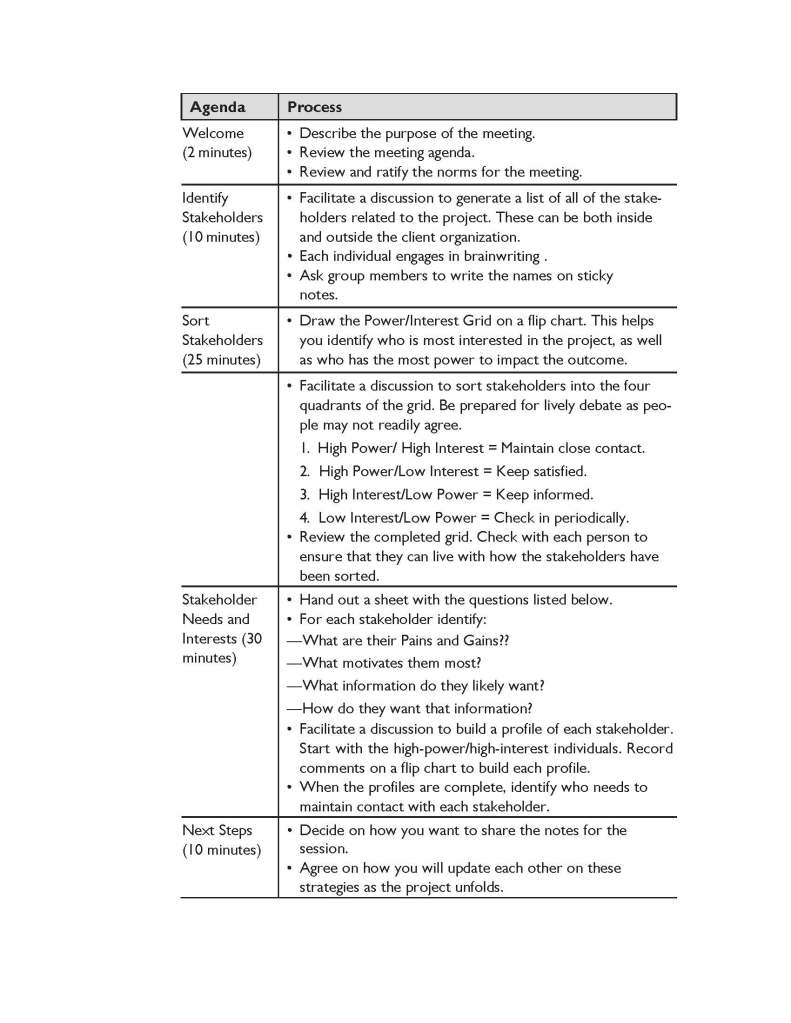
Like most facilitators I have strong opinions on brainstorming. And like a lot of the soft side of quality, these facilitation skills can really open themselves to a criticism of the vulnerability of scientific claims and there is a fair amount of justification for criticisms of the pursuit of novelty over truth. Add to it that there is this major pipeline of junk psychological science and there are good reasons for challenging these opinions.
It is for this reason I do less and less brainstorming as a verbal exercise, and rely more on brainwriting as I discussed in the post “Brainstorming usually sinks your ship.”
In the article “Should we allow criticism while brainstorming?” by Dylan Walsh we are exposed to some research from Jared Curhan at MIT that shows when criticism should be leveraged in brainstorming exercises. Well worth the read.
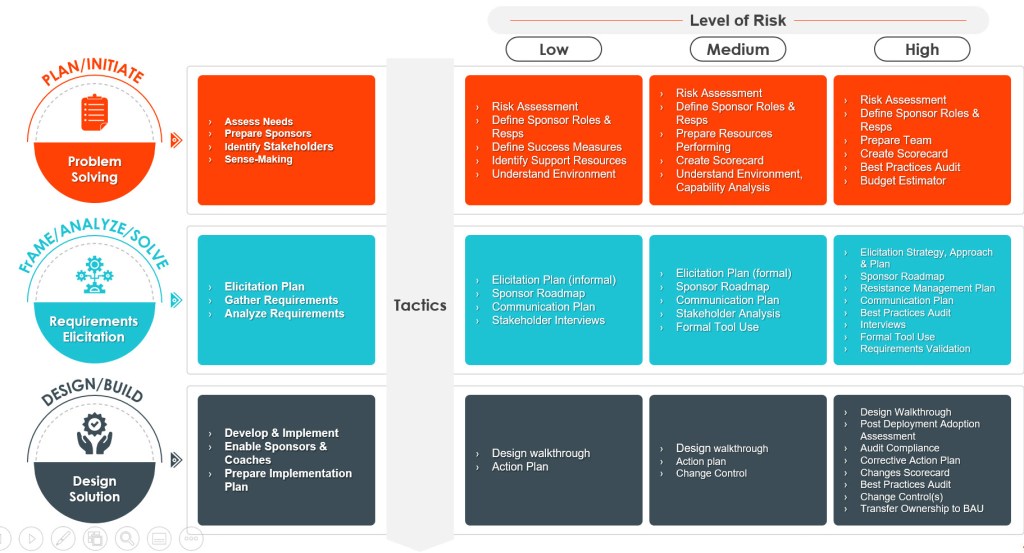
Like most activities, the level of effort is commensurate with the level of risk. Above I provide some different activities that can happen based on the risk inherent in the process and problem being evaluated.
Gemba, as a term, is here to stay. We’re told that gemba comes from the Japanese for “the actual place”, and people who know more than me say it probably should translate as “Genba” but phonetically it uses an “m” instead and as a result, it’s commonly referred to as gemba – so that’s how it is used. Someday I’ll see a good linguistic study of loan words in quality circles, and I have been known to fight against some of the “buzz-terminess” of adopting words from Japanese. But gemba is a term that seems to have settled in, and heck, English is a borrowing language.
Just don’t subject me to any more hour-long talks about how we’re all doing lean wrong because we misunderstood a Japanese written character (I can assure you I don’t know any Japanese written characters). The Lean practitioner community sometimes reminds me of 80s Ninja movies, and can be problematic in all the same ways – you start with “Enter the Ninja” and before long it’s Remo Williams baby!
So let’s pretend that gemba is an English word now, we’ve borrowed it and it means “where the work happens.” It also seems to be a noun and a verb.
And if you know any good studies on the heady blend of Japanophobia mixed with Japanophilia from the 80s and 90s that saturated quality and management thinking, send them my way.
I think we can draw from ethnography more in our methodology.
The Importance of the Gemba Walk
Gemba is a principle from the lean methodology that says “go and see” something happening for real – you need to go and see how the process really works. This principle rightly belongs as one of the center points of quality thinking. This may be fighting words but I think it is the strongest of the principles from Lean because of the straightforward “no duh” of the concept. Any quality idea that feels so straightforward and radical at the same time is powerful.
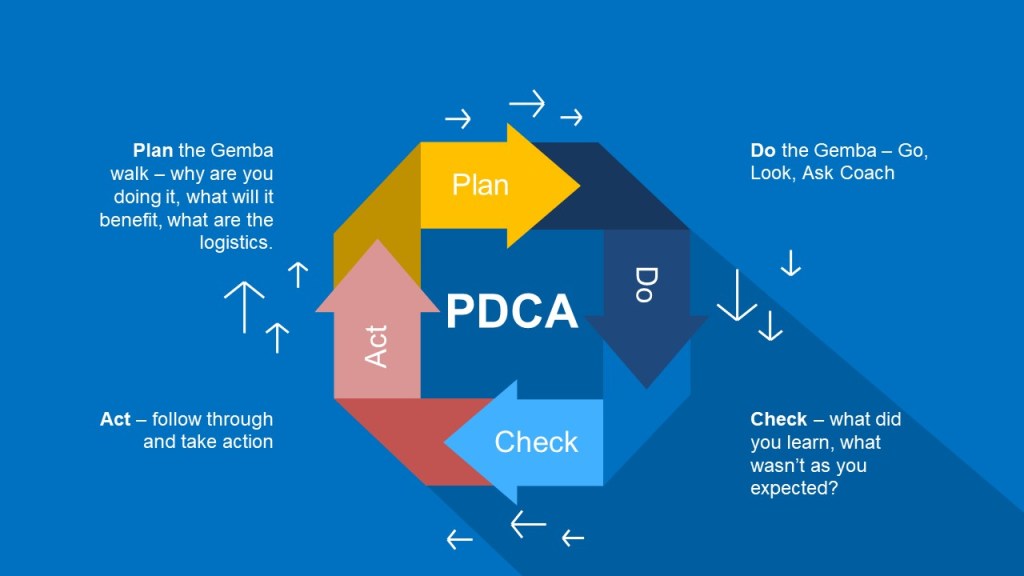
You can think of a gemba through the PDCA lifecycle -You plan, you do it, you decide on the learnings, you follow through.
Gemba seen through the PDCA lense
This is all about building a shared understanding of problems we all face together by:
Observation of specific issues where things don’t go as intended, listening to the people who do the work.
Discussion of what those issues mean both in the details of operations but also on a wider strategic level.
Commitment to problem solving in order to investigate further – not to fix the issue but to have the time to delve deeper. The assumption is that if people understand better what they do, they perform better at every aspects of their job
Gemba walks demonstrate visible commitment from the leadership to all members of the organization. They allow leadership to spread clear messages using open and honest dialogue and get a real indication of the progress of behavioral change at all levels. They empower employees because their contributions to site results are recognized and their ideas for continuous improvements heard.
Conducting a Successful Gemba Walk
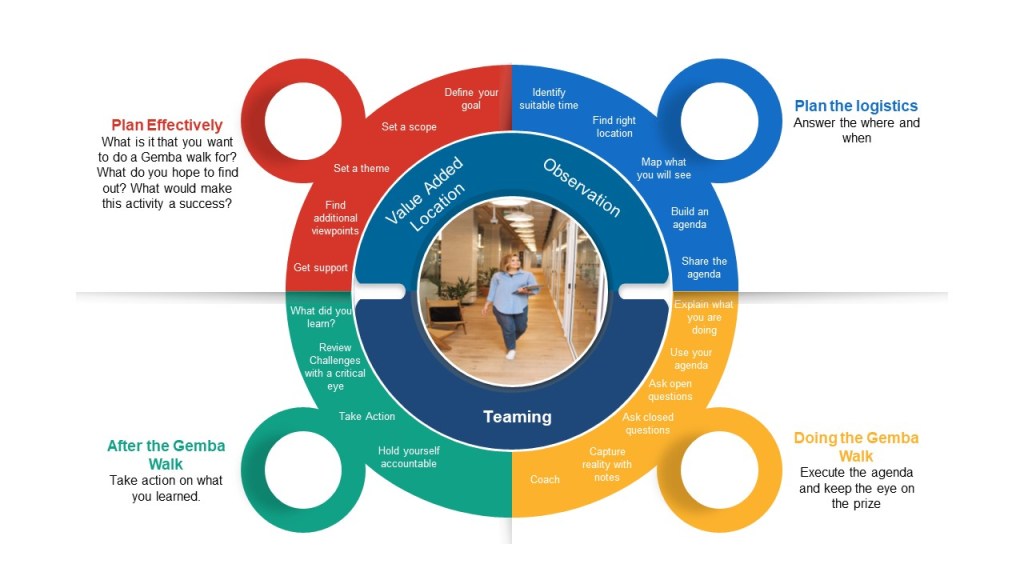
Elements of a Successful Gemba
Plan Effectively
Define your goal
What is it that you want to do a gemba walk for? What do you hope to find out? What would make this activity a success? A successful walk stresses discovery.
Set a scope
Which areas will you observe? A specific process? Team? This will allow you to zoom into more detail and get the most out of the activity.
Set a theme
What challenges or topics will you focus on? Specific and targeted gemba walks are the most effective. For example, having a emba focusing on Data Integrity, or area clearance or error reduction.
Picking the right challenge is critical. Workplaces are complex and confusing, a gemba walk can help find concrete problems and drive improvement linked to strategy.
Find additional viewpoints
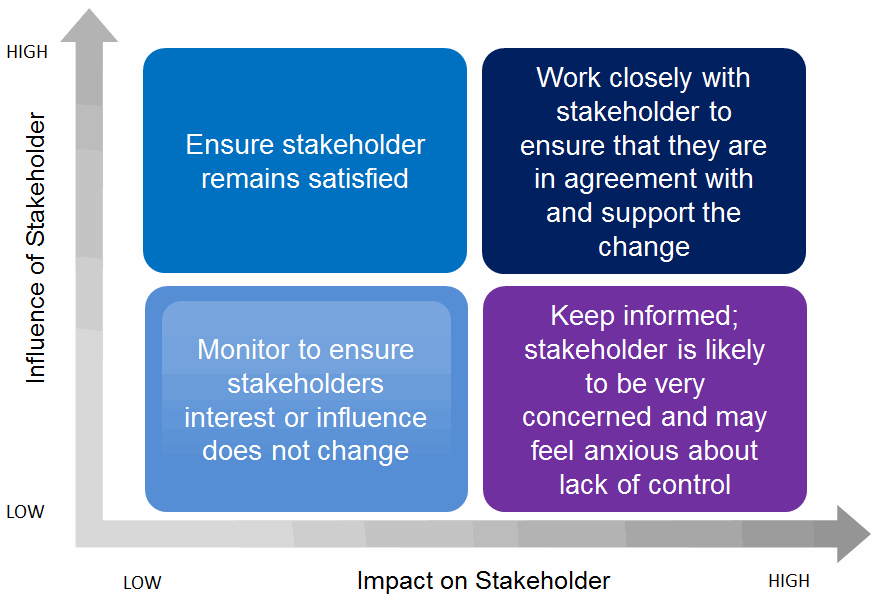
Who else can help you? Who could add a “fresh pair of eyes” to see the big questions that are left un-asked. Finding additional people to support will result in a richer output and can get buy in from your stakeholders.
Get support
Bring visibility and sponsorship for your gemba. Ensure all stakeholders are aware and on board.
Plan the Logistics
Identify Suitable Time
Find a suitable time from the process’ perspective. Be sure to also consider times of day, days of the week and any other time-based variations that occur in the process.
Find right location
Where should you see the process? Also, do you need to consider visiting multiple sites or areas?
Map what you’ll see
Define the process steps that you expect to see.
Build an agenda
What parts of the process will you see in what order? Are there any time sensitive processes to observe?
Share that agenda
Sharing your agenda to get help from the operational owner and other subject matter experts.
Doing the Gemba Walk
Explain what you are doing
Put people at ease when you’re observing the process.
When you are on the walk you need to challenge in a productive yet safe manner to create a place where everyone feels they’ve learned something useful and problems can be resolved. It pays to communicate both the purpose and overall approach by explaining the why, the who, and the when.
Use your agenda
Keep some flexibility but also make sure to cover everything.
Open discussion and explore the process challenges.
Ask closed questions
Use this to check your understanding of the process.
Capture reality with notes
Take notes as soon as possible to make sure you recall the reality of the situation.
Coach
As a coach, your objective is not to obtain results – that’s the person you’re coaching’s role – but to keep them striving to improve. Take a step back and focus on dismantling barriers.
What did you learn
What did you expect to see but didn’t? Also, what did you not expect to happen?
The ask questions, coach, learn aspect can be summarized as:
Visualize the ideal performance with your inner eye
Spot the specific difficulty the person is having (they’ll tell you – just listen)
Explain that (though sometimes they won’t want to hear it)
Spell out a simple exercise to practice overcoming the difficulty.
After the Gemba Walk
What did you learn?
Were challenges widespread or just one offs? Review challenges with a critical eye. The best way I’ve heard this explained is “helicopter” thinking – start n a very detailed operational point and ascend to the big picture and then return to the ground.
Resolve challenges with a critical eye
Define next steps and agree which are highest priority. It is a good outcome when what is observed on the gemba walk leads to a project that can transform the organization.
Take action
Follow-through on the agreed upon actions. Make them visible. In order to avoid being seen only as a critic you need to contribute firsthand.
Hold yourself to account
Share your recommendations with others. Engage in knowledge management and ensure actions are complete and effective.
Key points for executing a successful GEMBA
Gemba Walks as Standard Work
You can standardize a lot of the preparation of a gemba walk by creating standard work. I’ve seen this successfully done for data integrity, safety, material management, and other topics.
Build a frequency, and make sure they are often, and then hold leaders accountable.
Who
Best Practice Frequency
Minimum Recommended Frequency
First line supervisors
Each shift, multiple times
Each shift
Team leaders in individual units
Daily covering different shifts
2 per week
Unit/Department heads
1 per day
1 per week
Leadership team
1 per day
1 per month
Internal customers and support (e.g. purchasing, finance, HR)
1 per month
1 per quarter
Frequency recommendation example
Going to the Gemba for a Deviation and Root Cause Analysis
These same principles can apply to golden-hour deviation triage and root cause analysis. This form of gemba means bringing together a cross-functional team meeting that is assembled where a potential deviation event occurred. Going to the gemba and “freezing the scene” as close as possible to the time the event occurred will yield valuable clues about the environment that existed at the time – and fresher memories will provide higher quality interviews. This gemba has specific objectives:
Obtain a common understanding of the event: what happened, when and where it happened, who observed it, who was involved – all the facts surrounding the event. Is it a deviation?
Clearly describe actions taken, or that need to be taken, to contain impact from the event: product quarantine, physical or mechanical interventions, management or regulatory notifications, etc.
Interview involved operators: ask open-ended questions, like how the event unfolded or was discovered, from their perspective, or how the event could have been prevented, in their opinion – insights from personnel experienced with the process can prove invaluable during an investigation.
You will gain plenty of investigational leads from your observations and interviews at the gemba – which documents to review, which personnel to interview, which equipment history to inspect, and more. The gemba is such an invaluable experience that, for many minor events, root cause and CAPA can be determined fairly easily from information gathered solely at the gemba.
One of the great tools of root cause analysis, planning, process improvement and knowledge management is the interview. Properly used the interview allows one to gather a great deal of information and perspective and ferret out hidden information.
For interviews to be truly effective, we have to understand how the function and apply a process. Cognitive Interviewing, originally created for law enforcement and later adopted during accident investigations by the National Transportation Safety Board (NTSB), provides an effective framework. I was first introduced to this at my previous company, where it has become a real linchpin, so I share it here.
The two principles here are:
Witnesses need time and encouragement to recall information
Retrieval cues enhance memory recall
Based on these two principles there are four components:
Component
What It Consists of
Mental Reinstatement
Encourage the interviewee to mentally recreate the environment and people involved.
In-Depth Reporting
Encourage the reporting of all the details, even if it is minor or not directly related to the purpose of the interview. This is intended to improve the detail and accuracy of memory.
For example, if investigation a computer error, you would encourage the interviewee to discuss everything they were doing around the event. You would hold the interview at the station the error happened, ideally using the computeras much as possible.
Multiple Perspectives
Ask the interviewee to recall the event from others’ points of view. For example, the person upstream or downstream, or a partner or observer.
Several Orders
Ask the interviewee to recount the timeline in different ways. Beginning to end, end to beginning.
Four Components of Cognitive Interviewing
A key part of this is that retrieval cues access memory. This is why doing the interview on the scene (or Gemba) is so effective.
The basic behaviors you want to bring to bear are:
Recreate the original context; have them outline and walk you through process to explain how they work.
Tell the the witness to actively generate information and not wait passively for the interviewer to ask questions.
Adopt the witness’s perspective; ask eyewitness-compatible questions.
Perform the interview at the Gemba, the place where the work happens.
Listen actively, do not interrupt, and pause after the witness’s response.
Ask open-ended questions, utilize short phrases when possible.
Encourage the witness to use imagery. Explicitly request detailed descriptions.
Follow the sequence of the cognitive interview major components.
Bring support materials such as attachments, procedures, and copies of relevant documents.
Establish a connection with the witness; demeanor has a big impact.
Remember, active listening.
Do not tell the interviewee how they made the mistake, blame, or assume.
Active listening is key here.
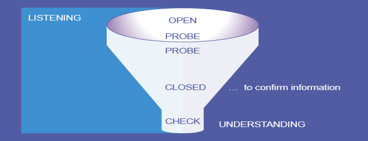
Active Listening funnel
At the mouth of the funnel we begin with an ‘open’ question. This question is intended to give the interviewee the widest possible scope for responding. Sometimes it may be necessary to repeat or rephrase this question to give the interviewee more thinking time and further opportunities to raise information. Working down the narrowing body of the funnel we use a series of probing questions to draw out further specific information and help complete the picture. Closed questions then have their place to draw out, check or confirm specific pieces of information, or to get the interviewee to commit on a point more precisely. This then brings us to the bottom of the funnel where we clarify, using a short summary, what we have got out of the discussion, aiming to check our understanding of the main points. The question sequence might go something like this:
‘Tell me how you went about…?’ (open)
‘How did you prepare?’ (open – secondary)
‘What was your starting point?’ (probe)
‘So, what happened next?’ (probe)
‘Who else was involved?’ (probe)
‘And how did they respond?’ (probe)
‘What were your thoughts at that stage?’ (probe)
‘What were the main outcomes?’ (probe)
‘So, that took a total of 30 minutes?’ (closed – clarifying)
‘And the task was completed?’ (closed – clarifying)
‘So, let me see if I’ve followed you…’ (checking – summary)
A good interview requires preparation. Have opening questions ready, ensure you have all the right props and the right people involved. That extra hour or two will pay dividends.


 Investigations of a Dog