Understanding the Levers of Change

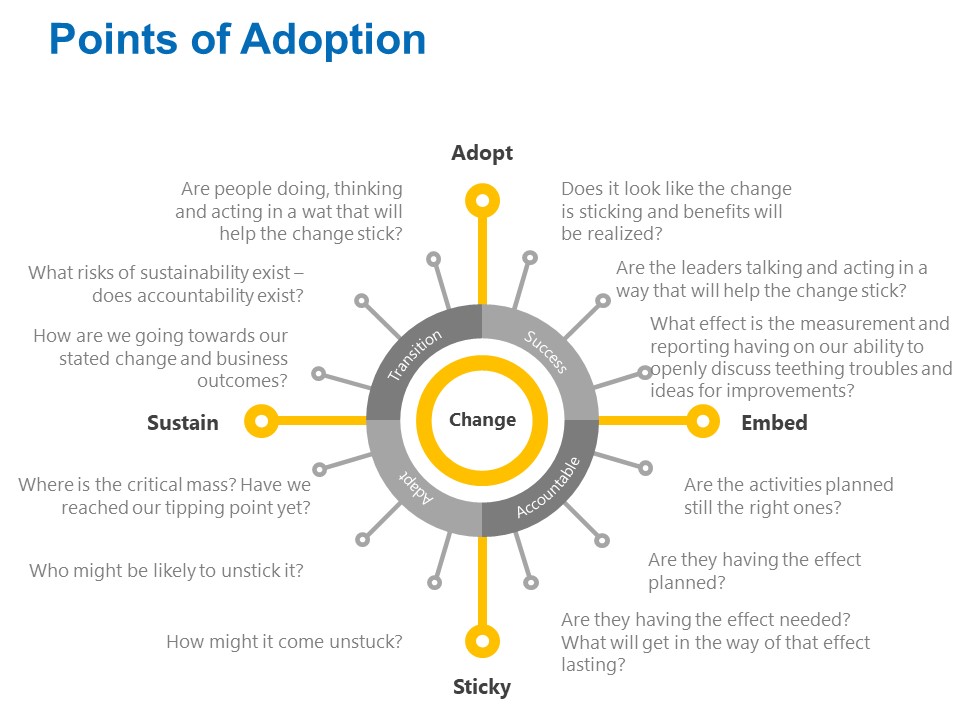
As part of my presentation “Sustaining Change – Executing a Sustainability Plan” at the ASQ Lean and Six Sigma Conference tomorrow I’ll be talking about levers of change.

Understanding the change landscape

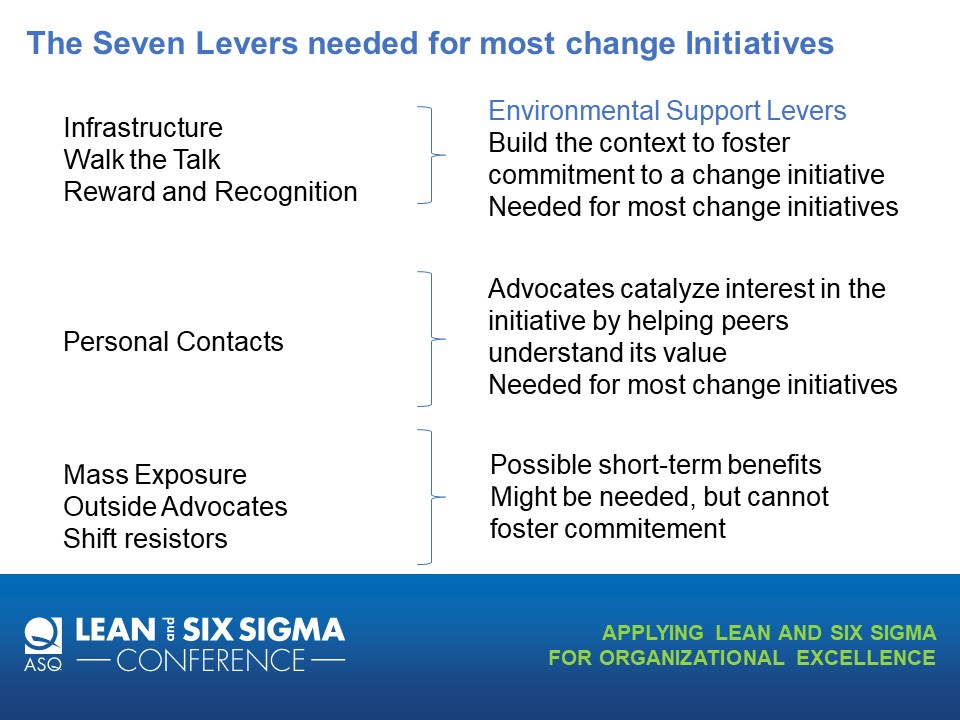
Change Management practitioners usually talk about seven levers:

  1. Infrastructure – Investing in the tools, processes, and other resources that employees need to be successful with the change initiative.
  2. Walk the Talk – active leadership is about ownership; it includes making the business case clear, modeling behaviors, clearing obstacles and making course corrections.
  3. Reward and Recognition – acknowledgement and compensation for employees who work to move the initiative forward
  4. Mass Exposure – getting out information about the change through broadcast messages and other communication pathways
  5. Personal Contacts – creating opportunities for advocates to share their experience of the change with peers who feel disengaged
  6. Outside advocates – bringing in resources (internal or external) to gain expertise for the change initiative
  7. Shift Resisters – moving people to areas less affected by the initiative.
7 levers of change

Conference Speaking -2020 Lean and Six Sigma

In February I will be presenting at the 2020 ASQ Lean and Six Sigma Conference in Phoenix on Sustaining Change – Executing a Sustainability Plan.

Here’s the presentation summary:

For Lean and Six Sigma projects a central question should always be “how do we sustain this change?” Sustainability is a major part of all the major change models but is often the easiest to neglect. This session will engage the participant in building a Sustainability Plan, a key tool to ensure the change is anchored and embedded in the organization. Through three case study examples of changes at the three major change levels -transactional, organizational and transformational – the participant will gain the knowledge to create and execute an effective change plan.

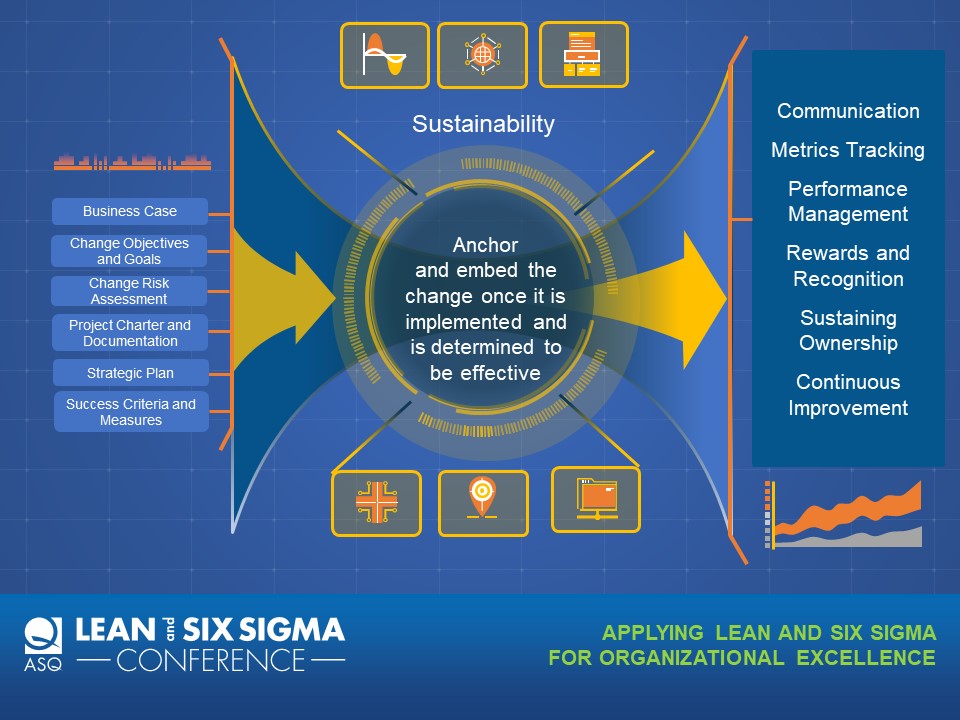
During this session examples will be given for each component of a sustainability plan:

  • Communication: Mechanisms for persuasive communication and ongoing socialization of the change, rites of parting (saying goodbye to the old ways of doing things), and rites of enhancement (acknowledgment of quick wins and continued adoption)
  • Metrics Tracking: How to identify and execute consistent and effective ongoing measurement and results reporting to track progress and ensure sustained results • Performance Management: Process for observing and objectively measuring desired behaviors and attitudes, including performance appraisal process, promoting, demoting and transferring, and training and development
  • Rewards and Recognition: Program of intrinsic and extrinsic incentives to reinforce desired behaviors and attitudes
  • Sustaining Ownership: Consistent process for ensuring sustained ownership of the change through the ongoing transfer of experience and knowledge
  • Continuous Improvement: Mechanisms for responding to changing requirements and implementing improvements based on feedback, observations, and metrics

The following questions will be explored, and tools for finding answers will be provided:

  • How should organizational achievements reinforcing the change be commemorated
  • What behaviors should be observed and measured on a regular basis?
  • What results should be observed and measured on a regular basis?
  • What metrics should be used for measuring behaviors and results?
  • What mechanisms should be used for reporting results? • What criteria should be used to allocate rewards and promotion?
  • What mechanisms should be used for training, coaching, and role modeling?
  • What processes and procedures should be put in place to ensure sustained ownership of the change?
  • What continuous improvement mechanisms will address low adoption rates and ensure the change becomes part of the organization’s normal functioning?

At the end of the session the user will have a template for creating a sustainability plan and will have been provided tools to successfully execute the sustainability phase of a change.

Learning Objectives 1. Assess the role of sustainability in the major change management methodologies and apply to lean and six sigma projects. 2. Facilitate the sustainability phase of change management. 3. Compose a sustainability plan.

MHRA on Passing the Baton from GPvP to GMP

I love the MHRA Inspectorate blog. They don’t write often, but when they do, good stuff. Here are some of my thoughts on the post on moving patient safety data from determination as part of the pharmacovigilance efforts to labeling to distribution.

Starting in the Good Pharmacovigilance Practice (GPvP) realm, triggers for updates may be identified by pharmacovigilance staff and the corresponding variations submitted by regulatory affairs staff, who will also receive notification of variation approval. At this stage Good Manufacturing Practice (GMP) processes come into play with arrangements for printing the updated leaflets and incorporating these into the supply chain.

MHRA Inspectporate Blog “Passing the baton from GPvP to GMP: Three top tips for protecting patients and staying compliant ” 17 Dec 2019

Unless otherwise stated, updates to patient information leaflets should be introduced within 3 to 6 months of approval” – this is the critical point stressed in this post. The recommendations given in the blog post are solid.

Blog RecommendationThoughts
Check that the end to end process facilitates the timely implementation of updates and that there is seamless transition from written procedures covering GPvP, regulatory affairs and GMP processes. Labeling is often a separate change control process. Integration and simplification in change management is critical and companies should look seriously at balkanization of systems.
Define what is meant by ‘implementation’ of an updated leaflet and make sure this is in advance of regulatory deadlines to prevent the need for batches being re-worked should there be any unexpected delays Effective dates on changes need to take into account deadlines.

Appropriate linkages to ERP and supply chain systems.
Ensure the QP has access to up to date information on the correct leaflet version that should be used at batch certification. Communication, and the use of integrated change management

I also read this morning Teresa Gorecki’s post “Dedicated, Integrated Quality Assurance Systems Critical to Successful Clinical Trials.” All of her points are highly relevant here.

PIC/S on Change Review and Effectiveness

Starting from the end, let’s review some of the requirements in the new draft PIC/S guidance.

Prior to change closure

RequirementImportant Points
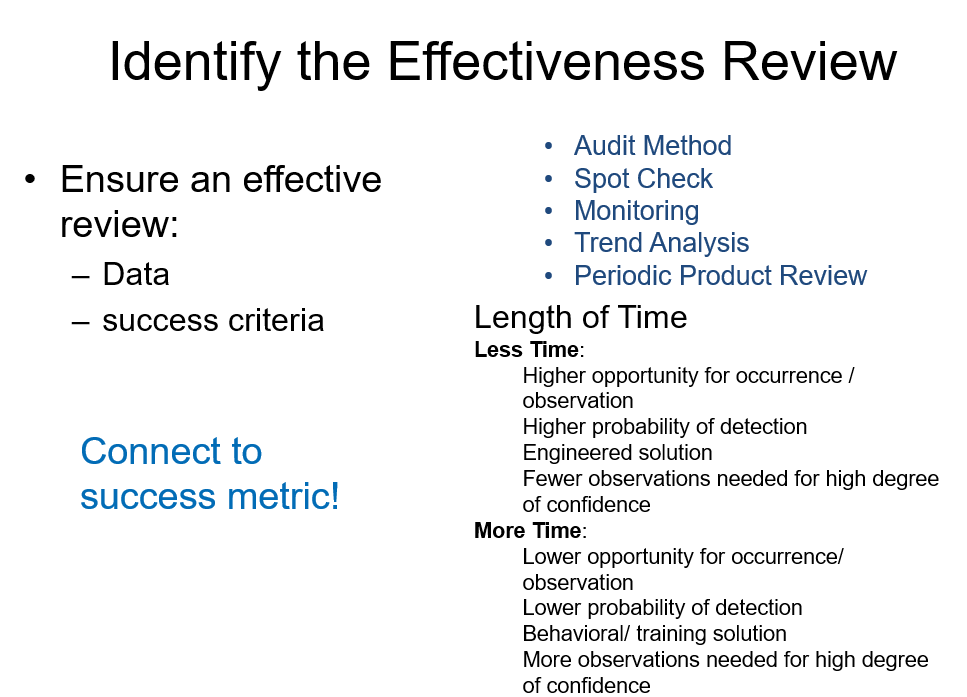
Changes meet their intended objectives and pre-defined effectiveness criteria. Any deviations from those criteria are adequately assessed, accepted and managed/justified. Whenever possible, quantitative data are leveraged to objectively determine change effectiveness (e.g. statistical confidence and coverage).Clearly delineating what effective means as a date is critical to generate data.

CQV activities can tell you if the intended objective is met. Effectiveness reviews must be made up of:

Sufficient data points, as described in the implementation plan, gathered to a described timeline, before an assessment of the change is made.

The success criteria should be achieved. If not, reasons why they have not been achieved should be assessed along with the mitigation steps to address the reasons why, including reverting to the previous operating state where appropriate. This may require the proposal of a subsequent change or amendment of the implementation plan to ensure success.

Data and knowledge gathered from implementation of the change should be shared with the development function and other locations, as appropriate, to ensure that learning can be applied in products under development or to similar products manufactured at the same or other locations
As part of the quality risk management activities, residual risks are assessed and managed to acceptable levels, and appropriate adaptations of procedures and controls are implemented.These are action items in the change control.

As part of the closure activities, revise the risk assessment, clearly delineating risk assessment in two phases.
Any unintended consequences or risks introduced as a result of changes are evaluated, documented, accepted and handled adequately, and are subject to a pre-defined monitoring timeframe.Leverage the deviation system.

Prior to or after change closure

RequirementImportant Points
Any post-implementation actions needed (including those for deviations from pre-defined acceptance criteria and/or CAPAs) are identified and adequately completed.If you waterfall into a CAPA system, it is important to include effectiveness reviews that are to the change, and not just to the root cause.
Relevant risk assessments are updated post-effectiveness assessments. New product/process knowledge resulting from those risk assessments are captured in the appropriate Quality and Operations documents (e.g. SOPs, Reports, Product Control Strategy documents, etc.)Risk management is not a once and done for change management.
Changes are monitored via ongoing monitoring systems to ensure maintenance of a state of control, and lessons learned are captured and shared/communicated.Knowledge management is critical as part of the product management lifecycle.

Lessons learned are critical.