Building Digital Trust: How Modern Infrastructure Transforms CxO-Sponsor Relationships Through Quality Agreements

The relationship between sponsors and contract organizations has evolved far beyond simple transactional exchanges. Digital infrastructure has become the cornerstone of trust, transparency, and operational excellence.

The trust equation is fundamentally changing due to the way our supply chains are being challenged.. Traditional quality agreements often functioned as static documents—comprehensive but disconnected from day-to-day operations. Today’s most successful partnerships are built on dynamic, digitally-enabled frameworks that provide real-time visibility into performance, compliance, and risk management.

Regulatory agencies are increasingly scrutinizing the effectiveness of sponsor oversight programs. The FDA’s emphasis on data integrity, combined with EMA’s evolving computerized systems requirements, means that sponsors can no longer rely on periodic audits and static documentation to demonstrate control over their outsourced activities.

Quality Agreements as Digital Trust Frameworks

The modern quality agreement must evolve from a compliance document to a digital trust framework. This transformation requires reimagining three fundamental components:

Dynamic Risk Assessment Integration

Traditional quality agreements categorize suppliers into static risk tiers (for example Category 1, 2, 2.5, or 3 based on material/service risk). Digital frameworks enable continuous risk profiling that adapts based on real-time performance data.

Integrate supplier performance metrics directly into your quality management system. When a Category 2 supplier’s on-time delivery drops below threshold or quality metrics deteriorate, the system should automatically trigger enhanced monitoring protocols without waiting for the next periodic review.

Automated Change Control Workflows

One of the most contentious areas in sponsor-CxO relationships involves change notifications and approvals. Digital infrastructure can transform this friction point into a competitive advantage.

The SMART approach to change control:

  • Standardized digital templates for change notifications
  • Machine-readable impact assessments
  • Automated routing based on change significance
  • Real-time status tracking for all stakeholders
  • Traceable decision logs with electronic signatures

Quality agreement language to include: “All change notifications shall be submitted through the designated digital platform within [X] business days of identification, with automated acknowledgment and preliminary impact assessment provided within [Y] hours.”

Transparent Performance Dashboards

The most innovative CxOs are moving beyond quarterly business reviews to continuous performance visibility. Quality agreements should build upon real-time access to key performance indicators (KPIs) that matter most to patient safety and product quality.

Examples of Essential KPIs for digital dashboards:

  • Batch disposition times and approval rates
  • Deviation investigation cycle times
  • CAPA effectiveness metrics
  • Environmental monitoring excursions and response times
  • Supplier change notification compliance rates

Communication Architecture for Transparency

Effective communication in pharmaceutical partnerships requires architectural thinking, not just protocol definition. The most successful CxO-sponsor relationships are built on what I call the “Three-Layer Communication Stack” which builds a rhythm of communication:

Layer 1: Operational Communication (Real-Time)

  • Purpose: Day-to-day coordination and issue resolution
  • Tools: Integrated messaging within quality management systems, automated alerts, mobile notifications
  • Quality agreement requirement: “Operational communications shall be conducted through validated, audit-trailed platforms with 24/7 availability and guaranteed delivery confirmation.”

Layer 2: Technical Communication (Scheduled)

  • Purpose: Performance reviews, trend analysis, continuous improvement
  • Tools: Shared analytics platforms, collaborative dashboards, video conferencing with screen sharing
  • Governance: Weekly operational reviews, monthly performance assessments, quarterly strategic alignments

Layer 3: Strategic Communication (Event-Driven)

  • Purpose: Relationship governance, escalation management, strategic planning
  • Stakeholders: Quality leadership, senior management, regulatory affairs
  • Framework: Joint steering committees, annual partnership reviews, regulatory alignment sessions

The Communication Plan Template

Every quality agreement should include a subsidiary Communication Plan that addresses:

  1. Stakeholder Matrix: Who needs what information, when, and in what format
  2. Escalation Protocols: Clear triggers for moving issues up the communication stack
  3. Performance Metrics: How communication effectiveness will be measured and improved
  4. Technology Requirements: Specified platforms, security requirements, and access controls
  5. Contingency Procedures: Alternative communication methods for system failures or emergencies

Include communication effectiveness as a measurable element in your supplier scorecards. Track metrics like response time to quality notifications, accuracy of status reporting, and proactive problem identification.

Data Governance as a Competitive Differentiator

Data integrity is more than just ensuring ALCOA+—it’s about creating a competitive moat through superior data governance. The organizations that master data sharing, analysis, and decision-making will dominate the next decade of pharmaceutical manufacturing and development.

The Modern Data Governance Framework

Data Architecture Definition

Your quality agreement must specify not just what data will be shared, but how it will be structured, validated, and integrated:

  • Master data management: Consistent product codes, batch numbering, and material identifiers across all systems
  • Data quality standards: Validation rules, completeness requirements, and accuracy thresholds
  • Integration protocols: APIs, data formats, and synchronization frequencies

Access Control and Security

With increasing regulatory focus on cybersecurity, your data governance plan must address:

  • Role-based access controls: Granular permissions based on job function and business need
  • Data classification: Confidentiality levels and handling requirements
  • Audit logging: Comprehensive tracking of data access, modification, and sharing

Analytics and Intelligence

The real competitive advantage comes from turning shared data into actionable insights:

  • Predictive analytics: Early warning systems for quality trends and supply chain disruptions
  • Benchmark reporting: Anonymous industry comparisons to identify improvement opportunities
  • Root cause analysis: Automated correlation of events across multiple systems and suppliers

The Data Governance Subsidiary Agreement

Consider creating a separate Data Governance Agreement that complements your quality agreement with specific sections covering data sharing objectives, technical architecture, governance oversight, and compliance requirements.

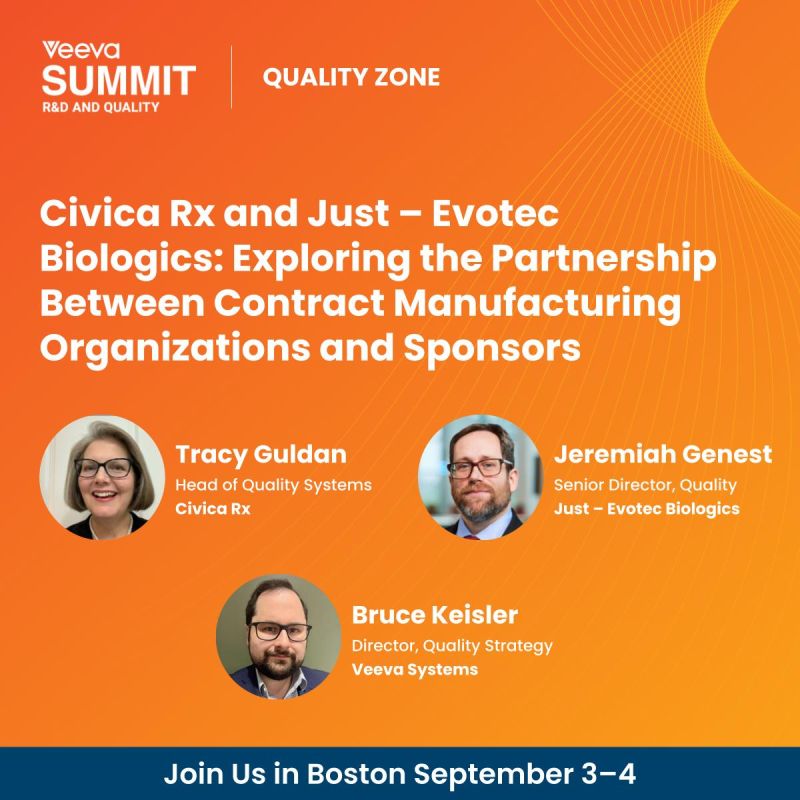
Veeva Summit

Next week I’ll be discussing this topic at the Veeva Summit, where I will bring some organizational learnings on to embrace digital infrastructure as a trust-building mechanism will forge stronger partnerships, achieve superior quality outcomes, and ultimately deliver better patient experiences.
The Hallway Track at a Conference

BOSCON 2024 starts tomorrow, so in honor of the local section’s juggernaut of a conference, I want to talk about the hallway track, my favorite part of a conference.

The hallway track at a conference refers to the informal networking, discussions, and spontaneous interactions that occur outside of scheduled sessions. It is often considered one of the most valuable aspects of attending a conference, as it facilitates connections that can lead to professional opportunities and insights that are not typically available in formal presentations.

How to Maximize the Hallway Track

To make the most of the hallway track, consider the following strategies:

1. Plan Ahead

  • Review the Agenda: Before the conference, identify key sessions you want to attend but also mark open slots for networking opportunities.
  • Set Goals: Determine what you hope to achieve through networking—whether it’s meeting specific individuals or learning about new trends in your field.

2. Engage with Others

  • Start Conversations: Use simple icebreakers like asking about someone’s favorite session or their plans for the day. This can lead to deeper discussions.
  • Introduce Yourself: Don’t hesitate to approach people you know from social media platforms like LinkedIn or Twitter. This can help solidify online connections in person.

3. Attend Social Events

  • Participate in Informal Gatherings: Join social events or activities that may be outside your comfort zone. These settings often foster more relaxed and meaningful conversations.

4. Be Open to New Experiences

  • Change Your Plans if Necessary: If someone recommends a session or event, be flexible enough to adjust your schedule. You might discover valuable insights or connections by following these leads.

5. Leverage the Environment

  • Use Common Areas: Spend time in hallways, lounges, and vendor areas where informal interactions are likely to occur. These spaces are conducive to spontaneous conversations.

6. Network with Purpose

  • Follow Up After the Conference: Collect contact information and follow up with new connections after the event. This helps solidify relationships formed during the hallway track.

By actively engaging in these practices, attendees can significantly enhance their conference experience and build lasting professional relationships through the hallway track.

Risk Assessments as part of Design and Verification

Facility design and manufacturing processes are complex, multi-stage operations, fraught with difficulty. Ensuring the facility meets Good Manufacturing Practice (GMP) standards and other regulatory requirements is a major challenge. The complex regulations around biomanufacturing facilities require careful planning and documentation from the earliest design stages. 

Which is why consensus standards like ASTM E2500 exist.

Central to these approaches are risk assessment, to which there are three primary components:

  • An understanding of the uncertainties in the design (which includes materials, processing, equipment, personnel, environment, detection systems, feedback control)
  • An identification of the hazards and failure mechanisms
  • An estimation of the risks associated with each hazard and failure

Folks often get tied up on what tool to use. Frankly, this is a phase approach. We start with a PHA for design, an FMEA for verification and a HACCP/Layers of Control Analysis for Acceptance. Throughout we use a bow-tie for communication.

AspectBow-TiePHA (Preliminary Hazard Analysis)FMEA (Failure Mode and Effects Analysis)HACCP (Hazard Analysis and Critical Control Points)
Primary FocusVisualizing risk pathwaysEarly hazard identificationPotential failure modesSystematically identify, evaluate, and control hazards that could compromise product safety
Timing in ProcessAny stageEarly developmentAny stage, often designThroughout production
ApproachCombines causes and consequencesTop-downBottom-upSystematic prevention
ComplexityModerateLow to moderateHighModerate
Visual RepresentationCentral event with causes and consequencesTabular formatTabular formatFlow diagram with CCPs
Risk QuantificationCan include, not requiredBasic risk estimationRisk Priority Number (RPN)Not typically quantified
Regulatory AlignmentLess common in pharmaAligns with ISO 14971Widely accepted in pharmaLess common in pharma
Critical PointsIdentifies barriersDoes not specifyIdentifies critical failure modesIdentifies Critical Control Points (CCPs)
ScopeSpecific hazardous eventSystem-level hazardsComponent or process-level failuresProcess-specific hazards
Team RequirementsCross-functionalLess detailed knowledge neededDetailed system knowledgeFood safety expertise
Ongoing ManagementCan be used for monitoringOften updated periodicallyRegularly updatedContinuous monitoring of CCPs
OutputVisual risk scenarioList of hazards and initial risk levelsPrioritized list of failure modesHACCP plan with CCPs
Typical Use in PharmaRisk communicationEarly risk identificationDetailed risk analysisProduct Safety/Contamination Control

At BOSCON this year I’ll be talking about this fascinating detail, perhaps too much detail.

A Collaborative Learning Event I Might Run

To complete a thought on community of practices I did this weekend with “A CoP is Collaborative Learning, not Lecture” and “How I would Organize a Meeting of a CoP” I’m now going to build, from the group up, a collaborative learning event I would love to organize.

A little caveat: I really burnt out on professional obligations last year and have just started to peak my head out. So, it may be a little harder to turn this mad scientist dream into a reality. However, I think it is worth putting out as a thought experiment.

Theme and Scope

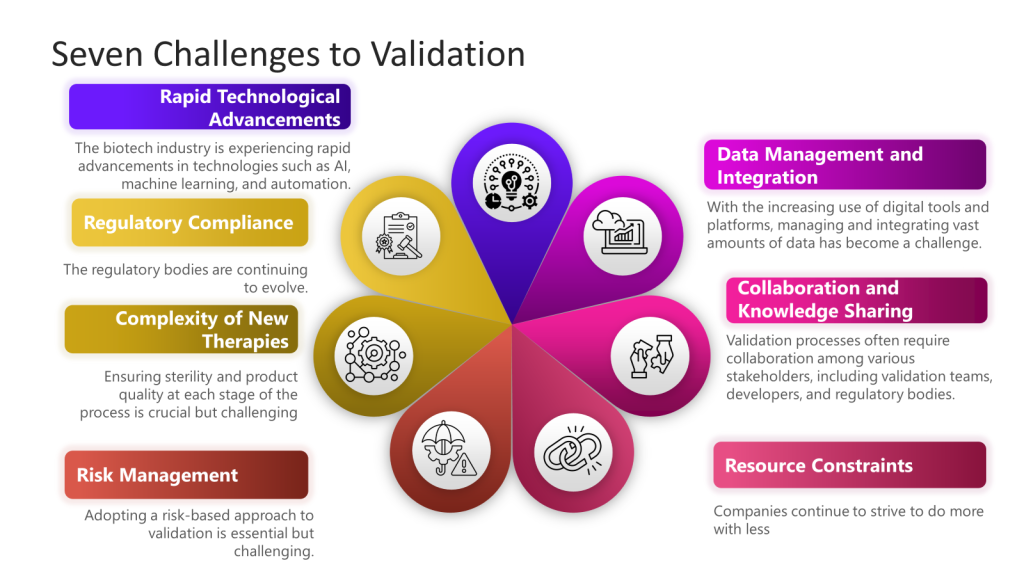
I’ve written a bit about the challenges to quality, and these challenges provide a framework for much of what I think and write about.

More specifically drawing from the “Challenges in Validation” focusing on the challenges of navigating a complex validation landscape characterized by rapid technological advancements, evolving regulatory standards, and the development of novel therapies.

This event would ask, “How do we rise to the challenges of validation in the next decade, leveraging technology and a risk management approach and drawing from the best practices of ASTM E2500, GAMP5, and others to meet and exceed changing regulatory requirements.”

Intended Audience

I go to events, and there are a lot of quality people, OR risk management people, OR computer systems (IT and Q) people, OR engineers, OR analytical method folks, OR process development people. Rarely do I see an event that looks at the whole picture. And rarely do I get to attend an event where we are sharing and blurring the lines between the various silos. So let us break down the silos and invite quality, IT, engineers, and process development individuals involved in the full spectrum of pharmaceutical (and possibly medtech) validation.

This holistic event is meant to blend boundaries, share best practices, challenge ourselves, and look across the entire validation lifecycle.

Structure

Opening/Networking (1 hour)

As people arrive, they go right into a poster event. These posters are each for a specific methodology/approach of ASTM E2500, ISPE Baseline Guides, FDA’s Guidance for Process Validation: General Principles and Practices, ICH’s QbD approach, and GAMP5. Maybe some other things.

These posters would each:

  • Provide an overview of what it is and why it is important
  • Overview of methodology
  • What challenges it overcomes
  • Lessons that can be applied
  • Challenges/problems inherent in the approach

These posters would be fun to develop and take a good squad of experts.

After an hour of mingling, sharing, and baselining, we could move to the next step.

Fish Bowl Debate (45 minutes)

Having earlier selected a specific topic and a panel of experts, hold a fish bowl debate. This would be excellent as a mock-inspection, maybe of a really challenging topic. Great place to bring those inspectors in.

During a fish bowl, everyone not in the center is taking notes. I love a worksheet to help with this by providing things to look for to get the critical thinking going.

Future Workshop (1.5 hour)

  1. Introduce the activity (10 min)
  2. Ask participants to reflect on their present-day situation, write down all their negative experiences on sticky notes, and place them on the wall. (15 min)
  3. Invite participants to list uncertainties they face by asking, “In your/our operating environment, what factors are impossible to predict or control their direction?” (5 min).
  4. Prioritize the most critical factors by asking, “Which factors threaten your/our ability to operate successfully?” (10 min)
  5. Based on the group’s history and experience, select the two most critical and most uncertain (X and Y). (5 min)
  6. Create a grid with two axes—X & Y—with a “more of <— —> less of” continuum to represent the factor on each axis. For example, suppose new modalities are a critically uncertain factor for the X-axis. In that case, one end of the X-axis is many new modalities, and the other is no new modalities. Repeat for the Y factor and axis. For instance, if patent protection is a critical factor, one end of the Y axis is strong patent protection, and the other has no patent protection. Four quadrants are created. (5 min)
  7. Break into four groups, and each group creatively names and writes a thumbnail scenario for one of the quadrants. (10 min)
  8. The four groups share their scenarios briefly. 2 min. each
  9. Participants fantasize about the desired future situation. How would the ideal situation be for them? At this stage, there are no limitations; everything is possible. Write on stick notes and apply them to the most likely quadrant. (10 minutes)
  10. Do a n/3 activity to find the top ideas (enough for groups of 4-5 each) (3 min)
  11. Explain the next activity (2 min)

Lunch (1 hour)

Open Space Solution (1 hour)

For each top idea, the participants vote with their feet and go to develop the concept. Each group is looking to come up with the challenge solved, a tool/methodology, and an example.

Review the Results of the Open Space Solutions (1 hour)

Each team presents for 5-8 minutes.

1-2-4-All (20 minutes)

  1. Silent self-reflection by individuals on the shared challenge, framed as a question “What opportunities do YOU see for making progress on this challenge? How would you handle this situation? What ideas or actions do you recommend?” (1 min)
  2. Generate ideas in pairs, building on ideas from self-reflection. (2 min)
  3. Share and develop ideas from your pair in foursomes (notice similarities and differences).( 4 min)
  4. Ask, “What is one idea that stood out in your conversation?” Each group shares one important idea with all (15 min)

Closing Commitment (5 min)

Where will this live? What comes next? Make a commitment to follow up electronically.

Networking

Spend an hour or so with drinks and food and discuss everything. Never enough socialization.