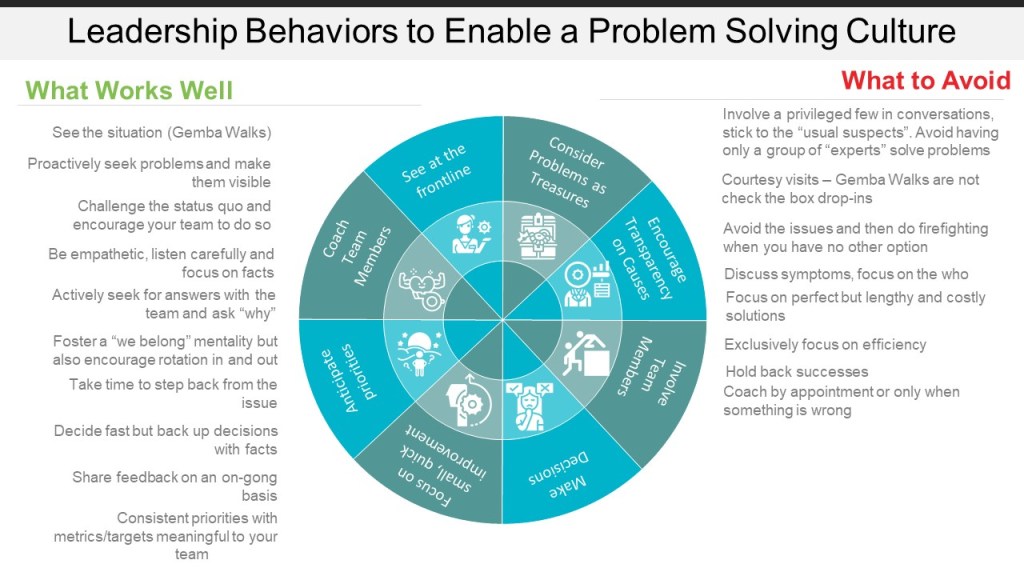
Be the Leader Needed for a Problem Solving Culture

Leadership is a critical element of a problem solving culture and rightly is emphasized in frameworks like the Baldridge or standards like ISO 9001:2015. Leadership is best looked at as the process for determining a possible future state that does not yet exist. As we strive to build excellence we need a passion for this work and to believe it to be truly important. Sharing that enthusiasm is motivating for all people involved and is a way to leverage greater success.

Good leaders encourage behaviors to maintain and improve quality by means of sound decision-making and risk-based thinking.

All of these leadership behaviors stem from four building blocks:

Anger and the job in difficult times

On Wednesday the United States set a devastating new record in the coronavirus pandemic: 3,124 people dead in one day. This was the first time the daily number of deaths has exceeded 3,000 but I fear it will not be the last. There are over 260k deaths in the US so far, over 1.5 million deaths worldwide. This is crippling, and it is difficult to go day-by-day with the pain of this suffering.

And yet, we need to work, support our families and communities. Get the job done. Amidst all that it is important to remember that is important to grieve and it is okay to be angry.

People grieve in diverse ways with different emotions, from anger, to depression to hopelessness, to resentment over what has been taken from them. Combined with the isolation of the pandemic, this is a recipe for poor mental health and poor coping mechanisms. And then there is a question of just how much and what sort of coping is good. Two-hundred-and-sixty thousand people are dead and there is a lot of evidence this is an underreport and a lot more people are going to die.

I hope you understand that I am angry. All day long. And it is a struggle not to bring that anger to work, not to let it twist my relationships. Yet that anger always exists.

I linked earlier this week to an article on mental health. It is particularly important to make this part of our organizations. Burnout must have a systematic fix.

What we need to give permission to, give space to, is a recognition that we are not in an okay state. And it may not be okay for a very long while, long after vaccines are widely available, and we return to the office.

It is okay to have taken a step back from obligations. I have not, for example, been writing much on this blog. It just did not work for me. Be kind to yourself and be okay with the things you must do less of. And when you are ready, go back to it.

Anger and Culture

Our organizational cultures are full of anger. What we must do is work to establish mechanisms to assure that anger is directed at issues or situations, not people. This will build psychological safety, enable good decisions and enhance our problem solving culture.

Some things we should do:

  • Acknowledge what is happening: Senior leadership needs to be working from compassion and generosity and taking real steps to address.
  • Treat toxic positivity as a bias: Toxic positivity is the assumption, either by one’s self or others, that despite a person’s emotional pain or difficult situation, they should only have a positive mindset. This is especially important as we have talent discussions, evaluate performance, and perform other managerial tasks.
  • Have systems around burnout
  • Focus on decision making quality
  • Build employee judgement feedback loops

We are not done. This winter will be very hard for many. As leaders we need to be ensuring our organizations can get through this and then leverage what we’ve learned to build a better culture.

Amazon’s lack of safety culture

Time after time, internal documents and interviews with company insiders show, Amazon officials have ignored or overlooked signs that the company was overloading its fast-growing delivery network while eschewing the expansive sort of training and oversight provided by a legacy carrier like UPS.

Inside Documents Show How Amazon Chose Speed Over Safety in Building Its Delivery Network” by James BandlerPatricia Callahan and Doris Burke, ProPublica, Ken Bensinger and Caroline O’Donovan, BuzzFeed News
 Dec. 23, 3 p.m. EST

Great reporting on the purposeful decisions that led to an unsafe culture. I recommend everyone reading this.

“Those interviews, as well as internal documents, reveal how executives at a company that prides itself on starting every meeting with a safety tip repeatedly quashed or delayed safety initiatives out of concern that they could jeopardize its mission of satisfying customers with ever-faster delivery.”

It all starts with leaders walking-the-walk and paying more than lip service to principles. “delighting the customer” is a great goal, but there are other stakeholders, and employee safety is a higher principle.

This article really reinforces my opinion that while there may be useful tools we can learn from FAANG companies, by-and-large their cultures do not appear ones truly dedicated to safety, quality and excellence.

It bears repeating. If we made pharmaceuticals the same way Amazon or Facebook operated, we’d all be dead. Every-time I read about Alphabet getting involved in healthcare I become petrified. One only has to look at the safety record of Tesla (both in the factory and the safety of it’s automobile) to start feeling worried on what happens when you take the bad culture from Silicon Valley and apply it to other endeavors..

Driving for Mature Quality Organizations – FDA recent perspective

Theresa Mullin, FDA’s Associate Director for Strategic Initiatives for the Center for Drug Evaluation and Research recently gave a presentation “Update from FDA CDER” at GMP by the Sea (I need to go to that that some-year).

As in other FDA presentations this presentation summarized the Quality Metrics Research Final Report by the University of St. Gallen as the appropriate steps to ensure quality maturity:

  1. Optimized set-up and cleaning procedures are documented as best practice process and rolled out throughout the whole plant.
  2. A large percentage of equipment on the shop floor is currently under statistical process control.
  3. For root cause analysis, the firm has standardized tools to get a deeper understanding of the influencing factors for problems.
  4. Goals and objectives of the manufacturing unit are closely linked and consistent with corporate objectives and the site has a clear focus.
  5. Manufacturers have joint improvement programs with suppliers to increase performance.
  6. All potential bottleneck machines are identified and supplied with additional spare parts.
  7. For product and process transfers between different units or sites,standardized procedures exist that ensure a fast, stable and compliant knowledge transfer.
  8. Charts showing the current performance status such as current scrap rates and current up times are posted on the shop floor and visible for everyone.
  9. The firm regularly surveys customers’ requirements.
  10. The firm ranks its suppliers and conducts supplier qualifications and audits.

This are some pretty low hanging fruit. They are also the pretty necessary in any organization, not just pharmaceuticals.

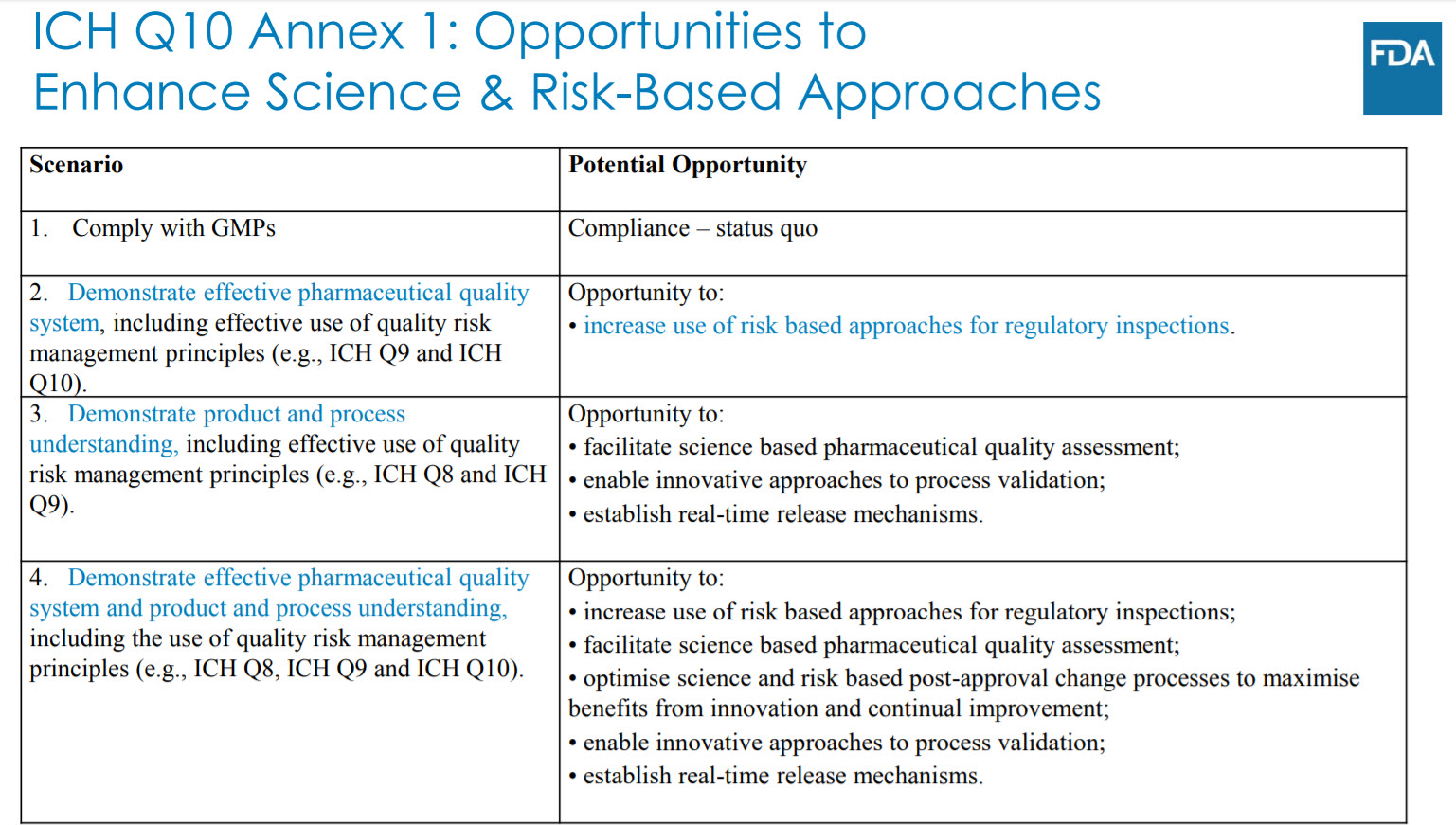
There was also a little discussion on the use of Q10 that really makes me wish I had been there to hear exactly what was said. I hope it was “Just freaking implement it already.”

In general, useful slides, I recommend going and checking them out.