
Decision Quality

The decisions we make are often complex and uncertain. A good decision-making process better is critical to success – knowing how we make decisions, and how to confirm we are making good decisions – allows us to bring quality to our decisions. To do this we need to understand what a quality decision looks like and how to obtain it.

There is no universal best process or set of steps to follow in making good decisions. However, any good decision process needs to have the idea of decision-quality as the measurable destination.

Decisions do not come ready to be made. They must be shaped starting by declaring what the decision you that must be made. All decisions have one thing in common – the best choice creates the best possibility of what you truly want. To find that best choice, you need decision-quality and you must recognize it as the destination when you get there. You cannot reach a good decision, achieve decision-quality, if you are unable to visualize or describe it. Nor can you say you have accomplished it, if you cannot recognize it when it is achieved.

What makes a Good Decision?

The six requirements for a good decision are: (1) an appropriate frame, (2) creative alternatives, (3) relevant and reliable information, (4) clear values and trade-offs, (5) sound reasoning, and (6) commitment to action. To judge the quality of any decision before you act, each requirement must be met and addressed with quality. I like representing it as a chain, because a decision is no better than the weakest link.
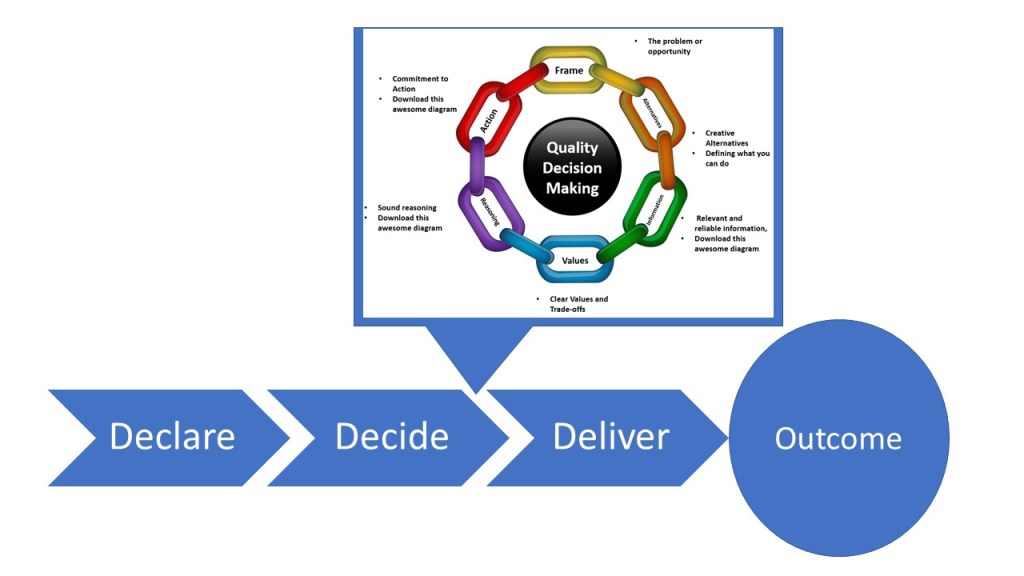
The frame specifies the problem or opportunity you are tackling, asking what is to be decided. It has three parts:  purpose in making the decision; scope of what will be included and left out; and your perspective including your point of view, how you want to approach the decision, what conversations will be needed, and with whom. Agreement on framing is essential, especially when more than one party is involved in decision making. What is important is to find the frame that is most appropriate for the situation. If you get the frame wrong, you will be solving the wrong problem or not dealing with the opportunity in the correct way.

The next three links are: alternatives – defining what you can do; information – capturing what you know and believe (but cannot control), and values – representing what you want and hope to achieve. These are the basis of the decision and are combined using sound reasoning, which guides you to the best choice (the alternative that gets you the most of what you want and in light of what you know). With sound reasoning, you reach clarity of intention and are ready for the final element – commitment to action.

Asking: “What is the decision I should be making?” is not a simple question. Furthermore, asking the question “On what decision should I be focusing?” is particularly challenging. It is a question, however, that is important to be asked, because you must know what decision you are making. It defines the range within which you have creative and compelling alternatives. It defines constraints. It defines what is possible. Many organizations fail to create a rich set of alternatives and simply debate whether to accept or reject a proposal. The problem with this approach is that people frequently latch on to ideas that are easily accessible, familiar or aligned directly with their experiences.

Exploring alternatives is a combination of analysis, rigor, technology and judgement. This is about the past and present – requiring additional judgement to anticipate future consequences. What we know about the future is uncertain and therefore needs to be described with possibilities and probabilities. Questions like: “What might happen?” and “How likely is it to happen?” are difficult and often compound. To produce reliable judgements about future outcomes and probabilities you must gather facts, study trends and interview experts while avoiding distortions from biases and decision traps. When one alternative provides everything desired, the choice among alternatives is not difficult. Trade-offs must be made when alternatives do not provide everything desired. You must then decide how much of one value you are willing to give up to receive more of another.  

Commitment to action is reached by involving the right people in the decision efforts. The right people must include individuals who have the authority and resources to commit to the decision and to make it stick (the decision makers) and those who will be asked to execute the decided-upon actions (the implementers). Decision makers are frequently not the implementers and much of a decision’s value can be lost in the handoff to implementers. It is important to always consider the resource requirements and challenges for implementation.

These six requirements of decision-quality can be used to judge the quality of the decision at the time it is made. There is no need to wait six months or six years to assess its outcome before declaring the decision’s quality. By meeting the six requirements you know at the time of the decision you made a high-quality choice. You cannot simply say: “I did all the right steps.” You have got to be able to judge the decision itself, not just how you got to that decision. When you ask, “How good is this decision if we make it now?” the answer must be a very big part of your process. The piece missing in the process just may be in the material and the research and that is a piece that must go right.

Decision-quality is all about reducing comfort zone bias – when people do what they know how to do, rather than what is needed to make a strong, high-quality decision. You overcome the comfort zone bias by figuring out where there are gaps. Let us say the gap is with alternatives. Your process then becomes primarily a creative process to generate alternatives instead of gathering a great deal more data. Maybe we are awash in a sea of information, but we just have not done the reasoning and modelling and understanding of the consequences. This becomes more of an analytical effort. The specific gaps define where you should put your attention to improve the quality of the decision.
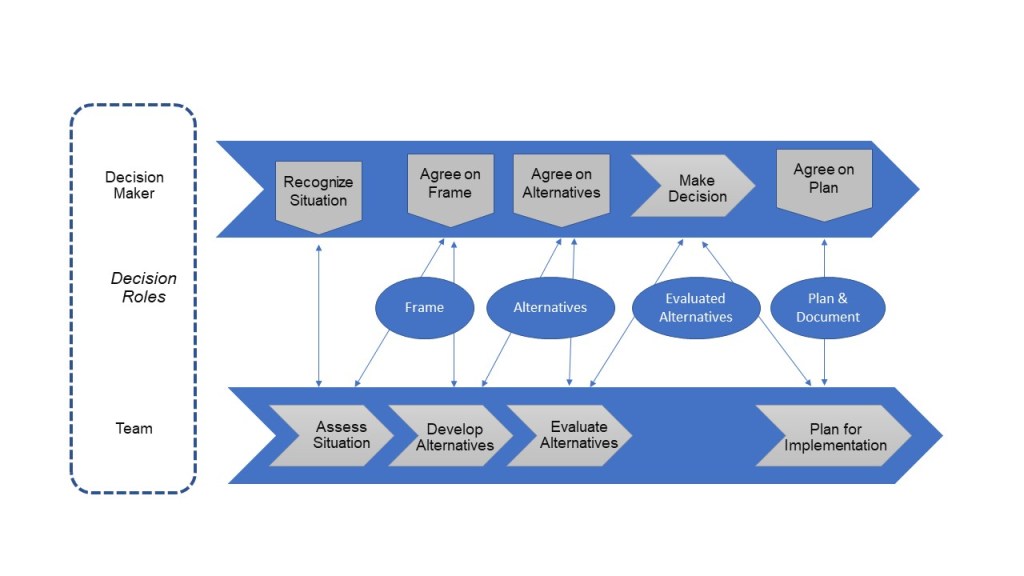
Leadership needs to have clearly defined decision rights and understand that the role of leadership is assembling the right people to make quality decisions. Once you know how to recognize digital quality, you need an effective and efficient process to get there and that process involves many things including structured interactions between decision maker and decision staff, remembering that productive discussions result when multiple parties are involved in the decision process and difference in judgement are present.

Beware Advocacy

The most common decision process tends to be an advocacy decision process – you are asking somebody to sell you an answer. Once you are in advocacy mode, you are no longer in a decision-quality mode and you cannot get the best choice out of an advocacy decision process. Advocacy suppresses alternatives. Advocacy forces confirming evidence bias and means selective attention to what supports your position. Once in advocacy mode, you are really in a sales mode and it becomes a people competition.

When you want quality in a decision, you want the alternatives to compete, not the people. From the decision board’s perspective, when you are making a decision, you want to have multiple alternatives in front of you and you want to figure out which of these alternatives beats the others in terms of understanding the full consequences in risk, uncertainty and return. For each of the alternatives one will show up better. If you can make this happen, then it is not the advocate selling it, it is you trying to help look at which of these things gives us the most value for our investment in some way.

The role outcomes play in the measuring of decision quality

Always think of decisions and outcomes as separate because when you make decisions in an uncertain world, you cannot fully control the outcomes. When looking back from an outcome to a decision, the only thing you can really tell is if you had a good outcome or a bad outcome. Hindsight bias is strong, and once triggered, it is hard to put yourself back into understanding what decisions should have been made with what you knew, or could have known, at the time.

In understanding how we use outcomes in terms of evaluating decisions, you need to understand the importance of documenting the decision and the decision quality at the time of the decision. Ask yourself, if you were going to look back two years from now, what about this decision file answers the questions: “Did we make a decision that was good?” and “What can we learn about the things about which we had some questions?” This kind of documentation is different from what people usually do. What is usually documented is the approval and the working process. There is usually no documentation answering the question: “If we are going to look back in the future, what would we need to know to be able to learn about making better decisions?”

The reason you want to look back is because that is the way you learn and improve the whole decision process. It is not for blaming; in the end, what you are trying to show in documentation is: “We made the best decision we could then. Here is what we thought about the uncertainties. Here is what we thought were the driving factors.” Its about having a learning culture.

When decision makers and individuals understand the importance of reaching quality in each of the six requirements, they feel meeting those requirements is a decision-making right and should be demanded as part of the decision process. To be in a position where they can make a good decision, they know they deserve a good frame and significantly different alternatives or they cannot be in a position to reach a powerful, correct conclusion and make a decision. From a decision-maker’s perspective, these are indeed needs and rights to be thought about. From a decision support perspective, these needs and rights are required to be able to position the decision maker to make a good choice.

Building decision-quality enables measurable value creation and its framework can be learned, implemented and measured. Decision-quality helps you navigate the complexity of uncertainty of significant and strategic choices, avoid mega biases and big decision traps.
Overcoming Subjectivity in Risk Management and Decision Making Requires a Culture of Quality and Excellence

Risk assessments, problem solving and making good decisions need teams, but any team has challenges in group think it must overcome. Ensuring your facilitators, team leaders and sponsors are aware and trained on these biases will help lead to deal with subjectivity, understand uncertainty and drive to better outcomes. But no matter how much work you do there, it won’t make enough of a difference until you’ve built a culture of quality and excellence.

The mindsets we are trying to build into our culture will strive to overcome a few biases in our teams that lead to subjectivity.

Bias Toward Fitting In

We have a natural desire to want to fit in. This tendency leads to two challenges:

Challenge #1: Believing we need to conform. Early in life, we realize that there are tangible benefits to be gained from following social and organizational norms and rules. As a result, we make a significant effort to learn and adhere to written and unwritten codes of behavior at work. But here’s the catch: Doing so limits what we bring to the organization.

Challenge #2: Failure to use one’s strengths. When employees conform to what they think the organization wants, they are less likely to be themselves and to draw on their strengths. When people feel free to stand apart from the crowd, they can exercise their signature strengths (such as curiosity, love for learning, and perseverance), identify opportunities for improvement, and suggest ways to exploit them. But all too often, individuals are afraid of rocking the boat.

We need to use several methods to combat the bias toward fitting in. These need to start at the cultural level. Risk management, problem solving and decision making only overcome biases when embedded in a wider, effective culture.

Encourage people to cultivate their strengths. To motivate and support employees, some companies allow them to spend a certain portion of their time doing work of their own choosing. Although this is a great idea, we need to build our organization to help individuals apply their strengths every day as a normal part of their jobs.

Managers need to help individuals identify and develop their fortes—and not just by discussing them in annual performance reviews. Annual performance reviews are horribly ineffective. Just by using “appreciation jolt”, positive feedback., can start to improve the culture. It’s particularly potent when friends, family, mentors, and coworkers share stories about how the person excels. These stories trigger positive emotions, cause us to realize the impact that we have on others, and make us more likely to continue capitalizing on our signature strengths rather than just trying to fit in.

Managers should ask themselves the following questions: Do I know what my employees’ talents and passions are? Am I talking to them about what they do well and where they can improve? Do our goals and objectives include making maximum use of employees’ strengths?

Increase awareness and engage workers. If people don’t see an issue, you can’t expect them to speak up about it.  

Model good behavior. Employees take their cues from the managers who lead them.

Bias Toward Experts

This is going to sound counter-intuitive, especially since expertise is so critical. Yet our biases about experts can cause a few challenges.

Challenge #1: An overly narrow view of expertise. Organizations tend to define “expert” too narrowly, relying on indicators such as titles, degrees, and years of experience. However, experience is a multidimensional construct. Different types of experience—including time spent on the front line, with a customer or working with particular people—contribute to understanding a problem in detail and creating a solution.

A bias toward experts can also lead people to misunderstand the potential drawbacks that come with increased time and practice in the job. Though experience improves efficiency and effectiveness, it can also make people more resistant to change and more likely to dismiss information that conflicts with their views.

Challenge #2: Inadequate frontline involvement. Frontline employees—the people directly involved in creating, selling, delivering, and servicing offerings and interacting with customers—are frequently in the best position to spot and solve problems. Too often, though, they aren’t empowered to do so.

The following tactics can help organizations overcome weaknesses of the expert bias.

Encourage workers to own problems that affect them. Make sure that your organization is adhering to the principle that the person who experiences a problem should fix it when and where it occurs. This prevents workers from relying too heavily on experts and helps them avoid making the same mistakes again. Tackling the problem immediately, when the relevant information is still fresh, increases the chances that it will be successfully resolved. Build a culture rich with problem-solving and risk management skills and behaviors.

Give workers different kinds of experience. Recognize that both doing the same task repeatedly (“specialized experience”) and switching between different tasks (“varied experience”) have benefits. Yes, Over the course of a single day, a specialized approach is usually fastest. But over time, switching activities across days promotes learning and kept workers more engaged. Both specialization and variety are important to continuous learning.

Empower employees to use their experience. Organizations should aggressively seek to identify and remove barriers that prevent individuals from using their expertise. Solving the customer’s problems in innovative, value-creating ways—not navigating organizational impediments— should be the challenging part of one’s job.

In short we need to build the capability to leverage all level of experts, and not just a few in their ivory tower.

These two biases can be overcome and through that we can start building the mindsets to deal effectively with subjectivity and uncertainty. Going further, build the following as part of our team activities as sort of a quality control checklist:

  1. Check for self-interest bias
  2. Check for the affect heuristic. Has the team fallen in love with its own output?
  3. Check for group think. Were dissenting views explored adequately?
  4. Check for saliency bias. Is this routed in past successes?
  5. Check for confirmation bias.
  6. Check for availability bias
  7. Check for anchoring bias
  8. Check for halo effect
  9. Check for sunk cost fallacy and endowment effect
  10. Check for overconfidence, planning fallacy, optimistic biases, competitor neglect
  11. Check for disaster neglect. Have the team conduct a post-mortem: Imagine that the worst has happened and develop a story about its causes.
  12. Check for loss aversion

A Structured Approach to Strategic Decisions

Making sound strategic decisions is crucial for organizational success, however, human judgment can be unreliable, leading to errors that can significantly impact that success. To address this challenge, a structured approach to strategic decision-making is essential.

Organizations can be viewed as decision factories, where the primary output is not physical products, but rather judgments and choices that shape the company’s future. This perspective, popularized by thinkers like Daniel Kahneman, emphasizes the critical role of decision-making in organizational success.

In a decision factory, every employee is part of the production line, contributing to the quality and efficiency of decisions made. Just as a traditional factory focuses on optimizing its manufacturing processes, a decision factory must refine its decision-making processes to ensure high-quality outcomes. This involves carefully designing the organizational structure, clarifying decision rights, and establishing effective methodologies.

To improve the quality of decisions, organizations should focus on several key areas. First, they need to align their decision-making processes with their strategic direction, ensuring that decisions at all levels support the company’s overall goals. Second, they should implement robust methodologies and processes that facilitate evidence-based analysis. Finally, cultivating a culture that values data-driven insights, encourages diverse perspectives, and promotes accountability is crucial for maintaining a high-performing decision factory.

The Challenge of Evaluative Judgments

These quality decisions are fundamentally evaluative judgments. They require decision-makers to process large amounts of complex information and either:

  1. Assign numerical scores to competing options
  2. Make a yes-no decision on a specific course of action

These judgments are susceptible to errors stemming from cognitive biases and random variations, often referred to as “noise”. Recognizing this unreliability is the first step towards improving the decision-making process.

There are several really good tools, such as Multi-Criteria Decision-Making, to help drive to good decision making. The Mediating Assessments Protocol , a method from the book “Noise”, designed by Daniel Kahneman and Olivier Sibony, “with noise mitigation as a primary objective” is an excellent, if slightly simpler, tool that deserves to be in your toolbox.

The Mediating Assessments Protocol (MAP)

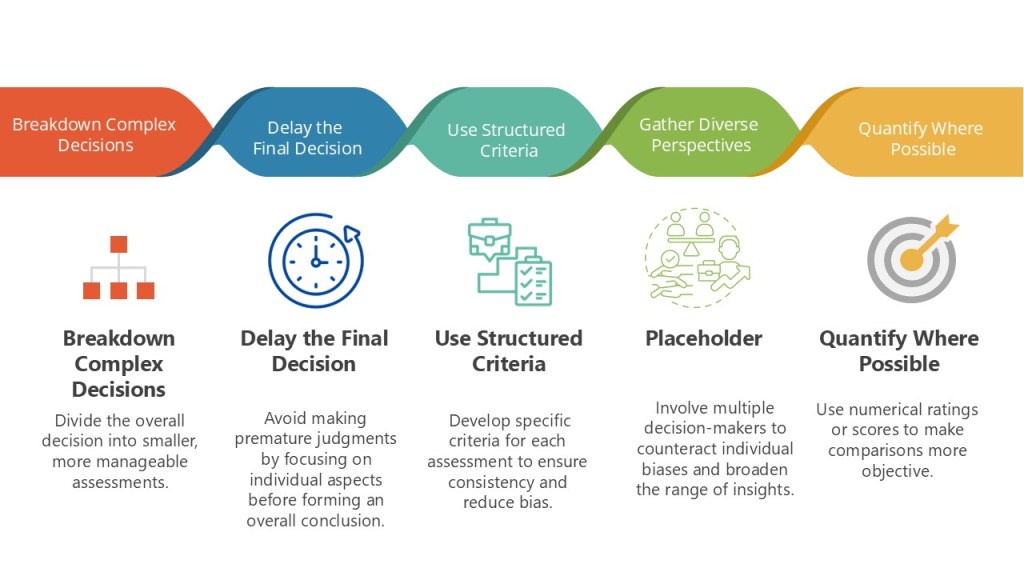
The Mediating Assessments Protocol (MAP) is a structured approach to strategic decision-making aims to reduce errors and improve the quality of judgments. I think this a good tool for the toolbox, as it:

  1. Break down complex decisions: Divide the overall decision into smaller, more manageable assessments.
  2. Delay the final decision: Avoid making premature judgments by focusing on individual aspects before forming an overall conclusion.
  3. Use structured criteria: Develop specific criteria for each assessment to ensure consistency and reduce bias.
  4. Gather diverse perspectives: Involve multiple decision-makers to counteract individual biases and broaden the range of insights.
  5. Quantify where possible: Use numerical ratings or scores to make comparisons more objective.

Implementing a structured approach like MAP can yield several benefits. First and foremost, it significantly reduces bias in the decision-making process. By breaking decisions into smaller components, the influence of initial impressions or irrelevant factors is minimized. This allows decision-makers to focus on each aspect individually, leading to more objective evaluations.

Another key advantage is improved consistency. Structured criteria ensure that all options are evaluated on the same basis, eliminating the variability that often occurs when different decision-makers use their own subjective standards. This consistency not only improves the quality of decisions but also makes it easier to compare and contrast different options.

Enhanced transparency is yet another benefit of a structured approach. The decision-making process becomes clearer and more defensible when each step is well-defined and documented. This transparency can be particularly valuable in organizations where decisions need to be justified to stakeholders or where there’s a need for accountability.

Lastly, a structured approach like MAP can lead to better group dynamics. By providing a framework for evaluation, it helps prevent groupthink and encourages diverse viewpoints. Team members are more likely to voice their opinions when there’s a clear process for considering different aspects of a decision, leading to more robust and well-rounded strategic choices.

To adopt a structured approach to strategic decision-making:

  1. Identify key decisions: Determine which strategic decisions would benefit most from a structured approach.
  2. Develop assessment criteria: Create specific, measurable criteria for each aspect of the decision.
  3. Train decision-makers: Ensure that all involved parties understand the MAP process and its benefits.
  4. Document the process: Keep records of assessments and final decisions for future reference and learning.
  5. Review and refine: Regularly evaluate the effectiveness of your structured approach and make improvements as needed.

By adopting a structured approach like MAP, organizations can significantly improve the quality of their strategic decisions. This method helps mitigate cognitive biases, reduces noise in the decision-making process, and ultimately leads to more reliable and successful outcomes. In an increasingly complex business landscape, such an approach can provide a crucial competitive advantage.


References

  • Kahneman, D., Lovallo, D., & Sibony, O. (2019). A structured approach to strategic decisions. MIT Sloan Management Review, 60(3), 67-73.
  • Sinnaiah, T., Adam, S., & Mahadi, B. (2023). A strategic management process: the role of decision-making style and organisational performance. Journal of Work-Applied Management, 15(1), 37-50.
  • Mintzberg, H., Ahlstrand, B., & Lampel, J. (2020). Strategy safari: A guided tour through the wilds of strategic management. Free Press.
  • Calabretta, G., Gemser, G., & Wijnberg, N. M. (2017). The interplay between intuition and rationality in strategic decision making: A paradox perspective. Organization Studies, 38(3-4), 365-401.
  • Hodgkinson, G. P., & Sadler-Smith, E. (2018). The dynamics of intuition and analysis in managerial and organizational decision making. Academy of Management Perspectives, 32(4), 473-492.
  • Keeney, R. L. (1982). Decision analysis: An overview. Operations Research, 30(5), 803-838.
  • Gregory, R., Failing, L., Harstone, M., Long, G., McDaniels, T., & Ohlson, D. (2012). Structured decision making: A practical guide to environmental management choices. John Wiley & Sons.
  • Eisenhardt, K. M., & Zbaracki, M. J. (1992). Strategic decision making. Strategic Management Journal, 13(S2), 17-37.
  • Hammond, J. S., Keeney, R. L., & Raiffa, H. (1998). The hidden traps in decision making. Harvard Business Review, 76(5), 47-58.
  • Papadakis, V. M., Lioukas, S., & Chambers, D. (1998). Strategic decision-making processes: The role of management and context. Strategic Management Journal, 19(2), 115-147.