Evolution of GMP Documentation: Analyzing the Transformative Changes in Draft EU Chapter 4

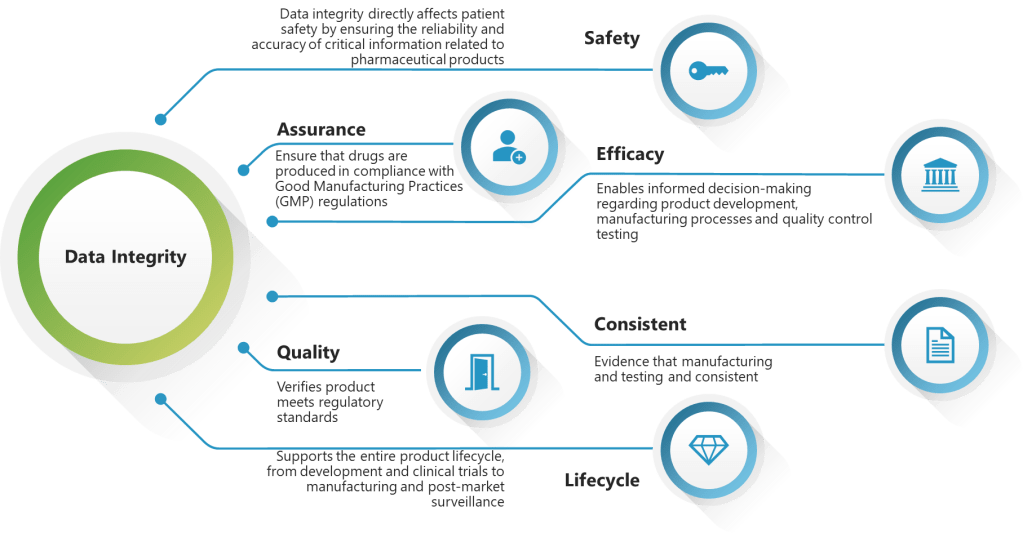
The draft revision of EU GMP Chapter 4 on Documentation represents more than just an update—it signals a paradigm shift toward digitalization, enhanced data integrity, and risk-based quality management in pharmaceutical manufacturing.

The Digital Transformation Imperative

The draft Chapter 4 emerges from a recognition that pharmaceutical manufacturing has fundamentally changed since 2011. The rise of Industry 4.0, artificial intelligence in manufacturing decisions, and the critical importance of data integrity following numerous regulatory actions have necessitated a complete reconceptualization of documentation requirements.

The new framework introduces comprehensive data governance systems, risk-based approaches throughout the documentation lifecycle, and explicit requirements for hybrid systems that combine paper and electronic elements. These changes reflect lessons learned from data integrity violations that have cost the industry billions in remediation and lost revenue.

Detailed Document Type Analysis

Master Documents: Foundation of Quality Systems

Document TypeCurrent Chapter 4 (2011) RequirementsDraft Chapter 4 (2025) RequirementsFDA 21 CFR 211ICH Q7WHO GMPISO 13485
Site Master FileA document describing the GMP related activities of the manufacturerRefer to EU GMP Guidelines, Volume 4 ‘Explanatory Notes on the preparation of a Site Master File’No specific equivalent, but facility information requirements under §211.176Section 2.5 – Documentation system should include site master file equivalent informationSection 4.1 – Site master file requirements similar to EU GMPQuality manual requirements under Section 4.2.2
Validation Master PlanNot specifiedA document describing the key elements of the site qualification and validation programProcess validation requirements under §211.100 and §211.110Section 12 – Validation requirements for critical operationsSection 4.2 – Validation and qualification programsValidation planning under Section 7.5.6 and design validation

The introduction of the Validation Master Plan as a mandatory master document represents the most significant addition to this category. This change acknowledges the critical role of systematic validation in modern pharmaceutical manufacturing and aligns EU GMP with global best practices seen in FDA and ICH frameworks.

The Site Master File requirement, while maintained, now references more detailed guidance, suggesting increased regulatory scrutiny of facility information and manufacturing capabilities.

Instructions: The Operational Backbone

Document TypeCurrent Chapter 4 (2011) RequirementsDraft Chapter 4 (2025) RequirementsFDA 21 CFR 211ICH Q7WHO GMPISO 13485
SpecificationsDescribe in detail the requirements with which the products or materials used or obtained during manufacture have to conform. They serve as a basis for quality evaluationRefer to glossary for definitionComponent specifications §211.84, drug product specifications §211.160Section 7.3 – Specifications for starting materials, intermediates, and APIsSection 4.12 – Specifications for starting materials and finished productsRequirements specifications under Section 7.2.1
Manufacturing Formulae, Processing, Packaging and Testing InstructionsProvide detail all the starting materials, equipment and computerised systems (if any) to be used and specify all processing, packaging, sampling and testing instructionsProvide complete detail on all the starting materials, equipment, and computerised systems (if any) to be used and specify all processing, packaging, sampling, and testing instructions to ensure batch to batch consistencyMaster production and control records §211.186, production record requirements §211.188Section 6.4 – Master production instructions and batch production recordsSection 4.13 – Manufacturing formulae and processing instructionsProduction and service provision instructions Section 7.5.1
Procedures (SOPs)Give directions for performing certain operationsOtherwise known as Standard Operating Procedures, documented set of instructions for performing and recording operationsWritten procedures required throughout Part 211 for various operationsSection 6.1 – Written procedures for all critical operationsSection 4.14 – Standard operating procedures for all operationsDocumented procedures throughout the standard, Section 4.2.1
Technical/Quality AgreementsAre agreed between contract givers and acceptors for outsourced activitiesWritten proof of agreement between contract givers and acceptors for outsourced activitiesContract manufacturing requirements implied, vendor qualificationSection 16 – Contract manufacturers agreements and responsibilitiesSection 7 – Contract manufacture and analysis agreementsOutsourcing agreements under Section 7.4 – Purchasing

The enhancement of Manufacturing Instructions to explicitly require “batch to batch consistency” represents a crucial evolution. This change reflects increased regulatory focus on manufacturing reproducibility and aligns with FDA’s process validation lifecycle approach and ICH Q7’s emphasis on consistent API production.

Procedures (SOPs) now explicitly encompass both “performing and recording operations,” emphasizing the dual nature of documentation as both instruction and evidence creation1. This mirrors FDA 21 CFR 211’s comprehensive procedural requirements and ISO 13485’s systematic approach to documented procedures910.

The transformation of Technical Agreements into Technical/Quality Agreements with emphasis on “written proof” reflects lessons learned from outsourcing challenges and regulatory enforcement actions. This change aligns with ICH Q7’s detailed contract manufacturer requirements and strengthens oversight of critical outsourced activities.

Records and Reports: Evidence of Compliance

Document TypeCurrent Chapter 4 (2011) RequirementsDraft Chapter 4 (2025) RequirementsFDA 21 CFR 211ICH Q7WHO GMPISO 13485
RecordsProvide evidence of various actions taken to demonstrate compliance with instructions, e.g. activities, events, investigations, and in the case of manufactured batches a history of each batch of productProvide evidence of various actions taken to demonstrate compliance with instructions, e.g. activities, events, investigations, and in the case of manufactured batches a history of each batch of product, including its distribution. Records include the raw data which is used to generate other recordsComprehensive record requirements throughout Part 211, §211.180 general requirementsSection 6.5 – Batch production records and Section 6.6 – Laboratory control recordsSection 4.16 – Records requirements for all GMP activitiesQuality records requirements under Section 4.2.4
Certificate of AnalysisProvide a summary of testing results on samples of products or materials together with the evaluation for compliance to a stated specificationProvide a summary of testing results on samples of products or materials together with the evaluation for compliance to a stated specificationLaboratory records and test results §211.194, certificate requirementsSection 11.15 – Certificate of analysis for APIsSection 6.8 – Certificates of analysis requirementsTest records and certificates under Section 7.5.3
ReportsDocument the conduct of particular exercises, projects or investigations, together with results, conclusions and recommendationsDocument the conduct of exercises, studies, assessments, projects or investigations, together with results, conclusions and recommendationsInvestigation reports §211.192, validation reportsSection 15 – Complaints and recalls, investigation reportsSection 4.17 – Reports for deviations, investigations, and studiesManagement review reports Section 5.6, validation reports

The expansion of Records to explicitly include “raw data” and “distribution information” represents perhaps the most impactful change for day-to-day operations. This enhancement directly addresses data integrity concerns highlighted by regulatory inspections and enforcement actions globally. The definition now states that “Records include the raw data which is used to generate other records,” establishing clear expectations for data traceability that align with FDA’s data integrity guidance and ICH Q7’s comprehensive record requirements.

Reports now encompass “exercises, studies, assessments, projects or investigations,” broadening the scope beyond the current “particular exercises, projects or investigations”. This expansion aligns with modern pharmaceutical operations that increasingly rely on various analytical studies and assessments for decision-making, matching ISO 13485’s comprehensive reporting requirements.

Revolutionary Framework Elements

Data Governance Revolution

The draft introduces an entirely new paradigm through its Data Governance Systems (Sections 4.10-4.18). This framework establishes:

  • Complete lifecycle management from data creation through retirement
  • Risk-based approaches considering data criticality and data risk
  • Service provider oversight with periodic review requirements
  • Ownership accountability throughout the data lifecycle

This comprehensive approach exceeds traditional GMP requirements and positions EU regulations at the forefront of data integrity management, surpassing even FDA’s current frameworks in systematic approach.

ALCOA++ Formalization

The draft formalizes ALCOA++ principles (Attributable, Legible, Contemporaneous, Original, Accurate, Complete, Consistent, Enduring, Available, Traceable) with detailed definitions for each attribute. This represents a major comprehensive regulatory codification of these principles, providing unprecedented clarity for industry implementation.

ALCOA++ Principles: Comprehensive Data Integrity Framework

The Draft EU GMP Chapter 4 (2025) formalizes the ALCOA++ principles as the foundation for data integrity in pharmaceutical manufacturing. This represents the first comprehensive regulatory codification of these expanded data integrity principles, building upon the traditional ALCOA framework with five additional critical elements.

Complete ALCOA++ Requirements Table

PrincipleCore RequirementPaper ImplementationElectronic Implementation
A – AttributableIdentify who performed the task and whenSignatures, dates, initialsUser authentication, e-signatures
L – LegibleInformation must be readable and unambiguousClear writing, permanent inkProper formats, search functionality
C – ContemporaneousRecord actions as they happen in real-timeImmediate recordingSystem timestamps, workflow controls
O – OriginalPreserve first capture of informationOriginal documents retainedDatabase integrity, backups
A – AccurateEnsure truthful representation of factsTraining, calibrated equipmentSystem validation, automated checks
+ CompleteInclude all critical information and metadataComplete data, no missing pagesMetadata capture, completeness checks
+ ConsistentStandardize data creation and processingStandard formats, consistent unitsData standards, validation rules
+ EnduringMaintain records throughout retention periodArchival materials, proper storageDatabase integrity, migration plans
+ AvailableEnsure accessibility for authorized personnelOrganized filing, access controlsRole-based access, query capabilities
+ TraceableEnable tracing of data history and changesSequential numbering, change logsAudit trails, version control

Hybrid Systems Management

Recognizing the reality of modern pharmaceutical operations, the draft dedicates sections 4.82-4.85 to hybrid systems that combine paper and electronic elements. This practical approach acknowledges that many manufacturers operate in mixed environments and provides specific requirements for managing these complex systems.

A New Era of Pharmaceutical Documentation

The draft EU GMP Chapter 4 represents the most significant evolution in pharmaceutical documentation requirements in over a decade. By introducing comprehensive data governance frameworks, formalizing data integrity principles, and acknowledging the reality of digital transformation, these changes position European regulations as global leaders in modern pharmaceutical quality management.

For industry professionals, these changes offer both challenges and opportunities. Organizations that proactively embrace these new paradigms will not only achieve regulatory compliance but will also realize operational benefits through improved data quality, enhanced decision-making capabilities, and reduced compliance costs.

The evolution from simple documentation requirements to comprehensive data governance systems reflects the maturation of the pharmaceutical industry and its embrace of digital technologies. As we move toward implementation, the industry’s response to these changes will shape the future of pharmaceutical manufacturing for decades to come.

The message is clear: the future of pharmaceutical documentation is digital, risk-based, and comprehensive. Organizations that recognize this shift and act accordingly will thrive in the new regulatory environment, while those that cling to outdated approaches risk being left behind in an increasingly sophisticated and demanding regulatory landscape.
The Effective Date of Documents

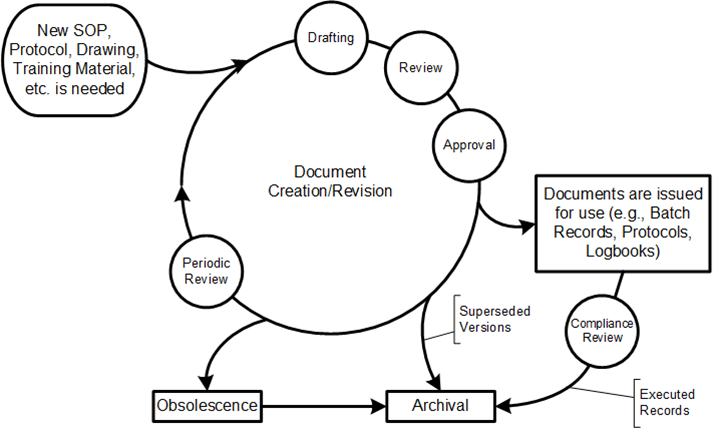
Document change control has a core set of requirements for managing critical information throughout its lifecycle. These requirements encompass:

  1. Approval of documents based on fit-for-purpose and fit-for-use before issuance
  2. Review and document updates as needed (including reapprovals)
  3. Managing changes and revision status
  4. Ensuring availability of current versions
  5. Maintaining document legibility and identification
  6. Controlling distribution of external documents

This lifecycle usually has three critical dates associated with approval:

  • Approval Date: When designated authorities have reviewed and approved the document
  • Issuance Date: When the document is released into the document management system
  • Effective Date: When the document officially takes effect and must be followed

These dates are dependent on the type of document and can change as a result of workflow decisions.

Type of DocumentApproval DateIssuance dateEffective Date
Functional Date Approved by final approver (sequential or parallel)Date Training Made AvailableEnd of Training Period
RecordDate Approved by final approver (sequential or parallel)Usually automated to be same as Date ApprovedUsually same as Date Approved
ReportDate Approved by final approver (sequential or parallel)Usually automated to be same as Date ApprovedUsually same as Date Approved

At the heart of the difference between these three days is the question of implementation and the Effective Date. At its core, the effective date is the date on which the requirements, instructions, or obligations in a document become binding for all affected parties. In the context of GxP document management, this represents the moment when:

  • Previous versions of the document are officially superseded
  • All operations must follow the new procedures outlined in the document
  • Training on the new procedures must be completed
  • Compliance audits will use the new document as their reference standard

Why Training Periods Matter in GxP Environments

One of the most frequently overlooked aspects of document management is the implementation period between document approval and its effective date. This period serves a critical purpose: ensuring that all affected personnel understand the document’s content and can execute its requirements correctly before it becomes binding.

In order to implement a new process change in a compliant manner, people must be trained in the new procedure before the document becomes effective. This fundamental principle ensures that by the time a new process goes “live,” everyone is prepared to perform the revised activity correctly and training records have been completed. Without this preparation period, organizations risk introducing non-compliance at the very moment they attempt to improve quality.

The implementation period bridges the gap between formal approval and practical application, addressing the human element of quality systems that automated solutions alone cannot solve.

Selecting Appropriate Implementation Periods

When configuring document change control systems, organizations must establish clear guidelines for determining implementation periods. The most effective approach is to build this determination into the change control workflow itself.

Several factors should influence the selection of implementation periods:

  • Urgency: In cases of immediate risk to patient safety or product quality, implementation periods may be compressed while still ensuring adequate training.
  • Risk Assessment: Higher-risk changes typically require more extensive training and therefore longer implementation periods.
  • Operational Impact: Changes affecting critical operations may need carefully staged implementation.
  • Training Complexity: Documents requiring hands-on training necessitate longer periods than read-only procedures.
  • Resource Availability: Consider the availability of trainers and affected personnel

Determining Appropriate Training Periods

The time required for training should be determined during the impact assessment phase of the change approval process. This assessment should consider:

  1. The number of people requiring training
  2. The complexity of the procedural changes
  3. The type of training required (read-only versus observed assessment)
  4. Operational constraints (shift patterns, production schedules)

Many organizations standardize on a default period (typically two weeks), but the most effective approach tailors the implementation period to each document’s specific requirements. For critical processes with many stakeholders, longer periods may be necessary, while simple updates affecting few staff might require only minimal time.

Consider this scenario: Your facility operates two shifts with 70 people during the day and 30 at night. An updated SOP requires all operators to complete not just read-only training but also a one-hour classroom assessment. If manufacturing schedules permit only 10 operators per shift to attend training, you would need a minimum of 7 days before the document becomes effective. Without this calculated implementation period, every operator would instantly become non-compliant when the new procedure takes effect.

Early Use of Documents

The distinction between a procedure’s approval date and its effective date serves a critical purpose. This gap allows for proper training and implementation before the procedure becomes binding. However, there are specific circumstances when personnel might appropriately use a procedure they’ve been trained on before its official effective date.

1. Urgent Safety or Quality Concerns

When there is an immediate risk to patient safety or product quality, the time between approval and effectiveness may be compressed. For these cases there should be a mechanism to move up the effective date.

In such cases, the organization should prioritize training and implementation while still maintaining proper documentation of the accelerated timeline.

2. During Implementation Period for Training Purposes

The implementation period itself is designed to allow for training and controlled introduction of the new procedure. During this time, a limited number of trained personnel may need to use the new procedure to:

  • Train others on the new requirements
  • Test the procedure in a controlled environment
  • Prepare systems and equipment for the full implementation

These are all tasks that should be captured in the change control.

3. For Qualification and Validation Activities

During qualification protocol execution, procedures that have been approved but are not yet effective may be used under controlled conditions to validate systems, equipment, or processes. These activities typically occur before full implementation and are carefully documented to demonstrate compliance. Again these are captured in the change control and appropriate validation plan.

In some regulatory contexts, such as IRB approvals in clinical research, there are provisions for “approval with conditions” where certain activities may proceed before all requirements are finalized2. While not directly analogous to procedure implementation, this demonstrates regulatory recognition of staged implementation approaches.

Required Controls When Using Pre-Effective Procedures

If an organization determines it necessary to use an approved but not yet effective procedure, the following controls should be in place:

  1. Documented Risk Assessment: A risk assessment should be conducted and documented to justify the early use of the procedure, especially considering potential impacts on product quality, data integrity, or patient safety.
  2. Authorization: Special authorization from management and quality assurance should be obtained and documented.
  3. Verification of Training: Evidence must be available confirming that the individuals using the procedure have been properly trained and assessed on the new requirements.

What About Parallel Compliance with Current Effective Procedures?

In all cases, the currently effective procedure must still be followed until the new procedure’s effective date. However there are changes, usually as a result of process improvement, usually in knowledge work processes where it is possible to use parts of the new procedure. For example, the new version of the deviation procedure adds additional requirements for assessing the deviation, or a new risk management tool is rolled out. In these cases you can meet the new compliance path without violating the current compliance path. The organization should demonstrate how both compliance paths are being maintained.

In cases where the new compliance path does not contain the old, but instead offers a new pathway, it is critical to maintain one way of work-as-prescribed and the effective date is a solid line.

Organizations should remember that the implementation period exists to ensure a smooth, compliant transition between procedures. Any exception to this standard approach should be carefully considered, well-justified, and thoroughly documented to maintain GxP compliance and minimize regulatory risk.

Beyond Documents: Embracing Data-Centric Thinking

We live in a fascinating inflection point in quality management, caught between traditional document-centric approaches and the emerging imperative for data-centricity needed to fully realize the potential of digital transformation. For several decades, we’ve been in a process that continues to accelerate through a technology transition that will deliver dramatic improvements in operations and quality. This transformation is driven by three interconnected trends: Pharma 4.0, the Rise of AI, and the shift from Documents to Data.

The History and Evolution of Documents in Quality Management

The history of document management can be traced back to the introduction of the file cabinet in the late 1800s, providing a structured way to organize paper records. Quality management systems have even deeper roots, extending back to medieval Europe when craftsman guilds developed strict guidelines for product inspection. These early approaches established the document as the fundamental unit of quality management—a paradigm that persisted through industrialization and into the modern era.

The document landscape took a dramatic turn in the 1980s with the increasing availability of computer technology. The development of servers allowed organizations to store documents electronically in centralized mainframes, marking the beginning of electronic document management systems (eDMS). Meanwhile, scanners enabled conversion of paper documents to digital format, and the rise of personal computers gave businesses the ability to create and store documents directly in digital form.

In traditional quality systems, documents serve as the backbone of quality operations and fall into three primary categories: functional documents (providing instructions), records (providing evidence), and reports (providing specific information). This document trinity has established our fundamental conception of what a quality system is and how it operates—a conception deeply influenced by the physical limitations of paper.

Photo by Andrea Piacquadio on Pexels.com

Breaking the Paper Paradigm: Limitations of Document-Centric Thinking

The Paper-on-Glass Dilemma

The maturation path for quality systems typically progresses mainly from paper execution to paper-on-glass to end-to-end integration and execution. However, most life sciences organizations remain stuck in the paper-on-glass phase of their digital evolution. They still rely on the paper-on-glass data capture method, where digital records are generated that closely resemble the structure and layout of a paper-based workflow. In general, the wider industry is still reluctant to transition away from paper-like records out of process familiarity and uncertainty of regulatory scrutiny.

Paper-on-glass systems present several specific limitations that hamper digital transformation:

  1. Constrained design flexibility: Data capture is limited by the digital record’s design, which often mimics previous paper formats rather than leveraging digital capabilities. A pharmaceutical batch record system that meticulously replicates its paper predecessor inherently limits the system’s ability to analyze data across batches or integrate with other quality processes.
  2. Manual data extraction requirements: When data is trapped in digital documents structured like paper forms, it remains difficult to extract. This means data from paper-on-glass records typically requires manual intervention, substantially reducing data utilization effectiveness.
  3. Elevated error rates: Many paper-on-glass implementations lack sufficient logic and controls to prevent avoidable data capture errors that would be eliminated in truly digital systems. Without data validation rules built into the capture process, quality systems continue to allow errors that must be caught through manual review.
  4. Unnecessary artifacts: These approaches generate records with inflated sizes and unnecessary elements, such as cover pages that serve no functional purpose in a digital environment but persist because they were needed in paper systems.
  5. Cumbersome validation: Content must be fully controlled and managed manually, with none of the advantages gained from data-centric validation approaches.

Broader Digital Transformation Struggles

Pharmaceutical and medical device companies must navigate complex regulatory requirements while implementing new digital systems, leading to stalling initiatives. Regulatory agencies have historically relied on document-based submissions and evidence, reinforcing document-centric mindsets even as technology evolves.

Beyond Paper-on-Glass: What Comes Next?

What comes after paper-on-glass? The natural evolution leads to end-to-end integration and execution systems that transcend document limitations and focus on data as the primary asset. This evolution isn’t merely about eliminating paper—it’s about reconceptualizing how we think about the information that drives quality management.

In fully integrated execution systems, functional documents and records become unified. Instead of having separate systems for managing SOPs and for capturing execution data, these systems bring process definitions and execution together. This approach drives up reliability and drives out error, but requires fundamentally different thinking about how we structure information.

A prime example of moving beyond paper-on-glass can be seen in advanced Manufacturing Execution Systems (MES) for pharmaceutical production. Rather than simply digitizing batch records, modern MES platforms incorporate AI, IIoT, and Pharma 4.0 principles to provide the right data, at the right time, to the right team. These systems deliver meaningful and actionable information, moving from merely connecting devices to optimizing manufacturing and quality processes.

AI-Powered Documentation: Breaking Through with Intelligent Systems

A dramatic example of breaking free from document constraints comes from Novo Nordisk’s use of AI to draft clinical study reports. The company has taken a leap forward in pharmaceutical documentation, putting AI to work where human writers once toiled for weeks. The Danish pharmaceutical company is using Claude, an AI model by Anthropic, to draft clinical study reports—documents that can stretch hundreds of pages.

This represents a fundamental shift in how we think about documents. Rather than having humans arrange data into documents manually, we can now use AI to generate high-quality documents directly from structured data sources. The document becomes an output—a view of the underlying data—rather than the primary artifact of the quality system.

Data Requirements: The Foundation of Modern Quality Systems in Life Sciences

Shifting from document-centric to data-centric thinking requires understanding that documents are merely vessels for data—and it’s the data that delivers value. When we focus on data requirements instead of document types, we unlock new possibilities for quality management in regulated environments.

At its core, any quality process is a way to realize a set of requirements. These requirements come from external sources (regulations, standards) and internal needs (efficiency, business objectives). Meeting these requirements involves integrating people, procedures, principles, and technology. By focusing on the underlying data requirements rather than the documents that traditionally housed them, life sciences organizations can create more flexible, responsive quality systems.

ICH Q9(R1) emphasizes that knowledge is fundamental to effective risk management, stating that “QRM is part of building knowledge and understanding risk scenarios, so that appropriate risk control can be decided upon for use during the commercial manufacturing phase.” We need to recognize the inverse relationship between knowledge and uncertainty in risk assessment. As ICH Q9(R1) notes, uncertainty may be reduced “via effective knowledge management, which enables accumulated and new information (both internal and external) to be used to support risk-based decisions throughout the product lifecycle.”

This approach helps us ensure that our tools take into account that our processes are living and breathing, our tools should take that into account. This is all about moving to a process repository and away from a document mindset.

Documents as Data Views: Transforming Quality System Architecture

When we shift our paradigm to view documents as outputs of data rather than primary artifacts, we fundamentally transform how quality systems operate. This perspective enables a more dynamic, interconnected approach to quality management that transcends the limitations of traditional document-centric systems.

Breaking the Document-Data Paradigm

Traditionally, life sciences organizations have thought of documents as containers that hold data. This subtle but profound perspective has shaped how we design quality systems, leading to siloed applications and fragmented information. When we invert this relationship—seeing data as the foundation and documents as configurable views of that data—we unlock powerful capabilities that better serve the needs of modern life sciences organizations.

The Benefits of Data-First, Document-Second Architecture

When documents become outputs—dynamic views of underlying data—rather than the primary focus of quality systems, several transformative benefits emerge.

First, data becomes reusable across multiple contexts. The same underlying data can generate different documents for different audiences or purposes without duplication or inconsistency. For example, clinical trial data might generate regulatory submission documents, internal analysis reports, and patient communications—all from a single source of truth.

Second, changes to data automatically propagate to all relevant documents. In a document-first system, updating information requires manually changing each affected document, creating opportunities for errors and inconsistencies. In a data-first system, updating the central data repository automatically refreshes all document views, ensuring consistency across the quality ecosystem.

Third, this approach enables more sophisticated analytics and insights. When data exists independently of documents, it can be more easily aggregated, analyzed, and visualized across processes.

In this architecture, quality management systems must be designed with robust data models at their core, with document generation capabilities built on top. This might include:

  1. A unified data layer that captures all quality-related information
  2. Flexible document templates that can be populated with data from this layer
  3. Dynamic relationships between data entities that reflect real-world connections between quality processes
  4. Powerful query capabilities that enable users to create custom views of data based on specific needs

The resulting system treats documents as what they truly are: snapshots of data formatted for human consumption at specific moments in time, rather than the authoritative system of record.

Electronic Quality Management Systems (eQMS): Beyond Paper-on-Glass

Electronic Quality Management Systems have been adopted widely across life sciences, but many implementations fail to realize their full potential due to document-centric thinking. When implementing an eQMS, organizations often attempt to replicate their existing document-based processes in digital form rather than reconceptualizing their approach around data.

Current Limitations of eQMS Implementations

Document-centric eQMS systems treat functional documents as discrete objects, much as they were conceived decades ago. They still think it terms of SOPs being discrete documents. They structure workflows, such as non-conformances, CAPAs, change controls, and design controls, with artificial gaps between these interconnected processes. When a manufacturing non-conformance impacts a design control, which then requires a change control, the connections between these events often remain manual and error-prone.

This approach leads to compartmentalized technology solutions. Organizations believe they can solve quality challenges through single applications: an eQMS will solve problems in quality events, a LIMS for the lab, an MES for manufacturing. These isolated systems may digitize documents but fail to integrate the underlying data.

Data-Centric eQMS Approaches

We are in the process of reimagining eQMS as data platforms rather than document repositories. A data-centric eQMS connects quality events, training records, change controls, and other quality processes through a unified data model. This approach enables more effective risk management, root cause analysis, and continuous improvement.

For instance, when a deviation is recorded in a data-centric system, it automatically connects to relevant product specifications, equipment records, training data, and previous similar events. This comprehensive view enables more effective investigation and corrective action than reviewing isolated documents.

Looking ahead, AI-powered eQMS solutions will increasingly incorporate predictive analytics to identify potential quality issues before they occur. By analyzing patterns in historical quality data, these systems can alert quality teams to emerging risks and recommend preventive actions.

Manufacturing Execution Systems (MES): Breaking Down Production Data Silos

Manufacturing Execution Systems face similar challenges in breaking away from document-centric paradigms. Common MES implementation challenges highlight the limitations of traditional approaches and the potential benefits of data-centric thinking.

MES in the Pharmaceutical Industry

Manufacturing Execution Systems (MES) aggregate a number of the technologies deployed at the MOM level. MES as a technology has been successfully deployed within the pharmaceutical industry and the technology associated with MES has matured positively and is fast becoming a recognized best practice across all life science regulated industries. This is borne out by the fact that green-field manufacturing sites are starting with an MES in place—paperless manufacturing from day one.

The amount of IT applied to an MES project is dependent on business needs. At a minimum, an MES should strive to replace paper batch records with an Electronic Batch Record (EBR). Other functionality that can be applied includes automated material weighing and dispensing, and integration to ERP systems; therefore, helping the optimization of inventory levels and production planning.

Beyond Paper-on-Glass in Manufacturing

In pharmaceutical manufacturing, paper batch records have traditionally documented each step of the production process. Early electronic batch record systems simply digitized these paper forms, creating “paper-on-glass” implementations that failed to leverage the full potential of digital technology.

Advanced Manufacturing Execution Systems are moving beyond this limitation by focusing on data rather than documents. Rather than digitizing batch records, these systems capture manufacturing data directly, using sensors, automated equipment, and operator inputs. This approach enables real-time monitoring, statistical process control, and predictive quality management.

An example of a modern MES solution fully compliant with Pharma 4.0 principles is the Tempo platform developed by Apprentice. It is a complete manufacturing system designed for life sciences companies that leverages cloud technology to provide real-time visibility and control over production processes. The platform combines MES, EBR, LES (Laboratory Execution System), and AR (Augmented Reality) capabilities to create a comprehensive solution that supports complex manufacturing workflows.

Electronic Validation Management Systems (eVMS): Transforming Validation Practices

Validation represents a critical intersection of quality management and compliance in life sciences. The transition from document-centric to data-centric approaches is particularly challenging—and potentially rewarding—in this domain.

Current Validation Challenges

Traditional validation approaches face several limitations that highlight the problems with document-centric thinking:

  1. Integration Issues: Many Digital Validation Tools (DVTs) remain isolated from Enterprise Document Management Systems (eDMS). The eDMS system is typically the first step where vendor engineering data is imported into a client system. However, this data is rarely validated once—typically departments repeat this validation step multiple times, creating unnecessary duplication.
  2. Validation for AI Systems: Traditional validation approaches are inadequate for AI-enabled systems. Traditional validation processes are geared towards demonstrating that products and processes will always achieve expected results. However, in the digital “intellectual” eQMS world, organizations will, at some point, experience the unexpected.
  3. Continuous Compliance: A significant challenge is remaining in compliance continuously during any digital eQMS-initiated change because digital systems can update frequently and quickly. This rapid pace of change conflicts with traditional validation approaches that assume relative stability in systems once validated.

Data-Centric Validation Solutions

Modern electronic Validation Management Systems (eVMS) solutions exemplify the shift toward data-centric validation management. These platforms introduce AI capabilities that provide intelligent insights across validation activities to unlock unprecedented operational efficiency. Their risk-based approach promotes critical thinking, automates assurance activities, and fosters deeper regulatory alignment.

We need to strive to leverage the digitization and automation of pharmaceutical manufacturing to link real-time data with both the quality risk management system and control strategies. This connection enables continuous visibility into whether processes are in a state of control.

The 11 Axes of Quality 4.0

LNS Research has identified 11 key components or “axes” of the Quality 4.0 framework that organizations must understand to successfully implement modern quality management:

  1. Data: In the quality sphere, data has always been vital for improvement. However, most organizations still face lags in data collection, analysis, and decision-making processes. Quality 4.0 focuses on rapid, structured collection of data from various sources to enable informed and agile decision-making.
  2. Analytics: Traditional quality metrics are primarily descriptive. Quality 4.0 enhances these with predictive and prescriptive analytics that can anticipate quality issues before they occur and recommend optimal actions.
  3. Connectivity: Quality 4.0 emphasizes the connection between operating technology (OT) used in manufacturing environments and information technology (IT) systems including ERP, eQMS, and PLM. This connectivity enables real-time feedback loops that enhance quality processes.
  4. Collaboration: Breaking down silos between departments is essential for Quality 4.0. This requires not just technological integration but cultural changes that foster teamwork and shared quality ownership.
  5. App Development: Quality 4.0 leverages modern application development approaches, including cloud platforms, microservices, and low/no-code solutions to rapidly deploy and update quality applications.
  6. Scalability: Modern quality systems must scale efficiently across global operations while maintaining consistency and compliance.
  7. Management Systems: Quality 4.0 integrates with broader management systems to ensure quality is embedded throughout the organization.
  8. Compliance: While traditional quality focused on meeting minimum requirements, Quality 4.0 takes a risk-based approach to compliance that is more proactive and efficient.
  9. Culture: Quality 4.0 requires a cultural shift that embraces digital transformation, continuous improvement, and data-driven decision-making.
  10. Leadership: Executive support and vision are critical for successful Quality 4.0 implementation.
  11. Competency: New skills and capabilities are needed for Quality 4.0, requiring significant investment in training and workforce development.

The Future of Quality Management in Life Sciences

The evolution from document-centric to data-centric quality management represents a fundamental shift in how life sciences organizations approach quality. While documents will continue to play a role, their purpose and primacy are changing in an increasingly data-driven world.

By focusing on data requirements rather than document types, organizations can build more flexible, responsive, and effective quality systems that truly deliver on the promise of digital transformation. This approach enables life sciences companies to maintain compliance while improving efficiency, enhancing product quality, and ultimately delivering better outcomes for patients.

The journey from documents to data is not merely a technical transition but a strategic evolution that will define quality management for decades to come. As AI, machine learning, and process automation converge with quality management, the organizations that successfully embrace data-centricity will gain significant competitive advantages through improved agility, deeper insights, and more effective compliance in an increasingly complex regulatory landscape.

The paper may go, but the document—reimagined as structured data that enables insight and action—will continue to serve as the foundation of effective quality management. The key is recognizing that documents are vessels for data, and it’s the data that drives value in the organization.

The Attributes of Good Procedure

Good documentation practices when documenting Work as Prescribed stresses the clarity, accuracy, thoroughness and control of the procedural instruction being written.

Clarity and Accuracy: Documentation should be clear and free from errors, ensuring that instructions are understood and followed correctly. This aligns with the concept of being precise in documentation.

Thoroughness: All relevant activities impacting quality should be recorded and controlled, indicating a need for comprehensive documentation practices.

Control and Integrity: The need for strict control over documentation to maintain integrity, accuracy, and availability throughout its lifecycle.

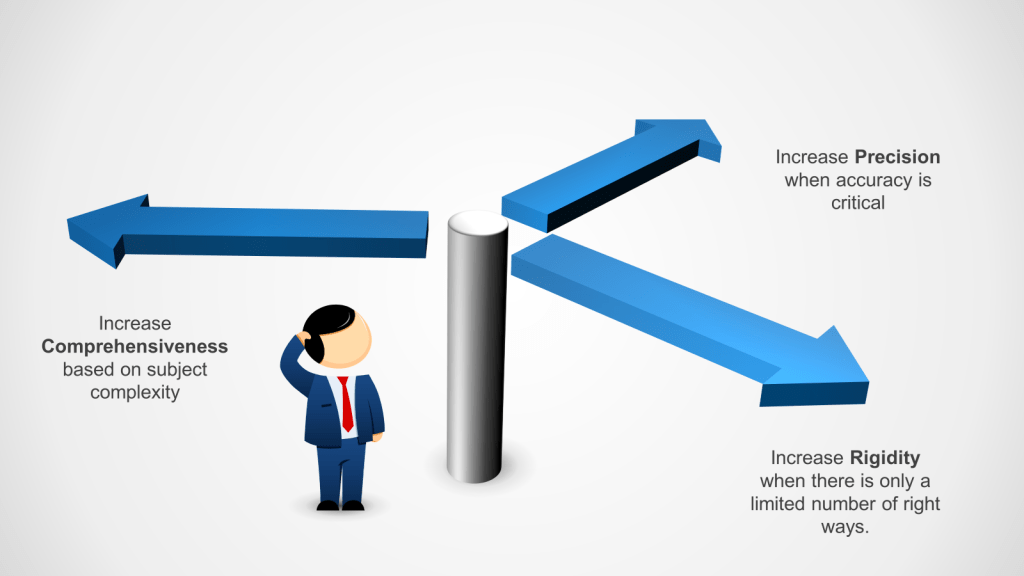
To meet these requirements we leverage three writing principles of precise, comprehensive and rigid.

Type of InstructionDefinitionAttributesWhen NeededWhyDifferencesExample
Precise Exact and accurate, leaving little room for interpretation.– Specific
– Detailed
– Unambiguous
When accuracy is critical, such as in scientific experiments or programming.Regulatory agencies require precise documentation to ensure tasks are performed consistently and correctlyFocuses on exactness and clarity, ensuring tasks are performed without deviation.Instructions for assembling a computer, specifying exact components and steps.
Comprehensive Complete and covering all necessary aspects of a task.– Thorough
– Inclusive
– Exhaustive
When a task is complex and requires understanding of all components, such as in training manuals.Comprehensive SOPs are crucial for ensuring all aspects of a process are covered, ensuring compliance with regulatory requirements.Provides a full overview, ensuring no part of the task is overlooked.Employee onboarding manual covering company policies, procedures, and culture.
Rigid Strict and inflexible, not allowing for changes.– Fixed
– Inflexible
– Consistent
When safety and compliance are paramount, such as batch recordsRigid instructions ensure compliance with strict regulatory standards.Ensures consistency and adherence to specific protocols, minimizing risks.Safety procedures for operating heavy machinery, with no deviations allowed.

When writing documents based on cognitive principles these three are often excellent for detailed task design but there are significant trade-offs inherent in these attributes when we codify knowledge:

  • The more comprehensive the instructions, the less likely that they can be absorbed, understood, and remembered by those responsible for execution – which is why it is important these instructions are followed at time of execution. Moreover, comprehensive instructions also risk can dilute the sense of responsibility felt by the person executing.
  • The more precise the instructions, the less they allow for customization or the exercise of employee initiative.
  • The more rigid the instructions, the less they will be able to evolve spontaneously as circumstances change. They require rigorous change management.

This means these tools are really good for complicated executions that must follow a specific set of steps. Ideal for equipment operations, testing, batch records. But as we shade into complex processes, which relies on domain knowledge, we start decreasing the rigidity, lowering the degree of precision, and walking a fine line on comprehensiveness.

Where organizations continue to struggle is in this understanding that it is not one size fits all. Every procedure is on a continuum and the level of comprehensiveness, precision and rigidity change as a result. Processes involving human judgement, customization for specific needs, or adaptations for changing circumstances should be written to a different standard than those involving execution of a test. It is also important to remember that a document may require high comprehensiveness, medium precision and low rigidity (for example a validation process).

Remember to use them with other tools for document writing. The goal here is to write documents that are usable to reach the necessary outcome.

Choose Your Font!

For a lot of reasons paper (and paper-on-glass) documents are with us for a long time. So it continually surprises me when I see documents in some basic, reduced readability font .

Even when we go to electronic systems that choice of font is going to be an important one. And it’s probably not the same font as what worked for you in a paper world.

And then there is all that training material and presentations (including conference material).

So spend some time and choose the fonts that works for you and your users. But please for goodness sake don’t default to a font because it is what you have always used.

I’m a huge fan of Roboto.

There was a nice writeup on fonts on SlideModel: 20 Best PowerPoint Fonts to Make Your Presentation Stand Out in 2023