Aging in the Workforce – or Why All Those Years Matter

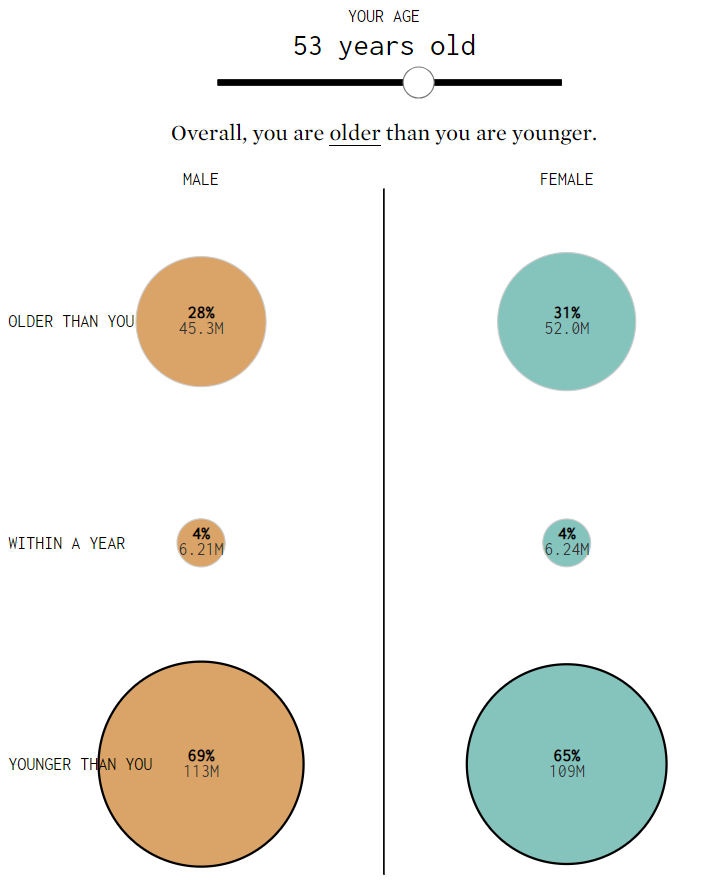
Source: https://flowingdata.com/2024/06/18/older-or-younger-than-the-population/

Wow, I’m older than a lot of people. When did that happen? (Shout out to my small cohort of fellow Gen-Xers!) So, in a bit of reflection, I want to discuss why I think aging in the quality profession is so critical.

The quality profession is an experience-heavy field. While formal education can provide some necessary theoretical knowledge, the practical skills required for the quality profession can only be mastered through extensive hands-on experience, practical application of skills, and the ability to adapt to real-world challenges.

Key characteristics

  1. Direct Experience: Students participate in activities that require them to apply what they have learned in a practical setting. An old adage is that you must do a job for three years before understanding it. However, you must keep going through the iterations since quality comprises multiple jobs. For example, my progress from deviation reviewer to eQMS implementation, to computer systems quality, to risk champion, to quality engineering, to change management process owner, to computer system implementor, to technology implementor, to validation quality, to operational excellence, to quality systems leader, to validation leader (and I am leaving a lot out). Layering and layering real experience again and again.
  2. Reflection: Reflection is a critical component of experiential learning. Most people don’t do that enough. The quality profession requires us to think about our experiences, analyze what we have learned, and consider how it applies to our work. Audits and inspections are interesting tools that can drive reflection when approached correctly.
  3. Active Participation: Quality professionals must be active agents in their learning process. They take initiative, make decisions, and are responsible for the outcomes of their actions. This active engagement helps to deepen their learning and develop critical thinking skills.
  4. Community Engagement: I joke about being able to tell what company some spent their formative years in. And that is not a good thing. Quality professionals need to seek out collaboration with the wider community members, often through professional organizations.
  5. Integration of Knowledge and Practice: Experiential fields bridge the gap between theoretical knowledge and practical application. Quality professionals must integrate what they have studied with real-world experiences, enhancing their understanding and retention of the material. And then do it again.

The quality profession is a dynamic and interactive learning environment emphasizing learning by doing, reflecting, and applying knowledge in real-world contexts.
Acountable People

We tend to jumble forms of accountability in an organization, often confusing between a people manager and a technical manager. I think its very important to differentiate between the two.

People managers deal with human resources and team dynamics, while technical managers deal with managing design, execution, and improvement. They can be the same person, but we need to recognize the differences and resource appropriately. Too often we blur the two roles and as a result neither is done well.

I’ve talked on this blog about a few of the technical manager types: Process Owners, the ASTM E2500 SME/Molecule Steward, and Knowledge Owners. There are certainly others out there. In the table below I added two more for comparison:

  • a qualified person from OSHA, because I think this is a great generic look at the concept
  • The EU Qualifed Person. Industry relevant and one that often gets confused in execution.
AspectQualified Person (OSHA Definition)Qualified Person (EU)Knowledge OwnerASTM E2500 SMEProcess Owner
Primary FocusEnsuring compliance with safety standards and solving technical problemsCertifying that each batch of a medicinal product meets all required provisionsManaging and maintaining knowledge within a specific domainEnsuring manufacturing systems meet quality and safety standardsManaging and optimizing a specific business process
Key ResponsibilitiesSolve or resolve problems related to the subject matter, work, or projectCertify batches meet GMP and regulatory standardsMaintain and update knowledge baseDefine system needs and identify critical aspectsDefine process goals, purpose, and KPIs
Design and install systems to improve safetyEnsure compliance with market authorization requirementsValidate and broadcast new knowledgeDevelop and execute verification strategiesCommunicate with key players and stakeholders
Ensure compliance with laws and standardsOversee quality control and assurance processesProvide training and supportReview system designs and manage risksAnalyze process performance and identify improvements
May not have the authority to stop workConduct audits and inspectionsMonitor and update knowledge assetsLead quality risk management effortsEnsure process compliance with regulations and standards
Skills RequiredTechnical expertise in the areaDegree in pharmacy, biology, chemistry, or related fieldSubject matter expertise in specific knowledge domainTechnical understanding of manufacturing systems and equipmentLeadership and communication skills
Certification, degree, or other professional recognitionSeveral years of experience in pharmaceutical manufacturingAnalytical and validation skillsRisk management and verification skillsAnalytical and problem-solving skills
Ability to solve technical problemsRegistered with the competent authority in the EU member stateTraining and support skillsContinuous improvement and change management skillsAbility to define and monitor KPIs
AuthorityAuthority to design and install safety systemsAuthority to certify batches and ensure complianceAuthority over knowledge management processes and contentAuthority to define and verify critical aspects of systemsAuthority to make decisions and implement changes in the process
Interaction with OthersCollaborates with production and quality control teamsWorks with quality control, assurance, and regulatory teamsWorks with various departments to ensure knowledge is shared and utilizedCollaborates with project stakeholders and engineering teamsCommunicates with project leaders, process users, and other stakeholders
Examples of ActivitiesReviewing batch documentation and certifying productsCertifying each batch of medicinal products before releaseValidating new knowledge submissionsConducting quality risk analyses and verification testsDefining process objectives and mission statements
Ensuring compliance with GMP and regulatory standardsEnsuring compliance with GMP and regulatory standardsProviding training on knowledge management systemsReviewing system designs and managing changesMonitoring process performance and compliance
Overseeing investigations related to quality issuesOverseeing quality control and assurance processesUpdating and maintaining knowledge databasesLeading continuous improvement effortsIdentifying and implementing process improvements
Industry ContextPrimarily in construction, manufacturing, and safety-critical industriesPharmaceutical and biotechnology industries within the EUApplicable across various industries, especially information-heavy sectorsPrimarily in pharmaceutical and biotechnology industriesApplicable in any industry with defined business processes
Comparison table
  • Qualified Person (OSHA Definition): Focuses on ensuring compliance with safety standards and solving technical problems. They possess technical expertise and professional recognition and are responsible for designing and installing safety systems.
  • Qualified Person (EU): Ensures that each batch of medicinal products meets all required provisions before release. They are responsible for compliance with GMP and regulatory standards and must be registered with the competent authority in the EU member state.
  • Knowledge Owner: Manages and disseminates knowledge within an organization. They ensure that knowledge is accurate, up-to-date, and accessible, and they provide training and support to facilitate knowledge sharing.
  • ASTM E2500 SME: Ensures that manufacturing systems meet quality and safety standards. They define system needs, develop verification strategies, manage risks, and lead continuous improvement efforts.
  • Process Owner: Manages and optimizes specific business processes. They define process goals, monitor performance, ensure compliance with standards, and implement improvements to enhance efficiency and effectiveness.

Common Themes

Subject Matter Expertise

  • All roles require a high level of subject matter expertise in their respective domains, whether it’s technical knowledge, regulatory compliance, manufacturing processes, or business processes.
  • This expertise is typically gained through formal education, certifications, extensive training, and practical experience.

Ensuring Compliance and Quality

  • A key responsibility across these roles is ensuring compliance with relevant laws, regulations, standards, and quality requirements.

Risk Identification and Management

  • These roles are all responsible for identifying potential risks, hazards, or process inefficiencies.
  • They are expected to develop and implement strategies to mitigate or eliminate these risks, ensuring the safety of operations and the quality of products or processes.

Continuous Improvement and Change Management

  • They are involved in continuous improvement efforts, identifying areas for optimization and implementing changes to enhance efficiency, quality, and knowledge sharing.
  • They are responsible for managing change processes, ensuring smooth transitions, and minimizing disruptions.

Authority and Decision-Making

  • Most of these roles have a certain level of authority and decision-making power within their respective domains.

Collaboration and Knowledge Sharing

  • Effective collaboration and knowledge sharing are essential for these roles to succeed.

While these roles have distinct responsibilities and focus areas, they share common goals of ensuring compliance, managing risks, driving continuous improvement, and leveraging subject matter expertise to achieve organizational objectives and maintain high standards of quality and safety. They are more similar than dissimilar and should be looked at holistically within the organization.

Expert Intuition and Risk Management

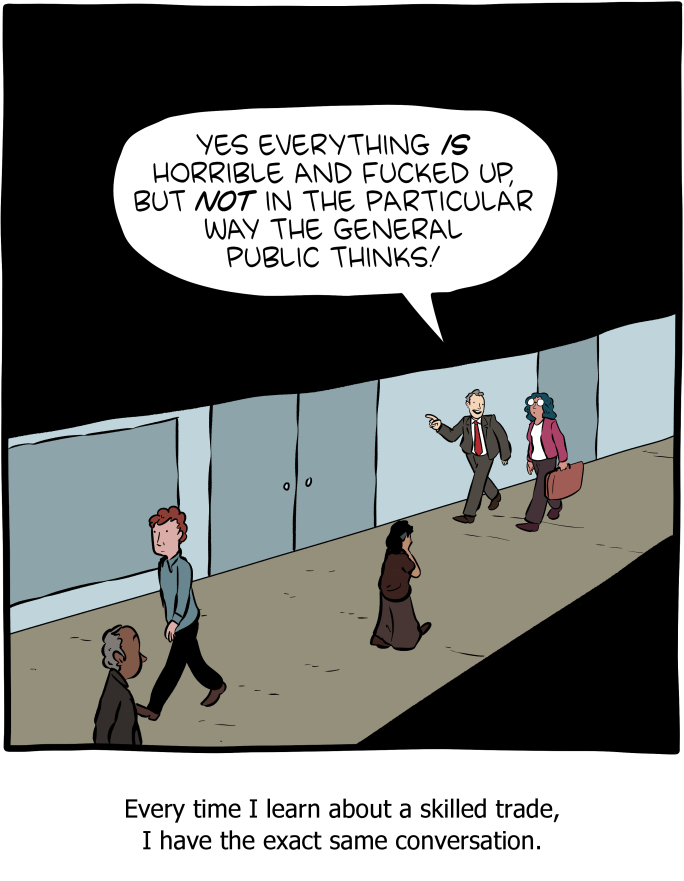
Saturday Morning Breakfast Cereal source http://smbc-comics.com/comic/horrible

Risk management is a crucial aspect of any organization or project. However, it is often subject to human errors in subjective risk judgments. This is because most risk assessment methods rely on subjective inputs from experts. Without certain precautions, experts can make consistent errors in judgment about uncertainty and risk.

There are methods that can correct the systemic errors that people make, but very few organizations implement them. As a result, there is often an almost universal understatement of risk. We need to keep in mind a few rules about experience and expertise.

  • Experience is a nonrandom, nonscientific sample of events throughout our lifetime.
  • Experience is memory-based and we are very selective regarding what we choose to remember,
  • What we conclude from our experience can be full of logical errors
  • Unless we get reliable feedback on past decisions, there is no reason to believe our experience will tell us much.

No matter how much experience we accumulate, we seem to be very inconsistent in its application.

Experts have unconscious heuristics and biases that impact their judgment, some important ones include:

  • Misconceptions of chance: If you flip a coin six times, which result is more likely (H= heads, T= tails): HHHTTT or HTHTTH? They are both equal, but many people assume that because the first series looks “less random” than the second, it must be less likely. This is an example of representativeness bias. We appear to judge odds based on what we assume to be representative scenarios. Human beings easily confuse patterns and randomness.
  • The conjunction fallacy: We often see specific events as more likely than broader categories of events.
  • Irrational belief in small samples
  • Disregarding variance in small samples. Small samples have more random variance that large samples is considered less than it should be.
  • Insensitivity to prior probabilities: People tend to ignore the past and focus on new information when making subjective estimates.

This is all about overconfidence as an expert, which will consistently underestimate risks.

What are some ways to overcome this? I recommend the following be built into your risk management system.

  • Pretend you are in the future looking back at failure. Start with the assumption that a major disaster did happen and describe how it happened.
  • Look to risks from others. Gather a list of related failures, for example, regulatory agency observations, and think of risks in relation to those.
  • Include Everyone. Your organization has numerous experts on all sorts of specific risks. Make the effort to survey representatives of just about every job level.
  • Do peer reviews. Check assumptions by showing them to peers who are not immersed in the assessment.
  • Implement metrics for performance. The Brier score is a way to evaluate the result of predictions both by how often the team was right and by the probability the estimated for getting a correct answer.

Further Reading

Here are some sources that discuss the topic of human errors and subjective judgments in risk management:

Experts think differently

Research on expertise has identified the following differences between expert performers and beginners

  • Experts have larger and more integrative knowledge units, and their represen­tations of information are more functional and abstract than those of novices, whose knowledge base is more fragmentary. For example, a beginning piano player reads sheet music note by note, whereas a concert pianist is able to see the whole row or even several rows of music notation at the same time.
  • When solving problems, experts may spend more time on the initial prob­lem evaluation and planning than novices. This enables them to form a holistic and in-depth understanding of the task and usually to reach a solution more swiftly than beginners.
  • Basic functions related to tasks or the job are automated in experts, whereas beginners need to pay attention to these functions. For instance, in a driving Basic functions related to tasks or the job are automated in experts, whereas beginners need to pay attention to these functions. For instance, in a driving school, a young driver focuses his or her attention on controlling devices and pedals, while an experienced driver performs basic strokes automatically. For this reason, an expert driver can observe and anticipate traffic situations better than a beginning driver.
  • Experts outperform novices in their metacognitive and reflective thinking. In other words, they make sharp observations of their own ways of think­ing, acting, and working, especially in non-routine situations when auto­ mated activities are challenged. Beginners’ knowledge is mainly explicit and they are dependent on learned rules. In addition to explicit knowledge, experts have tacit or implicit knowledge that accumulates with experience. This kind of knowledge makes it possible to make fast decisions on the basis of what is often called intuition.
  • In situations where something has gone wrong or when experts face totally new problems but are not required to make fast decisions, they critically reflect on their actions. Unlike beginners, experienced professionals focus their thinking not only on details but rather on the totality consisting of the details.
  • Experts’ thinking is more holistic than the thinking of novices. It seems that the quality of thinking is associated with the quality and amount of knowledge. With a fragmentary knowledge base, a novice in any field may remain on lower levels of thinking: things are seen as black and white, without any nuances. In contrast, more experienced colleagues with a more organized and holistic know­ledge base can access more material for their thinking, and, thus, may begin to explore different perspectives on matters and develop more relativistic views concerning certain problems. At the highest levels of thinking, an individual is able to reconcile different perspectives, either by forming a synthesis or by inte­grating different approaches or views.
LevelPerformance
BeginnerFollows simple directions
NovicePerforms using memory of facts and simple rules
CompetentMakes simple judgmentsfor typical tasksMay need help withcomplex or unusual tasksMay lack speed andflexibility
ProficientPerformance guided by deeper experience Able to figure out the most critical aspects of a situation Sees nuances missed by less-skilled performers Flexible performance
ExpertPerformance guided by extensive practice and easily retrievable knowledge and skillsNotices nuances, connections, and patterns Intuitive understanding based on extensive practice Able to solve difficult problems, learn quickly, and find needed resources
Levels of Performance

Sources

  • Clark, R. 2003. Building Expertise: Cognitive Methods for Training and Performance Improvement, 2nd ed. Silver Spring, MD: International Society for Performance Improvement.
  • Ericsson, K.A. 2016. Peak: Secrets From the New Science of Expertise. Boston: Houghton Mifflin Harcourt
  • Kallio, E, ed. Development of Adult Thinking : Interdisciplinary Perspectives on Cognitive Development and Adult Learning. Taylor & Francis Group, 2020.

.

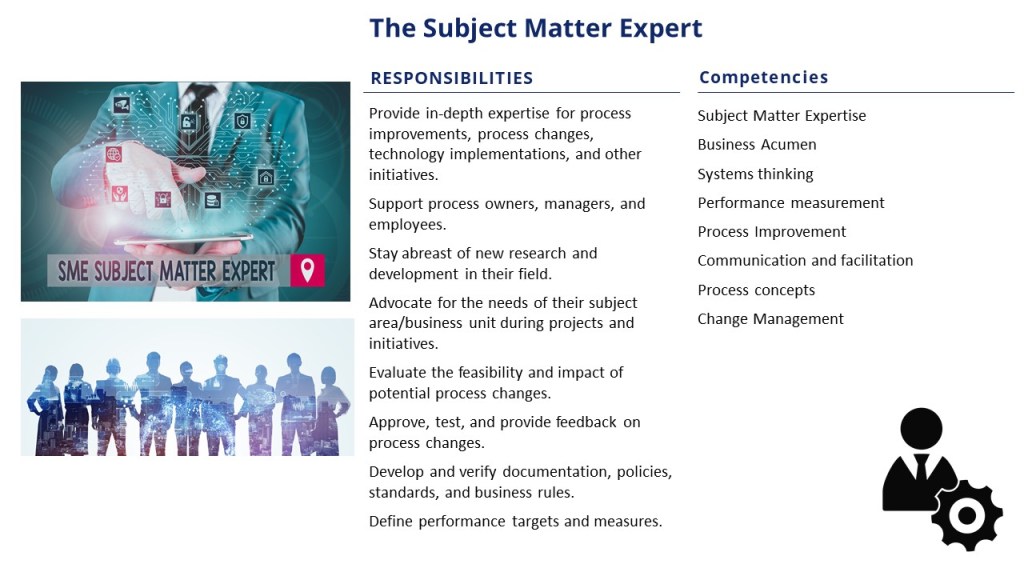
The Subject Matter Expert

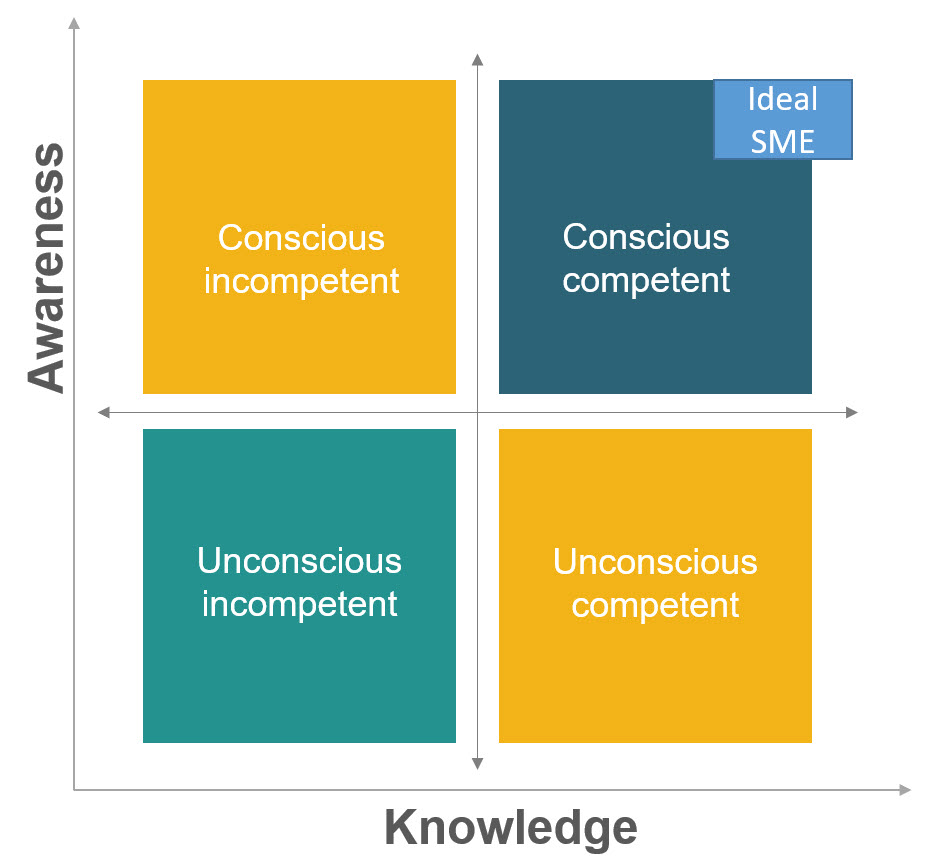
A subject matter expert (SME) is typically an expert on a division of a process, such as a specific tool, technology, or set of process steps. A process may have multiple subject matter experts associated with it, each with varying degrees of understanding of the over-arching process.

SMEs should have depth in their subject area. A great way to identify them is to look for individuals who have a proven track record as formal or informal mentors. To be effective, the SME must be approachable and able to show others the “how” and “why” behind their work. Building expertise, and thus building SMEs, is a fundamental part of a learning organization.

The archetype SMEs has the following attributes:

  • Are really, really smart and know more about their subjects than anybody else in your universe
  • Are willing, able, and looking forward to serving as experts
  • Can tell you what they know in a logical way
  • Understand why it is important for other people to know what they know
  • Are approachable and often fun to work with
  • Love to teach their subjects and make great presenters or facilitators
  • Stay current in their areas of expertise
  • Know when to refer you to someone else
  • Possess situational awareness
The Subject Matter Expert

Subject matter experts are a huge part of knowledge capture.

SME’s help drive Innovation through their strong knowledge of what-was and what-is in order to provide a solid foundation to comprehend what-could-be.