Risk Management is our Ability to Anticipate

Risk assessment is a pillar of the quality system because it gives us the ability to anticipate in a consistent manner. It is built on some fundamental criteria:

CriteriaAsksEnsure
ExpertiseWhat sort of expertise is relied upon to look into the futureDiversity in expertise. Drive out subjectivity
FrequencyHow often are future threats and opportunities assessed?Living risk assessments, cycles of review.
CommunicationHow are the expectations of future events communicated or shared within the system?Risk register. Knowledge management. Continuous improvement. Management review
StrategyWhat is the model of the futureSensemaking
Time horizonHow far ahead does the system look ahead? Is the time horizon different for different organization areas?System building
Acceptability of RisksWhich risks are considered acceptable and which unacceptable? On which basis?Controls
CultureIs risk awareness part of the organizational culture?Risk-based-thinking. Mindset
Anticipation Criteria to apply to Risk Management

Balancing Expertise

Quality professionals are often defined by our technical knowledge, and with that can come a genuine and intense love and interest in the work. In the pharmaceutical/med-device work, I work in this is defined by both a knowledge of the science and of the regulations (and that stuff inbetween – regulatory science).

The challenge here is that we start defining ourselves by our role as we progress as representing the highest level of expertise in this technical expertise, which means senior Quality (as in the department) jobs are defined in terms of in service to our function – patient safety and product quality (safety, efficacy, and quality). This can then lead to seeing people as the “means” to that end. This inevitably leads to prioritizing that outcome over people.

Do not get me wrong, results matter, and I am a firm proponent of product quality and patient safety. But this approach is reductionist and does not serve to drive fear out of the organization. How can people be safe if they are considered a means to produce value? We need to shift so that we realize we can only get to quality by focusing on our people.

Story is critical, or why tabletop roleplaying made me the quality professional I am today

I’ve written before on how storytelling is a critical skill. The ability to take data, take the events of the past and transform it into a coherent narrative is central to the quality profession, and frankly just about every other job out there.

This week I got one of my favorite compliments. We were working to take a series of events and shape it into a coherent narrative to explain what had happened, why we could be confident of the results, and how we had improved over time. And one of my co-workers had commented on how much they were learning from this process, and another responded that of course I was good at this because I was a gamer. And I was just tickled pink.

I make no secret of my hobby. My Twitter feed, for example, is one part geek, one part quality, one part politics. Search for me in google (and who doesn’t google search their coworkers?) and you’ll see gaming stuff on the front page. And in this day of working from home, my background is a bookshelf crammed full of games.

And I do think I am, to a large amount, the quality professional I am today because of that gaming background. There are many paths within quality, and this is part of mine.

Some of the things I’ve learned as a gamer include:

  • Storytelling skills
  • Communication skills
  • Organization skills
  • The ability to “think on your feet”
  • Humor
  • Patience
  • Creativity
  • Fairness
  • Knowledge of rules and how they work together in a system.
  • How to use visual aids, pictures et all
  • Paying attention to everyone, giving everyone a chance to be heroic
  • Conflict resolution skills

Which as a list definitely feels like the core of the profession.

So, fellow gamers in quality, next time we actually meet face-to-face at a conference, let’s find a little time to meet each other at the table.

Process and procedure complexity

People are at the heart of any organization. They set the organization’s goals, they manage it, they deal with suppliers and customers and they work together to produce results.

We manage this by processes. Process are on a continuum by how complicated and complex they are. Simpler jobs can be reliably done by following procedure. More complex ones require the ability to analyze a situation – using established rules – and decide which of several alternative paths to follow. In even more complex cases they analyze, diagnose, design, redesign, program, plan or schedule. In some cases, they create new products, processes and new ways of being. Very complex jobs require individuals who can analyze and solve very complex problems.

These complex, knowledge driven processes get difficult to provide as work-as-prescribed. The work involves thought and creativity, and finding the right balance is a continual balancing act of knowledge management.

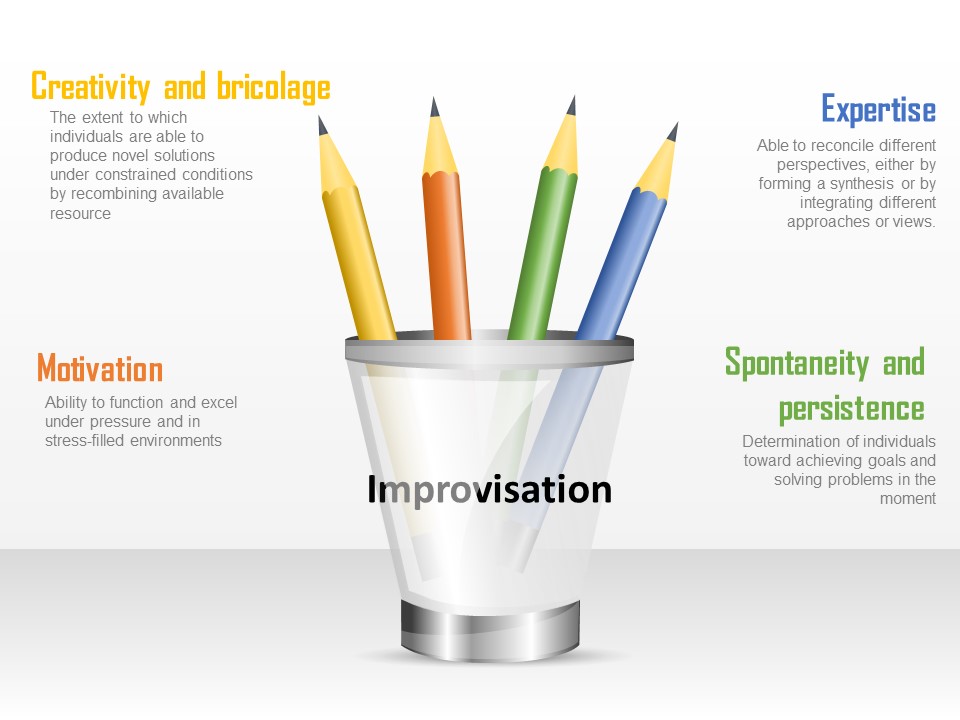
Improvisation

Improvisation Takes Practice” in HBR is a great read. When I first read it, I chuckled at how it brings my gamer hobby and my quality practice together.

Employee creativity—the production of novel and useful solutions, procedures, products, and services—is critical to organizational success. I would argue, creativity drives excellence. Improvisation is a key employee behavior that drives creativity and innovation.

Improvisation is essential for navigating volatile, uncertain, and complex environments and dealing with unforeseen obstacles. Improvisation is also key to drawing distinctions, implementing new ideas, and converting knowledge and insights into action in real time. When confronted with critical and disruptive events, employees can resolve challenges by following existing protocols and procedures. In contrast, when faced with novel events, employees cannot rely on routines and conventions to respond. Rather, they will have to shift their focus to new perspectives, features, and behaviors.

The process of building expertise, when practices are assimilated, embodied, and rendered tacit, creates improvisational competence. Improvisation is an important source of action generating learning: people act to make events meaningful and situations understandable and, in the process, deepen their expertise through further learning, becoming reflective practitioners.

As part of knowledge management, today’s improvisations are absorbed and embedded into tomorrow’s routines.

Improvisation leads to better decision making, as I discussed in the post “Yes…but….and