USP <1225> Revised: Aligning Compendial Validation with ICH Q2(R2) and Q14’s Lifecycle Vision

The United States Pharmacopeia’s proposed revision of General Chapter <1225> Validation of Compendial Procedures, published in Pharmacopeial Forum 51(6), represents the continuation of a fundamental shift in how we conceptualize analytical method validation—moving from static demonstration of compliance toward dynamic lifecycle management of analytical capability.

This gets to the heart of a challenge us to think differently about what validation actually means. The revised chapter introduces concepts like reportable result, fitness for purpose, replication strategy, and combined evaluation of accuracy and precision that force us to confront uncomfortable questions: What are we actually validating? For what purpose? Under what conditions? And most critically—how do we know our analytical procedures remain fit for purpose once validation is “complete”?

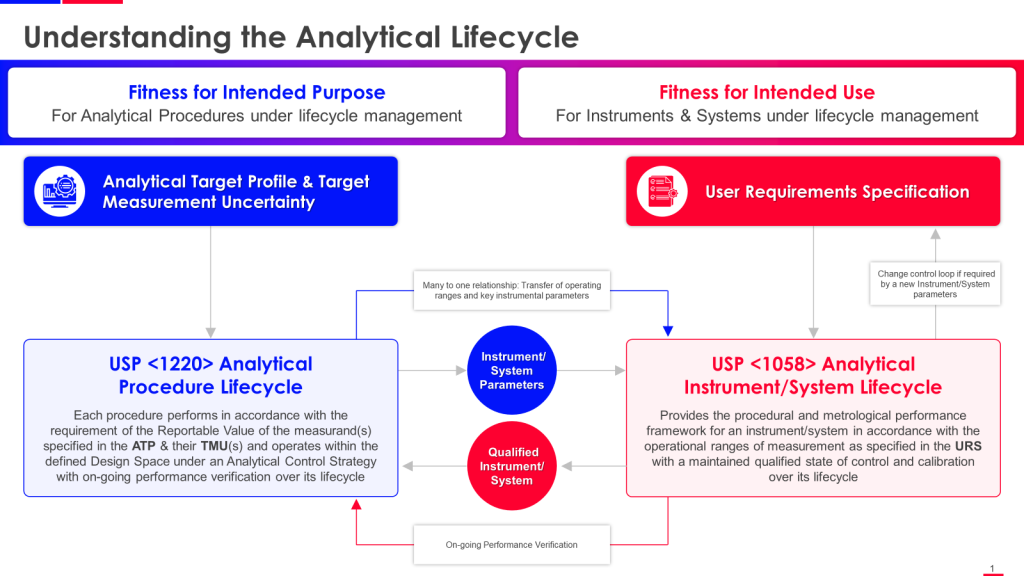
The timing of this revision is deliberate. USP is working to align <1225> more closely with ICH Q2(R2) Validation of Analytical Procedures and ICH Q14 Analytical Procedure Development, both finalized in 2023. Together with the already-official USP <1220> Analytical Procedure Life Cycle (May 2022), these documents form an interconnected framework that demands we abandon the comfortable fiction that validation is a discrete event rather than an ongoing commitment to analytical quality.

Traditional validation approaches cn create the illusion of control without delivering genuine analytical reliability. Methods that “passed validation” fail when confronted with real-world variability. System suitability tests that looked rigorous on paper prove inadequate for detecting performance drift. Acceptance criteria established during development turn out to be disconnected from what actually matters for product quality decisions.

The revised USP <1225> offers conceptual tools to address these failures—if we’re willing to use them honestly rather than simply retrofitting compliance theater onto existing practices. This post explores what the revision actually says, how it relates to ICH Q2(R2) and Q14, and what it demands from quality leaders who want to build genuinely robust analytical systems rather than just impressive validation packages.

The Validation Paradigm Shift: From Compliance Theater to Lifecycle Management

Traditional analytical method validation follows a familiar script. We conduct studies demonstrating acceptable performance for specificity, accuracy, precision, linearity, range, and (depending on the method category) detection and quantitation limits. We generate validation reports showing data meets predetermined acceptance criteria. We file these reports in regulatory submission dossiers or archive them for inspection readiness. Then we largely forget about them until transfer, revalidation, or regulatory scrutiny forces us to revisit the method’s performance characteristics.

This approach treats validation as what Sidney Dekker would call “safety theater”—a performance of rigor that may or may not reflect the method’s actual capability to generate reliable results under routine conditions. The validation study represents work-as-imagined: controlled experiments conducted by experienced analysts using freshly prepared standards and reagents, with carefully managed environmental conditions and full attention to procedural details. What happens during routine testing—work-as-done—often looks quite different.

The lifecycle perspective championed by ICH Q14 and USP <1220> fundamentally challenges this validation-as-event paradigm. From a lifecycle view, validation becomes just one stage in a continuous process of ensuring analytical fitness for purpose. Method development (Stage 1 in USP <1220>) generates understanding of how method parameters affect performance. Validation (Stage 2) confirms the method performs as intended under specified conditions. But the critical innovation is Stage 3—ongoing performance verification that treats method capability as dynamic rather than static.

The revised USP <1225> attempts to bridge these worldviews. It maintains the structure of traditional validation studies while introducing concepts that only make sense within a lifecycle framework. Reportable result—the actual output of the analytical procedure that will be used for quality decisions—forces us to think beyond individual measurements to what we’re actually trying to accomplish. Fitness for purpose demands we articulate specific performance requirements linked to how results will be used, not just demonstrate acceptable performance against generic criteria. Replication strategy acknowledges that the variability observed during validation must reflect the variability expected during routine use.

These aren’t just semantic changes. They represent a shift from asking “does this method meet validation acceptance criteria?” to “will this method reliably generate results adequate for their intended purpose under actual operating conditions?” That second question is vastly more difficult to answer honestly, which is why many organizations will be tempted to treat the new concepts as compliance checkboxes rather than genuine analytical challenges.

I’ve advocated on this blog for falsifiable quality systems—systems that make testable predictions that could be proven wrong through empirical observation. The lifecycle validation paradigm, properly implemented, is inherently more falsifiable than traditional validation. Instead of a one-time demonstration that a method “works,” lifecycle validation makes an ongoing claim: “This method will continue to generate results of acceptable quality when operated within specified conditions.” That claim can be tested—and potentially falsified—every time the method is used. The question is whether we’ll design our Stage 3 performance verification systems to actually test that claim or simply monitor for obviously catastrophic failures.

Core Concepts in the Revised USP <1225>

The revised chapter introduces several concepts that deserve careful examination because they change not just what we do but how we think about analytical validation.

Reportable Result: The Target That Matters

Reportable result may be the most consequential new concept in the revision. It’s defined as the final analytical result that will be reported and used for quality decisions—not individual sample preparations, not replicate injections, but the actual value that appears on a Certificate of Analysis or stability report.

This distinction matters enormously because validation historically focused on demonstrating acceptable performance of individual measurements without always considering how those measurements would be combined to generate reportable values. A method might show excellent repeatability for individual injections while exhibiting problematic variability when the full analytical procedure—including sample preparation, multiple preparations, and averaging—is executed under intermediate precision conditions.

The reportable result concept forces us to validate what we actually use. If our SOP specifies reporting the mean of duplicate sample preparations, each prepared in duplicate and injected in triplicate, then validation should evaluate the precision and accuracy of that mean value, not just the repeatability of individual injections. This seems obvious when stated explicitly, but review your validation protocols and ask honestly: are you validating the reportable result or just demonstrating that the instrument performs acceptably?

This concept aligns perfectly with the Analytical Target Profile (ATP) from ICH Q14, which specifies required performance characteristics for the reportable result. Together, these frameworks push us toward outcome-focused validation rather than activity-focused validation. The question isn’t “did we complete all the required validation experiments?” but “have we demonstrated that the reportable results this method generates will be adequate for their intended use?”

Fitness for Purpose: Beyond Checkbox Validation

Fitness for purpose appears throughout the revised chapter as an organizing principle for validation strategy. But what does it actually mean beyond regulatory rhetoric?

In the falsifiable quality systems framework I’ve been developing, fitness for purpose requires explicit articulation of how analytical results will be used and what performance characteristics are necessary to support those decisions. An assay method used for batch release needs different performance characteristics than the same method used for stability trending. A method measuring a critical quality attribute directly linked to safety or efficacy requires more stringent validation than a method monitoring a process parameter with wide acceptance ranges.

The revised USP <1225> pushes toward risk-based validation strategies that match validation effort to analytical criticality and complexity. This represents a significant shift from the traditional category-based approach (Categories I-IV) that prescribed specific validation parameters based on method type rather than method purpose.

However, fitness for purpose creates interpretive challenges that could easily devolve into justification for reduced rigor. Organizations might claim methods are “fit for purpose” with minimal validation because “we’ve been using this method for years without problems.” This reasoning commits what I call the effectiveness fallacy—assuming that absence of detected failures proves adequate performance. In reality, inadequate analytical methods often fail silently, generating subtly inaccurate results that don’t trigger obvious red flags but gradually degrade our understanding of product quality.

True fitness for purpose requires explicit, testable claims about method performance: “This method will detect impurity X at levels down to 0.05% with 95% confidence” or “This assay will measure potency within ±5% of true value under normal operating conditions.” These are falsifiable statements that ongoing performance verification can test. Vague assertions that methods are “adequate” or “appropriate” are not.

Replication Strategy: Understanding Real Variability

The replication strategy concept addresses a fundamental disconnect in traditional validation: the mismatch between how we conduct validation experiments and how we’ll actually use the method. Validation studies often use simplified replication schemes optimized for experimental efficiency rather than reflecting the full procedural reality of routine testing.

The revised chapter emphasizes that validation should employ the same replication strategy that will be used for routine sample analysis to generate reportable results. If your SOP calls for analyzing samples in duplicate on separate days, validation should incorporate that time-based variability. If sample preparation involves multiple extraction steps that might be performed by different analysts, intermediate precision studies should capture that source of variation.

This requirement aligns validation more closely with work-as-done rather than work-as-imagined. But it also makes validation more complex and time-consuming. Organizations accustomed to streamlined validation protocols will face pressure to either expand their validation studies or simplify their routine testing procedures to match validation replication strategies.

From a quality systems perspective, this tension reveals important questions: Have we designed our analytical procedures to be unnecessarily complex? Are we requiring replication beyond what’s needed for adequate measurement uncertainty? Or conversely, are our validation replication schemes unrealistically simplified compared to the variability we’ll encounter during routine use?

The replication strategy concept forces these questions into the open rather than allowing validation and routine operation to exist in separate conceptual spaces.

Statistical Intervals: Combined Accuracy and Precision

Perhaps the most technically sophisticated addition in the revised chapter is guidance on combined evaluation of accuracy and precision using statistical intervals. Traditional validation treats these as separate performance characteristics evaluated through different experiments. But in reality, what matters for reportable results is the total error combining both bias (accuracy) and variability (precision).

The chapter describes approaches for computing statistical intervals that account for both accuracy and precision simultaneously. These intervals can then be compared against acceptance criteria to determine if the method is validated. If the computed interval falls completely within acceptable limits, the method demonstrates adequate performance for both characteristics together.

This approach is more scientifically rigorous than separate accuracy and precision evaluations because it recognizes that these characteristics interact. A highly precise method with moderate bias might generate reportable results within acceptable ranges, while a method with excellent accuracy but poor precision might not. Traditional validation approaches that evaluate these characteristics separately can miss such interactions.

However, combined evaluation requires more sophisticated statistical expertise than many analytical laboratories possess. The chapter provides references to USP <1210> Statistical Tools for Procedure Validation, which describes appropriate methodologies, but implementation will challenge organizations lacking strong statistical support for their analytical functions.

This creates risk of what I’ve called procedural simulation—going through the motions of applying advanced statistical methods without genuine understanding of what they reveal about method performance. Quality leaders need to ensure that if their teams adopt combined accuracy-precision evaluation approaches, they actually understand the results rather than just feeding data into software and accepting whatever output emerges.

Knowledge Management: Building on What We Know

The revised chapter emphasizes knowledge management more explicitly than previous versions, acknowledging that validation doesn’t happen in isolation from development activities and prior experience. Data generated during method development, platform knowledge from similar methods, and experience with related products all constitute legitimate inputs to validation strategy.

This aligns with ICH Q14’s enhanced approach and ICH Q2(R2)’s acknowledgment that development data can support validation. But it also creates interpretive challenges around what constitutes adequate prior knowledge and how to appropriately leverage it.

In my experience leading quality organizations, knowledge management is where good intentions often fail in practice. Organizations claim to be “leveraging prior knowledge” while actually just cutting corners on validation studies. Platform approaches that worked for previous products get applied indiscriminately to new products with different critical quality attributes. Development data generated under different conditions gets repurposed for validation without rigorous evaluation of its applicability.

Effective knowledge management requires disciplined documentation of what we actually know (with supporting evidence), explicit identification of knowledge gaps, and honest assessment of when prior experience is genuinely applicable versus superficially similar. The revised USP <1225> provides the conceptual framework for this discipline but can’t force organizations to apply it honestly.

Comparing the Frameworks: USP <1225>, ICH Q2(R2), and ICH Q14

Understanding how these three documents relate—and where they diverge—is essential for quality professionals trying to build coherent analytical validation programs.

Analytical Target Profile: Q14’s North Star

ICH Q14 introduced the Analytical Target Profile (ATP) as a prospective description of performance characteristics needed for an analytical procedure to be fit for its intended purpose. The ATP specifies what needs to be measured (the quality attribute), required performance criteria (accuracy, precision, specificity, etc.), and the anticipated performance based on product knowledge and regulatory requirements.

The ATP concept doesn’t explicitly appear in revised USP <1225>, though the chapter’s emphasis on fitness for purpose and reportable result requirements creates conceptual space for ATP-like thinking. This represents a subtle tension between the documents. ICH Q14 treats the ATP as foundational for both enhanced and minimal approaches to method development, while USP <1225> maintains its traditional structure without explicitly requiring ATP documentation.

In practice, this means organizations can potentially comply with revised USP <1225> without fully embracing the ATP concept. They can validate methods against acceptance criteria without articulating why those particular criteria are necessary for the reportable result’s intended use. This risks perpetuating validation-as-compliance-exercise rather than forcing honest engagement with whether methods are actually adequate.

Quality leaders serious about lifecycle validation should treat the ATP as essential even when working with USP <1225>, using it to bridge method development, validation, and ongoing performance verification. The ATP makes explicit what traditional validation often leaves implicit—the link between analytical performance and product quality requirements.

Performance Characteristics: Evolution from Q2(R1) to Q2(R2)

ICH Q2(R2) substantially revises the performance characteristics framework from the 1996 Q2(R1) guideline. Key changes include:

Specificity/Selectivity are now explicitly addressed together rather than treated as equivalent. The revision acknowledges these terms have been used inconsistently across regions and provides unified definitions. Specificity refers to the ability to assess the analyte unequivocally in the presence of expected components, while selectivity relates to the ability to measure the analyte in a complex mixture. In practice, most analytical methods need to demonstrate both, and the revised guidance provides clearer expectations for this demonstration.

Range now explicitly encompasses non-linear calibration models, acknowledging that not all analytical relationships follow simple linear functions. The guidance describes how to demonstrate that methods perform adequately across the reportable range even when the underlying calibration relationship is non-linear. This is particularly relevant for biological assays and certain spectroscopic techniques where non-linearity is inherent to the measurement principle.

Accuracy and Precision can be evaluated separately or through combined approaches, as discussed earlier. This flexibility accommodates both traditional methodology and more sophisticated statistical approaches while maintaining the fundamental requirement that both characteristics be adequate for intended use.

Revised USP <1225> incorporates these changes while maintaining its compendial focus. The chapter continues to reference validation categories (I-IV) as a familiar framework while noting that risk-based approaches considering the method’s intended use should guide validation strategy. This creates some conceptual tension—the categories imply that method type determines validation requirements, while fitness-for-purpose thinking suggests that method purpose should drive validation design.

Organizations need to navigate this tension thoughtfully. The categories provide useful starting points for validation planning, but they shouldn’t become straitjackets preventing appropriate customization based on specific analytical needs and risks.

The Enhanced Approach: When and Why

ICH Q14 distinguishes between minimal and enhanced approaches to analytical procedure development. The minimal approach uses traditional univariate optimization and risk assessment based on prior knowledge and analyst experience. The enhanced approach employs systematic risk assessment, design of experiments, establishment of parameter ranges (PARs or MODRs), and potentially multivariate analysis.

The enhanced approach offers clear advantages: deeper understanding of method performance, identification of critical parameters and their acceptable ranges, and potentially more robust control strategies that can accommodate changes without requiring full revalidation. But it also demands substantially more development effort, statistical expertise, and time.

Neither ICH Q2(R2) nor revised USP <1225> mandates the enhanced approach, though both acknowledge it as a valid strategy. This leaves organizations facing difficult decisions about when enhanced development is worth the investment. In my experience, several factors should drive this decision:

  • Product criticality and lifecycle stage: Biologics products with complex quality profiles and long commercial lifecycles benefit substantially from enhanced analytical development because the upfront investment pays dividends in robust control strategies and simplified change management.
  • Analytical complexity: Multivariate spectroscopic methods (NIR, Raman, mass spectrometry) are natural candidates for enhanced approaches because their complexity demands systematic exploration of parameter spaces that univariate approaches can’t adequately address.
  • Platform potential: When developing methods that might be applied across multiple products, enhanced approaches can generate knowledge that benefits the entire platform, amortizing development costs across the portfolio.
  • Regulatory landscape: Biosimilar programs and products in competitive generic spaces may benefit from enhanced approaches that strengthen regulatory submissions and simplify lifecycle management in response to originator changes.

However, enhanced approaches can also become expensive validation theater if organizations go through the motions of design of experiments and parameter range studies without genuine commitment to using the resulting knowledge for method control and change management. I’ve seen impressive MODRs filed in regulatory submissions that are then completely ignored during commercial manufacturing because operational teams weren’t involved in development and don’t understand or trust the parameter ranges.

The decision between minimal and enhanced approaches should be driven by honest assessment of whether the additional knowledge generated will actually improve method performance and lifecycle management, not by belief that “enhanced” is inherently better or that regulators will be impressed by sophisticated development.

Validation Categories vs Risk-Based Approaches

USP <1225> has traditionally organized validation requirements using four method categories:

  • Category I: Methods for quantitation of major components (assay methods)
  • Category II: Methods for quantitation of impurities and degradation products
  • Category III: Methods for determination of performance characteristics (dissolution, drug release)
  • Category IV: Identification tests

Each category specifies which performance characteristics require evaluation. This framework provides clarity and consistency, making it easy to design validation protocols for common method types.

However, the category-based approach can create perverse incentives. Organizations might design methods to fit into categories with less demanding validation requirements rather than choosing the most appropriate analytical approach for their specific needs. A method capable of quantitating impurities might be deliberately operated only as a limit test (Category II modified) to avoid full quantitation validation requirements.

The revised chapter maintains the categories while increasingly emphasizing that fitness for purpose should guide validation strategy. This creates interpretive flexibility that can be used constructively or abused. Quality leaders need to ensure their teams use the categories as starting points for validation design, not as rigid constraints or opportunities for gaming the system.

Risk-based validation asks different questions than category-based approaches: What decisions will be made using this analytical data? What happens if results are inaccurate or imprecise beyond acceptable limits? How critical is this measurement to product quality and patient safety? These questions should inform validation design regardless of which traditional category the method falls into.

Specificity/Selectivity: Terminology That Matters

The evolution of specificity/selectivity terminology across these documents deserves attention because terminology shapes how we think about analytical challenges. ICH Q2(R1) treated the terms as equivalent, leading to regional confusion as different pharmacopeias and regulatory authorities developed different preferences.

ICH Q2(R2) addresses this by defining both terms clearly and acknowledging they address related but distinct aspects of method performance. Specificity is the ability to assess the analyte unequivocally—can we be certain our measurement reflects only the intended analyte and not interference from other components? Selectivity is the ability to measure the analyte in the presence of other components—can we accurately quantitate our analyte even in a complex matrix?

For monoclonal antibody product characterization, for instance, a method might be specific for the antibody molecule versus other proteins but show poor selectivity among different glycoforms or charge variants. Distinguishing these concepts helps us design studies that actually demonstrate what we need to know rather than generically “proving the method is specific.”

Revised USP <1225> adopts the ICH Q2(R2) terminology while acknowledging that compendial procedures typically focus on specificity because they’re designed for relatively simple matrices (standards and reference materials). The chapter notes that when compendial procedures are applied to complex samples like drug products, selectivity may need additional evaluation during method verification or extension.

This distinction has practical implications for how we think about method transfer and method suitability. A method validated for drug substance might require additional selectivity evaluation when applied to drug product, even though the fundamental specificity has been established. Recognizing this prevents the false assumption that validation automatically confers suitability for all potential applications.

The Three-Stage Lifecycle: Where USP <1220>, <1225>, and ICH Guidelines Converge

The analytical procedure lifecycle framework provides the conceptual backbone for understanding how these various guidance documents fit together. USP <1220> explicitly describes three stages:

Stage 1: Procedure Design and Development

This stage encompasses everything from initial selection of analytical technique through systematic development and optimization to establishment of an analytical control strategy. ICH Q14 provides detailed guidance for this stage, describing both minimal and enhanced approaches.

Key activities include:

  • Knowledge gathering: Understanding the analyte, sample matrix, and measurement requirements based on the ATP or intended use
  • Risk assessment: Identifying analytical procedure parameters that might impact performance, using tools from ICH Q9
  • Method optimization: Systematically exploring parameter spaces through univariate or multivariate experiments
  • Robustness evaluation: Understanding how method performance responds to deliberate variations in parameters
  • Analytical control strategy: Establishing set points, acceptable ranges (PARs/MODRs), and system suitability criteria

Stage 1 generates the knowledge that makes Stage 2 validation more efficient and Stage 3 performance verification more meaningful. Organizations that short-cut development—rushing to validation with poorly understood methods—pay for those shortcuts through validation failures, unexplained variability during routine use, and inability to respond effectively to performance issues.

The causal reasoning approach I’ve advocated for investigations applies equally to method development. When development experiments produce unexpected results, the instinct is often to explain them away or adjust conditions to achieve desired outcomes. But unexpected results during development are opportunities to understand causal mechanisms governing method performance. Methods developed with genuine understanding of these mechanisms prove more robust than methods optimized through trial and error.

Stage 2: Procedure Performance Qualification (Validation)

This is where revised USP <1225> and ICH Q2(R2) provide detailed guidance. Stage 2 confirms that the method performs as intended under specified conditions, generating reportable results of adequate quality for their intended use.

The knowledge generated in Stage 1 directly informs Stage 2 protocol design. Risk assessment identifies which performance characteristics need most rigorous evaluation. Robustness studies reveal which parameters need tight control versus which have wide acceptable ranges. The analytical control strategy defines system suitability criteria and measurement conditions.

However, validation historically has been treated as disconnected from development, with validation protocols designed primarily to satisfy regulatory expectations rather than genuinely confirm method fitness. The revised documents push toward more integrated thinking—validation should test the specific knowledge claims generated during development.

From a falsifiable systems perspective, validation makes explicit predictions about method performance: “When operated within these conditions, this method will generate results meeting these performance criteria.” Stage 3 exists to continuously test whether those predictions hold under routine operating conditions.

Organizations that treat validation as a compliance hurdle rather than a genuine test of method fitness often discover that methods “pass validation” but perform poorly in routine use. The validation succeeded at demonstrating compliance but failed to establish that the method would actually work under real operating conditions with normal analyst variability, standard material lot changes, and equipment variations.

Stage 3: Continued Procedure Performance Verification

Stage 3 is where lifecycle validation thinking diverges most dramatically from traditional approaches. Once a method is validated and in routine use, traditional practice involved occasional revalidation driven by changes or regulatory requirements, but no systematic ongoing verification of performance.

USP <1220> describes Stage 3 as continuous performance verification through routine monitoring of performance-related data. This might include:

  • System suitability trending: Not just pass/fail determination but statistical trending to detect performance drift
  • Control charting: Monitoring QC samples, reference standards, or replicate analyses to track method stability
  • Comparative testing: Periodic evaluation against orthogonal methods or reference laboratories
  • Investigation of anomalous results: Treating unexplained variability or atypical results as potential signals of method performance issues

Stage 3 represents the “work-as-done” reality of analytical methods—how they actually perform under routine conditions with real samples, typical analysts, normal equipment status, and unavoidable operational variability. Methods that looked excellent during validation (work-as-imagined) sometimes reveal limitations during Stage 3 that weren’t apparent in controlled validation studies.

Neither ICH Q2(R2) nor revised USP <1225> provides detailed Stage 3 guidance. This represents what I consider the most significant gap in the current guidance landscape. We’ve achieved reasonable consensus around development (ICH Q14) and validation (ICH Q2(R2), USP <1225>), but Stage 3—arguably the longest and most important phase of the analytical lifecycle—remains underdeveloped from a regulatory guidance perspective.

Organizations serious about lifecycle validation need to develop robust Stage 3 programs even without detailed regulatory guidance. This means defining what ongoing verification looks like for different method types and criticality levels, establishing monitoring systems that generate meaningful performance data, and creating processes that actually respond to performance trending before methods drift into inadequate performance.

Practical Implications for Quality Professionals

Understanding what these documents say matters less than knowing how to apply their principles to build better analytical quality systems. Several practical implications deserve attention.

Moving Beyond Category I-IV Thinking

The validation categories provided useful structure when analytical methods were less diverse and quality systems were primarily compliance-focused. But modern pharmaceutical development, particularly for biologics, involves analytical challenges that don’t fit neatly into traditional categories.

An LC-MS method for characterizing post-translational modifications might measure major species (Category I), minor variants (Category II), and contribute to product identification (Category IV) simultaneously. Multivariate spectroscopic methods like NIR or Raman might predict multiple attributes across ranges spanning both major and minor components.

Rather than contorting methods to fit categories or conducting redundant validation studies to satisfy multiple category requirements, risk-based thinking asks: What do we need this method to do? What performance is necessary for those purposes? What validation evidence would demonstrate adequate performance?

This requires more analytical thinking than category-based validation, which is why many organizations resist it. Following category-based templates is easier than designing fit-for-purpose validation strategies. But template-based validation often generates massive data packages that don’t actually demonstrate whether methods will perform adequately under routine conditions.

Quality leaders should push their teams to articulate validation strategies in terms of fitness for purpose first, then verify that category-based requirements are addressed, rather than simply executing category-based templates without thinking about what they’re actually demonstrating.

Robustness: From Development to Control Strategy

Traditional validation often treated robustness as an afterthought—a set of small deliberate variations tested at the end of validation to identify factors that might influence performance. ICH Q2(R1) explicitly stated that robustness evaluation should be considered during development, not validation.

ICH Q2(R2) and Q14 formalize this by moving robustness firmly into Stage 1 development. The purpose shifts from demonstrating that small variations don’t affect performance to understanding how method parameters influence performance and establishing appropriate control strategies.

This changes what robustness studies look like. Instead of testing whether pH ±0.2 units or temperature ±2°C affect performance, enhanced approaches use design of experiments to systematically map performance across parameter ranges, identifying critical parameters that need tight control versus robust parameters that can vary within wide ranges.

The analytical control strategy emerging from this work defines what needs to be controlled, how tightly, and how that control will be verified through system suitability. Parameters proven robust across wide ranges don’t need tight control or continuous monitoring. Parameters identified as critical get appropriate control measures and verification.

Revised USP <1225> acknowledges this evolution while maintaining compatibility with traditional robustness testing for organizations using minimal development approaches. The practical implication is that organizations need to decide whether their robustness studies are compliance exercises demonstrating nothing really matters, or genuine explorations of parameter effects informing control strategies.

In my experience, most robustness studies fall into the former category—demonstrating that the developer knew enough about the method to avoid obviously critical parameters when designing the robustness protocol. Studies that actually reveal important parameter sensitivities are rare because developers already controlled those parameters tightly during development.

Platform Methods and Prior Knowledge

Biotechnology companies developing multiple monoclonal antibodies or other platform products can achieve substantial efficiency through platform analytical methods—methods developed once with appropriate robustness and then applied across products with minimal product-specific validation.

ICH Q2(R2) and revised USP <1225> both acknowledge that prior knowledge and platform experience constitute legitimate validation input. A platform charge variant method that has been thoroughly validated for multiple products can be applied to new products with reduced validation, focusing on product-specific aspects like impurity specificity and acceptance criteria rather than repeating full performance characterization.

However, organizations often claim platform status for methods that aren’t genuinely robust across the platform scope. A method that worked well for three high-expressing stable molecules might fail for a molecule with unusual post-translational modifications or stability challenges. Declaring something a “platform method” doesn’t automatically make it appropriate for all platform products.

Effective platform approaches require disciplined knowledge management documenting what’s actually known about method performance across product diversity, explicit identification of product attributes that might challenge method suitability, and honest assessment of when product-specific factors require more extensive validation.

The work-as-done reality is that platform methods often perform differently across products but these differences go unrecognized because validation strategies assume platform applicability rather than testing it. Quality leaders should ensure that platform method programs include ongoing monitoring of performance across products, not just initial validation studies.

What This Means for Investigations

The connection between analytical method validation and quality investigations is profound but often overlooked. When products fail specification, stability trends show concerning patterns, or process monitoring reveals unexpected variability, investigations invariably rely on analytical data. The quality of those investigations depends entirely on whether the analytical methods actually perform as assumed.

I’ve advocated for causal reasoning in investigations—focusing on what actually happened and why rather than cataloging everything that didn’t happen. This approach demands confidence in analytical results. If we can’t trust that our analytical methods are accurately measuring what we think they’re measuring, causal reasoning becomes impossible. We can’t identify causal mechanisms when we can’t reliably observe the phenomena we’re investigating.

The lifecycle validation paradigm, properly implemented, strengthens investigation capability by ensuring analytical methods remain fit for purpose throughout their use. Stage 3 performance verification should detect analytical performance drift before it creates false signals that trigger fruitless investigations or masks genuine quality issues that should be investigated.

However, this requires that investigation teams understand analytical method limitations and consider measurement uncertainty when evaluating results. An assay result of 98% when specification is 95-105% doesn’t necessarily represent genuine process variation if the method’s measurement uncertainty spans several percentage points. Understanding what analytical variation is normal versus unusual requires engagement with the analytical validation and ongoing verification data—engagement that happens far too rarely in practice.

Quality organizations should build explicit links between their analytical lifecycle management programs and investigation processes. Investigation templates should prompt consideration of measurement uncertainty. Trending programs should monitor analytical variation separately from product variation. Investigation training should include analytical performance concepts so investigators understand what questions to ask when analytical results seem anomalous.

The Work-as-Done Reality of Method Validation

Perhaps the most important practical implication involves honest reckoning with how validation actually happens versus how guidance documents describe it. Validation protocols present idealized experimental sequences with carefully controlled conditions and expert execution. The work-as-imagined of validation assumes adequate resources, appropriate timeline, skilled analysts, stable equipment, and consistent materials.

Work-as-done validation often involves constrained timelines driving corner-cutting, resource limitations forcing compromise, analyst skill gaps requiring extensive supervision, equipment variability creating unexplained results, and material availability forcing substitutions. These conditions shape validation study quality in ways that rarely appear in validation reports.

Organizations under regulatory pressure to validate quickly might conduct studies before development is genuinely complete, generating data that meets protocol acceptance criteria without establishing genuine confidence in method fitness. Analytical labs struggling with staffing shortages might rely on junior analysts for validation studies that require expert judgment. Equipment with marginal suitability might be used because better alternatives aren’t available within timeline constraints.

These realities don’t disappear because we adopt lifecycle validation frameworks or implement ATP concepts. Quality leaders must create organizational conditions where work-as-done validation can reasonably approximate work-as-imagined validation. This means adequate resources, appropriate timelines that don’t force rushing, investment in analyst training and equipment capability, and willingness to acknowledge when validation studies reveal genuine limitations requiring method redevelopment.

The alternative is validation theater—impressive documentation packages describing validation studies that didn’t actually happen as reported or didn’t genuinely demonstrate what they claim to demonstrate. Such theater satisfies regulatory inspections while creating quality systems built on foundations of misrepresentation—exactly the kind of organizational inauthenticity that Sidney Dekker’s work warns against.

Critical Analysis: What USP <1225> Gets Right (and Where Questions Remain)

The revised USP <1225> deserves credit for several important advances while also raising questions about implementation and potential for misuse.

Strengths of the Revision

Lifecycle integration: By explicitly connecting to USP <1220> and acknowledging ICH Q14 and Q2(R2), the chapter positions compendial validation within the broader analytical lifecycle framework. This represents significant conceptual progress from treating validation as an isolated event.

Reportable result focus: Emphasizing that validation should address the actual output used for quality decisions rather than intermediate measurements aligns validation with its genuine purpose—ensuring reliable decision-making data.

Combined accuracy-precision evaluation: Providing guidance on total error approaches acknowledges the statistical reality that these characteristics interact and should be evaluated together when appropriate.

Knowledge management: Explicit acknowledgment that development data, prior knowledge, and platform experience constitute legitimate validation inputs encourages more efficient validation strategies and better integration across analytical lifecycle stages.

Flexibility for risk-based approaches: While maintaining traditional validation categories, the revision provides conceptual space for fitness-for-purpose thinking and risk-based validation strategies.

Potential Implementation Challenges

Statistical sophistication requirements: Combined accuracy-precision evaluation and other advanced approaches require statistical expertise many analytical laboratories lack. Without adequate support, organizations might misapply statistical methods or avoid them entirely, losing the benefits the revision offers.

Interpretive ambiguity: Concepts like fitness for purpose and appropriate use of prior knowledge create interpretive flexibility that can be used constructively or abused. Without clear examples and expectations, organizations might claim compliance while failing to genuinely implement lifecycle thinking.

Resource implications: Validating with replication strategies matching routine use, conducting robust Stage 3 verification, and maintaining appropriate knowledge management all require resources beyond traditional validation. Organizations already stretched thin might struggle to implement these practices meaningfully.

Integration with existing systems: Companies with established validation programs built around traditional category-based approaches face significant effort to transition toward lifecycle validation thinking, particularly for legacy methods already in use.

Regulatory expectations uncertainty: Until regulatory agencies provide clear inspection and review expectations around the revised chapter’s concepts, organizations face uncertainty about what will be considered adequate implementation versus what might trigger deficiency citations.

The Risk of New Compliance Theater

My deepest concern about the revision is that organizations might treat new concepts as additional compliance checkboxes rather than genuine analytical challenges. Instead of honestly grappling with whether methods are fit for purpose, they might add “fitness for purpose justification” sections to validation reports that provide ritualistic explanations without meaningful analysis.

Reportable result definitions could become templates copied across validation protocols without consideration of what’s actually being reported. Replication strategies might nominally match routine use while validation continues to be conducted under unrealistically controlled conditions. Combined accuracy-precision evaluations might be performed because the guidance mentions them without understanding what the statistical intervals reveal about method performance.

This theater would be particularly insidious because it would satisfy document review while completely missing the point. Organizations could claim to be implementing lifecycle validation principles while actually maintaining traditional validation-as-event practices with updated terminology.

Preventing this outcome requires quality leaders who understand the conceptual foundations of lifecycle validation and insist on genuine implementation rather than cosmetic compliance. It requires analytical organizations willing to acknowledge when they don’t understand new concepts and seek appropriate expertise. It requires resource commitment to do lifecycle validation properly rather than trying to achieve it within existing resource constraints.

Questions for the Pharmaceutical Community

Several questions deserve broader community discussion as organizations implement the revised chapter:

How will regulatory agencies evaluate fitness-for-purpose justifications? What level of rigor is expected? How will reviewers distinguish between thoughtful risk-based strategies and efforts to minimize validation requirements?

What constitutes adequate Stage 3 verification for different method types and criticality levels? Without detailed guidance, organizations must develop their own programs. Will regulatory consensus emerge around what adequate verification looks like?

How should platform methods be validated and verified? What documentation demonstrates platform applicability? How much product-specific validation is expected?

What happens to legacy methods validated under traditional approaches? Is retrospective alignment with lifecycle concepts expected? How should organizations prioritize analytical lifecycle improvement efforts?

How will contract laboratories implement lifecycle validation? Many analytical testing organizations operate under fee-for-service models that don’t easily accommodate ongoing Stage 3 verification. How will sponsor oversight adapt?

These questions don’t have obvious answers, which means early implementers will shape emerging practices through their choices. Quality leaders should engage actively with peers, standards bodies, and regulatory agencies to help develop community understanding of reasonable implementation approaches.

Building Falsifiable Analytical Systems

Throughout this blog, I’ve advocated for falsifiable quality systems—systems designed to make testable predictions that could be proven wrong through empirical observation. The lifecycle validation paradigm, properly implemented, enables genuinely falsifiable analytical systems.

Traditional validation generates unfalsifiable claims: “This method was validated according to ICH Q2 requirements” or “Validation demonstrated acceptable performance for all required characteristics.” These statements can’t be proven false because they describe historical activities rather than making predictions about ongoing performance.

Lifecycle validation creates falsifiable claims: “This method will generate reportable results meeting the Analytical Target Profile requirements when operated within the defined analytical control strategy.” This prediction can be tested—and potentially falsified—through Stage 3 performance verification.

Every batch tested, every stability sample analyzed, every investigation that relies on analytical results provides opportunity to test whether the method continues performing as validation claimed it would. System suitability results, QC sample trending, interlaboratory comparisons, and investigation findings all generate evidence that either supports or contradicts the fundamental claim that the method remains fit for purpose.

Building falsifiable analytical systems requires:

  • Explicit performance predictions: The ATP or fitness-for-purpose justification must articulate specific, measurable performance criteria that can be objectively verified, not vague assertions of adequacy.
  • Ongoing performance monitoring: Stage 3 verification must actually measure the performance characteristics claimed during validation and detect degradation before methods drift into inadequate performance.
  • Investigation of anomalies: Unexpected results, system suitability failures, or performance trending outside normal ranges should trigger investigation of whether the method continues to perform as validated, not just whether samples or equipment caused the anomaly.
  • Willingness to invalidate: Organizations must be willing to acknowledge when ongoing evidence falsifies validation claims—when methods prove inadequate despite “passing validation”—and take appropriate corrective action including method redevelopment or replacement.

This last requirement is perhaps most challenging. Admitting that a validated method doesn’t actually work threatens regulatory commitments, creates resource demands for method improvement, and potentially reveals years of questionable analytical results. The organizational pressure to maintain the fiction that validated methods remain adequate is immense.

But genuinely robust quality systems require this honesty. Methods that seemed adequate during validation sometimes prove inadequate under routine conditions. Technology advances reveal limitations in historical methods. Understanding of critical quality attributes evolves, changing performance requirements. Falsifiable analytical systems acknowledge these realities and adapt, while unfalsifiable systems maintain comforting fictions about adequacy until external pressure forces change.

The connection to investigation excellence is direct. When investigations rely on analytical results generated by methods known to be marginal but maintained because they’re “validated,” investigation findings become questionable. We might be investigating analytical artifacts rather than genuine quality issues, or failing to investigate real issues because inadequate analytical methods don’t detect them.

Investigations founded on falsifiable analytical systems can have greater confidence that anomalous results reflect genuine events worth investigating rather than analytical noise. This confidence enables the kind of causal reasoning that identifies true mechanisms rather than documenting procedural deviations that might or might not have contributed to observed results.

The Validation Revolution We Need

The convergence of revised USP <1225>, ICH Q2(R2), and ICH Q14 represents potential for genuine transformation in how pharmaceutical organizations approach analytical validation—if we’re willing to embrace the conceptual challenges these documents present rather than treating them as updated compliance templates.

The core shift is from validation-as-event to validation-as-lifecycle-stage. Methods aren’t validated once and then assumed adequate until problems force revalidation. They’re developed with systematic understanding, validated to confirm fitness for purpose, and continuously verified to ensure they remain adequate under evolving conditions. Knowledge accumulates across the lifecycle, informing method improvements and transfer while building organizational capability.

This transformation demands intellectual honesty about whether our methods actually perform as claimed, organizational willingness to invest resources in genuine lifecycle management rather than minimal compliance, and leadership that insists on substance over theater. These demands are substantial, which is why many organizations will implement the letter of revised requirements while missing their spirit.

For quality leaders committed to building genuinely robust analytical systems, the path forward involves:

  • Developing organizational capability in lifecycle validation thinking, ensuring analytical teams understand concepts beyond superficial compliance requirements and can apply them thoughtfully to specific analytical challenges.
  • Creating systems and processes that support Stage 3 verification, not just Stage 2 validation, acknowledging that ongoing performance monitoring is where lifecycle validation either succeeds or fails in practice.
  • Building bridges between analytical validation and other quality functions, particularly investigations, trending, and change management, so that analytical performance information actually informs decision-making across the quality system.
  • Maintaining falsifiability in analytical systems, insisting on explicit, testable performance claims rather than vague adequacy assertions, and creating organizational conditions where evidence of inadequate performance prompts honest response rather than rationalization.
  • Engaging authentically with what methods can and cannot do, avoiding the twin errors of assuming validated methods are perfect or maintaining methods known to be inadequate because they’re “validated.”

The pharmaceutical industry has an opportunity to advance analytical quality substantially through thoughtful implementation of lifecycle validation principles. The revised USP <1225>, aligned with ICH Q2(R2) and Q14, provides the conceptual framework. Whether we achieve genuine transformation or merely update compliance theater depends on choices quality leaders make about how to implement these frameworks in practice.

The stakes are substantial. Analytical methods are how we know what we think we know about product quality. When those methods are inadequate—whether because validation was theatrical, ongoing performance has drifted, or fitness for purpose was never genuinely established—our entire quality system rests on questionable foundations. We might be releasing product that doesn’t meet specifications, investigating artifacts rather than genuine quality issues, or maintaining comfortable confidence in systems that don’t actually work as assumed.

Lifecycle validation, implemented with genuine commitment to falsifiable quality systems, offers a path toward analytical capabilities we can actually trust rather than merely document. The question is whether pharmaceutical organizations will embrace this transformation or simply add new compliance layers onto existing practices while fundamental problems persist.

The answer to that question will emerge not from reading guidance documents but from how quality leaders choose to lead, what they demand from their analytical organizations, and what they’re willing to acknowledge about the gap between validation documents and validation reality. The revised USP <1225> provides tools for building better analytical systems. Whether we use those tools constructively or merely as updated props for compliance theater is entirely up to us.

Beyond Malfunction Mindset: Normal Work, Adaptive Quality, and the Future of Pharmaceutical Problem-Solving

Beyond the Shadow of Failure

Problem-solving is too often shaped by the assumption that the system is perfectly understood and fully specified. If something goes wrong—a deviation, a batch out-of-spec, or a contamination event—our approach is to dissect what “failed” and fix that flaw, believing this will restore order. This way of thinking, which I call the malfunction mindset, is as ingrained as it is incomplete. It assumes that successful outcomes are the default, that work always happens as written in SOPs, and that only failure deserves our scrutiny.

But here’s the paradox: most of the time, our highly complex manufacturing environments actually succeed—often under imperfect, shifting, and not fully understood conditions. If we only study what failed, and never question how our systems achieve their many daily successes, we miss the real nature of pharmaceutical quality: it is not the absence of failure, but the presence of robust, adaptive work. Taking this broader, more nuanced perspective is not just an academic exercise—it’s essential for building resilient operations that truly protect patients, products, and our organizations.

Drawing from my thinking through zemblanity (the predictable but often overlooked negative outcomes of well-intentioned quality fixes), the effectiveness paradox (why “nothing bad happened” isn’t proof your quality system works), and the persistent gap between work-as-imagined and work-as-done, this post explores why the malfunction mindset persists, how it distorts investigations, and what future-ready quality management should look like.

The Allure—and Limits—of the Failure Model

Why do we reflexively look for broken parts and single points of failure? It is, as Sidney Dekker has argued, both comforting and defensible. When something goes wrong, you can always point to a failed sensor, a missed checklist, or an operator error. This approach—introducing another level of documentation, another check, another layer of review—offers a sense of closure and regulatory safety. After all, as long as you can demonstrate that you “fixed” something tangible, you’ve fulfilled investigational due diligence.

Yet this fails to account for how quality is actually produced—or lost—in the real world. The malfunction model treats systems like complicated machines: fix the broken gear, oil the creaky hinge, and the machine runs smoothly again. But, as Dekker reminds us in Drift Into Failure, such linear thinking ignores the drift, adaptation, and emergent complexity that characterize real manufacturing environments. The truth is, in complex adaptive systems like pharmaceutical manufacturing, it often takes more than one “error” for failure to manifest. The system absorbs small deviations continuously, adapting and flexing until, sometimes, a boundary is crossed and a problem surfaces.

W. Edwards Deming’s wisdom rings truer than ever: “Most problems result from the system itself, not from individual faults.” A sustainable approach to quality is one that designs for success—and that means understanding the system-wide properties enabling robust performance, not just eliminating isolated malfunctions.

Procedural Fundamentalism: The Work-as-Imagined Trap

One of the least examined, yet most impactful, contributors to the malfunction mindset is procedural fundamentalism—the belief that the written procedure is both a complete specification and an accurate description of work. This feels rigorous and provides compliance comfort, but it is a profound misreading of how work actually happens in pharmaceutical manufacturing.

Work-as-imagined, as elucidated by Erik Hollnagel and others, represents an abstraction: it is how distant architects of SOPs visualize the “correct” execution of a process. Yet, real-world conditions—resource shortages, unexpected interruptions, mismatched raw materials, shifting priorities—force adaptation. Operators, supervisors, and Quality professionals do not simply “follow the recipe”: they interpret, improvise, and—crucially—adjust on the fly.

When we treat procedures as authoritative descriptions of reality, we create the proxy problem: our investigations compare real operations against an imagined baseline that never fully existed. Deviations become automatically framed as problem points, and success is redefined as rigid adherence, regardless of context or outcome.

Complexity, Performance Variability, and Real Success

So, how do pharmaceutical operations succeed so reliably despite the ever-present complexity and variability of daily work?

The answer lies in embracing performance variability as a feature of robust systems, not a flaw. In high-reliability environments—from aviation to medicine to pharmaceutical manufacturing—success is routinely achieved not by demanding strict compliance, but by cultivating adaptive capacity.

Consider environmental monitoring in a sterile suite: The procedure may specify precise times and locations, but a seasoned operator, noticing shifts in people flow or equipment usage, might proactively sample a high-risk area more frequently. This adaptation—not captured in work-as-imagined—actually strengthens data integrity. Yet, traditional metrics would treat this as a procedural deviation.

This is the paradox of the malfunction mindset: in seeking to eliminate all performance variability, we risk undermining precisely those adaptive behaviors that produce reliable quality under uncertainty.

Why the Malfunction Mindset Persists: Cognitive Comfort and Regulatory Reinforcement

Why do organizations continue to privilege the malfunction mindset, even as evidence accumulates of its limits? The answer is both psychological and cultural.

Component breakdown thinking is psychologically satisfying—it offers a clear problem, a specific cause, and a direct fix. For regulatory agencies, it is easy to measure and audit: did the deviation investigation determine the root cause, did the CAPA address it, does the documentation support this narrative? Anything that doesn’t fit this model is hard to defend in audits or inspections.

Yet this approach offers, at best, a partial diagnosis and, at worst, the illusion of control. It encourages organizations to catalog deviations while blindly accepting a much broader universe of unexamined daily adaptations that actually determine system robustness.

Complexity Science and the Art of Organizational Success

To move toward a more accurate—and ultimately more effective—model of quality, pharmaceutical leaders must integrate the insights of complexity science. Drawing from the work of Stuart Kauffman and others at the Santa Fe Institute, we understand that the highest-performing systems operate not at the edge of rigid order, but at the “edge of chaos,” where structure is balanced with adaptability.

In these systems, success and failure both arise from emergent properties—the patterns of interaction between people, procedures, equipment, and environment. The most meaningful interventions, therefore, address how the parts interact, not just how each part functions in isolation.

This explains why traditional root cause analysis, focused on the parts, often fails to produce lasting improvements; it cannot account for outcomes that emerge only from the collective dynamics of the system as a whole.

Investigating for Learning: The Take-the-Best Heuristic

A key innovation needed in pharmaceutical investigations is a shift to what Hollnagel calls Safety-II thinking: focusing on how things go right as well as why they occasionally go wrong.

Here, the take-the-best heuristic becomes crucial. Instead of compiling lists of all deviations, ask: Among all contributing factors, which one, if addressed, would have the most powerful positive impact on future outcomes, while preserving adaptive capacity? This approach ensures investigations generate actionable, meaningful learning, rather than feeding the endless paper chase of “compliance theater.”

Building Systems That Support Adaptive Capability

Taking complexity and adaptive performance seriously requires practical changes to how we design procedures, train, oversee, and measure quality.

  • Procedure Design: Make explicit the distinction between objectives and methods. Procedures should articulate clear quality goals, specify necessary constraints, but deliberately enable workers to choose methods within those boundaries when faced with new conditions.
  • Training: Move beyond procedural compliance. Develop adaptive expertise in your staff, so they can interpret and adjust sensibly—understanding not just “what” to do, but “why” it matters in the bigger system.
  • Oversight and Monitoring: Audit for adaptive capacity. Don’t just track “compliance” but also whether workers have the resources and knowledge to adapt safely and intelligently. Positive performance variability (smart adaptations) should be recognized and studied.
  • Quality System Design: Build systematic learning from both success and failure. Examine ordinary operations to discern how adaptive mechanisms work, and protect these capabilities rather than squashing them in the name of “control.”

Leadership and Systems Thinking

Realizing this vision depends on a transformation in leadership mindset—from one seeking control to one enabling adaptive capacity. Deming’s profound knowledge and the principles of complexity leadership remind us that what matters is not enforcing ever-stricter compliance, but cultivating an organizational context where smart adaptation and genuine learning become standard.

Leadership must:

  • Distinguish between complicated and complex: Apply detailed procedures to the former (e.g., calibration), but support flexible, principles-based management for the latter.
  • Tolerate appropriate uncertainty: Not every problem has a clear, single answer. Creating psychological safety is essential for learning and adaptation during ambiguity.
  • Develop learning organizations: Invest in deep understanding of operations, foster regular study of work-as-done, and celebrate insights from both expected and unexpected sources.

Practical Strategies for Implementation

Turning these insights into institutional practice involves a systematic, research-inspired approach:

  • Start procedure development with observation of real work before specifying methods. Small scale and mock exercises are critical.
  • Employ cognitive apprenticeship models in training, so that experience, reasoning under uncertainty, and systems thinking become core competencies.
  • Begin investigations with appreciative inquiry—map out how the system usually works, not just how it trips up.
  • Measure leading indicators (capacity, information flow, adaptability) not just lagging ones (failures, deviations).
  • Create closed feedback loops for corrective actions—insisting every intervention be evaluated for impact on both compliance and adaptive capacity.

Scientific Quality Management and Adaptive Systems: No Contradiction

The tension between rigorous scientific quality management (QbD, process validation, risk management frameworks) and support for adaptation is a false dilemma. Indeed, genuine scientific quality management starts with humility: the recognition that our understanding of complex systems is always partial, our controls imperfect, and our frameworks provisional.

A falsifiable quality framework embeds learning and adaptation at its core—treating deviations as opportunities to test and refine models, rather than simply checkboxes to complete.

The best organizations are not those that experience the fewest deviations, but those that learn fastest from both expected and unexpected events, and apply this knowledge to strengthen both system structure and adaptive capacity.

Embracing Normal Work: Closing the Gap

Normal pharmaceutical manufacturing is not the story of perfect procedural compliance; it’s the story of people, working together to achieve quality goals under diverse, unpredictable, and evolving conditions. This is both more challenging—and more rewarding—than any plan prescribed solely by SOPs.

To truly move the needle on pharmaceutical quality, organizations must:

  • Embrace performance variability as evidence of adaptive capacity, not just risk.
  • Investigate for learning, not blame; study success, not just failure.
  • Design systems to support both structure and flexible adaptation—never sacrificing one entirely for the other.
  • Cultivate leadership that values humility, systems thinking, and experimental learning, creating a culture comfortable with complexity.

This approach will not be easy. It means questioning decades of compliance custom, organizational habit, and intellectual ease. But the payoff is immense: more resilient operations, fewer catastrophic surprises, and, above all, improved safety and efficacy for the patients who depend on our products.

The challenge—and the opportunity—facing pharmaceutical quality management is to evolve beyond compliance theater and malfunction thinking into a new era of resilience and organizational learning. Success lies not in the illusory comfort of perfectly executed procedures, but in the everyday adaptations, intelligent improvisation, and system-level capabilities that make those successes possible.

The call to action is clear: Investigate not just to explain what failed, but to understand how, and why, things so often go right. Protect, nurture, and enhance the adaptive capacities of your organization. In doing so, pharmaceutical quality can finally become more than an after-the-fact audit; it will become the creative, resilient capability that patients, regulators, and organizations genuinely want to hire.

Excellence in Education: Building Falsifiable Quality Systems Through Transformative Training

The ECA recently wrote about a recurring theme across 2025 FDA warning letters that puts the spotlight on the troubling reality that inadequate training remains a primary driver of compliance failures across pharmaceutical manufacturing. Recent enforcement actions against companies like Rite-Kem Incorporated, Yangzhou Sion Commodity, and Staska Pharmaceuticals consistently cite violations of 21 CFR 211.25, specifically failures to ensure personnel receive adequate education, training, and experience for their assigned functions. These patterns, which are supported by deep dives into compliance data, indicate that traditional training approaches—focused on knowledge transfer rather than behavior change—are fundamentally insufficient for building robust quality systems. The solution requires a shift toward falsifiable quality systems where training programs become testable hypotheses about organizational performance, integrated with risk management principles that anticipate and prevent failures, and designed to drive quality maturity through measurable learning outcomes.

The Systemic Failure of Traditional Training Approaches

These regulatory actions reflect deeper systemic issues than mere documentation failures. They reveal organizations operating with unfalsifiable assumptions about training effectiveness—assumptions that cannot be tested, challenged, or proven wrong. Traditional training programs operate on the premise that information transfer equals competence development, yet regulatory observations consistently show this assumption fails under scrutiny. When the FDA investigates training effectiveness, they discover organizations that cannot demonstrate actual behavioral change, knowledge retention, or performance improvement following training interventions.

The Hidden Costs of Quality System Theater

As discussed before, many pharmaceutical organizations engage in what can be characterized as theater. In this case the elaborate systems of documentation, attendance tracking, and assessment create the appearance of comprehensive training while failing to drive actual performance improvements. This phenomenon manifests in several ways: annual training requirements that focus on seat time rather than competence development, generic training modules disconnected from specific job functions, and assessment methods that test recall rather than application. These approaches persist because they are unfalsifiable—they cannot be proven ineffective through normal business operations.

The evidence suggests that training theater is pervasive across the industry. Organizations invest significant resources in learning management systems, course development, and administrative overhead while failing to achieve the fundamental objective: ensuring personnel can perform their assigned functions competently and consistently. As architects of quality systems we need to increasingly scrutinizing the outcomes of training programs rather than their inputs, demanding evidence that training actually enables personnel to perform their functions effectively.

Falsifiable Quality Systems: A New Paradigm for Training Excellence

Falsifiable quality systems represent a departure from traditional compliance-focused approaches to pharmaceutical quality management. Falsifiable systems generate testable predictions about organizational behavior that can be proven wrong through empirical observation. In the context of training, this means developing programs that make specific, measurable predictions about learning outcomes, behavioral changes, and performance improvements—predictions that can be rigorously tested and potentially falsified.

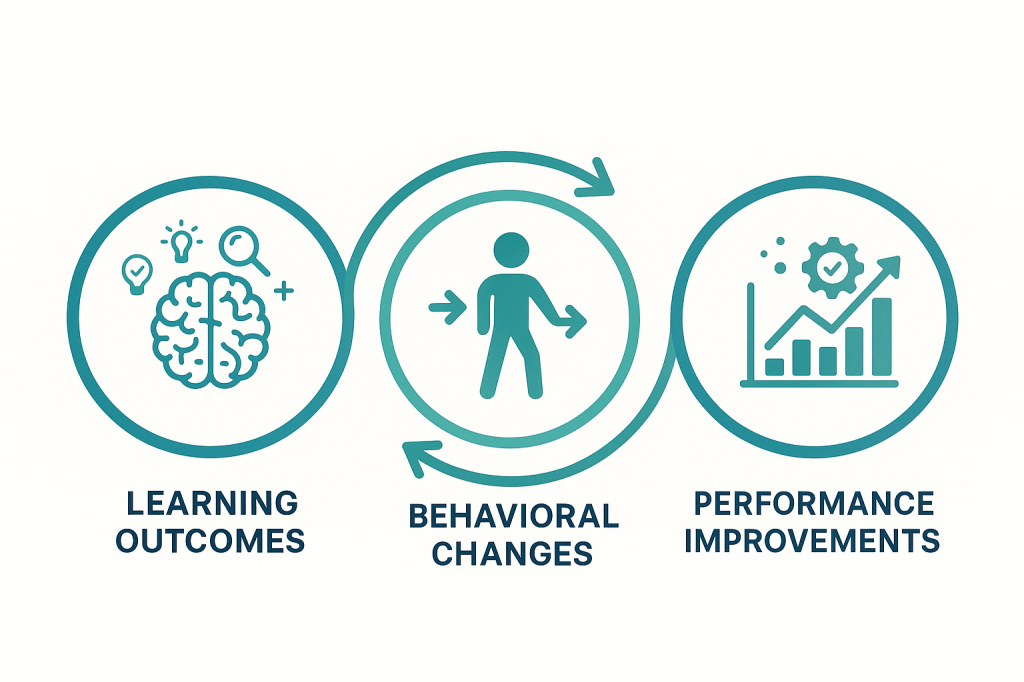
Infographic showing progression from learning outcomes to behavioral changes to performance improvements

Traditional training programs operate as closed systems that confirm their own effectiveness through measures like attendance rates, completion percentages, and satisfaction scores. Falsifiable training systems, by contrast, generate external predictions about performance that can be independently verified. For example, rather than measuring training satisfaction, a falsifiable system might predict specific reductions in deviation rates, improvements in audit performance, or increases in proactive risk identification following training interventions.

The philosophical shift from unfalsifiable to falsifiable training systems addresses a fundamental problem in pharmaceutical quality management: the tendency to confuse activity with achievement. Traditional training systems measure inputs—hours of training delivered, number of personnel trained, compliance with training schedules—rather than outputs—behavioral changes, performance improvements, and quality outcomes. This input focus creates systems that can appear successful while failing to achieve their fundamental objectives.

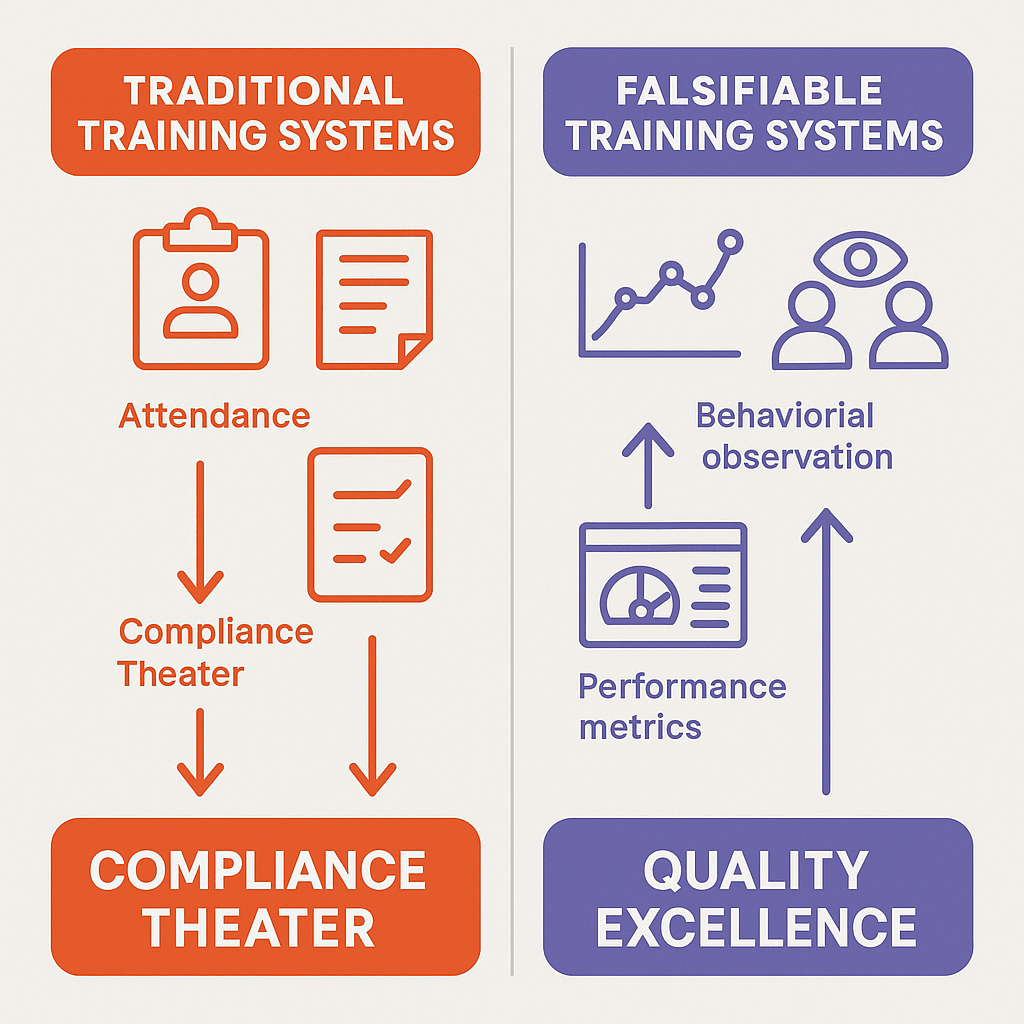
Traditional Training Systems (Left Side - Warning Colors):

Attendance Tracking: Focus on seat time rather than learning

Generic Assessments: One-size-fits-all testing approaches

Compliance Documentation: Paper trail without performance proof

Downward Arrow: Leading to "Training Theater" - appearance without substance

Falsifiable Training Systems (Right Side - Success Colors):

Predictive Models: Hypothesis-driven training design

Behavioral Measurement: Observable workplace performance changes

Performance Verification: Evidence-based outcome assessment

Upward Arrow: Leading to "Quality Excellence" - measurable results

Predictive Training Models

Falsifiable training systems begin with the development of predictive models that specify expected relationships between training interventions and organizational outcomes. These models must be specific enough to generate testable hypotheses while remaining practical for implementation in pharmaceutical manufacturing environments. For example, a predictive model for CAPA training might specify that personnel completing an enhanced root cause analysis curriculum will demonstrate a 25% improvement in investigation depth scores and a 40% reduction in recurring issues within six months of training completion.

The development of predictive training models requires deep understanding of the causal mechanisms linking training inputs to quality outcomes. This understanding goes beyond surface-level correlations to identify the specific knowledge, skills, and behaviors that drive superior performance. For root cause analysis training, the predictive model might specify that improved performance results from enhanced pattern recognition abilities, increased analytical rigor in evidence evaluation, and greater persistence in pursuing underlying causes rather than superficial explanations.

Predictive models must also incorporate temporal dynamics, recognizing that different aspects of training effectiveness manifest over different time horizons. Initial learning might be measurable through knowledge assessments administered immediately following training. Behavioral change might become apparent within 30-60 days as personnel apply new techniques in their daily work. Organizational outcomes like deviation reduction or audit performance improvement might require 3-6 months to become statistically significant. These temporal considerations are essential for designing evaluation systems that can accurately assess training effectiveness across multiple dimensions.

Measurement Systems for Learning Verification

Falsifiable training systems require sophisticated measurement approaches that can detect both positive outcomes and training failures. Traditional training evaluation often relies on Kirkpatrick’s four-level model—reaction, learning, behavior, and results—but applies it in ways that confirm rather than challenge training effectiveness. Falsifiable systems use the Kirkpatrick framework as a starting point but enhance it with rigorous hypothesis testing approaches that can identify training failures as clearly as training successes.

Level 1 (Reaction) measurements in falsifiable systems focus on engagement indicators that predict subsequent learning rather than generic satisfaction scores. These might include the quality of questions asked during training sessions, the depth of participation in case study discussions, or the specificity of action plans developed by participants. Rather than measuring whether participants “liked” the training, falsifiable systems measure whether participants demonstrated the type of engagement that research shows correlates with subsequent performance improvement.

Level 2 (Learning) measurements employ pre- and post-training assessments designed to detect specific knowledge and skill development rather than general awareness. These assessments use scenario-based questions that require application of training content to realistic work situations, ensuring that learning measurement reflects practical competence rather than theoretical knowledge. Critically, falsifiable systems include “distractor” assessments that test knowledge not covered in training, helping to distinguish genuine learning from test-taking artifacts or regression to the mean effects.

Level 3 (Behavior) measurements represent the most challenging aspect of falsifiable training evaluation, requiring observation and documentation of actual workplace behavior change. Effective approaches include structured observation protocols, 360-degree feedback systems focused on specific behaviors taught in training, and analysis of work products for evidence of skill application. For example, CAPA training effectiveness might be measured by evaluating investigation reports before and after training using standardized rubrics that assess analytical depth, evidence quality, and causal reasoning.

Level 4 (Results) measurements in falsifiable systems focus on leading indicators that can provide early evidence of training impact rather than waiting for lagging indicators like deviation rates or audit performance. These might include measures of proactive risk identification, voluntary improvement suggestions, or peer-to-peer knowledge transfer. The key is selecting results measures that are closely linked to the specific behaviors and competencies developed through training while being sensitive enough to detect changes within reasonable time frames.

"The Kirkpatrick Model for Training Effectiveness infographic showing a circular diagram with four concentric levels. At the center is Level 3 'Behavior' with an icon of a person and gears, labeled 'ON-THE-JOB LEARNING'. Surrounding this are four colored segments: Level 1 'Reaction' (dark blue, top left) measuring Engagement, Relevance, and Customer Satisfaction; Level 2 'Learning' (red/orange, bottom left) measuring Knowledge, Skills, Attitude, Confidence, and Commitment; Level 4 'Results' (gold/orange, right) measuring Leading Indicators and Desired Outcomes. The outer ring is dark blue with white text reading 'MONITOR', 'REINFORCE', 'ENCOURAGE', and 'REWARD' in the four segments. Gray arrows on the right indicate 'Monitor & Adjust' processes. Each level is represented by distinct icons: a clipboard for Reaction, a book for Learning, gears and person for Behavior, and a chart for Results."

This alt text provides a comprehensive description that would allow someone using a screen reader to understand both the visual structure and the content hierarchy of the Kirkpatrick training evaluation model, including the four levels, their associated metrics, and the continuous improvement cycle represented by the outer ring.

Risk-Based Training Design and Implementation

The integration of Quality Risk Management (QRM) principles with training design represents a fundamental advancement in pharmaceutical education methodology. Rather than developing generic training programs based on regulatory requirements or industry best practices, risk-based training design begins with systematic analysis of the specific risks posed by knowledge and skill gaps within the organization. This approach aligns training investments with actual quality and compliance risks while ensuring that educational resources address the most critical performance needs.

Risk-based training design employs the ICH Q9(R1) framework to systematically identify, assess, and mitigate training-related risks throughout the pharmaceutical quality system. Risk identification focuses on understanding how knowledge and skill deficiencies could impact product quality, patient safety, or regulatory compliance. For example, inadequate understanding of aseptic technique among sterile manufacturing personnel represents a high-impact risk with direct patient safety implications, while superficial knowledge of change control procedures might create lower-magnitude but higher-frequency compliance risks.

The risk assessment phase quantifies both the probability and impact of training-related failures while considering existing controls and mitigation measures. This analysis helps prioritize training investments and design appropriate learning interventions. High-risk knowledge gaps require intensive, hands-on training with multiple assessment checkpoints and ongoing competency verification. Lower-risk areas might be addressed through self-paced learning modules or periodic refresher training. The risk assessment also identifies scenarios where training alone is insufficient, requiring procedural changes, system enhancements, or additional controls to adequately manage identified risks.

Proactive Risk Detection Through Learning Analytics

Advanced risk-based training systems employ learning analytics to identify emerging competency risks before they manifest as quality failures or compliance violations. These systems continuously monitor training effectiveness indicators, looking for patterns that suggest degrading competence or emerging knowledge gaps. For example, declining assessment scores across multiple personnel might indicate inadequate training design, while individual performance variations could suggest the need for personalized learning interventions.

Learning analytics in pharmaceutical training systems must be designed to respect privacy while providing actionable insights for quality management. Effective approaches include aggregate trend analysis that identifies systemic issues without exposing individual performance, predictive modeling that forecasts training needs based on operational changes, and comparative analysis that benchmarks training effectiveness across different sites or product lines. These analytics support proactive quality management by enabling early intervention before competency gaps impact operations.

The integration of learning analytics with quality management systems creates powerful opportunities for continuous improvement in both training effectiveness and operational performance. By correlating training metrics with quality outcomes, organizations can identify which aspects of their training programs drive the greatest performance improvements and allocate resources accordingly. This data-driven approach transforms training from a compliance activity into a strategic quality management tool that actively contributes to organizational excellence.

Risk Communication and Training Transfer

Risk-based training design recognizes that effective learning transfer requires personnel to understand not only what to do but why it matters from a risk management perspective. Training programs that explicitly connect learning objectives to quality risks and patient safety outcomes demonstrate significantly higher retention and application rates than programs focused solely on procedural compliance. This approach leverages the psychological principle of meaningful learning, where understanding the purpose and consequences of actions enhances both motivation and performance.

Effective risk communication in training contexts requires careful balance between creating appropriate concern about potential consequences while maintaining confidence and motivation. Training programs should help personnel understand how their individual actions contribute to broader quality objectives and patient safety outcomes without creating paralyzing anxiety about potential failures. This balance is achieved through specific, actionable guidance that empowers personnel to make appropriate decisions while understanding the risk implications of their choices.

The development of risk communication competencies represents a critical training need across pharmaceutical organizations. Personnel at all levels must be able to identify, assess, and communicate about quality risks in ways that enable appropriate decision-making and continuous improvement. This includes technical skills like hazard identification and risk assessment as well as communication skills that enable effective knowledge transfer, problem escalation, and collaborative problem-solving. Training programs that develop these meta-competencies create multiplicative effects that enhance overall organizational capability beyond the specific technical content being taught.

Building Quality Maturity Through Structured Learning

The FDA’s Quality Management Maturity (QMM) program provides a framework for understanding how training contributes to overall organizational excellence in pharmaceutical manufacturing. QMM assessment examines five key areas—management commitment to quality, business continuity, advanced pharmaceutical quality system, technical excellence, and employee engagement and empowerment—with training playing critical roles in each area. Mature organizations demonstrate systematic approaches to developing and maintaining competencies that support these quality management dimensions.

Quality maturity in training systems manifests through several observable characteristics: systematic competency modeling that defines required knowledge, skills, and behaviors for each role; evidence-based training design that uses adult learning principles and performance improvement methodologies; comprehensive measurement systems that track training effectiveness across multiple dimensions; and continuous improvement processes that refine training based on performance outcomes and organizational feedback. These characteristics distinguish mature training systems from compliance-focused programs that meet regulatory requirements without driving performance improvement.

The development of quality maturity requires organizations to move beyond reactive training approaches that respond to identified deficiencies toward proactive systems that anticipate future competency needs and prepare personnel for evolving responsibilities. This transition involves sophisticated workforce planning, competency forecasting, and strategic learning design that aligns with broader organizational objectives. Mature organizations treat training as a strategic capability that enables business success rather than a cost center that consumes resources for compliance purposes.

Competency-Based Learning Architecture

Competency-based training design represents a fundamental departure from traditional knowledge-transfer approaches, focusing instead on the specific behaviors and performance outcomes that drive quality excellence. This approach begins with detailed job analysis and competency modeling that identifies the critical success factors for each role within the pharmaceutical quality system. For example, a competency model for quality assurance personnel might specify technical competencies like analytical problem-solving and regulatory knowledge alongside behavioral competencies like attention to detail and collaborative communication.

The architecture of competency-based learning systems includes several interconnected components: competency frameworks that define performance standards for each role; assessment strategies that measure actual competence rather than theoretical knowledge; learning pathways that develop competencies through progressive skill building; and performance support systems that reinforce learning in the workplace. These components work together to create comprehensive learning ecosystems that support both initial competency development and ongoing performance improvement.

Competency-based systems also incorporate adaptive learning technologies that personalize training based on individual performance and learning needs. Advanced systems use diagnostic assessments to identify specific competency gaps and recommend targeted learning interventions. This personalization increases training efficiency while ensuring that all personnel achieve required competency levels regardless of their starting point or learning preferences. The result is more effective training that requires less time and resources while achieving superior performance outcomes.

Progressive Skill Development Models

Quality maturity requires training systems that support continuous competency development throughout personnel careers rather than one-time certification approaches. Progressive skill development models provide structured pathways for advancing from basic competence to expert performance, incorporating both formal training and experiential learning opportunities. These models recognize that expertise development is a long-term process requiring sustained practice, feedback, and reflection rather than short-term information transfer.

Effective progressive development models incorporate several design principles: clear competency progression pathways that define advancement criteria; diverse learning modalities that accommodate different learning preferences and situations; mentorship and coaching components that provide personalized guidance; and authentic assessment approaches that evaluate real-world performance rather than abstract knowledge. For example, a progression pathway for CAPA investigators might begin with fundamental training in problem-solving methodologies, advance through guided practice on actual investigations, and culminate in independent handling of complex quality issues with peer review and feedback.

The implementation of progressive skill development requires sophisticated tracking systems that monitor individual competency development over time and identify opportunities for advancement or intervention. These systems must balance standardization—ensuring consistent competency development across the organization—with flexibility that accommodates individual differences in learning pace and career objectives. Successful systems also incorporate recognition and reward mechanisms that motivate continued competency development and reinforce the organization’s commitment to learning excellence.

Practical Implementation Framework

Systematic Training Needs Analysis

The foundation of effective training in pharmaceutical quality systems requires systematic needs analysis that moves beyond compliance-driven course catalogs to identify actual performance gaps and learning opportunities. This analysis employs multiple data sources—including deviation analyses, audit findings, near-miss reports, and performance metrics—to understand where training can most effectively contribute to quality improvement. Rather than assuming that all personnel need the same training, systematic needs analysis identifies specific competency requirements for different roles, experience levels, and operational contexts.

Effective needs analysis in pharmaceutical environments must account for the complex interdependencies within quality systems, recognizing that individual performance occurs within organizational systems that can either support or undermine training effectiveness. This systems perspective examines how organizational factors like procedures, technology, supervision, and incentives influence training transfer and identifies barriers that must be addressed for training to achieve its intended outcomes. For example, excellent CAPA training may fail to improve investigation quality if organizational systems continue to prioritize speed over thoroughness or if personnel lack access to necessary analytical tools.

The integration of predictive analytics into training needs analysis enables organizations to anticipate future competency requirements based on operational changes, regulatory developments, or quality system evolution. This forward-looking approach prevents competency gaps from developing rather than reacting to them after they impact performance. Predictive needs analysis might identify emerging training requirements related to new manufacturing technologies, evolving regulatory expectations, or changing product portfolios, enabling proactive competency development that maintains quality system effectiveness during periods of change.

Development of Falsifiable Learning Objectives

Traditional training programs often employ learning objectives that are inherently unfalsifiable—statements like “participants will understand good documentation practices” or “attendees will appreciate the importance of quality” that cannot be tested or proven wrong. Falsifiable learning objectives, by contrast, specify precise, observable, and measurable outcomes that can be independently verified. For example, a falsifiable objective might state: “Following training, participants will identify 90% of documentation deficiencies in standardized case studies and propose appropriate corrective actions that address root causes rather than symptoms.”

The development of falsifiable learning objectives requires careful consideration of the relationship between training content and desired performance outcomes. Objectives must be specific enough to enable rigorous testing while remaining meaningful for actual job performance. This balance requires deep understanding of both the learning content and the performance context, ensuring that training objectives align with real-world quality requirements. Effective falsifiable objectives specify not only what participants will know but how they will apply that knowledge in specific situations with measurable outcomes.

Falsifiable learning objectives also incorporate temporal specificity, defining when and under what conditions the specified outcomes should be observable. This temporal dimension enables systematic follow-up assessment that can verify whether training has achieved its intended effects. For example, an objective might specify that participants will demonstrate improved investigation techniques within 30 days of training completion, as measured by structured evaluation of actual investigation reports using standardized assessment criteria. This specificity enables organizations to identify training successes and failures with precision, supporting continuous improvement in educational effectiveness.

Assessment Design for Performance Verification

The assessment of training effectiveness in falsifiable quality systems requires sophisticated evaluation methods that can distinguish between superficial compliance and genuine competency development. Traditional assessment approaches—multiple-choice tests, attendance tracking, and satisfaction surveys—provide limited insight into actual performance capability and cannot support rigorous testing of training hypotheses. Falsifiable assessment systems employ authentic evaluation methods that measure performance in realistic contexts using criteria that reflect actual job requirements.

Scenario-based assessment represents one of the most effective approaches for evaluating competency in pharmaceutical quality contexts. These assessments present participants with realistic quality challenges that require application of training content to novel situations, providing insight into both knowledge retention and problem-solving capability. For example, CAPA training assessment might involve analyzing actual case studies of quality failures, requiring participants to identify root causes, develop corrective actions, and design preventive measures that address underlying system weaknesses. The quality of these responses can be evaluated using structured rubrics that provide objective measures of competency development.

Performance-based assessment extends evaluation beyond individual knowledge to examine actual workplace behavior and outcomes. This approach requires collaboration between training and operational personnel to design assessment methods that capture authentic job performance while providing actionable feedback for improvement. Performance-based assessment might include structured observation of personnel during routine activities, evaluation of work products using quality criteria, or analysis of performance metrics before and after training interventions. The key is ensuring that assessment methods provide valid measures of the competencies that training is intended to develop.

Continuous Improvement and Adaptation

Falsifiable training systems require robust mechanisms for continuous improvement based on empirical evidence of training effectiveness. This improvement process goes beyond traditional course evaluations to examine actual training outcomes against predicted results, identifying specific aspects of training design that contribute to success or failure. Continuous improvement in falsifiable systems is driven by data rather than opinion, using systematic analysis of training metrics to refine educational approaches and enhance performance outcomes.

The continuous improvement process must examine training effectiveness at multiple levels—individual learning, operational performance, and organizational outcomes—to identify optimization opportunities across the entire training system. Individual-level analysis might reveal specific content areas where learners consistently struggle, suggesting the need for enhanced instructional design or additional practice opportunities. Operational-level analysis might identify differences in training effectiveness across different sites or departments, indicating the need for contextual adaptation or implementation support. Organizational-level analysis might reveal broader patterns in training impact that suggest strategic changes in approach or resource allocation.

Continuous improvement also requires systematic experimentation with new training approaches, using controlled trials and pilot programs to test innovations before full implementation. This experimental approach enables organizations to stay current with advances in adult learning while maintaining evidence-based decision making about educational investments. For example, an organization might pilot virtual reality training for aseptic technique while continuing traditional approaches, comparing outcomes to determine which method produces superior performance improvement. This experimental mindset transforms training from a static compliance function into a dynamic capability that continuously evolves to meet organizational needs.

An Example

CompetencyAssessment TypeFalsifiable HypothesisAssessment MethodSuccess CriteriaFailure Criteria (Falsification)
Gowning ProceduresLevel 1: ReactionTrainees will rate gowning training as ≥4.0/5.0 for relevance and engagementPost-training survey with Likert scale ratingsMean score ≥4.0 with <10% of responses below 3.0Mean score <4.0 OR >10% responses below 3.0
Gowning ProceduresLevel 2: LearningTrainees will demonstrate 100% correct gowning sequence in post-training assessmentWritten exam + hands-on gowning demonstration with checklist100% pass rate on practical demonstration within 2 attempts<100% pass rate after 2 attempts OR critical safety errors observed
Gowning ProceduresLevel 3: BehaviorOperators will maintain <2% gowning deviations during observed cleanroom entries over 30 daysDirect observation with standardized checklist over multiple shiftsStatistical significance (p<0.05) in deviation reduction vs. baselineNo statistically significant improvement OR increase in deviations
Gowning ProceduresLevel 4: ResultsGowning-related contamination events will decrease by ≥50% within 90 days post-trainingTrend analysis of contamination event data with statistical significance testing50% reduction confirmed by chi-square analysis (p<0.05)<50% reduction OR no statistical significance (p≥0.05)
Aseptic TechniqueLevel 1: ReactionTrainees will rate aseptic technique training as ≥4.2/5.0 for practical applicabilityPost-training survey focusing on perceived job relevance and confidenceMean score ≥4.2 with confidence interval ≥3.8-4.6Mean score <4.2 OR confidence interval below 3.8
Aseptic TechniqueLevel 2: LearningTrainees will achieve ≥90% on aseptic technique knowledge assessment and skills demonstrationCombination written test and practical skills assessment with video review90% first-attempt pass rate with skills assessment score ≥85%<90% pass rate OR skills assessment score <85%
Aseptic TechniqueLevel 3: BehaviorOperators will demonstrate proper first air protection in ≥95% of observed aseptic manipulationsReal-time observation using behavioral checklist during routine operationsStatistically significant improvement in compliance rate vs. pre-trainingNo statistically significant behavioral change OR compliance decrease
Aseptic TechniqueLevel 4: ResultsAseptic process simulation failure rates will decrease by ≥40% within 6 monthsAPS failure rate analysis with control group comparison and statistical testing40% reduction in APS failures with 95% confidence interval<40% APS failure reduction OR confidence interval includes zero
Environmental MonitoringLevel 1: ReactionTrainees will rate EM training as ≥4.0/5.0 for understanding monitoring rationaleSurvey measuring comprehension and perceived value of monitoring programMean score ≥4.0 with standard deviation <0.8Mean score <4.0 OR standard deviation >0.8 indicating inconsistent understanding
Environmental MonitoringLevel 2: LearningTrainees will correctly identify ≥90% of sampling locations and techniques in practical examPractical examination requiring identification and demonstration of techniques90% pass rate on location identification and 95% on technique demonstration<90% location accuracy OR <95% technique demonstration success
Environmental MonitoringLevel 3: BehaviorPersonnel will perform EM sampling with <5% procedural deviations during routine operationsAudit-style observation with deviation tracking and root cause analysisSignificant reduction in deviation rate compared to historical baselineNo significant reduction in deviations OR increase above baseline
Environmental MonitoringLevel 4: ResultsLab Error EM results will decrease by ≥30% within 120 days of training completionStatistical analysis of EM excursion trends with pre/post training comparison30% reduction in lab error rate with statistical significance and sustained trend<30% lab error reduction OR lack of statistical significance
Material TransferLevel 1: ReactionTrainees will rate material transfer training as ≥3.8/5.0 for workflow integration understandingSurvey assessing understanding of contamination pathways and preventionMean score ≥3.8 with >70% rating training as “highly applicable”Mean score <3.8 OR <70% rating as applicable
Material TransferLevel 2: LearningTrainees will demonstrate 100% correct transfer procedures in simulated scenariosSimulation-based assessment with pass/fail criteria and video documentation100% demonstration success with zero critical procedural errors<100% demonstration success OR any critical procedural errors
Material TransferLevel 3: BehaviorMaterial transfer protocol violations will be <3% during observed operations over 60 daysStructured observation protocol with immediate feedback and correctionViolation rate <3% sustained over 60-day observation periodViolation rate ≥3% OR inability to sustain improvement
Material TransferLevel 4: ResultsCross-contamination incidents related to material transfer will decrease by ≥60% within 6 monthsIncident trend analysis with correlation to training completion dates60% incident reduction with 6-month sustained improvement confirmed<60% incident reduction OR failure to sustain improvement
Cleaning & DisinfectionLevel 1: ReactionTrainees will rate cleaning training as ≥4.1/5.0 for understanding contamination risksSurvey measuring risk awareness and procedure confidence levelsMean score ≥4.1 with >80% reporting increased contamination risk awarenessMean score <4.1 OR <80% reporting increased risk awareness
Cleaning & DisinfectionLevel 2: LearningTrainees will achieve ≥95% accuracy in cleaning agent selection and application method testsKnowledge test combined with practical application assessment95% accuracy rate with no critical knowledge gaps identified<95% accuracy OR identification of critical knowledge gaps
Cleaning & DisinfectionLevel 3: BehaviorCleaning procedure compliance will be ≥98% during direct observation over 45 daysCompliance monitoring with photo/video documentation of techniques98% compliance rate maintained across multiple observation cycles<98% compliance OR declining performance over observation period
Cleaning & DisinfectionLevel 4: ResultsCleaning-related contamination findings will decrease by ≥45% within 90 days post-trainingContamination event investigation with training correlation analysis45% reduction in findings with sustained improvement over 90 days<45% reduction in findings OR inability to sustain improvement

Technology Integration and Digital Learning Ecosystems

Learning Management Systems for Quality Applications

The days where the Learning Management Systems (LMS) is just there to track read-and-understands, on-the-job trainings and a few other things should be in the past. Unfortunately few technology providers have risen to the need and struggle to provide true competency tracking aligned with regulatory expectations, and integration with quality management systems. Pharmaceutical-capable LMS solutions must provide comprehensive documentation of training activities while supporting advanced learning analytics that can demonstrate training effectiveness.

We cry out for robust LMS platforms that incorporate sophisticated competency management features that align with quality system requirements while supporting personalized learning experiences. We need systems can track individual competency development over time, identify training needs based on role changes or performance gaps, and automatically schedule required training based on regulatory timelines or organizational policies. Few organizations have the advanced platforms that also support adaptive learning pathways that adjust content and pacing based on individual performance, ensuring that all personnel achieve required competency levels while optimizing training efficiency.

It is critical to have integration of LMS platforms with broader quality management systems to enable the powerful analytics that can correlate training metrics with operational performance indicators. This integration supports data-driven decision making about training investments while providing evidence of training effectiveness for regulatory inspections. For example, integrated systems might demonstrate correlations between enhanced CAPA training and reduced deviation recurrence rates, providing objective evidence that training investments are contributing to quality improvement. This analytical capability transforms training from a cost center into a measurable contributor to organizational performance.

Give me a call LMS/eQMS providers. I’ll gladly provide some consulting hours to make this actually happen.

Virtual and Augmented Reality Applications

We are just starting to realize the opportunities that virtual and augmented reality technologies offer for immersive training experiences that can simulate high-risk scenarios without compromising product quality or safety. These technologies are poised to be particularly valuable for pharmaceutical quality training because they enable realistic practice with complex procedures, equipment, or emergency situations that would be difficult or impossible to replicate in traditional training environments. For example, virtual reality can provide realistic simulation of cleanroom operations, allowing personnel to practice aseptic technique and emergency procedures without risk of contamination or product loss.

The effectiveness of virtual reality training in pharmaceutical applications depends on careful design that maintains scientific accuracy while providing engaging learning experiences. Training simulations must incorporate authentic equipment interfaces, realistic process parameters, and accurate consequences for procedural deviations to ensure that virtual experiences translate to improved real-world performance. Advanced VR training systems also incorporate intelligent tutoring features that provide personalized feedback and guidance based on individual performance, enhancing learning efficiency while maintaining training consistency across organizations.

Augmented reality applications provide complementary capabilities for performance support and just-in-time training delivery. AR systems can overlay digital information onto real-world environments, providing contextual guidance during actual work activities or offering detailed procedural information without requiring personnel to consult separate documentation. For quality applications, AR might provide real-time guidance during equipment qualification procedures, overlay quality specifications during inspection activities, or offer troubleshooting assistance during non-routine situations. These applications bridge the gap between formal training and workplace performance, supporting continuous learning throughout daily operations.

Data Analytics for Learning Optimization

The application of advanced analytics to pharmaceutical training data enables unprecedented insights into learning effectiveness while supporting evidence-based optimization of educational programs. Modern analytics platforms can examine training data across multiple dimensions—individual performance patterns, content effectiveness, temporal dynamics, and correlation with operational outcomes—to identify specific factors that contribute to training success or failure. This analytical capability transforms training from an intuitive art into a data-driven science that can be systematically optimized for maximum performance impact.

Predictive analytics applications can forecast training needs based on operational changes, identify personnel at risk of competency degradation, and recommend personalized learning interventions before performance issues develop. These systems analyze patterns in historical training and performance data to identify early warning indicators of competency gaps, enabling proactive intervention that prevents quality problems rather than reacting to them. For example, predictive models might identify personnel whose performance patterns suggest the need for refresher training before deviation rates increase or audit findings develop.

Learning analytics also enable sophisticated A/B testing of training approaches, allowing organizations to systematically compare different educational methods and identify optimal approaches for specific content areas or learner populations. This experimental capability supports continuous improvement in training design while providing objective evidence of educational effectiveness. For instance, organizations might compare scenario-based learning versus traditional lecture approaches for CAPA training, using performance metrics to determine which method produces superior outcomes for different learner groups. This evidence-based approach ensures that training investments produce maximum returns in terms of quality performance improvement.

Organizational Culture and Change Management

Leadership Development for Quality Excellence

The development of quality leadership capabilities represents a critical component of training systems that aim to build robust quality cultures throughout pharmaceutical organizations. Quality leadership extends beyond technical competence to encompass the skills, behaviors, and mindset necessary to drive continuous improvement, foster learning environments, and maintain unwavering commitment to patient safety and product quality. Training programs for quality leaders must address both the technical aspects of quality management and the human dimensions of leading change, building trust, and creating organizational conditions that support excellent performance.

Effective quality leadership training incorporates principles from both quality science and organizational psychology, helping leaders understand how to create systems that enable excellent performance rather than simply demanding compliance. This approach recognizes that sustainable quality improvement requires changes in organizational culture, systems, and processes rather than exhortations to “do better” or increased oversight. Quality leaders must understand how to design work systems that make good performance easier and poor performance more difficult, while creating cultures that encourage learning from failures and continuous improvement.

The assessment of leadership development effectiveness requires sophisticated measurement approaches that examine both individual competency development and organizational outcomes. Traditional leadership training evaluation often focuses on participant reactions or knowledge acquisition rather than behavioral change and organizational impact. Quality leadership assessment must examine actual leadership behaviors in workplace contexts, measure changes in organizational climate and culture indicators, and correlate leadership development with quality performance improvements. This comprehensive assessment approach ensures that leadership training investments produce tangible improvements in organizational quality capability.

Creating Learning Organizations

The transformation of pharmaceutical organizations into learning organizations requires systematic changes in culture, processes, and systems that go beyond individual training programs to address how knowledge is created, shared, and applied throughout the organization. Learning organizations are characterized by their ability to continuously improve performance through systematic learning from both successes and failures, adapting to changing conditions while maintaining core quality commitments. This transformation requires coordinated changes in organizational design, management practices, and individual capabilities that support collective learning and continuous improvement.

The development of learning organization capabilities requires specific attention to psychological safety, knowledge management systems, and improvement processes that enable organizational learning. Psychological safety—the belief that one can speak up, ask questions, or admit mistakes without fear of negative consequences—represents a fundamental prerequisite for organizational learning in regulated industries where errors can have serious consequences. Training programs must address both the technical aspects of creating psychological safety and the practical skills necessary for effective knowledge sharing, constructive challenge, and collaborative problem-solving.

Knowledge management systems in learning organizations must support both explicit knowledge transfer—through documentation, training programs, and formal communication systems—and tacit knowledge sharing through mentoring, communities of practice, and collaborative work arrangements. These systems must also incorporate mechanisms for capturing and sharing lessons learned from quality events, process improvements, and regulatory interactions to ensure that organizational learning extends beyond individual experiences. Effective knowledge management requires both technological platforms and social processes that encourage knowledge sharing and application.

Sustaining Behavioral Change

The sustainability of behavioral change following training interventions represents one of the most significant challenges in pharmaceutical quality education. Research consistently demonstrates that without systematic reinforcement and support systems, training-induced behavior changes typically decay within weeks or months of training completion. Sustainable behavior change requires comprehensive support systems that reinforce new behaviors, provide ongoing skill development opportunities, and maintain motivation for continued improvement beyond the initial training period.

Effective behavior change sustainability requires systematic attention to both individual and organizational factors that influence performance maintenance. Individual factors include skill consolidation through practice and feedback, motivation maintenance through goal setting and recognition, and habit formation through consistent application of new behaviors. Organizational factors include system changes that make new behaviors easier to perform, management support that reinforces desired behaviors, and measurement systems that track and reward behavior change outcomes.

The design of sustainable training systems must incorporate multiple reinforcement mechanisms that operate across different time horizons to maintain behavior change momentum. Immediate reinforcement might include feedback systems that provide real-time performance information. Short-term reinforcement might involve peer recognition programs or supervisor coaching sessions. Long-term reinforcement might include career development opportunities that reward sustained performance improvement or organizational recognition programs that celebrate quality excellence achievements. This multi-layered approach ensures that new behaviors become integrated into routine performance patterns rather than remaining temporary modifications that decay over time.

Regulatory Alignment and Global Harmonization

FDA Quality Management Maturity Integration

The FDA’s Quality Management Maturity program provides a strategic framework for aligning training investments with regulatory expectations while driving organizational excellence beyond basic compliance requirements. The QMM program emphasizes five key areas where training plays critical roles: management commitment to quality, business continuity, advanced pharmaceutical quality systems, technical excellence, and employee engagement and empowerment. Training programs aligned with QMM principles demonstrate systematic approaches to competency development that support mature quality management practices rather than reactive compliance activities.

Integration with FDA QMM requirements necessitates training systems that can demonstrate measurable contributions to quality management maturity across multiple organizational dimensions. This demonstration requires sophisticated metrics that show how training investments translate into improved quality outcomes, enhanced organizational capabilities, and greater resilience in the face of operational challenges. Training programs must be able to document their contributions to predictive quality management, proactive risk identification, and continuous improvement processes that characterize mature pharmaceutical quality systems.

The alignment of training programs with QMM principles also requires ongoing adaptation as the program evolves and regulatory expectations mature. Organizations must maintain awareness of emerging FDA guidance, industry best practices, and international harmonization efforts that influence quality management expectations. This adaptability requires training systems with sufficient flexibility to incorporate new requirements while maintaining focus on fundamental quality competencies that remain constant across regulatory changes. The result is training programs that support both current compliance and future regulatory evolution.

International Harmonization Considerations

The global nature of pharmaceutical manufacturing requires training systems that can support consistent quality standards across different regulatory jurisdictions while accommodating regional variations in regulatory expectations and cultural contexts. International harmonization efforts, particularly through ICH guidelines like Q9(R1), Q10, and Q12, provide frameworks for developing training programs that meet global regulatory expectations while supporting business efficiency through standardized approaches.

Harmonized training approaches must balance standardization—ensuring consistent quality competencies across global operations—with localization that addresses specific regulatory requirements, cultural factors, and operational contexts in different regions. This balance requires sophisticated training design that identifies core competencies that remain constant across jurisdictions while providing flexible modules that address regional variations. For example, core quality management competencies might be standardized globally while specific regulatory reporting requirements are tailored to regional needs.

The implementation of harmonized training systems requires careful attention to cultural differences in learning preferences, communication styles, and organizational structures that can influence training effectiveness across different regions. Effective global training programs incorporate cultural intelligence into their design, using locally appropriate learning methodologies while maintaining consistent learning outcomes. This cultural adaptation ensures that training effectiveness is maintained across diverse global operations while supporting the development of shared quality culture that transcends regional boundaries.

Emerging Regulatory Trends

The pharmaceutical regulatory landscape continues to evolve toward greater emphasis on quality system effectiveness rather than procedural compliance, requiring training programs that can adapt to emerging regulatory expectations while maintaining focus on fundamental quality principles. Recent regulatory developments, including the draft revision of EU GMP Chapter 1 and evolving FDA enforcement priorities, emphasize knowledge management, risk-based decision making, and continuous improvement as core quality system capabilities that must be supported through comprehensive training programs.

Emerging regulatory trends also emphasize the importance of data integrity, cybersecurity, and supply chain resilience as critical quality competencies that require specialized training development. These evolving requirements necessitate training systems that can rapidly incorporate new content areas while maintaining the depth and rigor necessary for effective competency development. Organizations must develop training capabilities that can anticipate regulatory evolution rather than merely reacting to new requirements after they are published.

The integration of advanced technologies—including artificial intelligence, machine learning, and advanced analytics—into pharmaceutical manufacturing creates new training requirements for personnel who must understand both the capabilities and limitations of these technologies. Training programs must prepare personnel to work effectively with intelligent systems while maintaining the critical thinking and decision-making capabilities necessary for quality oversight. This technology integration represents both an opportunity for enhanced training effectiveness and a requirement for new competency development that supports technological advancement while preserving quality excellence.

Measuring Return on Investment and Business Value

Financial Metrics for Training Effectiveness

The demonstration of training program value in pharmaceutical organizations requires sophisticated financial analysis that can quantify both direct cost savings and indirect value creation resulting from improved competency. Traditional training ROI calculations often focus on obvious metrics like reduced deviation rates or decreased audit findings while missing broader value creation through improved productivity, enhanced innovation capability, and increased organizational resilience. Comprehensive financial analysis must capture the full spectrum of training benefits while accounting for the long-term nature of competency development and performance improvement.

Direct financial benefits of effective training include quantifiable improvements in quality metrics that translate to cost savings: reduced product losses due to quality failures, decreased regulatory remediation costs, improved first-time approval rates for new products, and reduced costs associated with investigations and corrective actions. These benefits can be measured using standard financial analysis methods, comparing operational costs before and after training interventions while controlling for other variables that might influence performance. For example, enhanced CAPA training might be evaluated based on reductions in recurring deviations, decreased investigation cycle times, and improved effectiveness of corrective actions.

Indirect financial benefits require more sophisticated analysis but often represent the largest component of training value creation. These benefits include improved employee engagement and retention, enhanced organizational reputation and regulatory standing, increased capability for innovation and continuous improvement, and greater operational flexibility and resilience. The quantification of these benefits requires advanced analytical methods that can isolate training contributions from other organizational influences while providing credible estimates of economic value. This analysis must also consider the temporal dynamics of training benefits, which often increase over time as competencies mature and organizational capabilities develop.

Quality Performance Indicators

The development of quality performance indicators that can demonstrate training effectiveness requires careful selection of metrics that reflect both training outcomes and broader organizational performance. These indicators must be sensitive enough to detect training impacts while being specific enough to attribute improvements to educational interventions rather than other organizational changes. Effective quality performance indicators span multiple time horizons and organizational levels, providing comprehensive insight into how training contributes to quality excellence across different dimensions and timeframes.

Leading quality performance indicators focus on early evidence of training impact that can be detected before changes appear in traditional quality metrics. These might include improvements in risk identification rates, increases in voluntary improvement suggestions, enhanced quality of investigation reports, or better performance during training assessments and competency evaluations. Leading indicators enable early detection of training effectiveness while providing opportunities for course correction if training programs are not producing expected outcomes.

Lagging quality performance indicators examine longer-term training impacts on organizational quality outcomes. These indicators include traditional metrics like deviation rates, audit performance, regulatory inspection outcomes, and customer satisfaction measures, but analyzed in ways that can isolate training contributions. Sophisticated analysis techniques, including statistical control methods and comparative analysis across similar facilities or time periods, help distinguish training effects from other influences on quality performance. The integration of leading and lagging indicators provides comprehensive evidence of training value while supporting continuous improvement in educational effectiveness.

Long-term Organizational Benefits

The assessment of long-term organizational benefits from training investments requires longitudinal analysis that can track training impacts over extended periods while accounting for the cumulative effects of sustained competency development. Long-term benefits often represent the most significant value creation from training programs but are also the most difficult to measure and attribute due to the complex interactions between training, organizational development, and environmental changes that occur over extended timeframes.

Organizational capability development represents one of the most important long-term benefits of effective training programs. This development manifests as increased organizational learning capacity, enhanced ability to adapt to regulatory or market changes, improved innovation and problem-solving capabilities, and greater resilience in the face of operational challenges. The measurement of capability development requires assessment methods that examine organizational responses to challenges over time, comparing performance patterns before and after training interventions while considering external factors that might influence organizational capability.

Cultural transformation represents another critical long-term benefit that emerges from sustained training investments in quality excellence. This transformation manifests as increased employee engagement with quality objectives, greater willingness to identify and address quality concerns, enhanced collaboration across organizational boundaries, and stronger commitment to continuous improvement. Cultural assessment requires sophisticated measurement approaches that can detect changes in attitudes, behaviors, and organizational climate over extended periods while distinguishing training influences from other cultural change initiatives.

Transforming Quality Through Educational Excellence

The transformation of pharmaceutical training from compliance-focused information transfer to falsifiable quality system development represents both an urgent necessity and an unprecedented opportunity. The recurring patterns in 2025 FDA warning letters demonstrate that traditional training approaches are fundamentally inadequate for building robust quality systems capable of preventing the failures that continue to plague the pharmaceutical industry. Organizations that continue to rely on training theater—elaborate documentation systems that create the appearance of comprehensive education while failing to drive actual performance improvement—will find themselves increasingly vulnerable to regulatory enforcement and quality failures that compromise patient safety and business sustainability.

The falsifiable quality systems approach offers a scientifically rigorous alternative that transforms training from an unverifiable compliance activity into a testable hypothesis about organizational performance. By developing training programs that generate specific, measurable predictions about learning outcomes and performance improvements, organizations can create educational systems that drive continuous improvement while providing objective evidence of effectiveness. This approach aligns training investments with actual quality outcomes while supporting the development of quality management maturity that meets evolving regulatory expectations and business requirements.

The integration of risk management principles into training design ensures that educational investments address the most critical competency gaps while supporting proactive quality management approaches. Rather than generic training programs based on regulatory checklists, risk-based training design identifies specific knowledge and skill deficiencies that could impact product quality or patient safety, enabling targeted interventions that provide maximum return on educational investment. This risk-based approach transforms training from a reactive compliance function into a proactive quality management tool that prevents problems rather than responding to them after they occur.

The development of quality management maturity through structured learning requires sophisticated competency development systems that support continuous improvement in individual capability and organizational performance. Progressive skill development models provide pathways for advancing from basic compliance to expert performance while incorporating both formal training and experiential learning opportunities. These systems recognize that quality excellence is achieved through sustained competency development rather than one-time certification, requiring comprehensive support systems that maintain performance improvement over extended periods.

The practical implementation of these advanced training approaches requires systematic change management that addresses organizational culture, leadership development, and support systems necessary for educational transformation. Organizations must move beyond viewing training as a cost center that consumes resources for compliance purposes toward recognizing training as a strategic capability that enables business success and quality excellence. This transformation requires leadership commitment, resource allocation, and cultural changes that support continuous learning and improvement throughout the organization.

The measurement of training effectiveness in falsifiable quality systems demands sophisticated assessment approaches that can demonstrate both individual competency development and organizational performance improvement. Traditional training evaluation methods—attendance tracking, completion rates, and satisfaction surveys—provide insufficient insight into actual training impact and cannot support evidence-based improvement in educational effectiveness. Advanced assessment systems must examine training outcomes across multiple dimensions and time horizons while providing actionable feedback for continuous improvement.

The technological enablers available for pharmaceutical training continue to evolve rapidly, offering unprecedented opportunities for immersive learning experiences, personalized education delivery, and sophisticated performance analytics. Organizations that effectively integrate these technologies with sound educational principles can achieve training effectiveness and efficiency improvements that were impossible with traditional approaches. However, technology integration must be guided by learning science and quality management principles rather than technological novelty, ensuring that innovations actually improve educational outcomes rather than merely modernizing ineffective approaches.

The global nature of pharmaceutical manufacturing requires training approaches that can support consistent quality standards across diverse regulatory, cultural, and operational contexts while leveraging local expertise and knowledge. International harmonization efforts provide frameworks for developing training programs that meet global regulatory expectations while supporting business efficiency through standardized approaches. However, harmonization must balance standardization with localization to ensure training effectiveness across different cultural and operational contexts.

The financial justification for advanced training approaches requires comprehensive analysis that captures both direct cost savings and indirect value creation resulting from improved competency. Organizations must develop sophisticated measurement systems that can quantify the full spectrum of training benefits while accounting for the long-term nature of competency development and performance improvement. This financial analysis must consider the cumulative effects of sustained training investments while providing evidence of value creation that supports continued investment in educational excellence.

The future of pharmaceutical quality training lies in the development of learning organizations that can continuously adapt to evolving regulatory requirements, technological advances, and business challenges while maintaining unwavering commitment to patient safety and product quality. These organizations will be characterized by their ability to learn from both successes and failures, share knowledge effectively across organizational boundaries, and maintain cultures that support continuous improvement and innovation. The transformation to learning organization status requires sustained commitment to educational excellence that goes beyond compliance to embrace training as a fundamental capability for organizational success.

The opportunity before pharmaceutical organizations is clear: transform training from a compliance burden into a competitive advantage that drives quality excellence, regulatory success, and business performance. Organizations that embrace falsifiable quality systems, risk-based training design, and quality maturity development will establish sustainable competitive advantages while contributing to the broader pharmaceutical industry’s evolution toward scientific excellence and patient focus. The choice is not whether to improve training effectiveness—the regulatory environment and business pressures make this improvement inevitable—but whether to lead this transformation or be compelled to follow by regulatory enforcement and competitive disadvantage.

The path forward requires courage to abandon comfortable but ineffective traditional approaches in favor of evidence-based training systems that can be rigorously tested and continuously improved. It requires investment in sophisticated measurement systems, advanced technologies, and comprehensive change management that supports organizational transformation. Most importantly, it requires recognition that training excellence is not a destination but a continuous journey toward quality management maturity that serves the fundamental purpose of pharmaceutical manufacturing: delivering safe, effective medicines to patients who depend on our commitment to excellence.

The transformation begins with a single step: the commitment to make training effectiveness falsifiable, measurable, and continuously improvable. Organizations that take this step will discover that excellent training is not an expense to be minimized but an investment that generates compounding returns in quality performance, regulatory success, and organizational capability. The question is not whether this transformation will occur—the regulatory and competitive pressures make it inevitable—but which organizations will lead this change and which will be forced to follow. The choice, and the opportunity, is ours.