Understanding Some International Organizations – ICH, ICMRA and PIC/S

The ICH, ICMRA, and PIC/S are three important international organizations in the pharmaceutical regulatory space that folks should pay attention to and understand how they shape our profession’s future.

International Council for Harmonisation of Technical Requirements for Pharmaceuticals for Human Use (ICH)

The International Council for Harmonisation of Technical Requirements for Pharmaceuticals for Human Use (ICH) is a global initiative that brings together regulatory authorities and the pharmaceutical industry to discuss and establish common guidelines and standards for developing, registering, and post-approval pharmaceutical products.

History and Evolution

  • Establishment: ICH was established in 1990 by the regulatory authorities and pharmaceutical industry associations from Europe, Japan, and the United States. The goal was to harmonize the regulatory requirements for pharmaceutical product registration across these regions.
  • Reformation: In 2015, ICH was reformed and became a legal entity under Swiss law, transforming from the International Conference on Harmonisation to the International Council for Harmonisation. This change aimed to create a more robust and transparent governance structure and to expand its global reach.

Objectives and Goals

  • Harmonization: The primary goal of ICH is to achieve greater harmonization worldwide to ensure that safe, effective, and high-quality medicines are developed and registered in the most resource-efficient manner.
  • Efficiency: By harmonizing technical requirements, ICH aims to improve the efficiency of the drug development and registration process, reduce duplication of clinical trials, and minimize the use of animal testing without compromising safety and effectiveness.

Structure and Governance

  • ICH Assembly: This is the overarching governing body, which includes all members and observers. It adopts decisions on guidelines, membership, work plans, and budgets.
  • ICH Management Committee: This committee oversees the operational aspects, including administrative and financial matters and working group activities.
  • MedDRA Management Committee: This committee manages the Medical Dictionary for Regulatory Activities (MedDRA), standardizing medical terminology for adverse event reporting and clinical trial data.
  • ICH Secretariat: Handles the day-to-day management and coordination of ICH activities.

Guidelines and Categories

ICH guidelines are categorized into four main areas:

  • Quality: Covers topics such as stability testing, analytical validation, and good manufacturing practices (GMP).
  • Safety: Includes guidelines on genotoxicity, reproductive toxicity, and other safety evaluations.
  • Efficacy: Focuses on the design, conduct, safety, and reporting of clinical trials, including novel drug classes and pharmacogenetics.
  • Multidisciplinary: Encompasses cross-cutting topics like the Common Technical Document (CTD) and electronic standards for regulatory information transfer.

Global Impact and Implementation

  • Membership: ICH includes regulatory authorities and industry associations from around the world. It currently has 20 members and 36 observers.
  • Implementation: Regulatory members are committed to adopting and implementing ICH guidelines within their jurisdictions, ensuring consistent regulatory standards globally.

Key Activities

  • Guideline Development: ICH develops harmonized guidelines through a consensus-based process involving regulatory and industry experts.
  • Training and Support: Provide training materials and support to facilitate the consistent implementation of guidelines across different regions.

The ICH plays a crucial role in the global pharmaceutical regulatory landscape by promoting harmonized standards, improving the efficiency of drug development, and ensuring the safety and efficacy of medicines worldwide.

International Coalition of Medicines Regulatory Authorities (ICMRA)

The International Coalition of Medicines Regulatory Authorities (ICMRA) is a voluntary, executive-level, strategic coordinating, advocacy, and leadership entity. It brings together heads of national and regional medicines regulatory authorities worldwide to address global and emerging human medicine regulatory and safety challenges.

Objectives and Goals

  • Global Coordination: ICMRA provides a global architecture to support enhanced communication, information sharing, crisis response, and addressing regulatory science issues.
  • Strategic Direction: It offers direction for areas and activities common to many regulatory authorities’ missions and identifies areas for potential synergies.
  • Leveraging Resources: ICMRA leverages existing initiatives, enablers, and resources to maximize the global regulatory impact wherever possible.

Membership

  • Voluntary Participation: Membership is voluntary and open to all medicines regulatory authorities. It includes prominent entities such as the European Medicines Agency (EMA), the U.S. Food and Drug Administration (FDA), and many others worldwide.
  • Global Representation: The coalition includes regulatory authorities from various regions, with the World Health Organization (WHO) participating as an observer.

Key Activities and Projects

  • Antimicrobial Resistance (AMR): Developing a coordinated global approach to tackle AMR.
  • COVID-19 Response: During the COVID-19 pandemic, ICMRA has been pivotal in expediting and streamlining the development, authorization, and availability of COVID-19 treatments and vaccines worldwide.
  • Innovation and Pharmacovigilance: Ongoing investigations and case studies relating to emerging regulatory challenges and working on real-world evidence, adverse event reporting, and vaccine confidence.
  • Supply Chain Integrity: Ensuring the integrity of the global supply chain for medicines.

Strategic Importance

  • Enhanced Collaboration: ICMRA fosters international collaboration among medicine regulatory authorities to ensure the safety, quality, and efficacy of medicinal products globally.
  • Regulatory Agility: The coalition promotes regulatory agility and rapid response to global health emergencies, ensuring patients have timely access to safe and effective medical products.

The ICMRA plays a crucial role in the global regulatory landscape by enhancing communication and cooperation among medicines regulatory authorities, addressing shared challenges, and promoting the safety and efficacy of medicinal products worldwide.

Pharmaceutical Inspection Co-operation Scheme.

PIC/S stands for the Pharmaceutical Inspection Co-operation Scheme, a non-binding, informal co-operative arrangement between regulatory authorities in Good Manufacturing Practice (GMP) of medicinal products for human or veterinary use. Its main purpose is to lead the international development, implementation, and maintenance of harmonized GMP standards and quality systems of inspectorates in the pharmaceutical field.

History: PIC/S was established in 1995 as an extension to the Pharmaceutical Inspection Convention (PIC) of 1970. It was created to overcome legal limitations that prevented new countries from joining the original PIC due to incompatibilities with European law.

Membership: PIC/S is open to any regulatory authority with a comparable GMP inspection system. As of 2023, it comprises 56 participating authorities worldwide, including Europe, Africa, America, Asia, and Australasia.

Structure: PIC/S operates as an association under Swiss law, registered in Geneva, Switzerland. It has a committee, an executive bureau, and various working groups.

Relationship with Other Organizations: PIC/S works closely with other international bodies, including the European Medicines Agency (EMA), to promote GMP harmonization and share resources.

Objectives

  • Harmonizing inspection procedures worldwide
  • Providing training opportunities for inspectors
  • Developing common standards in GMP
  • Facilitating cooperation between competent authorities and international organizations

Activities

    • Developing and promoting harmonized GMP standards and guidance documents
    • Training competent authorities, particularly inspectors
    • Assessing and reassessing inspectorates
    • Facilitating networking among regulatory authorities

    Benefits

      • Ensures high standards among members
      • Provides training and networking opportunities
      • May facilitate pharmaceutical exports indirectly
      • Increases confidence in medicines manufactured in member countries

      PIC/S plays a crucial role in global pharmaceutical regulation by promoting harmonized standards, facilitating cooperation between regulatory authorities, and working towards ensuring the quality and safety of medicinal products worldwide.

      The Three in Overview

      AspectICHICMRAPIC/S
      Full NameInternational Council for Harmonisation of Technical Requirements for Pharmaceuticals for Human UseInternational Coalition of Medicines Regulatory AuthoritiesPharmaceutical Inspection Co-operation Scheme
      Established1990 (reformed in 2015)20131995
      Primary FocusHarmonization of technical requirements for drug development and registrationStrategic coordination and leadership in global human medicine regulationHarmonization of Good Manufacturing Practice (GMP) standards and inspections
      Main ObjectivesDevelop harmonized guidelines for drug development, registration, and post-approvalEnhance communication, information sharing, and crisis response among regulatorsDevelop common GMP standards and train inspectors
      Membership20 members, 36 observers (regulatory authorities and industry associations)Heads of medicines regulatory authorities worldwideGuideline development, training, and implementation support
      ScopeGlobal, with emphasis on technical aspects of drug developmentGlobal, focusing on high-level strategic issuesGlobal, concentrating on GMP and quality systems
      Key ActivitiesGuideline development, training, implementation supportStrategic direction, crisis response, addressing emerging challengesInspector training, assessment of inspectorates, developing GMP guidance
      Legal StatusLegal entity under Swiss lawVoluntary coalitionNon-binding, informal co-operative arrangement
      Industry InvolvementDirect involvement of pharmaceutical industry associationsLimited direct industry involvementNo direct industry involvement
      Main OutputHarmonized guidelines (Quality, Safety, Efficacy, Multidisciplinary)Strategic initiatives, position papers, statementsGMP guidelines, inspection reports, training programs

      This table highlights the distinct roles and focuses of these three important international pharmaceutical regulatory organizations. While they all contribute to global harmonization and cooperation in pharmaceutical regulation, each has a unique emphasis:

      • ICH primarily develops technical guidelines for drug development and registration.
      • ICMRA focuses on high-level strategic coordination among regulatory authorities.
      • PIC/S concentrates on harmonizing GMP standards and inspection practices.

      Their complementary roles contribute to a more cohesive global regulatory environment for pharmaceuticals.

      How to Monitor

      OrganizationWhat to MonitorHow to MonitorFrequency
      ICMRA– COVID-19 updates and guidance
      – Statements on regulatory issues
      – Reports on emerging topics (e.g., AI, RWE)
      – Strategic meetings and workshops
      – Check ICMRA website regularly
      – Subscribe to ICMRA newsletter
      – Follow ICMRA on social media
      – Attend public workshops when possible
      Monthly
      ICH– New and updated guidelines
      – Ongoing harmonization efforts
      – Implementation status of guidelines
      – Training materials and events
      – Monitor ICH website for updates
      – Subscribe to ICH news alerts
      – Participate in public consultations
      – Attend ICH training programs
      Bi-weekly
      PIC/S– GMP guide updates
      – New guidance documents
      – Training events and seminars
      – Inspection trends and focus areas
      – Check PIC/S website regularly
      – Subscribe to PIC/S newsletter
      – Review annual reports
      – Participate in PIC/S seminars if eligible
      Monthly

      Key points for monitoring:

      • Set up automated alerts or RSS feeds where available
      • Create a calendar reminder for regular check-ins on each organization’s website
      • Collaborate with regulatory affairs colleagues to share insights and updates
      • Implement a system to disseminate relevant information within your organization
      • Consider joining industry associations that actively engage with these organizations

      Key Links

      The State of the Analytical Lifecycle

      There have been a lot of changes in the way pharma thinks of analytical lifecycles in the last few years. With changes in technology, new product modalities, ICH Q2(R2) and ICH Q14 being released in November 2023, and USP <1220> in 2022, it is fair to say we are all catching up with our analytical lifecycle programs.

      Let’s discuss what I think are the four pivotal documents that provide direction.

      ICH Q2(R2) and ICH Q14

      ICH Q2(R2) and ICH Q14 are complementary guidelines that provide a comprehensive framework for the development, validation, and lifecycle management of analytical procedures used in the pharmaceutical industry.

      ICH Q14 describes the scientific principles and risk-based approaches for developing and maintaining suitable analytical procedures throughout their lifecycle. It outlines the key elements and considerations for analytical procedure development, including:

      • Defining an Analytical Target Profile (ATP)
      • Knowledge management and risk assessment
      • Evaluating robustness and parameter ranges
      • Establishing an Analytical Procedure Control Strategy
      • Lifecycle management and post-approval changes
      • Multivariate analytical procedures
      • Real-time release testing

      On the other hand, ICH Q2(R2) provides specific guidance on validating analytical procedures to demonstrate their suitability for the intended use. It covers various validation tests, methodologies, and evaluation criteria, such as:

      • Specificity/selectivity
      • Working range
      • Accuracy and precision
      • Robustness
      • Stability-indicating properties
      • Multivariate analytical procedures

      In summary, ICH Q14 establishes the overarching principles and approaches for analytical procedure development. At the same time, ICH Q2(R2) focuses on the validation aspects to ensure the analytical procedures are fit for purpose and meet quality requirements throughout their lifecycle. The two guidelines are intended to be applied together, with ICH Q14 providing the framework for development and ICH Q2(R2) specifying the validation requirements.

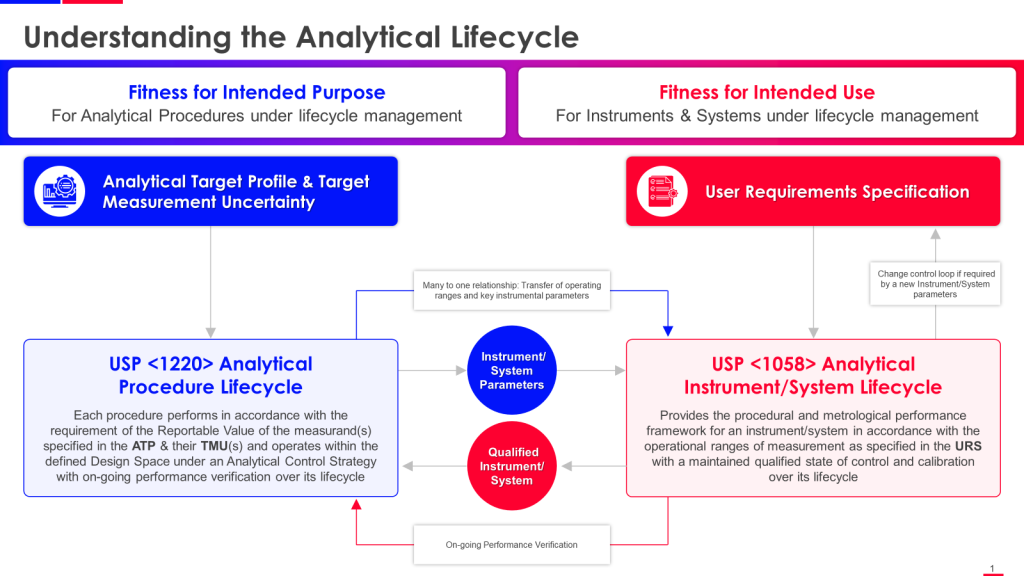
      USP <1220> Analytical Procedure Lifecycle and USP <1058> Analytical Instrument Qualification

      USP <1220> Analytical Procedure Lifecycle and USP <1058> Analytical Instrument Qualification are closely connected and complementary guidelines that provide a comprehensive framework for ensuring data integrity and quality in analytical procedures throughout their lifecycle.

      The key connections between USP <1220> and USP <1058> are:

      1. USP <1220> establishes the principles and requirements for managing the entire lifecycle of analytical procedures, from procedure design and development to retirement. It emphasizes the importance of defining an Analytical Target Profile (ATP) and implementing an Analytical Procedure Control Strategy.
      2. USP <1058> focuses explicitly on the qualification of analytical instruments that execute analytical procedures. It outlines the requirements for ensuring instruments are suitable for their intended use through proper qualification (Design, Installation, Operational, and Performance Qualification).
      3. The instrument qualification activities described in USP <1058> are critical to the overall Analytical Procedure Control Strategy outlined in USP <1220>. Proper instrument qualification as per <1058> helps ensure the quality and integrity of data generated by analytical procedures throughout their lifecycle.
      4. Both guidelines stress the importance of defining user requirements (ATP in <1220> and User Requirements Specification in <1058>) as the basis for procedure development and instrument qualification activities.
      5. USP <1220> requires ongoing monitoring and periodic requalification of analytical procedures, which includes re-evaluating the suitability of the analytical instruments used, as described in the Performance Qualification section of <1058>.

      USP <1220> provides the overarching framework for holistically managing analytical procedures. USP <1058> focuses on ensuring the instruments used to execute those procedures are properly qualified and suitable for their intended use. The two guidelines work together to maintain data integrity and quality across the entire analytical lifecycle.

      Complementary Approaches

      USP <1220> Analytical Procedure Lifecycle is closely related to and complements the ICH Q2(R2) and ICH Q14 guidelines.

      1. USP <1220> aligns with the principles outlined in ICH Q14 for managing the entire lifecycle of analytical procedures, from design and development to retirement. Both emphasize defining an Analytical Target Profile and implementing an Analytical Procedure Control Strategy.
      2. The validation activities described in ICH Q2(R2), such as evaluating specificity, accuracy, precision, and robustness, are critical components of the Analytical Procedure Control Strategy required by USP <1220>.
      3. USP <1220> requires ongoing monitoring and periodic requalification of analytical procedures, which aligns with the lifecycle management approach promoted in ICH Q14 and the validation during the lifecycle section in Q2(R2).
      4. All these guidelines stress the importance of knowledge management, risk management, and a science/risk-based approach throughout the analytical procedure lifecycle.
      5. The instrument qualification requirements outlined in USP <1058> are an integral part of the overall Analytical Procedure Control Strategy described in USP <1220>, ensuring instruments are suitable as per ICH Q2(R2) validation principles.

      In essence, USP <1220> provides a comprehensive framework for analytical procedure lifecycle management that incorporates and operationalizes the scientific principles and validation activities detailed in the ICH Q14 and Q2(R2) guidelines, while USP <1058> provides the roadmap for instrument qualification. These four documents establish harmonized best practices for analytical procedures from development through retirement.

      Phase Appropriate – An Unpacking

      There is no term more misused and misunderstood than “Phase Appropriate.” It is one of those terms that just about everyone involved in FDA-regulated industries has an opinion on and one where we all get tripped up.

      What do we mean by phase?

      Drug development can be divided into discovery, preclinical studies, clinical development, and market approval. 

      Each one of these phases is further broken down.

      It is also important to remember that certain activities may start in earlier phases. For example, for manufacturing, tech transfer, and commercial manufacturing can start in Phase 3 (and more and more these days even 2!).

      A similar approach can apply to medical devices.

      Phase Appropriate GMPs

      A Review of Regulations

      21 CFR 210.2(c)An investigational drug for use in a phase 1 study, as described in § 312.21(a) of this chapter, is subject to the statutory requirements set forth in 21 U.S.C. 351(a)(2)(B). The production of such drug is exempt from compliance with the regulations in part 211 of this chapter. However, this exemption does not apply to an investigational drug for use in a phase 1 study once the investigational drug has been made available for use by or for the sponsor in a phase 2 or phase 3 study, as described in § 312.21(b) and (c) of this chapter, or the drug has been lawfully marketed. If the investigational drug has been made available in a phase 2 or phase 3 study or the drug has been lawfully marketed, the drug for use in the phase 1 study must comply with part 211.
      FDA Guidance CGMP for Phase 1 Investigational Drugs
      EMA/INS/GMP/258937/2022Guideline on the responsibilities of the sponsor with
      regard to handling and shipping of investigational
      medicinal products for human use in accordance with
      Good Clinical Practice and Good Manufacturing Practice
      Eudralex Volume 4 Annex 13Investigational Medicinal Products
      ICH Q10 Diagram of the ICH Q10 Pharmaceutical Quality System Model (Annex 2)

      What Activities are Phase-specific for the GMPs

      Phase 1:

      • Critical quality attributes identified with safety Critical Quality Attributes (CQAs) clearly documented
      • Process changes as information is accumulated
      • Controls for analytical methods

      Phase 2:

      • Processes characterized and Production and Process Controls (PPC) identified
      • Analytical methods are qualified
      • Materials acceptance criteria
      • Critical vendors qualified

      Phase 3:

      • Processes validated with Production and Process Controls (PPC) identified and controlled
      • Validation of analytical methods
      • Materials have been fully qualified and tested upon receipt as appropriate

      What About the Quality System?

      ICH Q10 clearly spells out the PQS requirements, breaking down into stages of Pharmaceutical Development (usually Phase 1 and earlier), Technology Transfer (usually phase 2), Commercial Manufacturing (which may start before approval) and Product Discontinuation. Q10 then lays out the expectations by these stages for the four key elements of:

      1. Process performance and product quality monitoring system
      2. Corrective action and preventive action (CAPA) system
      3. Change management system
      4. Management review of process performance and product quality.
       Pharmaceutical DevelopmentTechnology TransferCommercial ManufacturingProduct Discontinuation
      Process Performance and Product QualityProcess and product knowledge generated and process and product monitoring conducted throughout development can be used to establish a control strategy for manufacturing.Monitoring during scale-up activities can provide a preliminary indication of process performance and the successful integration into manufacturing. Knowledge obtained during transfer and scale up activities can be useful in further developing the control strategy.A well-defined system for process performance and product quality monitoring should be applied to assure performance within a state of control and to identify improvement areas.Once manufacturing ceases, monitoring such as stability testing should continue to completion of the studies. Appropriate action on marketed product should continue to be executed according to regional regulations.
      Corrective Action and Preventive ActionProduct or process variability is explored. CAPA methodology is useful where corrective actions and preventive actions are incorporated into the iterative design and development process.CAPA can be used as an effective system for feedback, feedforward and continual improvement.CAPA should be used and the effectiveness of the actions should be evaluated.CAPA should continue after the product is discontinued. The impact on product remaining on the market should be considered as well as other products which might be impacted.
      Change ManagementChange is an inherent part of the development process and should be documented; the formality of the change management process should be consistent with the stage of pharmaceutical development.The change management system should provide management and documentation of adjustments made to the process during technology transfer activities.A formal change management system should be in place for commercial manufacturing. Oversight by the quality unit should provide assurance of appropriate science and risk based assessments.Any changes after product discontinuation should go through an appropriate change management system.
      Management Review of Process Performance and Product QualityAspects of management review can be performed to ensure adequacy of the product and process design.Aspects of management review should be performed to ensure the developed product and process can be manufactured at commercial scale.Management review should be a structured system, as described above, and should support continual improvement.Management review should include such items as product stability and product quality complaints.
      ICH Stage appropriate quality system elements

      Together with ICH Q9, this sets forth a framework of building knowledge and risk management into all aspects of the system together with a robust issue management mindset. There are really three things driving this.

      1. Consistency in execution
      2. Document decision making
      3. Follow through

      Some aspects remain pretty steady in all phases/stages, while others will grow as the organization develops.

      The Difference Between Maturity and Phase Appropriate

      People confuse phase appropriate with maturity all the time. Phase appropriate means doing the right activities in the right order. Maturity means the how is the most effective possible.

      Quality Management Maturity (QMM) is the state attained when drug manufacturers have consistent, reliable, and robust business processes to achieve quality objectives and promote continual improvement. This is both composed of phase independent and phase dependent aspects.

      Remember, a Quality Culture is the foundation that makes the rest of this happen.

      Q9 (r1) Risk Management Draft

      Q9 (r1) starts with all the same sections on scope and purpose. There are slight differences in ordering in scope, mainly because of the new sections below, but there isn’t much substantially different.

      4.1 Responsibilities

      This is the first major change with added paragraphs on subjectivity, which basically admits that it exists and everyone should be aware of that. This is the first major change that should be addressed in the quality system “All participants involved with quality risk management activities should acknowledge, anticipate, and address the potential for subjectivity.”

      Aligned with that requirement is a third bullet for decision-makers: “assure that subjectivity in quality risk management activities is controlled and minimised, to facilitate scientifically robust risk-based decision making.”

      Solid additions, if a bit high level. A topic of some interest on this blog, recognizing the impact of subjectivity is critical to truly developing good risk management.

      Expect to start getting questions on how you acknowledge, anticipate and address subjectivity. It will take a few years for this to work its way through the various inspectorates after approval, but it will. There are various ways to crack this, but it will require both training and tools to make it happen. It also reinforces the need for well-trained facilitators.

      5.1 Formality in Quality Risk Management

      “The degree of rigor and formality of quality risk management should reflect available knowledge and be commensurate with the complexity and/ or criticality of the issue to be addressed.”

      That statement in Q9 has long been a nugget of long debate, so it is good to see section 5.1 added to give guidance on how to implement it, utilizing 3 axis:

      • Uncertainty: This draft of Q9 utilizes a fairly simple definition of uncertainty and needs to be better aligned to ISO 31000. This is where I am going to definitely submit comments. Taking a straight knowledge management approach and defining uncertainty solely on lack of knowledge misses the other element of uncertainty that are important.
      • Importance: This was probably the critical determination folks applied to formality in the past.
      • Complexity: Not much said on complexity, which is worrisome because this is a tough one to truly analyze. It requires system thinking, and a ot of folks really get complicated and complex confused.

      This section is important, the industry needs it as too many companies have primitive risk management approaches because they shoe-horn everything into a one size fits all level of formality and thus either go overboard or do not go far enough. But as written this draft of Q9 is a boon to consultants.

      We then go on to get just how much effort should go into higher formality versus lower level of formality which boils down to higher formality is more stand alone and lower formality happens within another aspect of the quality system.

      5.2 Risk-based Decision Making

      Another new section, definitely designed to align to ISO 9001-2015 thinking. Based on the level of formality we are given three types with the first two covering separate risk management activities and the third being rule-based in procedures.

      6. INTEGRATION OF QUALITY RISK MANAGEMENT INTO INDUSTRY AND REGULATORY OPERATIONS

      Section 6 gets new subsection “The role of Quality Risk Management in addressing Product Availability Risks,” “Manufacturing Process Variation and State of Control (internal and external),” “Manufacturing Facilities,” “Oversight of Outsourced Activities and Suppliers.” These new subsections expand on what used to be solely a list of bullet points and provide some points to consider in their topic area. They are also good things to make sure risk management is built into if not already there.

      Overall Thoughts

      The ICH members did exactly what they told us they were going to do, and pretty much nothing else. I do not think they dealt with the issues deeply and definitively enough, and have added a whole lot of ambiguity into the guidance. which is better than being silent on the topic, but I’m hoping for a lot more.

      Subjectivity, uncertainty, and formality are critical topics. Hopefully your risk management program is already taking these into account.

      I’m hoping we will also see a quick revision of the PIC/S “Assessment of Quality Risk Management Implementation” to align to these concepts.

      ICH Q9 Risk Management (r1) in consultation

      ICH Q9 (r1) is in step 2, which means it is out for comments.

      Section 5, “Risk Management Methodology” is greatly expanded, with a discussion on just what level of formality means in risk management using three criteria of uncertainty, complexity, and importance. Section 5 then goes into risk based decision making to a greater depth than seen previously in guidances.

      Section 6 is greatly expanded as well.

      I need to read this in more depth before providing a deeper analysis.