An information gap is a known unknown, a question that one is aware of but for which one is uncertain of the answer. It is a disparity between what the decision maker knows and what could be known The attention paid to such an information gap depends on two key factors: salience, and importance.
The salience of a question indicates the degree to which contextual factors in a situation highlight it. Salience might depend, for example, on whether there is an obvious counterfactual in which the question can be definitively answered.
The importance of a question is a measure of how much one’s utility would depend on the actual answer. It is this factor—importance—which is influenced by actions like gambling on the answer or taking on risk that the information gap would be relevant for assessing.
People are at the heart of any organization. They set the organization’s goals, they manage it, they deal with suppliers and customers and they work together to produce results.
We manage this by processes. Process are on a continuum by how complicated and complex they are. Simpler jobs can be reliably done by following procedure. More complex ones require the ability to analyze a situation – using established rules – and decide which of several alternative paths to follow. In even more complex cases they analyze, diagnose, design, redesign, program, plan or schedule. In some cases, they create new products, processes and new ways of being. Very complex jobs require individuals who can analyze and solve very complex problems.
“Improvisation Takes Practice” in HBR is a great read. When I first read it, I chuckled at how it brings my gamer hobby and my quality practice together.
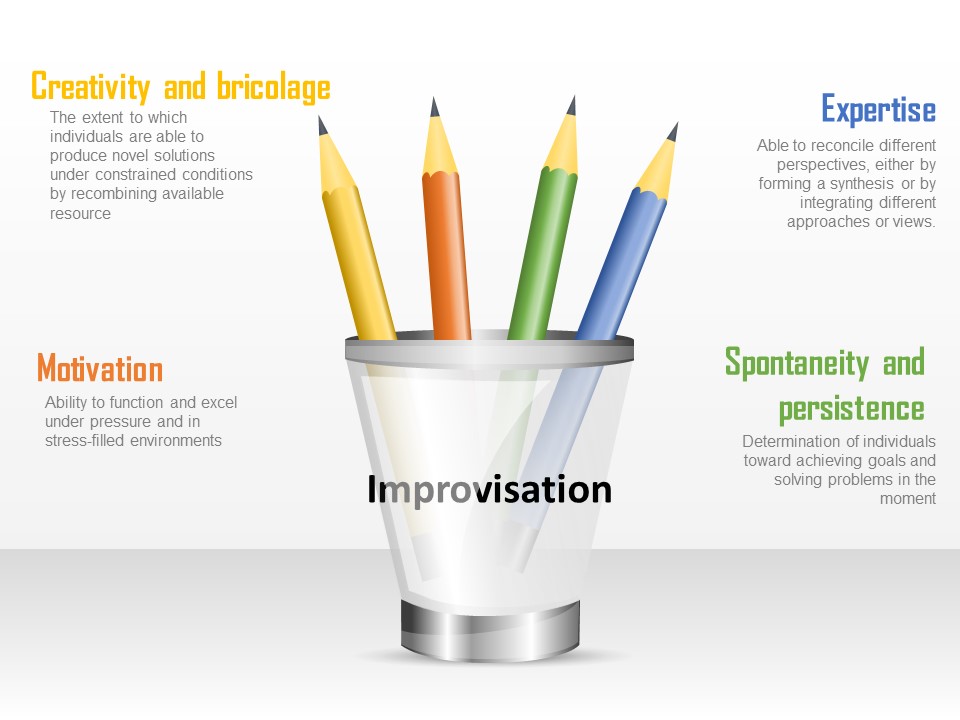
Employee creativity—the production of novel and useful solutions, procedures, products, and services—is critical to organizational success. I would argue, creativity drives excellence. Improvisation is a key employee behavior that drives creativity and innovation.
Improvisation is essential for navigating volatile, uncertain, and complex environments and dealing with unforeseen obstacles. Improvisation is also key to drawing distinctions, implementing new ideas, and converting knowledge and insights into action in real time. When confronted with critical and disruptive events, employees can resolve challenges by following existing protocols and procedures. In contrast, when faced with novel events, employees cannot rely on routines and conventions to respond. Rather, they will have to shift their focus to new perspectives, features, and behaviors.
The process of building expertise, when practices are assimilated, embodied, and rendered tacit, creates improvisational competence. Improvisation is an important source of action generating learning: people act to make events meaningful and situations understandable and, in the process, deepen their expertise through further learning, becoming reflective practitioners.
Nonaka classified knowledge as explicit and tacit. This concept has become the center piece of knowledge management and fundamental concept in process improvement.
Explicit knowledge is documented and accepted knowledge. Tacit knowledge stems more from experience and is more undocumented in nature. In spite of being difficult to interpret and transfer, tacit knowledge is regarded as the root of all organizational knowledge.
Tacit knowledge, unlike its explicit counterpart, mostly consists of perceptions and is often unstructured and non-documented in nature. Therefore, mental models, justification of beliefs, heuristics, judgments, “gut feelings” and the communication skills of the individual can influence the quality of tacit knowledge.
The process of creation of knowledge begins with the creation and sharing of tacit knowledge, which stems from socialization, facilitation of experience and interactive capacity of individuals with their coworkers.
Creation and Sharing of Knowledge
Knowledge creation involved organizations and it’s individual transcending the boundaries of the old to the new by acquiring new knowledge, which is considered to be mostly tacit in nature. The key to tacit knowledge sharing lies in the willingness and capacity of individuals to share what they know (knowledge donation) and to use what they learn (knowledge collection).
Knowledge quality is the acquisition of useful and innovative knowledge and is the degree to which people are satisfied with the quality of the shared knowledge and find it useful in accomplishing their activities. The quality of knowledge can be measured by frequency, usefulness and innovativeness, and can be innovative or new for the system or organization. However, if the knowledge is not beneficial to achieving the objective of the objective of the organization then it does not fulfill the criteria of knowledge quality. There are six attributes to knowledge quality: adaptability, innovativeness, applicability, expandability, justifiability and authenticity,
Sources
Kaser, P.A. and Miles, R.E. (2002), “Understanding knowledge activists’ successes and failures”, Long Range Planning, Vol. 35 No. 1, pp. 9-28.
Kucharska, W. and Dabrowski, J. (2016), “Tacit knowledge sharing and personal branding: how to derive innovation from project teams”, in Proceedings of the11th European Conference on Innovation and Entrepreneurship ECIE, pp. 435-443.
Nonaka, I. (1994), “A dynamic theory of organizational knowledge creation”, Organizational Science, Vol. 5 No. 1, pp. 14-37.
Nonaka, I. and Takeuchi, H. (1995), The Knowledge-Creating Company, Oxford University Press, New York, NY.
Nonaka, I. and Toyama, R. (2003), “The knowledge-creating theory revisited: knowledge creation as a synthesizing process”, Knowledge Management Research and Practice, Vol. 1 No. 1, pp. 2-10.
Nonaka, I. and Von Krogh, G. (2009), “Perspective—tacit knowledge and knowledge conversion: controversy and advancement in organizational knowledge creation theory”, Organization Science, Vol. 20 No. 3, pp. 635-652
Riege, A. (2005), “Three-dozen knowledge-sharing barriers managers must consider”, Journal of Knowledge Management, Vol. 9 No. 3, pp. 18-35.
Smedlund, A. (2008), “The knowledge system of a firm: social capital for explicit, tacit and potential knowledge”, Journal of Knowledge Management, Vol. 12 No. 1, pp. 63-77.
Spender, J.C. (1996), “Making knowledge the basis of a dynamic theory of the firm”, Strategic Management Journal, Vol. 17 No. S2, pp. 45-62.
Soo, C.W., Devinney, T.M. and Midgley, D.F. (2004), “The role of knowledge quality in firm performance”, In Tsoukas, H. and Mylonopoulus, N. (Eds), Organizations as Knowledge Systems. Knowledge, Learning and Dynamic Capabilities, Palgrave Macmillan, London, pp. 252-275.
Sorenson, O., Rivkin, J.W. and Fleming, L. (2006), “Complexity, networks and knowledge flow”, Research Policy, Vol. 35 No. 7, pp. 994-1017.
Waheed, M. and Kaur, K. (2016), “Knowledge quality: a review and a revised conceptual model”, Information Development, Vol. 32 No. 3, pp. 271-284.
Wang, Z. and Wang, N. (2012), “Knowledge sharing, innovation and firm performance”, Expert Systems with Applications, Vol. 39 No. 10, pp. 8899-8908.
Our organizations are based on the interactions of individuals, teams and other organizations into a complex adaptive environment. We need to manage productive relationships as part of a complex system and interactions among parts can produce valuable, new, and unpredictable capabilities that are not inherent in any of the parts acting alone. This is why knowledge management, having a learning culture, is such a fundamental part of the work we do.
There are seven major categories we engage in when we manage, maintain, and create knowledge.
The activity of bringing tacit knowledge into action (e.g. translating a mental model of a process activity into the actual operating tasks)
Knowledge Work Activities
As can be seen in the table above these seven activities involve moving between tacit and explicit knowledge. The apply to both declarative and procedural knowledge.
Examples of tacit and explicit knowledge
Socialization
Socialization is the level of interaction between, and communication of, various actors within an organization, which leads to the building of personal familiarity, improved communication, and problem solving. Often called learning the roles, this is the the process by which an individual acquires the social knowledge and skills necessary to assume an organizational role. Socialization encourages two-way information exchange, builds and establishes relationship trust, and enable transparency of information.
Socialization creates an operating style, enabling people to communicate with each other, have a language that they all understand and behavioral styles that are compatible. It reinforces basic assumptions and shares espoused values by helping create common norms and compatible cultures.
The combination of knowledge drives innovation and a learning culture. This includes the ability to identify different sources of knowledge, understand different learning processes, and combine internal and external knowledge effectively.
Knowledge combination capability generates through exchange of knowledge between individuals and work teams is a process that allows the transfer of knowledge to the organization and that can be applied to develop and improve products and processes.
Internalization
As we move towards qualification we internalize knowledge.




 Investigations of a Dog