Practicing Humility as Part of a Quality Culture

Cultural humility is an important part of Quality Culture. Cultural humility is often seen as approaching interactions with an attitude of openness, asking questions to learn rather than making assumptions, being willing to admit what you don’t know, and constantly examining your own lens and biases. It’s about creating an environment where all perspectives are valued and people feel respected.

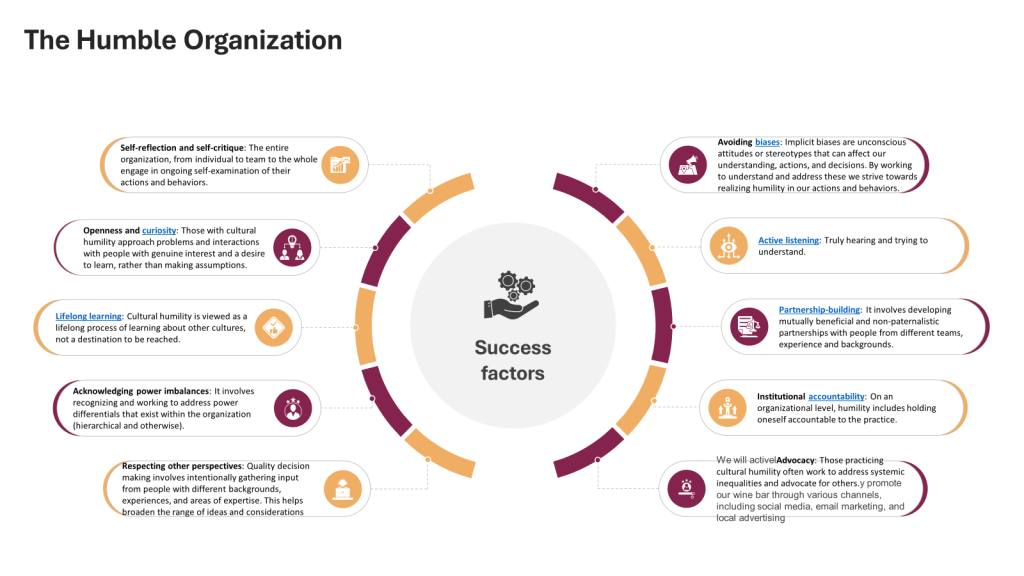
Cultural humility involves several key characteristics and behaviors:

  1. Self-reflection and self-critique: The entire organization, from individual to team to the whole engage in ongoing self-examination of their actions and behaviors.
  2. Openness and curiosity: Those with cultural humility approach problems and interactions with people with genuine interest and a desire to learn, rather than making assumptions.
  3. Lifelong learning: Cultural humility is viewed as a lifelong process of learning about other cultures, not a destination to be reached.
  4. Acknowledging power imbalances: It involves recognizing and working to address power differentials that exist within the organization (hierarchical and otherwise).
  5. Respecting other perspectives: Quality decision making involves intentionally gathering input from people with different backgrounds, experiences, and areas of expertise. This helps broaden the range of ideas and considerations
  6. Avoiding biases: Implicit biases are unconscious attitudes or stereotypes that can affect our understanding, actions, and decisions. By working to understand and address these we strive towards realizing humility in our actions and behaviors.
  7. Active listening: Truly hearing and trying to understand.
  8. Partnership-building: It involves developing mutually beneficial and non-paternalistic partnerships with people from different teams, experience and backgrounds.
  9. Institutional accountability: On an organizational level, humility includes holding oneself accountable to the practice.
  10. Advocacy: Those practicing cultural humility often work to address systemic inequalities and advocate for others.
Leadership Behaviors

Humble leaders exhibit the following behaviors:

  1. Admitting limitations and mistakes
  2. Appreciating others’ strengths and contributions
  3. Being open to new ideas and feedback
  4. Listening before speaking
  5. Encouraging employees to keep trying and viewing mistakes as learning opportunities
  6. Taking responsibility for employees’ mistakes
  7. Modeling openness and fallibility
  8. Maintaining a collective focus

Cultural Attributes

A work culture with humble leadership is characterized by:

  1. Openness to new ideas and continuous learning
  2. Appreciation for diverse perspectives and contributions
  3. Reduced fear of taking interpersonal risks
  4. High-quality interpersonal relationships
  5. Collective humility within teams
  6. Trust between leaders and team members
  7. Inclusivity and reduced power differentials
  8. Emphasis on growth and development rather than blame

Employee Perceptions and Behaviors

In a humble environment, employees are more likely to:

  1. Feel safe expressing themselves and taking risks
  2. Believe in their ability to contribute constructively
  3. Engage in voice behaviors and share ideas
  4. Show themselves freely without fear of adverse consequences
  5. Imitate leaders in showing their own shortcomings and appreciating others
  6. Perceive making mistakes as acceptable
  7. Experience increased job satisfaction and reduced turnover intentions

Organizational Practices

To cultivate humility and psychological safety, organizations can:

  1. Develop policies and practices that promote diversity, equity, and inclusion
  2. Create an inclusive climate for errors and mutual assistance
  3. Implement leadership development programs focused on humble behaviors
  4. Encourage open dialogue and social relationships in teams
  5. Foster an error management climate that doesn’t punish mistakes but learns from them

Some Recent Psychological Safety Articles from HBR

When a Team Member Speaks Up — and It Doesn’t Go Well” by Megan Reitz
 and Amy C. Edmondson addresses the critical issue of speaking up in organizations and the potential negative outcomes that can occur. Great stuff, well worth the read, and particularly relevant to the themes of a just, conducive, and quality culture where open communication and diverse perspectives are core values.

“Research: “New Hires’ Psychological Safety Erodes Quickly” by Amy C. Edmondson, Derrick P. Bransby, and Michaela J. Kerrissey confirms what I’ve long suspected about a deadly trough in psychological safety. I’ve certainly felt it myself. Going to be thinking about this for a long while.

Quality and a Just Culture

It is fascinating that for all the discussion around quality culture, which borrows from Safety II and other safety movements/submovements, we’ve largely avoided using the term justice, which is so prevalent in certain areas of the safety world. One can replace quality with justice and talk about many of the same things.

Both attempt to realize Deming’s Point 8—to drive out fear—which I consider Deming’s most radical proposition.

We really should see them as building blocks. A just culture enables the open reporting and analysis of errors necessary for a quality culture to identify areas for improvement. The two cultures are complementary—a robust quality program requires psychological safety fostered by a just culture. However, a quality culture has broader aims beyond responding to errors or safety lapses. We cannot have a Quality Culture without a Just Culture.

Psychological safety creates an environment where staff can speak up, enabling a just culture. A just culture defines the balanced accountability approach for responding to errors and safety events. A quality culture is a broader concept that drives improvement across the organization, relying on the foundation of a just culture.

But I really wish we used the term justice more. Promoting justice is an activity I wish we took more seriously as a profession.

Decentralized Decision-making

Decentralizing decision-making helps make better and faster decisions while inspiring people to feel needed by the organization and to be empowered. It is a central aspect of democratic leadership and a core way to build a quality culture.

Decentralized decision-making requires psychological safety and a recognition that it just doesn’t happen. Like any behavior, it needs time needs to be spent to develop and nurture.

As a value, decentralized decision-making might look like this:

  1. Value: Decentralized Decision-Making
  2. Definition: Decisions are made by the people who do the work. Everyone is trained to make data-driven decisions by paying attention to the problem, task or numbers, not the person.
  3. Desired Behaviors:

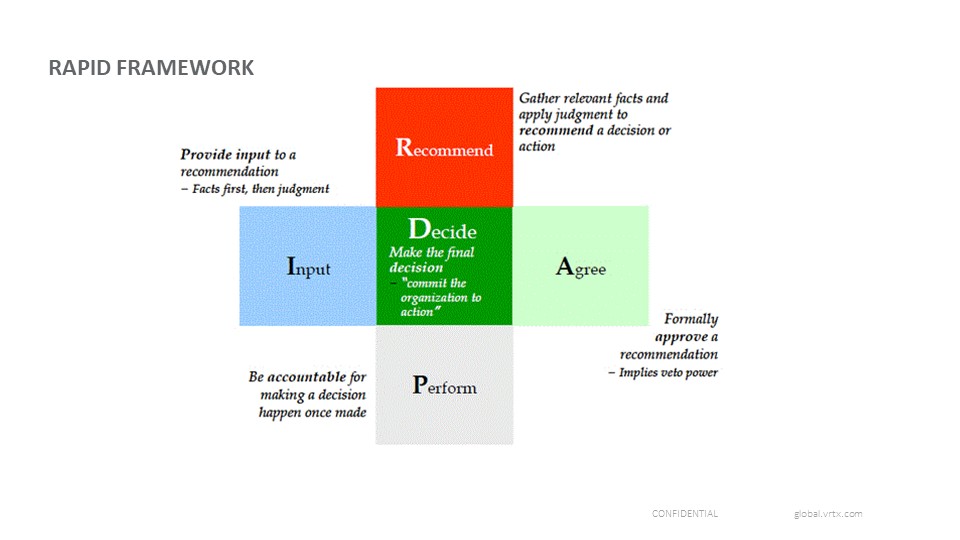
To make this work, it is critical to teach decision-making. A popular method is RAPID, an acronym of 5 words that refer to the group of people involved in the steps of decision-making -Recommend, Agree, Perform, Input, Decision. This was a framework developed by Bain & Company as a systemized framework to design an action plan regarding a problem

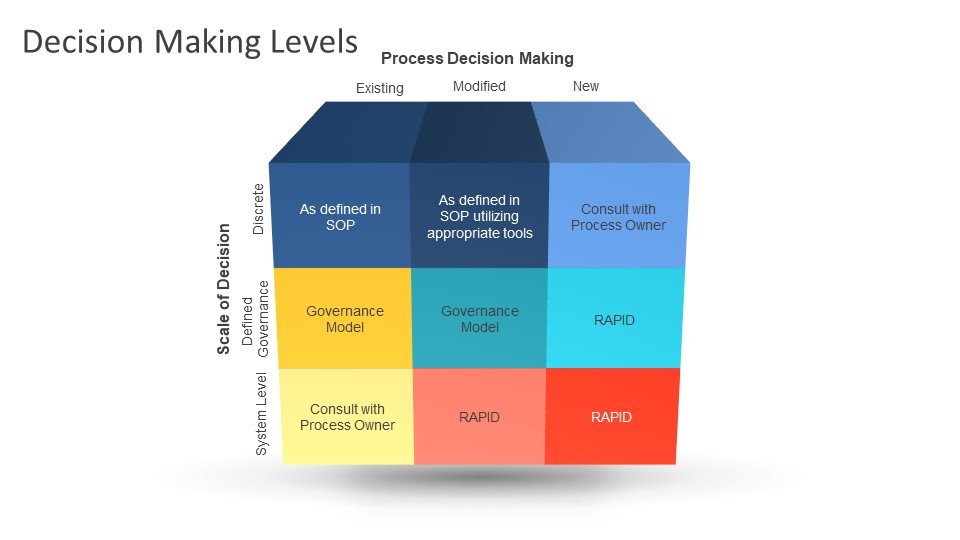
With the base of how a decision is made, the next step is to decide what sort of decisions exist in the organization, and how they get made. I recommend two axis:

  1. The Scale of the Decision: What is the risk level of the decision
  2. The Level of Process Controls: How well defined is the process around the area of the decision

Accountability does not go away to be Psychologically Safe

A common and distorted application of psychological safety is that it is somehow a shield from accountability. Non-performing employees tend to invoke it as an excuse for poor performance, insisting that a focus on psychological safety means valuing people and building relationships. That’s true, but stretching the premise, they claim that we should give them a pass when they don’t perform.

The flawed logic seems to be along the lines of because we may have used fear and intimidation, command and control, and manipulative and coercive tactics with people in the past, in an attempt to hold folks accountable, we must shed the artifacts that drive accountability in order to have an environment of psychological safety.

In my experience, this is especially prevalent when discussing metrics around overdue quality systems records and training. How to discuss what is late, can you even publish a list of folks with overdue training?

I want to be very clear, psychological safety is not a kind of diplomatic immunity from having to deliver results. It is not a shield from accountability.

Being held accountable can be looked at as transparency in progress. Psychological safety allows us to be vulnerable and to trust that the organization will take the problems seriously and address them.