The last few posts have all been questions I’ve been asked. This is one of my favorite ways to generate a blog post, as quite frankly what I am obsessing about all day at work is stuff I can’t easily turn into blog posts without running it through legal. Better to stay at a specific level of generality in these things.
So, I’m throwing open the door. Send me your questions on quality related matters or the other topics I like to write about on this blog and I will try to answer them to the best of my abilities.
Critical thinking may be one of the most overused terms out there. It can mean just about anything anyone wants it to. We keep seeing it popping up in ICH Q9(r1), guidance on data integrity, and many other places. It has really become shorthand for “think better.” So, let us go to the basics and discuss what critical thinking is.
Critical thinking is a multifaceted cognitive process that involves the active and skillful conceptualization, application, analysis, synthesis, and evaluation of information gathered from observation, experience, reflection, reasoning, or communication. It aims to form a judgment or make a decision based on reliable information and rational analysis.
Questioning and Clarifying: Critical thinking begins with questioning the information presented and clarifying the purpose and context of the thinking process. This involves identifying the problem or question and understanding the assumptions and concepts.
Analyzing and Evaluating: This involves breaking down information into constituent parts to understand its structure and meaning. It also includes evaluating the credibility of sources, the validity of arguments, and the relevance and accuracy of the information.
Synthesizing and Interpreting: Critical thinkers synthesize information from various sources to form a coherent understanding. They interpret data and evidence to draw conclusions and make informed judgments.
Awareness of Biases: It is crucial to be aware of one’s own biases and assumptions. Critical thinkers strive to minimize personal biases’ influence and objectively consider alternative viewpoints.
Intellectual Standards: Critical thinking is guided by intellectual standards such as clarity, accuracy, precision, consistency, relevance, sound evidence, good reasons, depth, breadth, and fairness.
Application and Communication: It involves applying the insights gained through critical thinking to real-world problems and effectively communicating the reasoning behind decisions and judgments.
Critical thinking is a vital skill that involves a disciplined approach to analyzing and evaluating information. It is characterized by a commitment to intellectual rigor and a systematic method of questioning, analyzing, and synthesizing information to make well-informed decisions. Developing critical thinking skills is a lifelong endeavor that enhances one’s ability to reason and make judgments.
Critical thinking is something we educate on, not train. We cannot proceduralize critical thinking; we can only create tools to drive the behaviors.
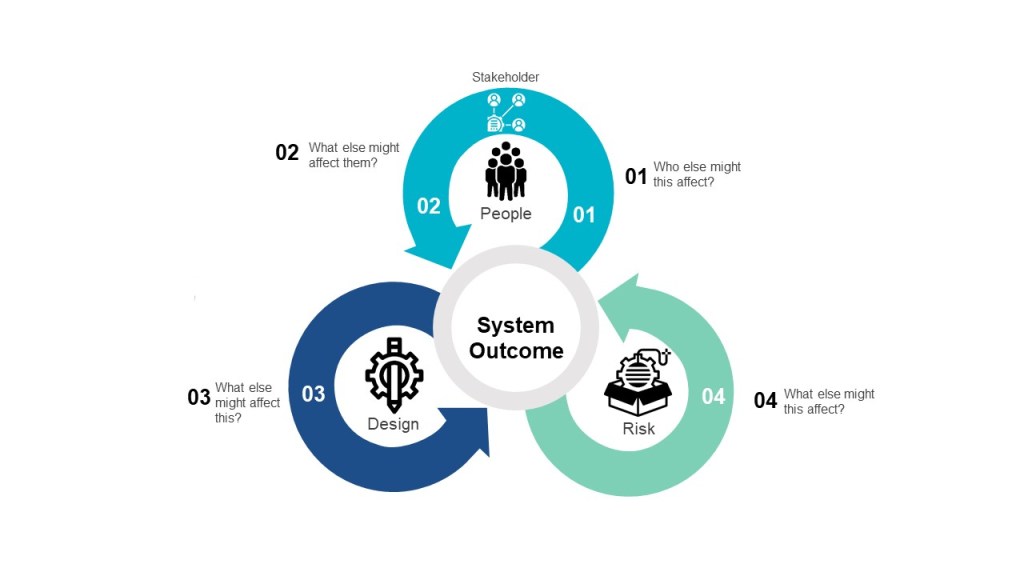
The Outcome Identification Loop asks four questions around a given outcome which can be very valuable in understanding a proposed design, event, or risk.
Through answering these questions, outcomes and relationships to further define a central question, and can be used to shape problem-solving, risk mitigation, and process improvement.
Questions 1 “Who else might this affect?’ and 2 “What else might affect them?’ are paired questions from stakeholder identification and analysis techniques.
Question 3 “What else might affect this?” relates to system analysis and design and can be fed by, and lead to, the chains of outcomes elicited using analysis methods, such as process modelling and root cause analysis.
Question 4 “What else might this affect?” considers uncertainty and risk.
These four questions can be iterative. Use them near the beginning to define the problem and then at the end to tie together the entire work.
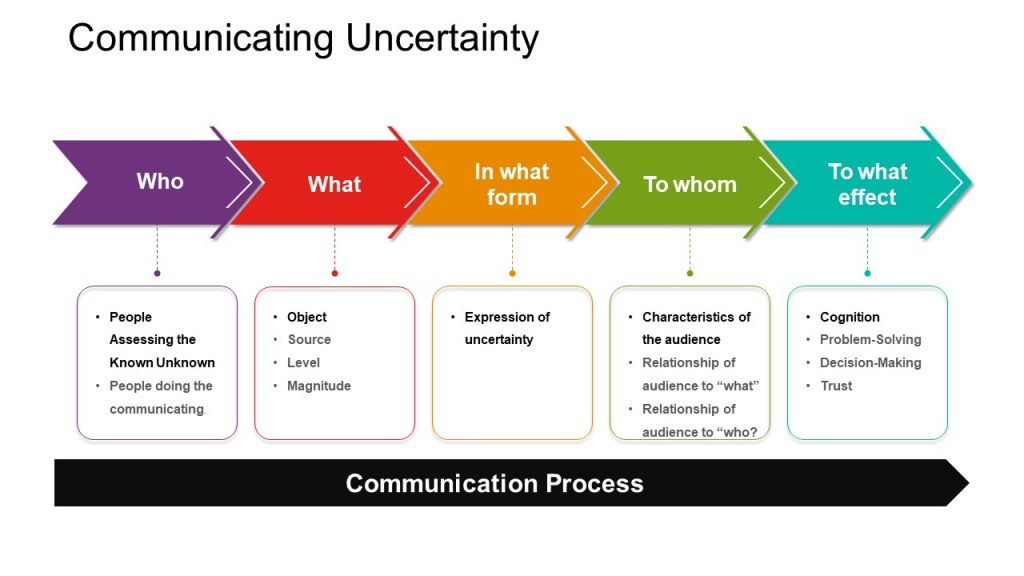
An information gap is a known unknown, a question that one is aware of but for which one is uncertain of the answer. It is a disparity between what the decision maker knows and what could be known The attention paid to such an information gap depends on two key factors: salience, and importance.
The salience of a question indicates the degree to which contextual factors in a situation highlight it. Salience might depend, for example, on whether there is an obvious counterfactual in which the question can be definitively answered.
The importance of a question is a measure of how much one’s utility would depend on the actual answer. It is this factor—importance—which is influenced by actions like gambling on the answer or taking on risk that the information gap would be relevant for assessing.
Benefits of Written Rules: Capture important learnings and assumptions Establish a standardized, organized and reproducible, method of conducting work safely Ensure effective transfer of knowledge to new members of the group Require disciplined thinking to formally document thus reducing errors in processes Create a framework for delegation of decision-making Demonstrate the organizations commitment to safety
I don’t think there is a quality person who would read that list and not nod knowingly. Reading the excellent article quoted above reminded me that we all probably do EHS, Quality and compliance in general all wrong.
Yes, Health & Safety is about the employee; Quality is about the product (and legal is about following the law and finance does something about money) but what when you look at the tools we pretty much have a common tool-box. Root cause analysis, procedures, risk management, system thinking.
What is truly different is the question we ask:
Quality asks about the customer
Health and Safety asks about the employee
Environment asks about, well, the environment
I find it fascinating that it became environment, health and safety and most companies, as again, the question asked is rather different. In companies where care of the environment is separate (such as the energy industry) you will definitely see it as a separate entity.
I have only been at one company that was on the path of looking at quality, environment, health and safety were all similar disciplines and united them under a chief compliance officer (who was also head of legal). My current company is still struggling along the path of uniting standards and tools.
There is definitely a lot of different domain knowledge between the three, the same way quality is different between industries. However the commonalities that unite us are many and ones we should spend more time exploring.




 Investigations of a Dog