Harnessing the Adaptive Toolbox: How Gerd Gigerenzer’s Approach to Decision Making Works Within Quality Risk Management

As quality professionals, we can often fall into the trap of believing that more analysis, more data, and more complex decision trees lead to better outcomes. But what if this fundamental assumption is not just wrong, but actively harmful to effective risk management? Gerd Gigerenzer‘s decades of research on bounded rationality and fast-and-frugal heuristics suggests exactly that—and the implications for how we approach quality risk management are profound.

The Myth of Optimization in Risk Management

Too much of our risk management practice assumes we operate like Laplacian demons—omniscient beings with unlimited computational power and perfect information. Gigerenzer calls this “unbounded rationality,” and it’s about as realistic as expecting your quality management system to implement itself.

In reality, experts operate under severe constraints: limited time, incomplete information, constantly changing regulations, and the perpetual pressure to balance risk mitigation with operational efficiency. How we move beyond thinking of these as bugs to be overcome, and build tools that address these concerns is critical to thinking of risk management as a science.

Enter the Adaptive Toolbox

Gigerenzer’s adaptive toolbox concept revolutionizes how we think about decision-making under uncertainty. Rather than viewing our mental shortcuts (heuristics) as cognitive failures that need to be corrected, the adaptive toolbox framework recognizes them as evolved tools that can outperform complex analytical methods in real-world conditions.

The toolbox consists of three key components that every risk manager should understand:

Search Rules: How we look for information when making risk decisions. Instead of trying to gather all possible data (which is impossible anyway), effective heuristics use smart search strategies that focus on the most diagnostic information first.

Stopping Rules: When to stop gathering information and make a decision. This is crucial in quality management where analysis paralysis can be as dangerous as hasty decisions.

Decision Rules: How to integrate the limited information we’ve gathered into actionable decisions.

These components work together to create what Gigerenzer calls “ecological rationality”—decision strategies that are adapted to the specific environment in which they operate. For quality professionals, this means developing risk management approaches that fit the actual constraints and characteristics of pharmaceutical manufacturing, not the theoretical world of perfect information.
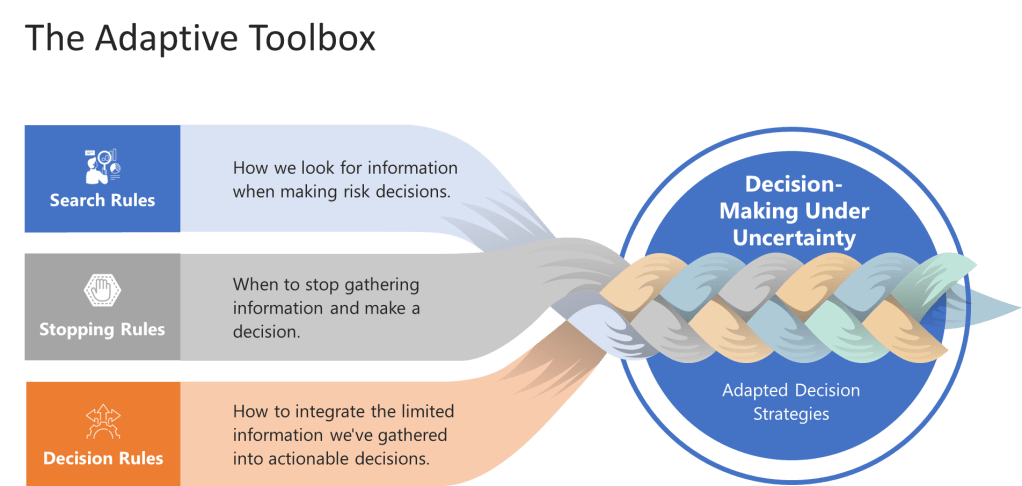
A conceptual diagram titled "The Adaptive Toolbox" showing three components that feed into decision-making under uncertainty. On the left are three colored boxes: blue "Search Rules" (described as "How we look for information when making risk decisions"), gray "Stopping Rules" ("When to stop gathering information and make a decision"), and orange "Decision Rules" ("How to integrate the limited information we've gathered into actionable decisions"). These three components are connected by flowing ribbons that weave together and lead to a circular blue target on the right labeled "Decision-Making Under Uncertainty" with "Adapted Decision Strategies" at the bottom. The visual represents how different cognitive tools work together to help make decisions when facing uncertainty.

This alt text captures the key visual elements, the hierarchical relationship between components, the flow from left to right, and the overall concept being illustrated about adaptive decision-making strategies under uncertainty.

The Less-Is-More Revolution

One of Gigerenzer’s most counterintuitive findings is the “less-is-more effect”—situations where ignoring information actually leads to better decisions. This challenges everything we think we know about evidence-based decision making in quality.

Consider an example from emergency medicine that directly parallels quality risk management challenges. When patients arrive with chest pain, doctors traditionally used complex diagnostic algorithms considering up to 19 different risk factors. But researchers found that a simple three-question decision tree outperformed the complex analysis in both speed and accuracy.

The fast-and-frugal tree asked only:

  1. Are there ST segment changes on the EKG?
  2. Is chest pain the chief complaint?
  3. Does the patient have any additional high-risk factors?
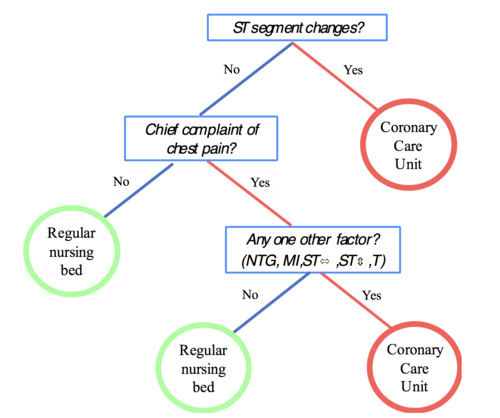
A fast-and-frugal tree that helps emergency room doctors decide whether to send a patient to a regular nursing bed or the coronary care unit (Green & Mehr, 1997).

Based on these three questions, doctors could quickly and accurately classify patients as high-risk (requiring immediate intensive care) or low-risk (suitable for regular monitoring). The key insight: the simple approach was not just faster—it was more accurate than the complex alternative.

Applying Fast-and-Frugal Trees to Quality Risk Management

This same principle applies directly to quality risk management decisions. Too often, we create elaborate risk assessment matrices that obscure rather than illuminate the critical decision factors. Fast-and-frugal trees offer a more effective alternative.

Let’s consider deviation classification—a daily challenge for quality professionals. Instead of complex scoring systems that attempt to quantify every possible risk dimension, a fast-and-frugal tree might ask:

  1. Does this deviation involve a patient safety risk? If yes → High priority investigation (exit to immediate action)
  2. Does this deviation affect product quality attributes? If yes → Standard investigation timeline
  3. Is this a repeat occurrence of a similar deviation? If yes → Expedited investigation, if no → Routine handling
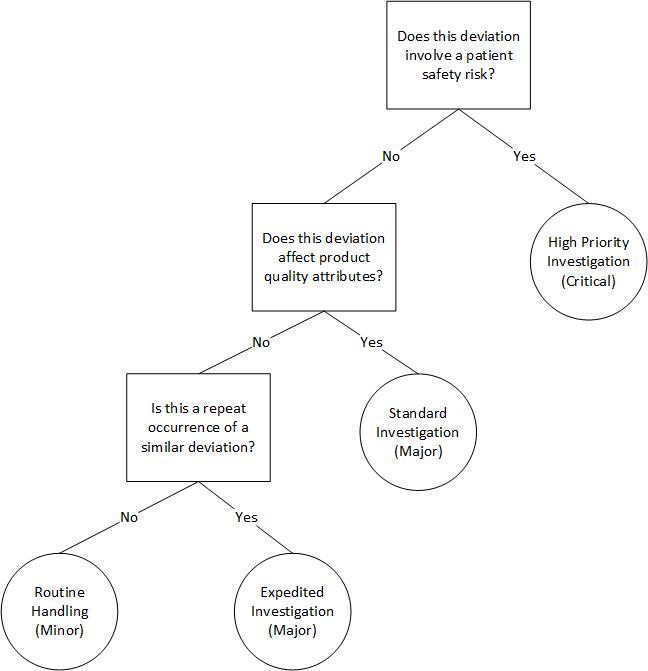
Flowchart titled ‘Does this deviation involve a patient safety risk?’ At the top is a decision box with that question. An arrow labeled ‘Yes’ leads to a circle labeled ‘High Priority Investigation (Critical).’ An arrow labeled ‘No’ leads downward to a decision box reading ‘Does this deviation affect product quality attributes?’ From that box, an arrow labeled ‘Yes’ leads to a circle labeled ‘Standard Investigation (Major).’ An arrow labeled ‘No’ leads downward to a decision box reading ‘Is this a repeat occurrence of a similar deviation?’ From that box, an arrow labeled ‘Yes’ leads to a circle labeled ‘Expedited Investigation (Major),’ and an arrow labeled ‘No’ leads to a circle labeled ‘Routine Handling (Minor).

This simple decision tree accomplishes several things that complex matrices struggle with. First, it prioritizes patient safety above all other considerations—a value judgment that gets lost in numerical scoring systems. Second, it focuses investigative resources where they’re most needed. Third, it’s transparent and easy to train staff on, reducing variability in risk classification.

The beauty of fast-and-frugal trees isn’t just their simplicity. It is their robustness. Unlike complex models that break down when assumptions are violated, simple heuristics tend to perform consistently across different conditions.

The Recognition Heuristic in Supplier Quality

Another powerful tool from Gigerenzer’s adaptive toolbox is the recognition heuristic. This suggests that when choosing between two alternatives where one is recognized and the other isn’t, the recognized option is often the better choice.

In supplier qualification decisions, quality professionals often struggle with elaborate vendor assessment schemes that attempt to quantify every aspect of supplier capability. But experienced quality professionals know that supplier reputation—essentially a form of recognition—is often the best predictor of future performance.

The recognition heuristic doesn’t mean choosing suppliers solely on name recognition. Instead, it means understanding that recognition reflects accumulated positive experiences across the industry. When coupled with basic qualification criteria, recognition can be a powerful risk mitigation tool that’s more robust than complex scoring algorithms.

This principle extends to regulatory decision-making as well. Experienced quality professionals develop intuitive responses to regulatory trends and inspector concerns that often outperform elaborate compliance matrices. This isn’t unprofessional—it’s ecological rationality in action.

Take-the-Best Heuristic for Root Cause Analysis

The take-the-best heuristic offers an alternative approach to traditional root cause analysis. Instead of trying to weight and combine multiple potential root causes, this heuristic focuses on identifying the single most diagnostic factor and basing decisions primarily on that information.

In practice, this might mean:

  1. Identifying potential root causes in order of their diagnostic power
  2. Investigating the most powerful indicator first
  3. If that investigation provides a clear direction, implementing corrective action
  4. Only continuing to secondary factors if the primary investigation is inconclusive

This approach doesn’t mean ignoring secondary factors entirely, but it prevents the common problem of developing corrective action plans that try to address every conceivable contributing factor, often resulting in resource dilution and implementation challenges.

Managing Uncertainty in Validation Decisions

Validation represents one of the most uncertainty-rich areas of quality management. Traditional approaches attempt to reduce uncertainty through exhaustive testing, but Gigerenzer’s work suggests that some uncertainty is irreducible—and that trying to eliminate it entirely can actually harm decision quality.

Consider computer system validation decisions. Teams often struggle with determining how much testing is “enough,” leading to endless debates about edge cases and theoretical scenarios. The adaptive toolbox approach suggests developing simple rules that balance thoroughness with practical constraints:

The Satisficing Rule: Test until system functionality meets predefined acceptance criteria across critical business processes, then stop. Don’t continue testing just because more testing is theoretically possible.

The Critical Path Rule: Focus validation effort on the processes that directly impact patient safety and product quality. Treat administrative functions with less intensive validation approaches.

The Experience Rule: Leverage institutional knowledge about similar systems to guide validation scope. Don’t start every validation from scratch.

These heuristics don’t eliminate validation rigor—they channel it more effectively by recognizing that perfect validation is impossible and that attempting it can actually increase risk by delaying system implementation or consuming resources needed elsewhere.

Ecological Rationality in Regulatory Strategy

Perhaps nowhere is the adaptive toolbox more relevant than in regulatory strategy. Regulatory environments are characterized by uncertainty, incomplete information, and time pressure—exactly the conditions where fast-and-frugal heuristics excel.

Successful regulatory professionals develop intuitive responses to regulatory trends that often outperform complex compliance matrices. They recognize patterns in regulatory communications, anticipate inspector concerns, and adapt their strategies based on limited but diagnostic information.

The key insight from Gigerenzer’s work is that these intuitive responses aren’t unprofessional—they represent sophisticated pattern recognition based on evolved cognitive mechanisms. The challenge for quality organizations is to capture and systematize these insights without destroying their adaptive flexibility.

This might involve developing simple decision rules for common regulatory scenarios:

The Precedent Rule: When facing ambiguous regulatory requirements, look for relevant precedent in previous inspections or industry guidance rather than attempting exhaustive regulatory interpretation.

The Proactive Communication Rule: When regulatory risk is identified, communicate early with authorities rather than developing elaborate justification documents internally.

The Materiality Rule: Focus regulatory attention on changes that meaningfully affect product quality or patient safety rather than attempting to address every theoretical concern.

Building Adaptive Capability in Quality Organizations

Implementing Gigerenzer’s insights requires more than just teaching people about heuristics—it requires creating organizational conditions that support ecological rationality. This means:

Embracing Uncertainty: Stop pretending that perfect risk assessments are possible. Instead, develop decision-making approaches that are robust under uncertainty.

Valuing Experience: Recognize that experienced professionals’ intuitive responses often reflect sophisticated pattern recognition. Don’t automatically override professional judgment with algorithmic approaches.

Simplifying Decision Structures: Replace complex matrices and scoring systems with simple decision trees that focus on the most diagnostic factors.

Encouraging Rapid Iteration: Rather than trying to perfect decisions before implementation, develop approaches that allow rapid adjustment based on feedback.

Training Pattern Recognition: Help staff develop the pattern recognition skills that support effective heuristic decision-making.

The Subjectivity Challenge

One common objection to heuristic-based approaches is that they introduce subjectivity into risk management decisions. This concern reflects a fundamental misunderstanding of both traditional analytical methods and heuristic approaches.

Traditional risk matrices and analytical methods appear objective but are actually filled with subjective judgments: how risks are defined, how probabilities are estimated, how impacts are categorized, and how different risk dimensions are weighted. These subjective elements are simply hidden behind numerical facades.

Heuristic approaches make subjectivity explicit rather than hiding it. This transparency actually supports better risk management by forcing teams to acknowledge and discuss their value judgments rather than pretending they don’t exist.

The recent revision of ICH Q9 explicitly recognizes this challenge, noting that subjectivity cannot be eliminated from risk management but can be managed through appropriate process design. Fast-and-frugal heuristics support this goal by making decision logic transparent and teachable.

Four Essential Books by Gigerenzer

For quality professionals who want to dive deeper into this framework, here are four books by Gigerenzer to read:

1. “Simple Heuristics That Make Us Smart” (1999) – This foundational work, authored with Peter Todd and the ABC Research Group, establishes the theoretical framework for the adaptive toolbox. It demonstrates through extensive research how simple heuristics can outperform complex analytical methods across diverse domains. For quality professionals, this book provides the scientific foundation for understanding why less can indeed be more in risk assessment.

2. “Gut Feelings: The Intelligence of the Unconscious” (2007) – This more accessible book explores how intuitive decision-making works and when it can be trusted. It’s particularly valuable for quality professionals who need to balance analytical rigor with practical decision-making under pressure. The book provides actionable insights for recognizing when to trust professional judgment and when more analysis is needed.

3. “Risk Savvy: How to Make Good Decisions” (2014) – This book directly addresses risk perception and management, making it immediately relevant to quality professionals. It challenges common misconceptions about risk communication and provides practical tools for making better decisions under uncertainty. The sections on medical decision-making are particularly relevant to pharmaceutical quality management.

4. “The Intelligence of Intuition” (Cambridge University Press, 2023) – Gigerenzer’s latest work directly challenges the widespread dismissal of intuitive decision-making in favor of algorithmic solutions. In this compelling analysis, he traces what he calls the “war on intuition” in social sciences, from early gendered perceptions that dismissed intuition as feminine and therefore inferior, to modern technological paternalism that argues human judgment should be replaced by perfect algorithms. For quality professionals, this book is essential reading because it demonstrates that intuition is not irrational caprice but rather “unconscious intelligence based on years of experience” that evolved specifically to handle uncertain and dynamic situations where logic and big data algorithms provide little benefit. The book provides both theoretical foundation and practical guidance for distinguishing reliable intuitive responses from wishful thinking—a crucial skill for quality professionals who must balance analytical rigor with rapid decision-making under uncertainty.

The Implementation Challenge

Understanding the adaptive toolbox conceptually is different from implementing it organizationally. Quality systems are notoriously resistant to change, particularly when that change challenges fundamental assumptions about how decisions should be made.

Successful implementation requires a gradual approach that demonstrates value rather than demanding wholesale replacement of existing methods. Consider starting with pilot applications in lower-risk areas where the benefits of simpler approaches can be demonstrated without compromising patient safety.

Phase 1: Recognition and Documentation – Begin by documenting the informal heuristics that experienced staff already use. You’ll likely find that your most effective team members already use something resembling fast-and-frugal decision trees for routine decisions.

Phase 2: Formalization and Testing – Convert informal heuristics into explicit decision rules and test them against historical decisions. This helps build confidence and identifies areas where refinement is needed.

Phase 3: Training and Standardization – Train staff on the formalized heuristics and create simple reference tools that support consistent application.

Phase 4: Continuous Adaptation – Build feedback mechanisms that allow heuristics to evolve as conditions change and new patterns emerge.

Measuring Success with Ecological Metrics

Traditional quality metrics often focus on process compliance rather than decision quality. Implementing an adaptive toolbox approach requires different measures of success.

Instead of measuring how thoroughly risk assessments are documented, consider measuring:

  • Decision Speed: How quickly can teams classify and respond to different types of quality events?
  • Decision Consistency: How much variability exists in how similar situations are handled?
  • Resource Efficiency: What percentage of effort goes to analysis versus action?
  • Adaptation Rate: How quickly do decision approaches evolve in response to new information?
  • Outcome Quality: What are the actual consequences of decisions made using heuristic approaches?

These metrics align better with the goals of effective risk management: making good decisions quickly and consistently under uncertainty.

The Training Implication

If we accept that heuristic decision-making is not just inevitable but often superior, it changes how we think about quality training. Instead of teaching people to override their intuitive responses with analytical methods, we should focus on calibrating and improving their pattern recognition abilities.

This means:

  • Case-Based Learning: Using historical examples to help staff recognize patterns and develop appropriate responses
  • Scenario Training: Practicing decision-making under time pressure and incomplete information
  • Feedback Loops: Creating systems that help staff learn from decision outcomes
  • Expert Mentoring: Pairing experienced professionals with newer staff to transfer tacit knowledge
  • Cross-Functional Exposure: Giving staff experience across different areas to broaden their pattern recognition base

Addressing the Regulatory Concern

One persistent concern about heuristic approaches is regulatory acceptability. Will inspectors accept fast-and-frugal decision trees in place of traditional risk matrices?

The key insight from Gigerenzer’s work is that regulators themselves use heuristics extensively in their inspection and decision-making processes. Experienced inspectors develop pattern recognition skills that allow them to quickly identify potential problems and focus their attention appropriately. They don’t systematically evaluate every aspect of a quality system—they use diagnostic shortcuts to guide their investigations.

Understanding this reality suggests that well-designed heuristic approaches may actually be more acceptable to regulators than complex but opaque analytical methods. The key is ensuring that heuristics are:

  • Transparent: Decision logic should be clearly documented and explainable
  • Consistent: Similar situations should be handled similarly
  • Defensible: The rationale for the heuristic approach should be based on evidence and experience
  • Adaptive: The approach should evolve based on feedback and changing conditions

The Integration Challenge

The adaptive toolbox shouldn’t replace all analytical methods—it should complement them within a broader risk management framework. The key is understanding when to use which approach.

Use Heuristics When:

  • Time pressure is significant
  • Information is incomplete and unlikely to improve quickly
  • The decision context is familiar and patterns are recognizable
  • The consequences of being approximately right quickly outweigh being precisely right slowly
  • Resource constraints limit the feasibility of comprehensive analysis

Use Analytical Methods When:

  • Stakes are extremely high and errors could have catastrophic consequences
  • Time permits thorough analysis
  • The decision context is novel and patterns are unclear
  • Regulatory requirements explicitly demand comprehensive documentation
  • Multiple stakeholders need to understand and agree on decision logic

Looking Forward

Gigerenzer’s work suggests that effective quality risk management will increasingly look like a hybrid approach that combines the best of analytical rigor with the adaptive flexibility of heuristic decision-making.

This evolution is already happening informally as quality professionals develop intuitive responses to common situations and use analytical methods primarily for novel or high-stakes decisions. The challenge is making this hybrid approach explicit and systematic rather than leaving it to individual discretion.

Future quality management systems will likely feature:

  • Adaptive Decision Support: Systems that learn from historical decisions and suggest appropriate heuristics for new situations
  • Context-Sensitive Approaches: Risk management methods that automatically adjust based on situational factors
  • Rapid Iteration Capabilities: Systems designed for quick adjustment rather than comprehensive upfront planning
  • Integrated Uncertainty Management: Approaches that explicitly acknowledge and work with uncertainty rather than trying to eliminate it

The Cultural Transformation

Perhaps the most significant challenge in implementing Gigerenzer’s insights isn’t technical—it’s cultural. Quality organizations have invested decades in building analytical capabilities and may resist approaches that appear to diminish the value of that investment.

The key to successful cultural transformation is demonstrating that heuristic approaches don’t eliminate analysis—they optimize it by focusing analytical effort where it provides the most value. This requires leadership that understands both the power and limitations of different decision-making approaches.

Organizations that successfully implement adaptive toolbox principles often find that they can:

  • Make decisions faster without sacrificing quality
  • Reduce analysis paralysis in routine situations
  • Free up analytical resources for genuinely complex problems
  • Improve decision consistency across teams
  • Adapt more quickly to changing conditions

Conclusion: Embracing Bounded Rationality

Gigerenzer’s adaptive toolbox offers a path forward that embraces rather than fights the reality of human cognition. By recognizing that our brains have evolved sophisticated mechanisms for making good decisions under uncertainty, we can develop quality systems that work with rather than against our cognitive strengths.

This doesn’t mean abandoning analytical rigor—it means applying it more strategically. It means recognizing that sometimes the best decision is the one made quickly with limited information rather than the one made slowly with comprehensive analysis. It means building systems that are robust to uncertainty rather than brittle in the face of incomplete information.

Most importantly, it means acknowledging that quality professionals are not computers. They are sophisticated pattern-recognition systems that have evolved to navigate uncertainty effectively. Our quality systems should amplify rather than override these capabilities.

The adaptive toolbox isn’t just a set of decision-making tools—it’s a different way of thinking about human rationality in organizational settings. For quality professionals willing to embrace this perspective, it offers the possibility of making better decisions, faster, with less stress and more confidence.

And in an industry where patient safety depends on the quality of our decisions, that possibility is worth pursuing, one heuristic at a time.
Strategic Decision Delegation in Quality Leadership

If you are like me, you face a fundamental choice on a daily (or hourly basis): we can either develop distributed decision-making capability throughout our organizations, or we can create bottlenecks that compromise our ability to respond effectively to quality events, regulatory changes, and operational challenges. The reactive control mindset—where senior quality leaders feel compelled to personally approve every decision—creates dangerous delays in an industry where timing can directly impact patient safety.

It makes sense, we are an experience based profession, so decisions tend to need by more experienced people. But that can really lead to an over tendency to make decisions. Next time you are being asked to make a decision as these four questions.

1. Who is Closest to the Action?

Proximity is a form of expertise. The quality team member completing batch record reviews has direct insight into manufacturing anomalies that executive summaries cannot capture. The QC analyst performing environmental monitoring understands contamination patterns that dashboards obscure. The validation specialist working on equipment qualification sees risk factors that organizational charts miss.

Consider routine decisions about cleanroom environmental monitoring deviations. The microbiologist analyzing the data understands the contamination context, seasonal patterns, and process-specific risk factors better than any senior leader reviewing summary reports. When properly trained and given clear escalation criteria, they can make faster, more scientifically grounded decisions about investigation scope and corrective actions.

2. Pattern Recognition and Systematization

Quality systems are rich with pattern decisions—deviation classifications, supplier audit findings, cleaning validation deviations, or analytical method deviations. These decisions often follow established precedent and can be systematized through clear criteria derived from your quality risk management framework.

This connects directly to ICH Q9(R1)’s principle of formality in quality risk management. The level of delegation should be commensurate with the risk level, but routine decisions with established precedent and clear acceptance criteria represent prime candidates for systematic delegation.

3. Leveraging Specialized Expertise

In pharmaceutical quality, technical depth often trumps hierarchical position in decision quality. The microbiologist analyzing contamination events may have specialized knowledge that outweighs organizational seniority. The specialist tracking FDA guidance may see compliance implications that escape broader quality leadership attention.

Consider biologics manufacturing decisions where process characterization data must inform manufacturing parameters. The bioprocess engineer analyzing cell culture performance data possesses specialized insight that generic quality management cannot match. When decision authority is properly structured, these technical experts can make more informed decisions about process adjustments within validated ranges.

4. Eliminating Decision Bottlenecks

Quality systems are particularly vulnerable to momentum-stalling bottlenecks. CAPA timelines extend, investigations languish, and validation activities await approvals because decision authority remains unclear. In our regulated environment, the risk isn’t just a suboptimal decision—it’s often no decision at all, which can create far greater compliance and patient safety risks.

Contamination control strategies, environmental monitoring programs, and cleaning validation protocols all suffer when every decision must flow through senior quality leadership. Strategic delegation creates clear authority for qualified team members to act within defined parameters while maintaining appropriate oversight.

Building Decision Architecture in Quality Systems

Effective delegation in pharmaceutical quality requires systematic implementation:

Phase 1: Decision Mapping and Risk Assessment

Using quality risk management principles, catalog your current decision types:

  • High-risk, infrequent decisions: Major CAPA approvals, manufacturing process changes, regulatory submission decisions (retain centralized authority)
  • Medium-risk, pattern decisions: Routine deviation investigations, supplier performance assessments, analytical method variations (candidates for structured delegation)
  • Low-risk, high-frequency decisions: Environmental monitoring trend reviews, routine calibration approvals, standard training completions (ideal for delegation)

Phase 2: Competency-Based Authority Matrix

Develop decision authority levels tied to demonstrated competencies rather than just organizational hierarchy. This should include:

  • Technical qualifications required for specific decision categories
  • Experience thresholds for handling various risk levels
  • Training requirements for expanded decision authority
  • Documentation standards for delegated decisions

Phase 3: Oversight Evolution

Transition from pre-decision approval to post-decision coaching. This requires:

  • Quality metrics tracking decision effectiveness across the organization
  • Regular review of delegated decisions for continuous improvement
  • Feedback systems that support decision-making development
  • Clear escalation pathways for complex situations

Finding Rhythm in Quality Risk Management: Moving Beyond Control to Adaptive Excellence

The pharmaceutical industry has long operated under what Michael Hudson aptly describes in his recent Forbes article as “symphonic control, “carefully orchestrated strategies executed with rigid precision, where quality units can function like conductors trying to control every note. But as Hudson observes, when our meticulously crafted risk assessments collide with chaotic reality, what emerges is often discordant. The time has come for quality risk management to embrace what I am going to call “rhythmic excellence,” a jazz-inspired approach that maintains rigorous standards while enabling adaptive performance in our increasingly BANI (Brittle, Anxious, Non-linear, and Incomprehensible) regulatory and manufacturing environment.

And since I love a good metaphor, I bring you:

Rhythmic Quality Risk Management

Recent research by Amy Edmondson and colleagues at Harvard Business School provides compelling evidence for rhythmic approaches to complex work. After studying more than 160 innovation teams, they found that performance suffered when teams mixed reflective activities (like risk assessments and control strategy development) with exploratory activities (like hazard identification and opportunity analysis) in the same time period. The highest-performing teams established rhythms that alternated between exploration and reflection, creating distinct beats for different quality activities.

This finding resonates deeply with the challenges we face in pharmaceutical quality risk management. Too often, our risk assessment meetings become frantic affairs where hazard identification, risk analysis, control strategy development, and regulatory communication all happen simultaneously. Teams push through these sessions exhausted and unsatisfied, delivering risk assessments they aren’t proud of—what Hudson describes as “cognitive whiplash”.

From Symphonic Control to Jazz-Based Quality Leadership

The traditional approach to pharmaceutical quality risk management mirrors what Hudson calls symphonic leadership—attempting to impose top-down structure as if more constraint and direction are what teams need to work with confidence. We create detailed risk assessment procedures, prescriptive FMEA templates, and rigid review schedules, then wonder why our teams struggle to adapt when new hazards emerge or when manufacturing conditions change unexpectedly.

Karl Weick’s work on organizational sensemaking reveals why this approach undermines our quality objectives: complex manufacturing environments require “mindful organizing” and the ability to notice subtle changes and respond fluidly. Setting a quality rhythm and letting go of excessive control provides support without constraint, giving teams the freedom to explore emerging risks, experiment with novel control strategies, and make sense of the quality challenges they face.

This represents a fundamental shift in how we conceptualize quality risk management leadership. Instead of being the conductor trying to orchestrate every risk assessment note, quality leaders should function as the rhythm section—establishing predictable beats that keep everyone synchronized while allowing individual expertise to flourish.

The Quality Rhythm Framework: Four Essential Beats

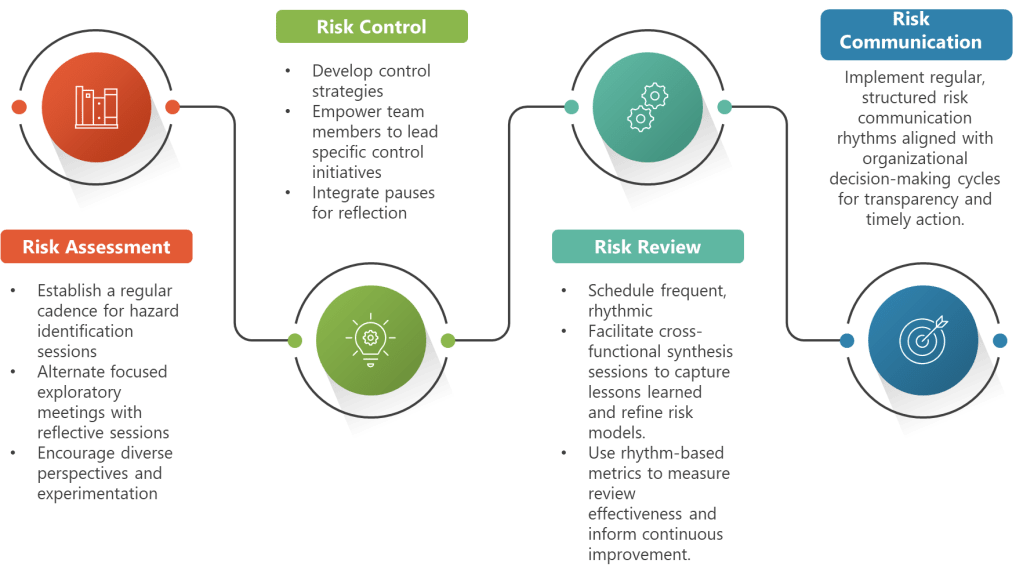
Drawing from Hudson’s research-backed insights and integrating them with ICH Q9(R1) requirements, I envision a Quality Rhythm Framework built on four essential beats:

Beat 1: Find Your Risk Cadence

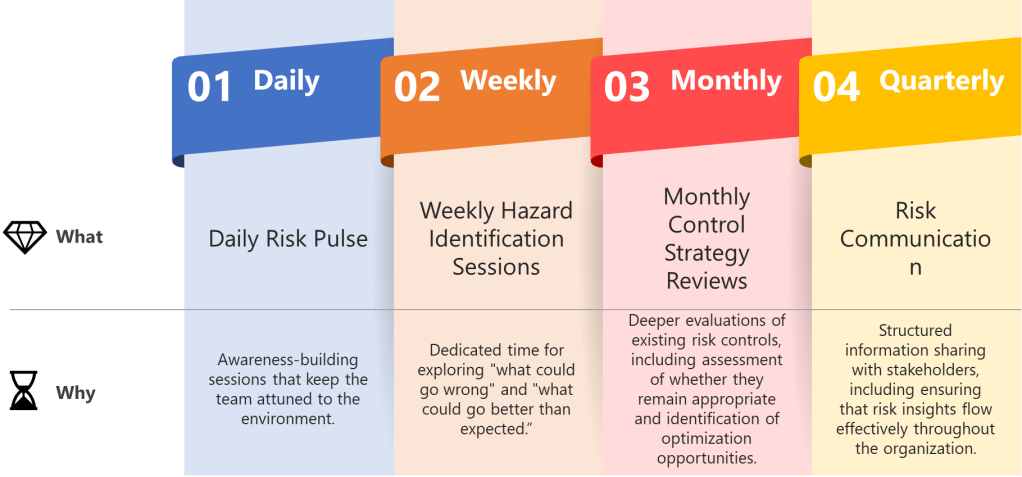
Establish predictable rhythms that create temporal anchors for your quality team while maintaining ICH Q9 compliance. Weekly hazard identification sessions, daily deviation assessments, monthly control strategy reviews, and quarterly risk communication cycles aren’t just meetings—they’re the beats that keep everyone synchronized while allowing individual risk management expression.

The ICH Q9(R1) revision’s emphasis on proportional formality aligns perfectly with this rhythmic approach. High-risk processes require more frequent beats, while lower-risk areas can operate with extended rhythms. The key is consistency within each risk category, creating what Weick calls “structured flexibility”—the ability to respond creatively within clear boundaries.

Consider implementing these quality-specific rhythmic structures:

  • Daily Risk Pulse: Brief stand-ups focused on emerging quality signals—not comprehensive risk assessments, but awareness-building sessions that keep the team attuned to the manufacturing environment.
  • Weekly Hazard Identification Sessions: Dedicated time for exploring “what could go wrong” and, following ISO 31000 principles, “what could go better than expected.” These sessions should alternate between different product lines or process areas to maintain focus.
  • Monthly Control Strategy Reviews: Deeper evaluations of existing risk controls, including assessment of whether they remain appropriate and identification of optimization opportunities.
  • Quarterly Risk Communication Cycles: Structured information sharing with stakeholders, including regulatory bodies when appropriate, ensuring that risk insights flow effectively throughout the organization.

Beat 2: Pause for Quality Breaths

Hudson emphasizes that jazz musicians know silence is as important as sound, and quality risk management desperately needs structured pauses. Build quality breaths into your organizational rhythm—moments for reflection, integration, and recovery from the intense focus required for effective risk assessment.

Research by performance expert Jim Loehr demonstrates that sustainable excellence requires oscillation, not relentless execution. In quality contexts, this means creating space between intensive risk assessment activities and implementation of control strategies. These pauses allow teams to process complex risk information, integrate diverse perspectives, and avoid the decision fatigue that leads to poor risk judgments.

Practical quality breaths include:

  • Post-Assessment Integration Time: Following comprehensive risk assessments, build in periods where team members can reflect on findings, consult additional resources, and refine their thinking before finalizing control strategies.
  • Cross-Functional Synthesis Sessions: Regular meetings where different functions (Quality, Operations, Regulatory, Technical) come together not to make decisions, but to share perspectives and build collective understanding of quality risks.
  • Knowledge Capture Moments: Structured time for documenting lessons learned, updating risk models based on new experience, and creating institutional memory that enhances future risk assessments.

Beat 3: Encourage Quality Experimentation

Within your rhythmic structure, create psychological safety and confidence that team members can explore novel risk identification approaches without fear of hitting “wrong notes.” When learning and reflection are part of a predictable beat, trust grows and experimentation becomes part of the quality flow.

The ICH Q9(R1) revision’s focus on managing subjectivity in risk assessments creates opportunities for experimental approaches. Instead of viewing subjectivity as a problem to eliminate, we can experiment with structured methods for harnessing diverse perspectives while maintaining analytical rigor.

Hudson’s research shows that predictable rhythm facilitates innovation—when people are comfortable with the rhythm, they’re free to experiment with the melody. In quality risk management, this means establishing consistent frameworks that enable creative hazard identification and innovative control strategy development.

Experimental approaches might include:

  • Success Mode and Benefits Analysis (SMBA): As I’ve discussed previously, complement traditional FMEA with systematic identification of positive potential outcomes. Experiment with different SMBA formats and approaches to find what works best for specific process areas.
  • Cross-Industry Risk Insights: Dedicate portions of risk assessment sessions to exploring how other industries handle similar quality challenges. These experiments in perspective-taking can reveal blind spots in traditional pharmaceutical approaches.
  • Scenario-Based Risk Planning: Experiment with “what if” exercises that go beyond traditional failure modes to explore complex, interdependent risk situations that might emerge in dynamic manufacturing environments.

Beat 4: Enable Quality Solos

Just as jazz musicians trade solos while the ensemble provides support, look for opportunities for individual quality team members to drive specific risk management initiatives. This distributed leadership approach builds capability while maintaining collective coherence around quality objectives.

Hudson’s framework emphasizes that adaptive leaders don’t try to be conductors but create conditions for others to lead. In quality risk management, this means identifying team members with specific expertise or interest areas and empowering them to lead risk assessments in those domains.

Quality leadership solos might include:

  • Process Expert Risk Leadership: Assign experienced operators or engineers to lead risk assessments for processes they know intimately, with quality professionals providing methodological support.
  • Cross-Functional Risk Coordination: Empower individuals to coordinate risk management across organizational boundaries, taking ownership for ensuring all relevant perspectives are incorporated.
  • Innovation Risk Championship: Designate team members to lead risk assessments for new technologies or novel approaches, building expertise in emerging quality challenges.

The Rhythmic Advantage: Three Quality Transformation Benefits

Mastering these rhythmic approaches to quality risk management provide three advantages that mirror Hudson’s leadership research:

Fluid Quality Structure

A jazz ensemble can improvise because musicians share a rhythm. Similarly, quality rhythms keep teams functioning together while offering freedom to adapt to emerging risks, changing regulatory requirements, or novel manufacturing challenges. Management researchers call this “structured flexibility”—exactly what ICH Q9(R1) envisions when it emphasizes proportional formality.

When quality teams operate with shared rhythms, they can respond more effectively to unexpected events. A contamination incident doesn’t require completely reinventing risk assessment approaches—teams can accelerate their established rhythms, bringing familiar frameworks to bear on novel challenges while maintaining analytical rigor.

Sustainable Quality Energy

Quality risk management is inherently demanding work that requires sustained attention to complex, interconnected risks. Traditional approaches often lead to burnout as teams struggle with relentless pressure to identify every possible hazard and implement perfect controls. Rhythmic approaches prevent this exhaustion by regulating pace and integrating recovery.

More importantly, rhythmic quality management aligns teams around purpose and vision rather than merely compliance deadlines. This enables what performance researchers call “sustainable high performance”—quality excellence that endures rather than depletes organizational energy.

When quality professionals find rhythm in their risk management work, they develop what Mihaly Csikszentmihalyi identified as “flow state,” moments when attention is fully focused and performance feels effortless. These states are crucial for the deep thinking required for effective hazard identification and the creative problem-solving needed for innovative control strategies.

Enhanced Quality Trust and Innovation

The paradox Hudson identifies, that some constraint enables creativity, applies directly to quality risk management. Predictable rhythms don’t stifle innovation; they provide the stable foundation from which teams can explore novel approaches to quality challenges.

When quality teams know they have regular, structured opportunities for risk exploration, they’re more willing to raise difficult questions, challenge assumptions, and propose unconventional solutions. The rhythm creates psychological safety for intellectual risk-taking within the controlled environment of systematic risk assessment.

This enhanced innovation capability is particularly crucial as pharmaceutical manufacturing becomes increasingly complex, with continuous manufacturing, advanced process controls, and novel drug modalities creating quality challenges that traditional risk management approaches weren’t designed to address.

Integrating Rhythmic Principles with ICH Q9(R1) Compliance

The beauty of rhythmic quality risk management lies in its fundamental compatibility with ICH Q9(R1) requirements. The revision’s emphasis on scientific knowledge, proportional formality, and risk-based decision-making aligns perfectly with rhythmic approaches that create structured flexibility for quality teams.

Rhythmic Risk Assessment Enhancement

ICH Q9 requires systematic hazard identification, risk analysis, and risk evaluation. Rhythmic approaches enhance these activities by establishing regular, focused sessions for each component rather than trying to accomplish everything in marathon meetings.

During dedicated hazard identification beats, teams can employ diverse techniques—traditional brainstorming, structured what-if analysis, cross-industry benchmarking, and the Success Mode and Benefits Analysis I’ve advocated. The rhythm ensures these activities receive appropriate attention while preventing the cognitive overload that reduces identification effectiveness.

Risk analysis benefits from rhythmic separation between data gathering and interpretation activities. Teams can establish rhythms for collecting process data, manufacturing experience, and regulatory intelligence, followed by separate beats for analyzing this information and developing risk models.

Rhythmic Risk Control Development

The ICH Q9(R1) emphasis on risk-based decision-making aligns perfectly with rhythmic approaches to control strategy development. Instead of rushing from risk assessment to control implementation, rhythmic approaches create space for thoughtful strategy development that considers multiple options and their implications.

Rhythmic control development might include beats for:

  • Control Strategy Ideation: Creative sessions focused on generating potential control approaches without immediate evaluation of feasibility or cost.
  • Implementation Planning: Separate sessions for detailed planning of selected control strategies, including resource requirements, timeline development, and change management considerations.
  • Effectiveness Assessment: Regular rhythms for evaluating implemented controls, gathering performance data, and identifying optimization opportunities.

Rhythmic Risk Communication

ICH Q9’s communication requirements benefit significantly from rhythmic approaches. Instead of ad hoc communication when problems arise, establish regular rhythms for sharing risk insights, control strategy updates, and lessons learned.

Quality communication rhythms should align with organizational decision-making cycles, ensuring that risk insights reach stakeholders when they’re most useful for decision-making. This might include monthly updates to senior leadership, quarterly reports to regulatory affairs, and annual comprehensive risk reviews for long-term strategic planning.

Practical Implementation: Building Your Quality Rhythm

Implementing rhythmic quality risk management requires systematic integration rather than wholesale replacement of existing approaches. Start by evaluating your current risk management processes to identify natural rhythm points and opportunities for enhancement.

Phase 1: Rhythm Assessment and Planning

Map your existing quality risk management activities against rhythmic principles. Identify where teams experience the cognitive whiplash Hudson describes—trying to accomplish too many different types of thinking in single sessions. Look for opportunities to separate exploration from analysis, strategy development from implementation planning, and individual reflection from group decision-making.

Establish criteria for quality rhythm frequency based on risk significance, process complexity, and organizational capacity. High-risk processes might require daily pulse checks and weekly deep dives, while lower-risk areas might operate effectively with monthly assessment rhythms.

Train quality teams on rhythmic principles and their application to risk management. Help them understand how rhythm enhances rather than constrains their analytical capabilities, providing structure that enables deeper thinking and more creative problem-solving.

Phase 2: Pilot Program Development

Select pilot areas where rhythmic approaches are most likely to demonstrate clear benefits. New product development projects, technology implementation initiatives, or process improvement activities often provide ideal testing grounds because their inherent uncertainty creates natural opportunities for both risk management and opportunity identification.

Design pilot programs to test specific rhythmic principles:

  • Rhythm Separation: Compare traditional comprehensive risk assessment meetings with rhythmic approaches that separate hazard identification, risk analysis, and control strategy development into distinct sessions.
  • Quality Breathing: Experiment with structured pauses between intensive risk assessment activities and measure their impact on decision quality and team satisfaction.
  • Distributed Leadership: Identify opportunities for team members to lead specific aspects of risk management and evaluate the impact on engagement and expertise development.

Phase 3: Organizational Integration

Based on pilot results, develop systematic approaches for scaling rhythmic quality risk management across the organization. This requires integration with existing quality systems, regulatory processes, and organizational governance structures.

Consider how rhythmic approaches will interact with regulatory inspection activities, change control processes, and continuous improvement initiatives. Ensure that rhythmic flexibility doesn’t compromise documentation requirements or audit trail integrity.

Establish metrics for evaluating rhythmic quality risk management effectiveness, including both traditional risk management indicators (incident rates, control effectiveness, regulatory compliance) and rhythm-specific measures (team engagement, innovation frequency, decision speed).

Phase 4: Continuous Enhancement and Cultural Integration

Like all aspects of quality risk management, rhythmic approaches require continuous improvement based on experience and changing needs. Regular assessment of rhythm effectiveness helps refine approaches over time and ensures sustained benefits.

The ultimate goal is cultural integration—making rhythmic thinking a natural part of how quality professionals approach risk management challenges. This requires consistent leadership modeling, recognition of rhythmic successes, and integration of rhythmic principles into performance expectations and career development.

Measuring Rhythmic Quality Success

Traditional quality metrics focus primarily on negative outcome prevention: deviation rates, batch failures, regulatory findings, and compliance scores. While these remain important, rhythmic quality risk management requires expanded measurement approaches that capture both defensive effectiveness and adaptive capability.

Enhanced metrics should include:

  • Rhythm Consistency Indicators: Frequency of established quality rhythms, participation rates in rhythmic activities, and adherence to planned cadences.
  • Innovation and Adaptation Measures: Number of novel risk identification approaches tested, implementation rate of creative control strategies, and frequency of process improvements emerging from risk management activities.
  • Team Engagement and Development: Participation in quality leadership opportunities, cross-functional collaboration frequency, and professional development within risk management capabilities.
  • Decision Quality Indicators: Time from risk identification to control implementation, stakeholder satisfaction with risk communication, and long-term effectiveness of implemented controls.

Regulatory Considerations: Communicating Rhythmic Value

Regulatory agencies are increasingly interested in risk-based approaches that demonstrate genuine process understanding and continuous improvement capabilities. Rhythmic quality risk management strengthens regulatory relationships by showing sophisticated thinking about process optimization and quality enhancement within established frameworks.

When communicating with regulatory agencies, emphasize how rhythmic approaches improve process understanding, enhance control strategy development, and support continuous improvement objectives. Show how structured flexibility leads to better patient protection through more responsive and adaptive quality systems.

Focus regulatory communications on how enhanced risk understanding leads to better quality outcomes rather than on operational efficiency benefits that might appear secondary to regulatory objectives. Demonstrate how rhythmic approaches maintain analytical rigor while enabling more effective responses to emerging quality challenges.

The Future of Quality Risk Management: Beyond Rhythm to Resonance

As we master rhythmic approaches to quality risk management, the next evolution involves what I call “quality resonance”—the phenomenon that occurs when individual quality rhythms align and amplify each other across organizational boundaries. Just as musical instruments can create resonance that produces sounds more powerful than any individual instrument, quality organizations can achieve resonant states where risk management effectiveness transcends the sum of individual contributions.

Resonant quality organizations share several characteristics:

  • Synchronized Rhythm Networks: Quality rhythms in different departments, processes, and product lines align to create organization-wide patterns of risk awareness and response capability.
  • Harmonic Risk Communication: Information flows between quality functions create harmonics that amplify important signals while filtering noise, enabling more effective decision-making at all organizational levels.
  • Emergent Quality Intelligence: The interaction of multiple rhythmic quality processes generates insights and capabilities that wouldn’t be possible through individual efforts alone.

Building toward quality resonance requires sustained commitment to rhythmic principles, continuous refinement of quality cadences, and patient development of organizational capability. The payoff, however, is transformational: quality risk management that not only prevents problems but actively creates value through enhanced understanding, improved processes, and strengthened competitive position.

Finding Your Quality Beat

Uncertainty is inevitable in pharmaceutical manufacturing, regulatory environments, and global supply chains. As Hudson emphasizes, the choice is whether to exhaust ourselves trying to conduct every quality note or to lay down rhythms that enable entire teams to create something extraordinary together.

Tomorrow morning, when you walk into that risk assessment meeting, you’ll face this choice in real time. Will you pick up the conductor’s baton, trying to control every analytical voice? Or will you sit at the back of the stage and create the beat on which your quality team can find its flow?

The research is clear: rhythmic approaches to complex work create better outcomes, higher engagement, and more sustainable performance. The ICH Q9(R1) framework provides the flexibility needed to implement rhythmic quality risk management while maintaining regulatory compliance. The tools and techniques exist to transform quality risk management from a defensive necessity into an adaptive capability that drives innovation and competitive advantage.

The question isn’t whether rhythmic quality risk management will emerge—it’s whether your organization will lead this transformation or struggle to catch up. The teams that master quality rhythm first will be best positioned to thrive in our increasingly BANI pharmaceutical world, turning uncertainty into opportunity while maintaining the rigorous standards our patients deserve.

Start with one beat. Find one aspect of your current quality risk management where you can separate exploration from analysis, create space for reflection, or enable someone to lead. Feel the difference that rhythm makes. Then gradually expand, building the quality jazz ensemble that our complex manufacturing world demands.

The rhythm section is waiting. It’s time to find your quality beat.

Embracing the Upside: How ISO 31000’s Risk-as-Opportunities Approach Can Transform Your Quality Risk Management Program

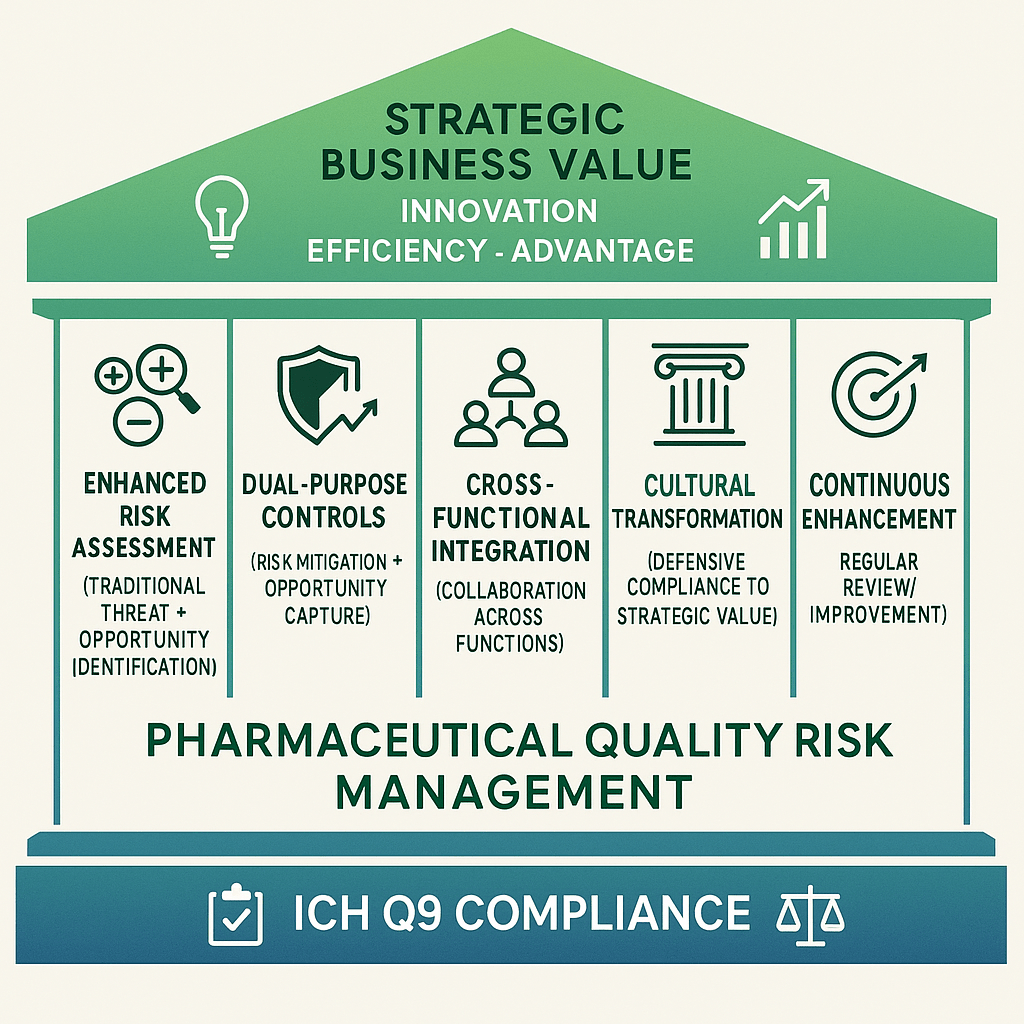
The pharmaceutical industry has long operated under a defensive mindset when it comes to risk management. We identify what could go wrong, assess the likelihood and impact of failure modes, and implement controls to prevent or mitigate negative outcomes. This approach, while necessary and required by ICH Q9, represents only half the risk equation. What our quality risk management program could become not just a compliance necessity, but a strategic driver of innovation, efficiency, and competitive advantage?

Enter the ISO 31000 perspective on risk—one that recognizes risk as “the effect of uncertainty on objectives,” where that effect can be positive, negative, or both. This broader definition opens up transformative possibilities for how we approach quality risk management in pharmaceutical manufacturing. Rather than solely focusing on preventing bad things from happening, we can start identifying and capitalizing on good things that might occur.

The Evolution of Risk Thinking in Pharmaceuticals

For decades, our industry’s risk management approach has been shaped by regulatory necessity and liability concerns. The introduction of ICH Q9 in 2005—and its recent revision in 2023—provided a structured framework for quality risk management that emphasizes scientific knowledge, proportional formality, and patient protection. This framework has served us well, establishing systematic approaches to risk assessment, control, communication, and review.

However, the updated ICH Q9(R1) recognizes that we’ve been operating with significant blind spots. The revision addresses issues including “high levels of subjectivity in risk assessments,” “failing to adequately manage supply and product availability risks,” and “lack of clarity on risk-based decision-making”. These challenges suggest that our traditional approach to risk management, while compliant, may not be fully leveraging the strategic value that comprehensive risk thinking can provide.

The ISO 31000 standard offers a complementary perspective that can address these gaps. By defining risk as uncertainty’s effect on objectives—with explicit recognition that this effect can create opportunities as well as threats—ISO 31000 provides a framework for risk management that is inherently more strategic and value-creating.

Understanding Risk as Opportunity in the Pharmaceutical Context

Lot us start by establishing a clear understanding of what “positive risk” or “opportunity” means in our context. In pharmaceutical quality management, opportunities are uncertain events or conditions that, if they occur, would enhance our ability to achieve quality objectives beyond our current expectations.

Consider these examples:

Manufacturing Process Opportunities: A new analytical method validates faster than anticipated, allowing for reduced testing cycles and increased throughput. The uncertainty around validation timelines created an opportunity that, when realized, improved operational efficiency while maintaining quality standards.

Supply Chain Opportunities: A raw material supplier implements process improvements that result in higher-purity ingredients at lower cost. This positive deviation from expected quality created opportunities for enhanced product stability and improved margins.

Technology Integration Opportunities: Implementation of process analytical technology (PAT) tools not only meets their intended monitoring purpose but reveals previously unknown process insights that enable further optimization opportunities.

Regulatory Opportunities: A comprehensive quality risk assessment submitted as part of a regulatory filing demonstrates such thorough understanding of the product and process that regulators grant additional manufacturing flexibility, creating opportunities for more efficient operations.

These scenarios illustrate how uncertainty—the foundation of all risk—can work in our favor when we’re prepared to recognize and capitalize on positive outcomes.

The Strategic Value of Opportunity-Based Risk Management

Integrating opportunity recognition into your quality risk management program delivers value across multiple dimensions:

Enhanced Innovation Capability

Traditional risk management often creates conservative cultures where “safe” decisions are preferred over potentially transformative ones. By systematically identifying and evaluating opportunities, we can make more balanced decisions that account for both downside risks and upside potential. This leads to greater willingness to explore innovative approaches to quality challenges while maintaining appropriate risk controls.

Improved Resource Allocation

When we only consider negative risks, we tend to over-invest in protective measures while under-investing in value-creating activities. Opportunity-oriented risk management helps optimize resource allocation by identifying where investments might yield unexpected benefits beyond their primary purpose.

Strengthened Competitive Position

Companies that effectively identify and capitalize on quality-related opportunities can develop competitive advantages through superior operational efficiency, faster time-to-market, enhanced product quality, or innovative approaches to regulatory compliance.

Cultural Transformation

Perhaps most importantly, embracing opportunities transforms the perception of risk management from a necessary burden to a strategic enabler. This cultural shift encourages proactive thinking, innovation, and continuous improvement throughout the organization.

Mapping ISO 31000 Principles to ICH Q9 Requirements

The beauty of integrating ISO 31000’s opportunity perspective with ICH Q9 compliance lies in their fundamental compatibility. Both frameworks emphasize systematic, science-based approaches to risk management with proportional formality based on risk significance. The key difference is scope—ISO 31000’s broader definition of risk naturally encompasses opportunities alongside threats.

Risk Assessment Enhancement

ICH Q9 requires risk assessment to include hazard identification, analysis, and evaluation. The ISO 31000 approach enhances this by expanding identification beyond failure modes to include potential positive outcomes. During hazard analysis and risk assessment (HARA), we can systematically ask not only “what could go wrong?” but also “what could go better than expected?” and “what positive outcomes might emerge from this uncertainty?”

For example, when assessing risks associated with implementing a new manufacturing technology, traditional ICH Q9 assessment would focus on potential failures, integration challenges, and validation risks. The enhanced approach would also identify opportunities for improved process understanding, unexpected efficiency gains, or novel approaches to quality control that might emerge during implementation.

Risk Control Expansion

ICH Q9’s risk control phase traditionally focuses on risk reduction and risk acceptance. The ISO 31000 perspective adds a third dimension: opportunity enhancement. This involves implementing controls or strategies that not only mitigate negative risks but also position the organization to capitalize on positive uncertainties should they occur.

Consider controls designed to manage analytical method transfer risks. Traditional controls might include extensive validation studies, parallel testing, and contingency procedures. Opportunity-enhanced controls might also include structured data collection protocols designed to identify process insights, cross-training programs that build broader organizational capabilities, or partnerships with equipment vendors that could lead to preferential access to new technologies.

Risk Communication and Opportunity Awareness

ICH Q9 emphasizes the importance of risk communication among stakeholders. When we expand this to include opportunity communication, we create organizational awareness of positive possibilities that might otherwise go unrecognized. This enhanced communication helps ensure that teams across the organization are positioned to identify and report positive deviations that could represent valuable opportunities.

Risk Review and Opportunity Capture

The risk review process required by ICH Q9 becomes more dynamic when it includes opportunity assessment. Regular reviews should evaluate not only whether risk controls remain effective, but also whether any positive outcomes have emerged that could be leveraged for further benefit. This creates a feedback loop that continuously enhances both risk management and opportunity realization.

Implementation Framework

Implementing opportunity-based risk management within your existing ICH Q9 program requires systematic integration rather than wholesale replacement. Here’s a practical framework for making this transition:

Phase 1: Assessment and Planning

Begin by evaluating your current risk management processes to identify integration points for opportunity assessment. Review existing risk assessments to identify cases where positive outcomes might have been overlooked. Establish criteria for what constitutes a meaningful opportunity in your context—this might include potential cost savings, quality improvements, efficiency gains, or innovation possibilities above defined thresholds.

Key activities include:

  • Mapping current risk management processes against ISO 31000 principles
  • Perform a readiness evaluation
  • Training risk management teams on opportunity identification techniques
  • Developing templates and tools that prompt opportunity consideration
  • Establishing metrics for tracking opportunity identification and realization

Readiness Evaluation

Before implementing opportunity-based risk management, conduct a thorough assessment of organizational readiness and capability. This includes evaluating current risk management maturity, cultural factors that might support or hinder adoption, and existing processes that could be enhanced.

Key assessment areas include:

  • Current risk management process effectiveness and consistency
  • Organizational culture regarding innovation and change
  • Leadership support for expanded risk management approaches
  • Available resources for training and process enhancement
  • Existing cross-functional collaboration capabilities

Phase 2: Process Integration

Systematically integrate opportunity assessment into your existing risk management workflows. This doesn’t require new procedures—rather, it involves enhancing existing processes to ensure opportunity identification receives appropriate attention alongside threat assessment.

Modify risk assessment templates to include opportunity identification sections. Train teams to ask opportunity-focused questions during risk identification sessions. Develop criteria for evaluating opportunity significance using similar approaches to threat assessment—considering likelihood, impact, and detectability.

Update risk control strategies to include opportunity enhancement alongside risk mitigation. This might involve designing controls that serve dual purposes or implementing monitoring systems that can detect positive deviations as well as negative ones.

This is the phase I am currently working through. Make sure to do a pilot program!

Pilot Program Development

Start with pilot programs in areas where opportunities are most likely to be identified and realized. This might include new product development projects, technology implementation initiatives, or process improvement activities where uncertainty naturally creates both risks and opportunities.

Design pilot programs to:

  • Test opportunity identification and evaluation methods
  • Develop organizational capability and confidence
  • Create success stories that support broader adoption
  • Refine processes and tools based on practical experience

Phase 3: Cultural Integration

The success of opportunity-based risk management ultimately depends on cultural adoption. Teams need to feel comfortable identifying and discussing positive possibilities without being perceived as overly optimistic or insufficiently rigorous.

Establish communication protocols that encourage opportunity reporting alongside issue escalation. Recognize and celebrate cases where teams successfully identify and capitalize on opportunities. Incorporate opportunity realization into performance metrics and success stories.

Scaling and Integration Strategy

Based on pilot program results, develop a systematic approach for scaling opportunity-based risk management across the organization. This should include timelines, resource requirements, training programs, and change management strategies.

Consider factors such as:

  • Process complexity and risk management requirements in different areas
  • Organizational change capacity and competing priorities
  • Resource availability and investment requirements
  • Integration with other improvement and innovation initiatives

Phase 4: Continuous Enhancement

Like all aspects of quality risk management, opportunity integration requires continuous improvement. Regular assessment of the program’s effectiveness in identifying and capitalizing on opportunities helps refine the approach over time.

Conduct periodic reviews of opportunity identification accuracy—are teams successfully recognizing positive outcomes when they occur? Evaluate opportunity realization effectiveness—when opportunities are identified, how successfully does the organization capitalize on them? Use these insights to enhance training, processes, and organizational support for opportunity-based risk management.

Long-term Sustainability Planning

Ensure that opportunity-based risk management becomes embedded in organizational culture and processes rather than remaining dependent on individual champions or special programs. This requires systematic integration into standard operating procedures, performance metrics, and leadership expectations.

Plan for:

  • Ongoing training and capability development programs
  • Regular assessment and continuous improvement of opportunity identification processes
  • Integration with career development and advancement criteria
  • Long-term resource allocation and organizational support

Tools and Techniques for Opportunity Integration

Include a Success Mode and Benefits Analysis in your FMEA (Failure Mode and Effects Analysis)

Traditional FMEA focuses on potential failures and their effects. Opportunity-enhanced FMEA includes “Success Mode and Benefits Analysis” (SMBA) that systematically identifies potential positive outcomes and their benefits. For each process step, teams assess not only what could go wrong, but also what could go better than expected and how to position the organization to benefit from such outcomes.

A Success Mode and Benefits Analysis (SMBA) is the positive complement to the traditional Failure Mode and Effects Analysis (FMEA). While FMEA identifies where things can go wrong and how to prevent or mitigate failures, SMBA systematically evaluates how things can go unexpectedly right—helping organizations proactively capture, enhance, and realize benefits that arise from process successes, innovations, or positive deviations.

What Does a Success Mode and Benefits Analysis Look Like?

The SMBA is typically structured as a table or worksheet with a format paralleling the FMEA, but with a focus on positive outcomes and opportunities. A typical SMBA process includes the following columns and considerations:

Step/ColumnDescription
Process Step/FunctionThe specific process, activity, or function under investigation.
Success ModeDescription of what could go better than expected or intended—what’s the positive deviation?
Benefits/EffectsThe potential beneficial effects if the success mode occurs (e.g., improved yield, faster cycle, enhanced quality, regulatory flexibility).
Likelihood (L)Estimated probability that the success mode will occur.
Magnitude of Benefit (M)Qualitative or quantitative evaluation of how significant the benefit would be (e.g., minor, moderate, major; or by quantifiable metrics).
DetectabilityCan the opportunity be spotted early? What are the triggers or signals of this benefit occurring?
Actions to Capture/EnhanceSteps or controls that could help ensure the success is recognized and benefits are realized (e.g., monitoring plans, training, adaptation of procedures).
Benefit Priority Number (BPN)An optional calculated field (e.g., L × M) to help the team prioritize follow-up actions.
  • Proactive Opportunity Identification: Instead of waiting for positive results to emerge, the process prompts teams to seek out “what could go better than planned?”.
  • Systematic Benefit Analysis: Quantifies or qualifies benefits just as FMEA quantifies risk.
  • Follow-Up Actions: Establishes ways to amplify and institutionalize successes.

When and How to Use SMBA

  • Use SMBA alongside FMEA during new technology introductions, process changes, or annual reviews.
  • Integrate into cross-functional risk assessments to balance risk aversion with innovation.
  • Use it to foster a culture that not just “prevents failure,” but actively “captures opportunity” and learns from success.

Opportunity-Integrated Risk Matrices

Traditional risk matrices plot likelihood versus impact for negative outcomes. Enhanced matrices include separate quadrants or scales for positive outcomes, allowing teams to visualize both threats and opportunities in the same framework. This provides a more complete picture of uncertainty and helps prioritize actions based on overall risk-opportunity balance.

Scenario Planning with Upside Cases

While scenario planning typically focuses on “what if” situations involving problems, opportunity-oriented scenario planning includes “what if” situations involving unexpected successes. This helps teams prepare to recognize and capitalize on positive outcomes that might otherwise be missed.

Innovation-Focused Risk Assessments

When evaluating new technologies, processes, or approaches, include systematic assessment of innovation opportunities that might emerge. This involves considering not just whether the primary objective will be achieved, but what secondary benefits or unexpected capabilities might develop during implementation.

Organizational Considerations

Leadership Commitment and Cultural Change

Successful integration of opportunity-based risk management requires genuine leadership commitment to cultural change. Leaders must model behavior that values both threat mitigation and opportunity creation. This means celebrating teams that identify valuable opportunities alongside those that prevent significant risks.

Leadership should establish clear expectations that risk management includes opportunity identification as a core responsibility. Performance metrics, recognition programs, and resource allocation decisions should reflect this balanced approach to uncertainty management.

Training and Capability Development

Teams need specific training to develop opportunity identification skills. While threat identification often comes naturally in quality-conscious cultures, opportunity recognition requires different cognitive approaches and tools.

Training programs should include:

  • Techniques for identifying positive potential outcomes
  • Methods for evaluating opportunity significance and likelihood
  • Approaches for designing controls that enhance opportunities while mitigating risks
  • Communication skills for discussing opportunities without compromising analytical rigor

Cross-Functional Integration

Opportunity-based risk management is most effective when integrated across organizational functions. Quality teams might identify process improvement opportunities, while commercial teams recognize market advantages, and technical teams discover innovation possibilities.

Establishing cross-functional opportunity review processes ensures that identified opportunities receive appropriate evaluation and resource allocation regardless of their origin. Regular communication between functions helps build organizational capability to recognize and act on opportunities systematically.

Measuring Success in Opportunity-Based Risk Management

Existing risk management metrics typically focus on negative outcome prevention: deviation rates, incident frequency, compliance scores, and similar measures. While these remain important, opportunity-based programs should also track positive outcome realization.

Enhanced metrics might include:

  • Number of opportunities identified per risk assessment
  • Percentage of identified opportunities that are successfully realized
  • Value generated from opportunity realization (cost savings, quality improvements, efficiency gains)
  • Time from opportunity identification to realization

Innovation and Improvement Indicators

Opportunity-focused risk management should drive increased innovation and continuous improvement. Tracking metrics related to process improvements, technology adoption, and innovation initiatives provides insight into the program’s effectiveness in creating value beyond compliance.

Consider monitoring:

  • Rate of process improvement implementation
  • Success rate of new technology adoptions
  • Number of best practices developed and shared across the organization
  • Frequency of positive deviations that lead to process optimization

Cultural and Behavioral Measures

The ultimate success of opportunity-based risk management depends on cultural integration. Measuring changes in organizational attitudes, behaviors, and capabilities provides insight into program sustainability and long-term impact.

Relevant measures include:

  • Employee engagement with risk management processes
  • Frequency of voluntary opportunity reporting
  • Cross-functional collaboration on risk and opportunity initiatives
  • Leadership participation in opportunity evaluation and resource allocation

Regulatory Considerations and Compliance Integration

Maintaining ICH Q9 Compliance

The opportunity-enhanced approach must maintain full compliance with ICH Q9 requirements while adding value through expanded scope. This means ensuring that all required elements of risk assessment, control, communication, and review continue to receive appropriate attention and documentation.

Regulatory submissions should clearly demonstrate that opportunity identification enhances rather than compromises systematic risk evaluation. Documentation should show how opportunity assessment strengthens process understanding and control strategy development.

Communicating Value to Regulators

Regulators are increasingly interested in risk-based approaches that demonstrate genuine process understanding and continuous improvement capabilities. Opportunity-based risk management can strengthen regulatory relationships by demonstrating sophisticated thinking about process optimization and quality enhancement.

When communicating with regulatory agencies, emphasize how opportunity identification improves process understanding, enhances control strategy development, and supports continuous improvement objectives. Show how the approach leads to better risk control through deeper process knowledge and more robust quality systems.

Global Harmonization Considerations

Different regulatory regions may have varying levels of comfort with opportunity-focused risk management discussions. While the underlying risk management activities remain consistent with global standards, communication approaches should be tailored to regional expectations and preferences.

Focus regulatory communications on how enhanced risk understanding leads to better patient protection and product quality, rather than on business benefits that might appear secondary to regulatory objectives.

Conclusion

Integrating ISO 31000’s opportunity perspective with ICH Q9 compliance represents more than a process enhancement and is a shift toward strategic risk management that positions quality organizations as value creators rather than cost centers. By systematically identifying and capitalizing on positive uncertainties, we can transform quality risk management from a defensive necessity into an offensive capability that drives innovation, efficiency, and competitive advantage.

The framework outlined here provides a practical path forward that maintains regulatory compliance while unlocking the strategic value inherent in comprehensive risk thinking. Success requires leadership commitment, cultural change, and systematic implementation, but the potential returns—in terms of operational excellence, innovation capability, and competitive position—justify the investment.

As we continue to navigate an increasingly complex and uncertain business environment, organizations that master the art of turning uncertainty into opportunity will be best positioned to thrive. The integration of ISO 31000’s risk-as-opportunities approach with ICH Q9 compliance provides a roadmap for achieving this mastery while maintaining the rigorous standards our industry demands.

Section 4 of Draft Annex 11: Quality Risk Management—The Scientific Foundation That Transforms Validation

If there is one section that serves as the philosophical and operational backbone for everything else in the new regulation, it’s Section 4: Risk Management. This section embodies current regulatory thinking on how risk management, in light of the recent ICH Q9 (R1) is the scientific methodology that transforms how we think about, design, validate, and operate s in GMP environments.

Section 4 represents the regulatory codification of what quality professionals have long advocated: that every decision about computerized systems, from initial selection through operational oversight to eventual decommissioning, must be grounded in rigorous, documented, and scientifically defensible risk assessment. But more than that, it establishes quality risk management as the living nervous system of digital compliance, continuously sensing, evaluating, and responding to threats and opportunities throughout the system lifecycle.

For organizations that have treated risk management as a checkbox exercise or a justification for doing less validation, Section 4 delivers a harsh wake-up call. The new requirements don’t just elevate risk management to regulatory mandate—they transform it into the primary lens through which all computerized system activities must be viewed, planned, executed, and continuously improved.

The Philosophical Revolution: From Optional Framework to Mandatory Foundation

The transformation between the current Annex 11’s brief mention of risk management and Section 4’s comprehensive requirements represents more than regulatory updating—it reflects a fundamental shift in how regulators view the relationship between risk assessment and system control. Where the 2011 version offered generic guidance about applying risk management “throughout the lifecycle,” Section 4 establishes specific, measurable, and auditable requirements that make risk management the definitive basis for all computerized system decisions.

Section 4.1 opens with an unambiguous statement that positions quality risk management as the foundation of system lifecycle management: “Quality Risk Management (QRM) should be applied throughout the lifecycle of a computerised system considering any possible impact on product quality, patient safety or data integrity.” This language moves beyond the permissive “should consider” of the old regulation to establish QRM as the mandatory framework through which all system activities must be filtered.

The explicit connection to ICH Q9(R1) in Section 4.2 represents a crucial evolution. By requiring that “risks associated with the use of computerised systems in GMP activities should be identified and analysed according to an established procedure” and specifically referencing “examples of risk management methods and tools can be found in ICH Q9 (R1),” the regulation transforms ICH Q9 from guidance into regulatory requirement. Organizations can no longer treat ICH Q9 principles as aspirational best practices—they become the enforceable standard for pharmaceutical risk management.

This integration creates powerful synergies between pharmaceutical quality system requirements and computerized system validation. Risk assessments conducted under Section 4 must align with broader ICH Q9 principles while addressing the specific challenges of digital systems, cloud services, and automated processes. The result is a comprehensive risk management framework that bridges traditional pharmaceutical operations with modern digital infrastructure.

The requirement in Section 4.3 that “validation strategy and effort should be determined based on the intended use of the system and potential risks to product quality, patient safety and data integrity” establishes risk assessment as the definitive driver of validation scope and approach. This eliminates the historical practice of using standardized validation templates regardless of system characteristics or applying uniform validation approaches across diverse system types.

Under Section 4, every validation decision—from the depth of testing required to the frequency of periodic reviews—must be traceable to specific risk assessments that consider the unique characteristics of each system and its role in GMP operations. This approach rewards organizations that invest in comprehensive risk assessment while penalizing those that rely on generic, one-size-fits-all validation approaches.

Risk-Based System Design: Architecture Driven by Assessment

Perhaps the most transformative aspect of Section 4 is found in Section 4.4, which requires that “risks associated with the use of computerised systems in GMP activities should be mitigated and brought down to an acceptable level, if possible, by modifying processes or system design.” This requirement positions risk assessment as a primary driver of system architecture rather than simply a validation planning tool.

The language “modifying processes or system design” establishes a hierarchy of risk control that prioritizes prevention over detection. Rather than accepting inherent system risks and compensating through enhanced testing or operational controls, Section 4 requires organizations to redesign systems and processes to eliminate or minimize risks at their source. This approach aligns with fundamental safety engineering principles while ensuring that risk mitigation is built into system architecture rather than layered on top.

The requirement that “the outcome of the risk management process should result in the choice of an appropriate computerised system architecture and functionality” makes risk assessment the primary criterion for system selection and configuration. Organizations can no longer choose systems based purely on cost, vendor relationships, or technical preferences—they must demonstrate that system architecture aligns with risk assessment outcomes and provides appropriate risk mitigation capabilities.

This approach particularly impacts cloud system implementations, SaaS platform selections, and integrated system architectures where risk assessment must consider not only individual system capabilities but also the risk implications of system interactions, data flows, and shared infrastructure. Organizations must demonstrate that their chosen architecture provides adequate risk control across the entire integrated environment.

The emphasis on system design modification as the preferred risk mitigation approach will drive significant changes in vendor selection criteria and system specification processes. Vendors that can demonstrate built-in risk controls and flexible architecture will gain competitive advantages over those that rely on customers to implement risk mitigation through operational procedures or additional validation activities.

Data Integrity Risk Assessment: Scientific Rigor Applied to Information Management

Section 4.5 introduces one of the most sophisticated requirements in the entire draft regulation: “Quality risk management principles should be used to assess the criticality of data to product quality, patient safety and data integrity, the vulnerability of data to deliberate or indeliberate alteration, deletion or loss, and the likelihood of detection of such actions.”

This requirement transforms data integrity from a compliance concept into a systematic risk management discipline. Organizations must assess not only what data is critical but also how vulnerable that data is to compromise and how likely they are to detect integrity failures. This three-dimensional risk assessment approach—criticality, vulnerability, and detectability—provides a scientific framework for prioritizing data protection efforts and designing appropriate controls.

The distinction between “deliberate or indeliberate” data compromise acknowledges that modern data integrity threats encompass both malicious attacks and innocent errors. Risk assessments must consider both categories and design controls that address the full spectrum of potential data integrity failures. This approach requires organizations to move beyond traditional access control and audit trail requirements to consider the full range of technical, procedural, and human factors that could compromise data integrity.

The requirement to assess “likelihood of detection” introduces a crucial element often missing from traditional data integrity approaches. Organizations must evaluate not only how to prevent data integrity failures but also how quickly and reliably they can detect failures that occur despite preventive controls. This assessment drives requirements for monitoring systems, audit trail analysis capabilities, and incident detection procedures that can identify data integrity compromises before they impact product quality or patient safety.

This risk-based approach to data integrity creates direct connections between Section 4 and other draft Annex 11 requirements, particularly Section 10 (Handling of Data), Section 11 (Identity and Access Management), and Section 12 (Audit Trails). Risk assessments conducted under Section 4 drive the specific requirements for data input verification, access controls, and audit trail monitoring implemented through other sections.

Lifecycle Risk Management: Dynamic Assessment in Digital Environments

The lifecycle approach required by Section 4 acknowledges that computerized systems exist in dynamic environments where risks evolve continuously due to technology changes, process modifications, security threats, and operational experience. Unlike traditional validation approaches that treat risk assessment as a one-time activity during system implementation, Section 4 requires ongoing risk evaluation and response throughout the system lifecycle.

This dynamic approach particularly impacts cloud-based systems and SaaS platforms where underlying infrastructure, security controls, and functional capabilities change regularly without direct customer involvement. Organizations must establish procedures for evaluating the risk implications of vendor-initiated changes and updating their risk assessments and control strategies accordingly.

The lifecycle risk management approach also requires integration with change control processes, periodic review activities, and incident management procedures. Every significant system change must trigger risk reassessment to ensure that new risks are identified and appropriate controls are implemented. This creates a feedback loop where operational experience informs risk assessment updates, which in turn drive control system improvements and validation strategy modifications.

Organizations implementing Section 4 requirements must develop capabilities for continuous risk monitoring that can detect emerging threats, changing system characteristics, and evolving operational patterns that might impact risk assessments. This requires investment in risk management tools, monitoring systems, and analytical capabilities that extend beyond traditional validation and quality assurance functions.

Integration with Modern Risk Management Methodologies

The explicit reference to ICH Q9(R1) in Section 4.2 creates direct alignment between computerized system risk management and the broader pharmaceutical quality risk management framework. This integration ensures that computerized system risk assessments contribute to overall product and process risk understanding while benefiting from the sophisticated risk management methodologies developed for pharmaceutical operations.

ICH Q9(R1)’s emphasis on managing and minimizing subjectivity in risk assessment becomes particularly important for computerized system applications where technical complexity can obscure risk evaluation. Organizations must implement risk assessment procedures that rely on objective data, established methodologies, and cross-functional expertise rather than individual opinions or vendor assertions.

The ICH Q9(R1) toolkit—including Failure Mode and Effects Analysis (FMEA), Hazard Analysis and Critical Control Points (HACCP), and Fault Tree Analysis (FTA)—provides proven methodologies for systematic risk identification and assessment that can be applied to computerized system environments. Section 4’s reference to these tools establishes them as acceptable approaches for meeting regulatory requirements while providing flexibility for organizations to choose methodologies appropriate to their specific circumstances.

The integration with ICH Q9(R1) also emphasizes the importance of risk communication throughout the organization and with external stakeholders including suppliers, regulators, and business partners. Risk assessment results must be communicated effectively to drive appropriate decision-making at all organizational levels and ensure that risk mitigation strategies are understood and implemented consistently.

Operational Implementation: Transforming Risk Assessment from Theory to Practice

Implementing Section 4 requirements effectively requires organizations to develop sophisticated risk management capabilities that extend far beyond traditional validation and quality assurance functions. The requirement for “established procedures” means that risk assessment cannot be ad hoc or inconsistent—organizations must develop repeatable, documented methodologies that produce reliable and auditable results.

The procedures must address risk identification methods that can systematically evaluate the full range of potential threats to computerized systems including technical failures, security breaches, data integrity compromises, supplier issues, and operational errors. Risk identification must consider both current system states and future scenarios including planned changes, emerging threats, and evolving operational requirements.

Risk analysis procedures must provide quantitative or semi-quantitative methods for evaluating risk likelihood and impact across the three critical dimensions specified in Section 4.1: product quality, patient safety, and data integrity. This analysis must consider the interconnected nature of modern computerized systems where risks in one system or component can cascade through integrated environments to impact multiple processes and outcomes.

Risk evaluation procedures must establish criteria for determining acceptable risk levels and identifying risks that require mitigation. These criteria must align with organizational risk tolerance, regulatory expectations, and business objectives while providing clear guidance for risk-based decision making throughout the system lifecycle.

Risk mitigation procedures must prioritize design and process modifications over operational controls while ensuring that all risk mitigation strategies are evaluated for effectiveness and maintained throughout the system lifecycle. Organizations must develop capabilities for implementing system architecture changes, process redesign, and operational control enhancements based on risk assessment outcomes.

Technology and Tool Requirements for Effective Risk Management

Section 4’s emphasis on systematic, documented, and traceable risk management creates significant requirements for technology tools and platforms that can support sophisticated risk assessment and management processes. Organizations must invest in risk management systems that can capture, analyze, and track risks throughout complex system lifecycles while maintaining traceability to validation activities, change control processes, and operational decisions.

Risk assessment tools must support the multi-dimensional analysis required by Section 4, including product quality impacts, patient safety implications, and data integrity vulnerabilities. These tools must accommodate the dynamic nature of computerized system environments where risks evolve continuously due to technology changes, process modifications, and operational experience.

Integration with existing quality management systems, validation platforms, and operational monitoring tools becomes essential for maintaining consistency between risk assessments and other quality activities. Organizations must ensure that risk assessment results drive validation planning, change control decisions, and operational monitoring strategies while receiving feedback from these activities to update and improve risk assessments.

Documentation and traceability requirements create needs for sophisticated document management and workflow systems that can maintain relationships between risk assessments, system specifications, validation protocols, and operational procedures. Organizations must demonstrate clear traceability from risk identification through mitigation implementation and effectiveness verification.

Regulatory Expectations and Inspection Implications

Section 4’s comprehensive risk management requirements fundamentally change regulatory inspection dynamics by establishing risk assessment as the foundation for evaluating all computerized system compliance activities. Inspectors will expect to see documented, systematic, and scientifically defensible risk assessments that drive all system-related decisions from initial selection through ongoing operation.

The integration with ICH Q9(R1) provides inspectors with established criteria for evaluating risk management effectiveness including assessment methodology adequacy, stakeholder involvement appropriateness, and decision-making transparency. Organizations must demonstrate that their risk management processes meet ICH Q9(R1) standards while addressing the specific challenges of computerized system environments.

Risk-based validation approaches will receive increased scrutiny as inspectors evaluate whether validation scope and depth align appropriately with documented risk assessments. Organizations that cannot demonstrate clear traceability between risk assessments and validation activities will face significant compliance challenges regardless of validation execution quality.

The emphasis on system design and process modification as preferred risk mitigation strategies means that inspectors will evaluate whether organizations have adequately considered architectural and procedural alternatives to operational controls. Simply implementing extensive operational procedures to manage inherent system risks may no longer be considered adequate risk mitigation.

Ongoing risk management throughout the system lifecycle will become a key inspection focus as regulators evaluate whether organizations maintain current risk assessments and adjust control strategies based on operational experience, technology changes, and emerging threats. Static risk assessments that remain unchanged throughout system operation will be viewed as inadequate regardless of initial quality.

Strategic Implications for Pharmaceutical Operations

Section 4’s requirements represent a strategic inflection point for pharmaceutical organizations as they transition from compliance-driven computerized system approaches to risk-based digital strategies. Organizations that excel at implementing Section 4 requirements will gain competitive advantages through more effective system selection, optimized validation strategies, and superior operational risk management.

The emphasis on risk-driven system architecture creates opportunities for organizations to differentiate themselves through superior system design and integration strategies. Organizations that can demonstrate sophisticated risk assessment capabilities and implement appropriate system architectures will achieve better operational outcomes while reducing compliance costs and regulatory risks.

Risk-based validation approaches enabled by Section 4 provide opportunities for more efficient resource allocation and faster system implementation timelines. Organizations that invest in comprehensive risk assessment capabilities can focus validation efforts on areas of highest risk while reducing unnecessary validation activities for lower-risk system components and functions.

The integration with ICH Q9(R1) creates opportunities for pharmaceutical organizations to leverage their existing quality risk management capabilities for computerized system applications while enhancing overall organizational risk management maturity. Organizations can achieve synergies between product quality risk management and system risk management that improve both operational effectiveness and regulatory compliance.

Future Evolution and Continuous Improvement

Section 4’s lifecycle approach to risk management positions organizations for continuous improvement in risk assessment and mitigation capabilities as they gain operational experience and encounter new challenges. The requirement for ongoing risk evaluation creates feedback loops that enable organizations to refine their risk management approaches based on real-world performance and emerging best practices.

The dynamic nature of computerized system environments means that risk management capabilities must evolve continuously to address new technologies, changing threats, and evolving operational requirements. Organizations that establish robust risk management foundations under Section 4 will be better positioned to adapt to future regulatory changes and technology developments.

The integration with broader pharmaceutical quality systems creates opportunities for organizations to develop comprehensive risk management capabilities that span traditional manufacturing operations and modern digital infrastructure. This integration enables more sophisticated risk assessment and mitigation strategies that consider the full range of factors affecting product quality, patient safety, and data integrity.

Organizations that embrace Section 4’s requirements as strategic capabilities rather than compliance obligations will build sustainable competitive advantages through superior risk management that enables more effective system selection, optimized operational strategies, and enhanced regulatory relationships.

The Foundation for Digital Transformation

Section 4 ultimately serves as the scientific foundation for pharmaceutical digital transformation by providing the risk management framework necessary to evaluate, implement, and operate sophisticated computerized systems with appropriate confidence and control. The requirement for systematic, documented, and traceable risk assessment provides the methodology necessary to navigate the complex risk landscapes of modern pharmaceutical operations.

The emphasis on risk-driven system design creates the foundation for implementing advanced technologies including artificial intelligence, machine learning, and automated process control with appropriate risk understanding and mitigation. Organizations that master Section 4’s requirements will be positioned to leverage these technologies effectively while maintaining regulatory compliance and operational control.

The lifecycle approach to risk management provides the framework necessary to manage the continuous evolution of computerized systems in dynamic business and regulatory environments. Organizations that implement Section 4 requirements effectively will build the capabilities necessary to adapt continuously to changing circumstances while maintaining consistent risk management standards.

Section 4 represents more than regulatory compliance—it establishes the scientific methodology that enables pharmaceutical organizations to harness the full potential of digital technologies while maintaining the rigorous risk management standards essential for protecting product quality, patient safety, and data integrity. Organizations that embrace this transformation will lead the industry’s evolution toward more sophisticated, efficient, and effective pharmaceutical operations.

Requirement AreaDraft Annex 11 Section 4 (2025)Current Annex 11 (2011)ICH Q9(R1) 2023Implementation Impact
Lifecycle ApplicationQRM applied throughout entire lifecycle considering product quality, patient safety, data integrityRisk management throughout lifecycle considering patient safety, data integrity, product qualityQuality risk management throughout product lifecycleRequires continuous risk assessment processes rather than one-time validation activities
Risk Assessment FocusRisks identified and analyzed per established procedure with ICH Q9(R1) methodsRisk assessment should consider patient safety, data integrity, product qualitySystematic risk identification, analysis, and evaluationMandates systematic procedures using proven methodologies rather than ad hoc approaches
Validation StrategyValidation strategy and effort determined based on intended use and potential risksValidation extent based on justified and documented risk assessmentRisk-based approach to validation and control strategiesLinks validation scope directly to risk assessment outcomes, potentially reducing or increasing validation burden
Risk MitigationRisks mitigated to acceptable level through process/system design modificationsRisk mitigation not explicitly detailedRisk control through reduction and acceptance strategiesPrioritizes system design changes over operational controls, potentially requiring architecture modifications
Data Integrity RiskQRM principles assess data criticality, vulnerability, detection likelihoodData integrity risk mentioned but not detailedData integrity risks as part of overall quality risk assessmentRequires sophisticated three-dimensional risk assessment for all data management activities
Documentation RequirementsDocumented risk assessments required for all computerized systemsRisk assessment should be justified and documentedDocumented, transparent, and reproducible risk management processesElevates documentation standards and requires traceability throughout system lifecycle
Integration with QRMFully integrated with ICH Q9(R1) quality risk management principlesGeneral risk management principlesCore principle of pharmaceutical quality systemCreates mandatory alignment between system and product risk management activities
Ongoing Risk ReviewRisk review required for changes and incidents throughout lifecycleRisk review not explicitly requiredRegular risk review based on new knowledge and experienceEstablishes continuous risk monitoring as operational requirement rather than periodic activity