Practicing Humility as Part of a Quality Culture

Cultural humility is an important part of Quality Culture. Cultural humility is often seen as approaching interactions with an attitude of openness, asking questions to learn rather than making assumptions, being willing to admit what you don’t know, and constantly examining your own lens and biases. It’s about creating an environment where all perspectives are valued and people feel respected.

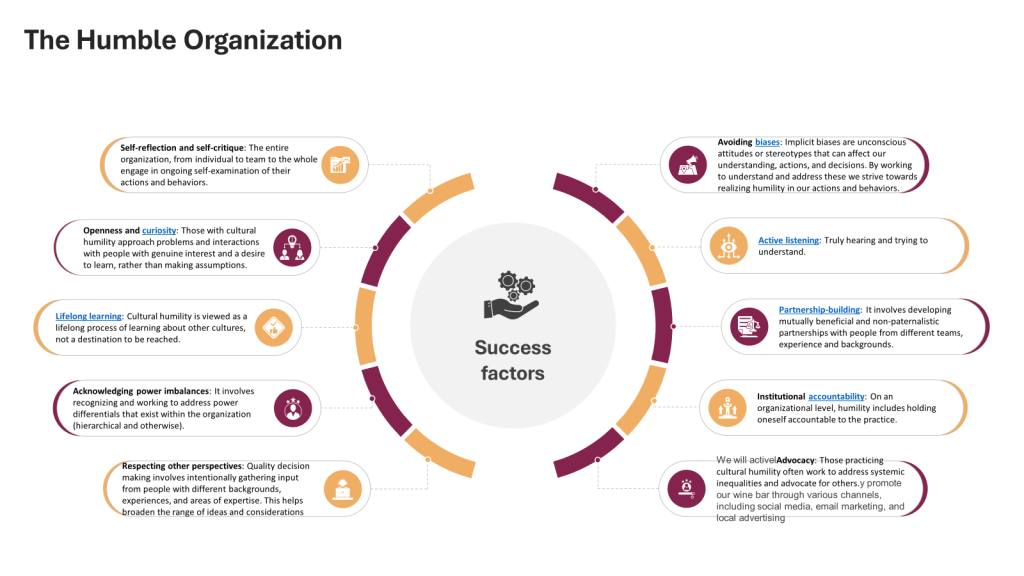
Cultural humility involves several key characteristics and behaviors:

  1. Self-reflection and self-critique: The entire organization, from individual to team to the whole engage in ongoing self-examination of their actions and behaviors.
  2. Openness and curiosity: Those with cultural humility approach problems and interactions with people with genuine interest and a desire to learn, rather than making assumptions.
  3. Lifelong learning: Cultural humility is viewed as a lifelong process of learning about other cultures, not a destination to be reached.
  4. Acknowledging power imbalances: It involves recognizing and working to address power differentials that exist within the organization (hierarchical and otherwise).
  5. Respecting other perspectives: Quality decision making involves intentionally gathering input from people with different backgrounds, experiences, and areas of expertise. This helps broaden the range of ideas and considerations
  6. Avoiding biases: Implicit biases are unconscious attitudes or stereotypes that can affect our understanding, actions, and decisions. By working to understand and address these we strive towards realizing humility in our actions and behaviors.
  7. Active listening: Truly hearing and trying to understand.
  8. Partnership-building: It involves developing mutually beneficial and non-paternalistic partnerships with people from different teams, experience and backgrounds.
  9. Institutional accountability: On an organizational level, humility includes holding oneself accountable to the practice.
  10. Advocacy: Those practicing cultural humility often work to address systemic inequalities and advocate for others.
Leadership Behaviors

Humble leaders exhibit the following behaviors:

  1. Admitting limitations and mistakes
  2. Appreciating others’ strengths and contributions
  3. Being open to new ideas and feedback
  4. Listening before speaking
  5. Encouraging employees to keep trying and viewing mistakes as learning opportunities
  6. Taking responsibility for employees’ mistakes
  7. Modeling openness and fallibility
  8. Maintaining a collective focus

Cultural Attributes

A work culture with humble leadership is characterized by:

  1. Openness to new ideas and continuous learning
  2. Appreciation for diverse perspectives and contributions
  3. Reduced fear of taking interpersonal risks
  4. High-quality interpersonal relationships
  5. Collective humility within teams
  6. Trust between leaders and team members
  7. Inclusivity and reduced power differentials
  8. Emphasis on growth and development rather than blame

Employee Perceptions and Behaviors

In a humble environment, employees are more likely to:

  1. Feel safe expressing themselves and taking risks
  2. Believe in their ability to contribute constructively
  3. Engage in voice behaviors and share ideas
  4. Show themselves freely without fear of adverse consequences
  5. Imitate leaders in showing their own shortcomings and appreciating others
  6. Perceive making mistakes as acceptable
  7. Experience increased job satisfaction and reduced turnover intentions

Organizational Practices

To cultivate humility and psychological safety, organizations can:

  1. Develop policies and practices that promote diversity, equity, and inclusion
  2. Create an inclusive climate for errors and mutual assistance
  3. Implement leadership development programs focused on humble behaviors
  4. Encourage open dialogue and social relationships in teams
  5. Foster an error management climate that doesn’t punish mistakes but learns from them

What to Do When You Realize You’ve Made a Mistake

  1. Take responsibilitySay, “I was wrong.” (Don’t say “mistakes were made” or “it didn’t turn out the way I had anticipated” or any other version that deflects or minimizes your personal contribution). Offer a brief explanation, but do not make excuses. Acknowledge that your error had a negative impact on others, and be willing to really listen, without defensiveness, to others’ recounting of that impact. Do not interrupt. Apologize.
  2. Address what you need to do right now. Taking responsibility is critical, as is taking action. This is core to crisis communication, even if your mistake doesn’t constitute a major crisis. Tell others what you are doing right now to remedy the mistake, and distinguish between the parts that can be fixed, and those that can’t. Include what you are doing to address the substantive impact (money, time, processes, etc.) and well as the relational impact (feelings, reputation, trust, etc.) of having been wrong. Be open to feedback about what you’re doing. Over-communicate your plans.
  3. Share what you will do differently next time. Being wrong is messy. Being wrong without self-reflection is irresponsible, even if you hate self-reflection. Take some time to think about what your contribution was to this situation, and identify how others contributed as well. (Try to stay away from using words like “fault” or “blame” — which tend to put people on the defensive.) Then tell those impacted by your error what you’ve learned about yourself, and what you’re going to do differently in the future. For example, you might recognize that you tend to dismiss the input of someone you don’t see eye-to-eye with, and that in the future, you’re going to actively engage her, and consider her perspective. Ask for help where you need it. And ask others to give you frequent feedback down the road on the commitments you’re making.

Continual reminders to myself to do better.

Photo by George Becker on Pexels.com

Building Situational Humility

The biggest thing I am working on is situational humility. How do I successfully balance the subject matter expertise my organization needs with the humility to truly lead? It is clear that such humility is critical to building psychological safety, and psychological safety is critical to building innovative teams.

Amy Edmondson’s powerful talk on psychological safety and teams

For most of my career I’ve been prized for my subject matter expertise, but there are huge limits, no one can know everything, so I am cultivating the following behaviors in my practices.

To build Humility do thisWhich meansAnd I do this
Know what you don’t knowResist “master of the universe” impulses. You may yourself excel in an area, but as a leader you are, by definition, a generalist. Rely on those who have relevant qualification and expertise. Know when to defer and delegate.I have a list of key topics that are both in my space and overlap and individuals who involving in the discussion is critical.

I’ve created a “swear jar” for every time I say something like “I have an answer” and at this rate I’ll be taking a lot of people out for drinks by the time this pandemic is over. It is all IOUs right now because I don’t remember the last time I used cash and I don’t think I’ve seen a dollar bill in 11 months.
Resist falling for your own publicityWe all put the best spin on our success — and then conveniently forget that the reality wasn’t as flawless. This is an interesting one for me. Having joined a new company 10 months ago it has been important to avoid the spin on my joining, and to not exacerbate it.

I’ve taken to keeping a list of problems and who is the right people who are not me that can solve them.
Never underestimate others The world is filled with other hard-working, knowledgable, and creative professionalsI purposely look for opportunities to meet with folks at all levels and ask them to collaborate.
Embrace and promote a spirit of serviceFocus on finding ways to help others to succeedI’m all about the development. Crucial for me here is stepping back and letting others lead, even if its more work for me as I spend more time coaching and mentoring than would actually take to do the job. But lets be honest, can’t and shouldn’t do anything.
Listen, even (no, especially) to the weird ideasOnly when you are not convinced that your idea is or will be better than someone else’s do you really open your ears to what they are saying. But there is ample evidence that you should: the most imaginative and valuable ideas tend to come from left field, from some associate who seems a little offbeat, and may not hold an exalted position in the organization.I love the weird, though maybe most when they are my weird ideas. Been working to strengthen idea management as a concept and practice in my organization.
Be passionately curiousConstantly welcome and seek out new knowledge, and insist on curiosity from those around you. Research has found linkages between curiosity and many positive leadership attributes (including emotional and social intelligence). Take it from Einstein. “I have no special talent,” he claimed. “I am only passionately curious.”I’m a voracious reading machine, its always been a central skill.

How I am trying to teach others to be curious and turn it to their advantage.
Elements of Situational Humility
Photo by rob walsh on Unsplash