Coherence and Quality

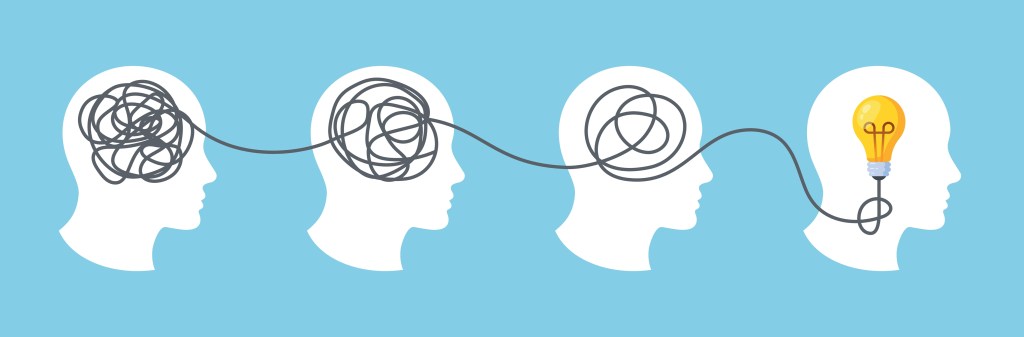
Sonja Blignaut on More Beyond wrote a good post “All that jazz … making coherence coherent” on coherence where she states at the end “In order to remain competitive and thrive in the new world of work, we need to focus our organization design, leadership and strategic efforts on the complex contexts and create the conditions for coherence. “

Ms. Blignaut defines coherence mainly through analogy and metaphor, so I strongly recommend reading the original post.

In my post “Forget the technology, Quality 4.0 is all about thinking” I spelled out some principles of system design.

PrincipleDescription
BalanceThe system creates value for the multiple stakeholders. While the ideal is to develop a design that maximizes the value for all the key stakeholders, the designer often has to compromise and balance the needs of the various stakeholders.
CongruenceThe degree to which the system components are aligned and consistent with each other and the other organizational systems, culture, plans, processes, information, resource decisions, and actions.
ConvenienceThe system is designed to be as convenient as possible for the participants to implement (a.k.a. user friendly). System includes specific processes, procedures, and controls only when necessary.
CoordinationSystem components are interconnected and harmonized with the other (internal and external) components, systems, plans, processes, information, and resource decisions toward common action or effort. This is beyond congruence and is achieved when the individual components of a system operate as a fully interconnected unit.
EleganceComplexity vs. benefit — the system includes only enough complexity as is necessary to meet the stakeholder’s needs. In other words, keep the design as simple as possible and no more while delivering the desired benefits. It often requires looking at the system in new ways.
HumanParticipants in the system are able to find joy, purpose and meaning in their work.
LearningKnowledge management, with opportunities for reflection and learning (learning loops), is designed into the system. Reflection and learning are built into the system at key points to encourage single- and double-loop learning from experience to improve future implementation and to systematically evaluate the design of the system itself.
SustainabilityThe system effectively meets the near- and long-term needs of the current stakeholders without compromising the ability of future generations of stakeholders to meet their own needs.

I used the term congruence to summarize the point Ms. Blignaut is reaching with alignment and coherence. I love her putting these against the Cynefin framework, it makes a great of sense to see alignment for the obvious domain and the need for coherence driving from complexity.

So what might a drive for coherence look like? Well if we start with coherence being the long-range order (the jazz analogy) we are building systems that build order through their function – they learn and are sustainable.

To apply this in the framework of ICHQ10 or the US FDA’s “Guidance for Industry Quality Systems Approach to Pharmaceutical CGMP Regulations” one way to drive for coherence is to use similar building blocks across our systems: risk management, data integrity, and knowledge management are all examples of that.

Document Management

Today many companies are going digital, striving for paperless, reinventing how individuals find information, record data and make decisions. It is often good when undergoing these decisions to go back to basics and make sure we are all on the same page before we proceed.

There are three major types/functions of documents:

  • Functional Documents provide instructions so people can perform tasks and make decisions safely effectively, compliantly and consistently. This usually includes things like procedures, process instructions, protocols, methods and specifications. Many of these need some sort of training decision. Functional documents should involve a process to ensure they are up-to-date, especially in relation to current practices and relevant standards (periodic review)
  • Records provide evidence that actions were taken and decisions were made in keeping with procedures. This includes batch manufacturing records, logbooks and laboratory data sheets and notebooks. Records are a popular target for electronic alternatives.
  • Reports provide specific information on a particular topic on a formal, standardized way. Reports may include data summaries, findings and actions to be taken.

Often times these types are all engaged in a lifecycle. An SOP directs us to write a protocol (two documents), we execute the protocol (a record) and then write a report. This fluidity allows us to combine the types.

Throughout these types we need to apply good change management and data integrity practices (ALCOA).

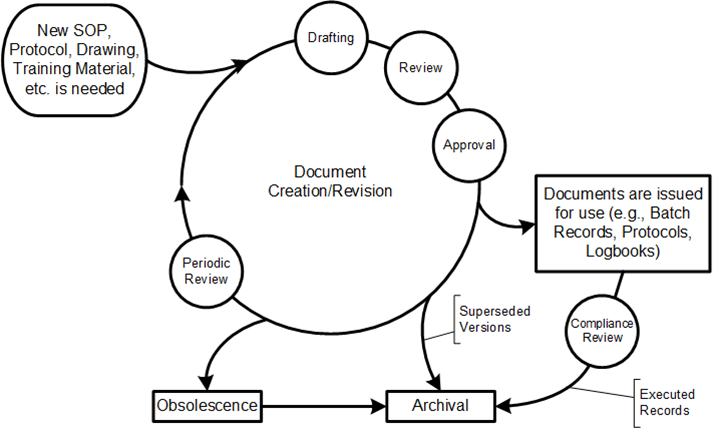
All of these types follow a very similar path for their lifecycle.

document lifecycle

Everything we do is risk based. Some questions to ask when developing and improving this system include:

  • What are the risks of writing procedures at a “low level of detail versus a high level of detail) how much variability do we allow individuals performing a task?) – Both have advantages, both have disadvantages and it is not a one-sized fits all approach.
  • What are the risks in verifying (witnessing) non-critical tasks? How do we identify critical tasks?
  • What are the risks in not having evidence that a procedure-defined task was completed?
  • What are the risks in relation to archiving and documentation retrieval?

There is very little difference between paper records and documents and electronic records and documents as far as what is given above. Electronic records require the same concerns around generation, distribution and maintenance. Just now you are looking at a different set of safeguards and activities to make it happen.