In the Kilpatrick model, a level 2 assessment measures how much individuals learned. It is asking did the learners actually learn what we wanted them to learn? Did we actually advance knowledge?
For many of us, the old go-to is the multiple-choice quiz.
If we actually want to assess a learner’s ability to do something or think critically about a topic, a multiple-choice quiz isn’t going to work. This isn’t to say that a multiple-choice quiz can’t be challenging, but the focus of a multiple-choice quiz is on the learner’s understanding of the content, not on the learner’s knowledge of how to apply the content to a variety of different contexts.
Say we are designing a root cause analysis course. By the end of the course, your learners should be able to understand some core principles of root cause analysis so that they can perform better investigations, find root causes and determine appropriate CAPAs. While there may be some inherently wrong approaches to root cause analysis that could be assessed in a multiple-choice quiz, a skilled investigator will likely not be dealing with obvious “right” and “wrong” ways to identify causes. Most investigations require complex interactions with people. As such, there may be multiple decisions an investigator needs to make and, within the scope of a course, it could be really hard to identify what skills a budding investigator needs to develop through multiple-choice quizzes alone.
So, what kinds of assessments could you use beyond multiple-choice quizzes and when should you use them? There’s a lot of complexity to these choices which ultimately need to align what you want people in the course to learn with how you think they can best demonstrate evidence of that learning.
Assessment Instrument
When to use it
Example
Multiple-Choice Quiz or Exam
To assess a learner’s understanding of a concept, definition, or specific process. Could also be used to assess responses or reactions to a scenario-based question if there are clear “right” or “wrong” responses.
Understanding of core concepts of root cause analysis. Simple branching choices, for example what tool to use when.
Open-Ended Questions
To assess a learner’s ability to interpret and apply a new idea. Could also be used to assess a learner’s ability to describe an approach to a process or problem.
Demonstrate knowledge of root cause analysis techniques through various practice exercises.
Long-Form Written Assignment
To assess a learner’s ability to make an argument, analyze a text or current event, or use outside evidence to inform a particular claim. Could also be used to assess a learner’s understanding of how to produce a piece of writing specific to a particular field or discipline (for example, a lab report in a lab sciences context or a policy memo in a public policy context).
Write an analysis and investigation report up from a example.
Project
To assess a learner’s ability to make a new product and apply skills learned to build an independent work. Could also be used to assess a learner’s understanding of how to create a field-specific artifact.
Conduct a root cause analysis from an exercise.
On the job training.
Portfolio
To assess a learner’s ability to grow, revise, and create a body of work over a particular period of time.
Review of investigations on periodic basis
Assessment Types
A lot of learning experiences will implement a combination of these types of assessments in a course, and it’s likely that at different phases of your course and for different purposes, you will need to select more than one assessment or evaluation method.
Remember that an assessment serves two additional purposes: It helps the learners recognize where they are in the course so that they have an understanding of the progress, and it helps you, as the facilitator, see what challenges and triumphs the learners are experiencing all the way throughout the course.
Does training in your organization seem like death by PowerPoint? Is learning viewed as something an expert dumps in the lap of the learner.? However, that’s not what learning is – lectures and one-way delivery end up resulting in very little learning.
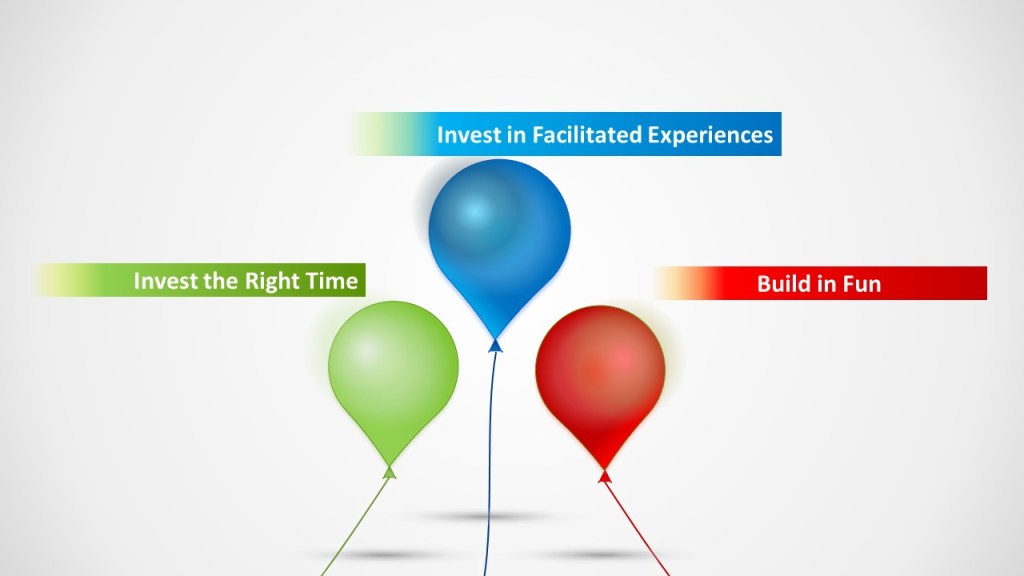
For deeper meaning to occur, invest in professionally facilitated experiences that enable staff to form mental models they remember. Get people thinking before and after the training to ensure that the mental model stays fresh in the mind.
Culture of Cutting Time
Avoid the desire for training in shorter and shorter chunks. The demands of the workplace are increasingly complex and stressful, so any time out of the office is a serious cost. The paradox is that by shortening the training, we don’t give the time for structured learning, which sabotages the investment when the training program could be substantially improved by adding the time to allow the learning to be consolidated.
We know that learning takes place when people have fun, stress is low, and the environment encourages discovery. Make training cheerful and open rather than dull and quiet. Encourage lots of informal learning opportunities. Give more control to the learner to shape their experience. Have fun!
As part of his model for Proxies for Work-as-Done, Steven Shorrock covers Work-as-Instructed. I think the entire series is salient to the work of building a quality organization, so please spend the time to read the entire series. You’ll definitely see inspiration in many of the themes I’ve been discussing.
When designing training we want to make sure four things happen:
Training is used correctly as a solution to a performance problem
Training has the the right content, objectives or methods
Trainees are sent to training for which they do have the basic skills, prerequisite skills, or confidence needed to learn
Training delivers the expected learning
Training is a useful lever in organization change and improvement. We want to make sure the training drives organization metrics. And like everything, you need to be able to measure it to improve.
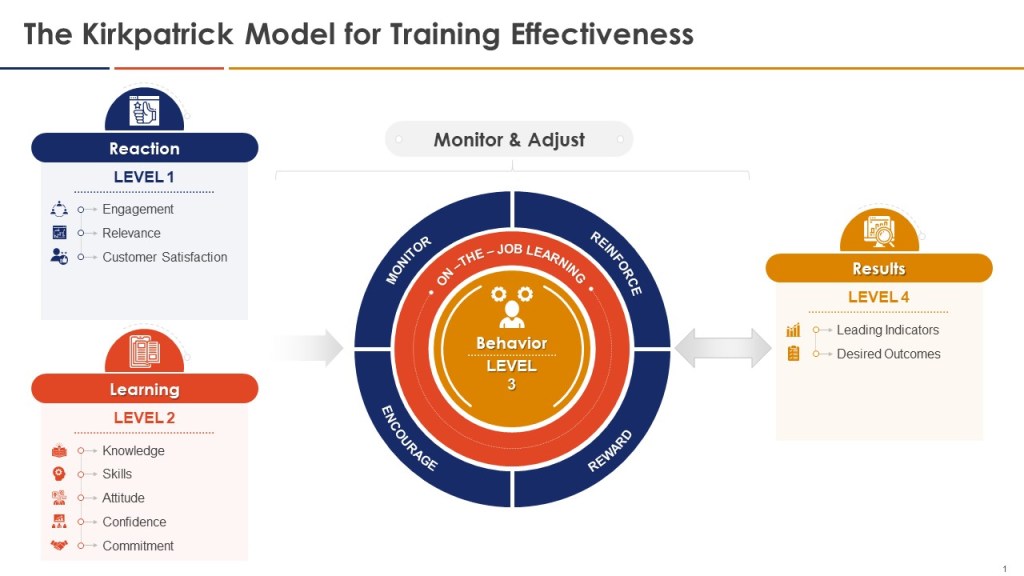
The Kirkpatrick model is a simple and fairly accurate way to measure the effectiveness of adult learning events (i.e., training), and while other methods are introduced periodically, the Kirkpatrick model endures because of its simplicity. The model consists of four levels, each designed to measure a specific element of the training. Created by Donald Kirkpatrick, this model has been in use for over 50 years, evolving over multiple decades through application by learning and development professionals around the world. It is the most recognized method of evaluating the effectiveness of training programs. The model has stood the test of time and became popular due to its ability to break down complex subject into manageable levels. It takes into account any style of training, both informal and formal.
Level 1: Reaction
Kirkpatrick’s first level measures the learners’ reaction to the training. A level 1 evaluation is leveraging the strong correlation between learning retention and how much the learners enjoyed the time spent and found it valuable. Level 1 evaluations, euphemistically called a “smile sheet” should delve deeper than merely whether people liked the course. A good course evaluation will concentrate on three elements: course content, the physical environment and the instructor’s presentation/skills.
Level 2: Learning
Level 2 of Kirkpatrick’s model, learning, measures how much of the content attendees learned as a result of the training session. The best way to make this evaluation is through the use of a pre- and posttest. Pre- and posttests are key to ascertaining whether the participants learned anything in the learning event. Identical pre- and posttests are essential because the difference between the pre- and posttest scores indicates the amount of learning that took place. Without a pretest, one does not know if the trainees knew the material before the session, and unless the questions are the same, one cannot be certain that trainees learned the material in the session.
Level 3: Behavior
Level 3 measures whether the learning is transferred into practice in the workplace.
Level 4: Results
Measures the effect on the business environment. Do we meet objectives?
Evaluation Level
Characteristics
Examples
Level 1: Reaction
Reaction evaluation is how the delegates felt, and their personal reactions to the training or learning experience, for example: ▪ Did trainee consider the training relevant? ▪ Did they like the venue, equipment, timing, domestics, etc? ▪ Did the trainees like and enjoy the training? ▪ Was it a good use of their time? ▪ Level of participation ▪ Ease and comfort of experience
▪ feedback forms based on subjective personal reaction to the training experience ▪ Verbal reaction which can be analyzed ▪ Post-training surveys or questionnaires ▪ Online evaluation or grading by delegates ▪ Subsequent verbal or written reports given by delegates to managers back at their jobs ▪ typically ‘happy sheets’
Level 2: Learning
Learning evaluation is the measurement of the increase in knowledge or intellectual capability from before to after the learning experience: ▪ Did the trainees learn what intended to be taught? ▪ Did the trainee experience what was intended for them to experience? ▪ What is the extent of advancement or change in the trainees after the training, in the direction or area that was intended?
▪ Interview or observation can be used before and after although it is time-consuming and can be inconsistent ▪ Typically assessments or tests before and after the training ▪ Methods of assessment need to be closely related to the aims of the learning ▪ Reliable, clear scoring and measurements need to be established ▪ hard-copy, electronic, online or interview style assessments are all possible
Level 3: Behavior
Behavior evaluation is the extent to which the trainees applied the learning and changed their behavior, and this can be immediately and several months after the training, depending on the situation: ▪ Did the trainees put their learning into effect when back on the job? ▪ Were the relevant skills and knowledge used? ▪ Was there noticeable and measurable change in the activity and performance of the trainees when back in their roles? ▪ Would the trainee be able to transfer their learning to another person? is the trainee aware of their change in behavior, knowledge, skill level? ▪ Was the change in behavior and new level of knowledge sustained?
▪ Observation and interview over time are required to assess change, relevance of change, and sustainability of change ▪ Assessments need to be designed to reduce subjective judgment of the observer ▪ 360-degree feedback is useful method and need not be used before training, because respondents can make a judgment as to change after training, and this can be analyzed for groups of respondents and trainees ▪ Online and electronic assessments are more difficult to incorporate – assessments tend to be more successful when integrated within existing management and coaching protocols
Level 4: Results
Results evaluation is the effect on the business or environment resulting from the improved performance of the trainee – it is the acid test
Measures would typically be business or organizational key performance indicators, such as: volumes, values, percentages, timescales, return on investment, and other quantifiable aspects of organizational performance, for instance; numbers of complaints, staff turnover, attrition, failures, wastage, non-compliance, quality ratings, achievement of standards and accreditations, growth, retention, etc.
The challenge is to identify which and how relate to the trainee’s input and influence. Therefore it is important to identify and agree accountability and relevance with the trainee at the start of the training, so they understand what is to be measured ▪ This process overlays normal good management practice – it simply needs linking to the training input ▪ For senior people particularly, annual appraisals and ongoing agreement of key business objectives are integral to measuring business results derived from training
4 Levels of Training Effectiveness
Example in Practice – CAPA
When building a training program, start with the intended behaviors that will drive results. Evaluating our CAPA program, we have two key aims, which we can apply measures against.
To support each of these top-level measures we define a set of behavior indicators, such as cycle time, right the first time, etc. To support these, a review rubric is implemented.
Our four levels to measure training effectiveness will now look like this:
Level
Measure
Level 1: Reaction
Personal action plan and a happy sheet
Level 2: Learning
Completion of Rubric on a sample event
Level 3: Behavior
Continued performance and improvement against the Rubric and the key review behavior indicators
Level 4: Results
Improvements in % of recurring issues and an increase in preventive to corrective actions
This is all about measuring the effectiveness of the transfer of behaviors.
Strong Signals of Transfer Expectations in the Organization
Signals that Weaken Transfer Expectations in the Organization
Training participants are required to attend follow-up sesions and other transfer interventions.
What is indicates: Individuals and teams are committed to the change and obtaining the intended benefits.
Attending the training is compulsory, but participating in follow-up sessions or oter transfer interventions is voluntary or even resisted by the organization.
What is indicates: They key factor of a trainee is attendance, not behavior change.
The training description specifies transfer goals (e.g. “Trainee increases CAPA success by driving down recurrence of root cause”)
What is indicates: The organization has a clear vision and expectation on what the training should accomplish.
The training description roughly outlines training goals (e.g. “Trainee improves their root cause analysis skills”)
What is indicates: The organization only has a vague idea of what the training should accomplish.
Supervisors take time to support transfer (e.g. through pre- and post-training meetings). Transfer support is part of regular agendas.
What is indicates: Transfer is considered important in the organization and supported by supervisors and managers, all the way to the top.
Supervisors do not invest in transfer support. Transfer support is not part of the supervisor role.
What is indicates: Transfer is not considered very important in the organziaiton. Managers have more important things to do.
Each training ends with careful planning of individual transfer intentions.
What is indicates: Defining transfer intentions is a central component of the training.
Transfer planning at the end of the training does not take place or only sporadically.
What is indicates: Defining training intentions is not (or not an essential) part of the training.
Good training, and thus good and consistent transfer, builds that into the process. It is why I such a fan of utilizing a Rubric to drive consistent performance.
(a) Each person engaged in the manufacture, processing, packing, or holding of a drug product shall have education, training, and experience, or any combination thereof, to enable that person to perform the assigned functions. Training shall be in the particular operations that the employee performs and in current good manufacturing practice (including the current good manufacturing practice regulations in this chapter and written procedures required by these regulations) as they relate to the employee’s functions. Training in current good manufacturing practice shall be conducted by qualified individuals on a continuing basis and with sufficient frequency to assure that employees remain familiar with CGMP requirements applicable to them.
(b) Each person responsible for supervising the manufacture, processing, packing, or holding of a drug product shall have the education, training, and experience, or any combination thereof, to perform assigned functions in such a manner as to provide assurance that the drug product has the safety, identity, strength, quality, and purity that it purports or is represented to possess.
(c) There shall be an adequate number of qualified personnel to perform and supervise the manufacture, processing, packing, or holding of each drug product.
US FDA 21CFR 210.25
All parts of the Pharmaceutical Quality system should be adequately resourced with competent personnel, and suitable and sufficient premises, equipment and facilities.
EU EMA/INS/GMP/735037/201 2.1
The organization shall determine and provide the resources needed for the establishment, implementation, maintenance and continual improvement of the quality management system. The organization shall consider:
a) the capabilities of, and constraints on, existing internal resources; b) what needs to be obtained from external providers.
ISO 9001:2015 requirement 7.1.1
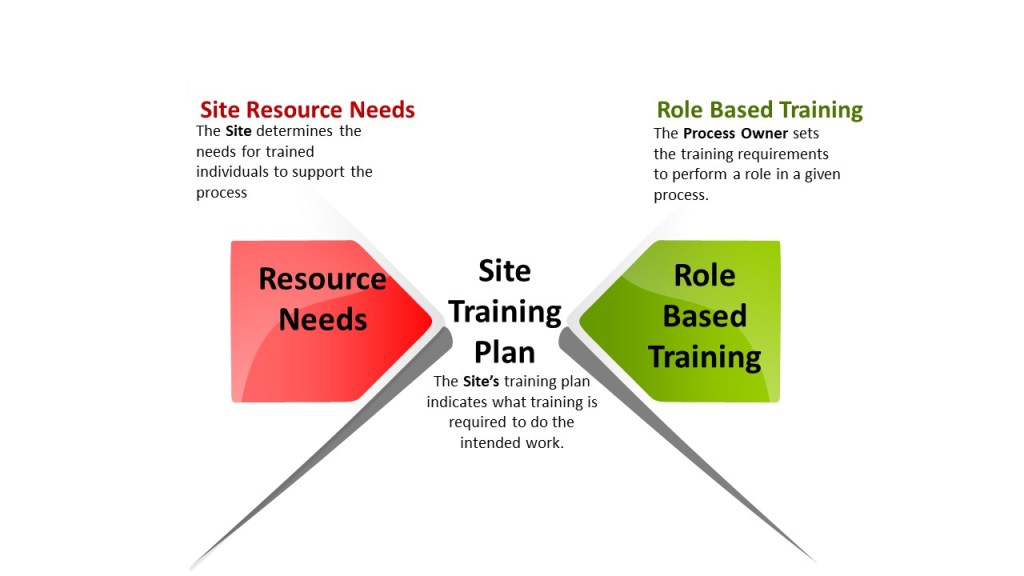
It is critical to have enough people with the appropriate level of training to execute their tasks.
It is fairly easy to define the individual training plan, stemming from the job description and the process training requirements. In the aggregate we get the ability to track overdue training, and a forward look at what training is coming due. Quite frankly, lagging indicators that show success at completing assigned training but give no insight to the central question – do we have enough qualified individuals to do the work?
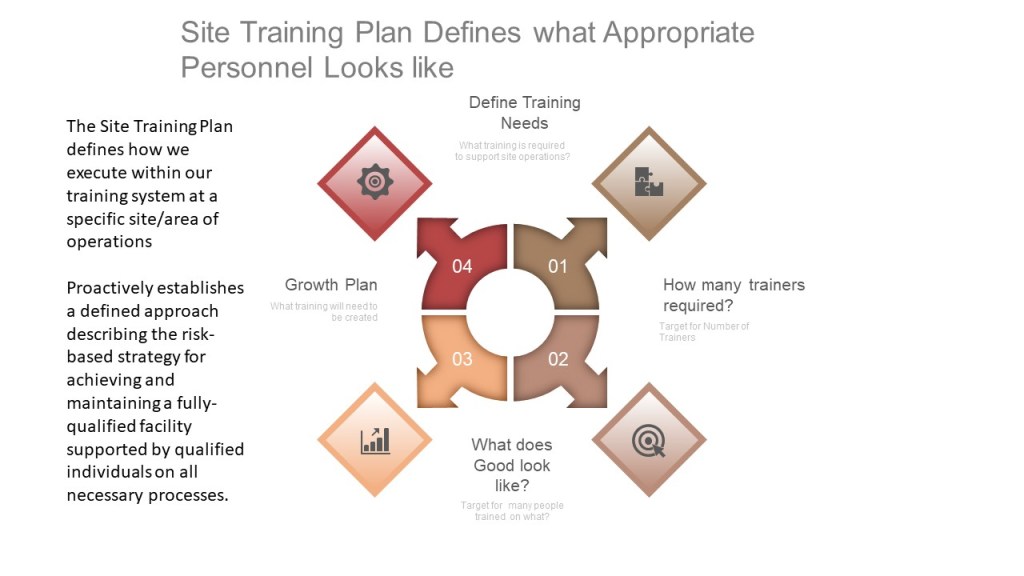
To get this proactive, we start with the resource plan. What operations need to happen in a time frame and what are the resources needed. We then compare that to the training requirements for those operations.
We can then evaluate current training status and retention levels and determine how many instructors we will need to ensure adequate training.
We perform a gap assessment to determine what new training needs exist
We then take a forward look at what new improvements are planned and ensure appropriate training is forecasted.
Now we have a good picture of what an “adequate number” is. We can now set a leading KPI to ensure that training is truly proactive.

 Investigations of a Dog