
Procedure is Work-as-Prescribed

Written procedures with their step-by-step breakdown are a fundamental tool for ensuring quality through consistent execution of the work. As a standardized guideline for tasks, procedures serve many additional purposes: basis of training, ensuring regulatory requirements are met, ensuring documentation is prepared and handled correctly.

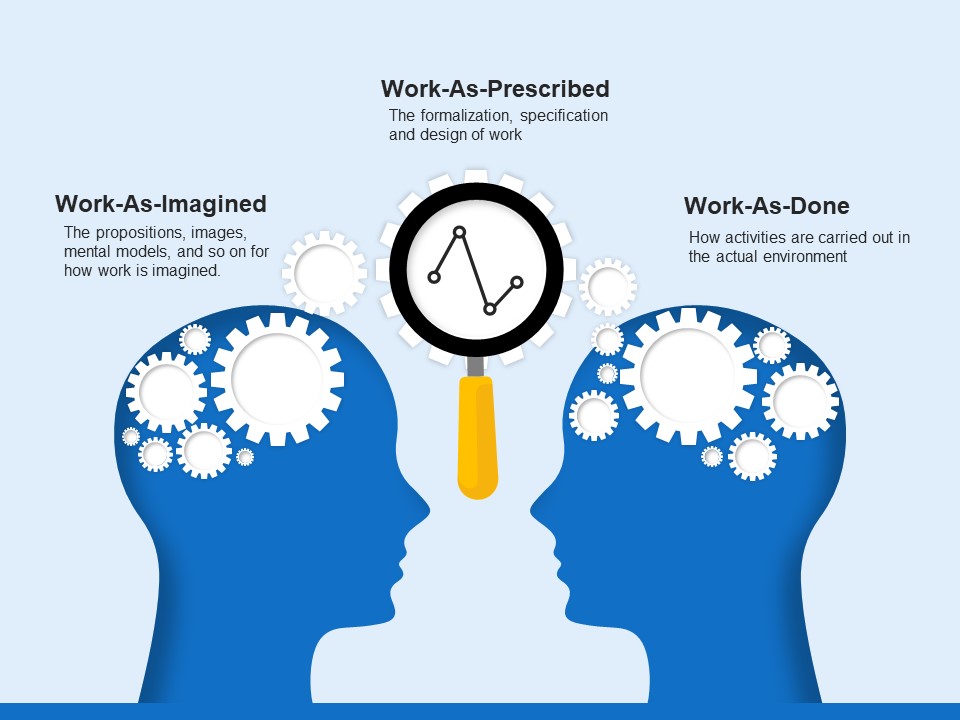
As written prescriptions of how work is to be performed, they can be based on abstract and often decontextualized expectations of work. The writers of the procedures are translating Work-as-Imagined. As a result, it is easy to write from a perspective of ideal and stable conditions for work and end up ignoring the nuances introduced by the users of procedures and the work environment.

The day-to-day activities where the procedures are implemented is Work-as-Done. Work-is-Done is filled with all the factors that influence the way tasks are carried out – spatial and physical conditions; human factors such as attention, memory, and fatigue; knowledge and skills.

Ensuring that our procedures translate from the abstraction of Work-as-Imagined to the realities of Work-as-Done as closely as possible is why we should engage in step-by-step real-world challenge as part of procedure review.

Steven Shorrock calls this procedural level “Work-as-Prescribed.”

Work-as-Prescribed gives us the structure to take a more dynamic view of workers, the documents they follow, and the procedural and organizational systems in which they work. Deviations from Work-as-Prescribed point-of-view are not exclusively negative and are an ability to close the gap. This is a reason to closely monitor causes such as “inadequate procedure” and “failure to follow procedure” – they are indicators of a drift between Work-as-Prescribed and Work-as-Done. Management review will often highlight a disharmony with Work-As-Imagined.

The place where actions are performed in real-world operations is called, in safety thinking, the sharp-end. The blunt-end is management and those who imagine work, such as engineers, removed from doing the work.

Our goal is to shrink the gap between Work-as-Imagined and Work-as-Done through refining the best possible Work-as-Prescribed and reduce the differences between the sharp and the blunt ends. This is why we stress leadership behaviors like Gemba walks and ensure a good document change process that strives to give those who use procedure a greater voice and agency.
Quality-as-Imagined versus Quality-as-Done

Assumptions about how work is carried out is often very different from the reality of the work. This is the difference between work-as-imagined and work-as-done. Assumptions about work as imagined often turn out to be wrong because they are based on a fundamental misunderstanding. Steven Shorrock on Humanistic Systems has been doing a great series on proxies for work-as-done that I recommend you read for more details.

The complexity of our organizations implies a certain level of inevitable unexpected variability and thus a gap between Work-as-Imagined and Work-as-Done. Work-as-Imagined reflects how work is understood by those who are separated from it by time or space; it is an over-simplified version of what is actually going on. Work-as-Done takes account of what it means to function effectively, despite resource-constrained circumstances. The analysis of the gap between Work-As-Imagined and Work-as-Done usually indicates that performance variability is present in both desired and undesired outcomes and, therefore, successful outcomes do not necessarily occur because people are behaving according to Work-as-Imagined.

The same concept applies to the nature and implications of the gap between the prescribed quality practices and policies, Quality-as-Imagined, and the way they are deployed in practice, Quality-as-Done.

This gap should be no surprise. Our organizations are complex systems, and complexity can give rise to unintended consequences.

The interesting thing is that quality can drive a reduction of that gap, solving for complexity.

The Influence of Complexity on Quality
Dynamic InteractionsWide DiversityUnexpected VariabilityResilience
SocialInteractions between employeesEmployees with varying skill levels
Employee turnover
Diversity of functions performed by employees
(e.g. multiskilling)
Errors when operating equipment and tools
Unexpected behaviors
Absenteeism
Variability in human labor demand
Unexpected outcomes from
social interactions (e.g. conflicts and alliances)
Employees’ ability to
anticipate risks
Critical analysis of data
Informal agreements between workers to distribute the workload
TechnicalInteractions between production resources
Interactions due to tightly coupled operations (e.g. time constraints, low inventories, capacity constraints)
Product diversity
Diversity of quality requirements
Diversity of client requirements
Technical disruptions
Resource availability (e.g. maintenance staff)
Variability in production times (e.g. cycle time, lead time)
Dimensional variability (e.g. potential for defects)
Inspection readiness
Corrective, preventive and predictive measures
Work OrganizationInteractions between information sources
Interactions between functions
Interactions between processes
Interactions between performance indicators
Diversity in managerial controls
Diversity in relationships with external agents
Diversity of rules and procedures
Variability in the hiring of new workers
Changing priorities (e.g. frequent rescheduling due to unexpected conditions)
Variability in timing and
accuracy of information
Negotiation, partnership and bargaining power with suppliers and clients
Investments on new resources
Multidisciplinary problem-solving meetings
External EnvironmentInteractions between the organization, suppliers, and clients
Interactions with regulatory bodies
Diversity in suppliers
Diversity in clients
Variability in Demand/Need
Variability in logistics
Capacity and slack management
Examples of Complexity Impact