Cultivating expertise, in short learning, is critical to building a quality culture. Yet, the urgency of work easily trumps learning. It can be difficult to carve out time for learning in the inexorable flow of daily tasks. We are all experienced with the way learning ends up being in the lowest box on the 2×2 Eisenhower matrix, or however you like to prioritize your tasks.
For learning to really happen, it must fit around and align itself to our working days. We need to build our systems so that learning is an inevitable result of doing work. There are also things we as individuals can practice to make learning happen.
What we as individuals can do
Practice mindfulness. As you go about your daily job be present and aware, using it as an opportunity to ability to learn and develop. Don’t just sit in on that audit; notice and learn the auditor’s tactics and techniques as you engage with her. Ask product managers about product features; ask experts about industry trends; ask peers for feedback on your presentation skills. These kinds of inquiries are learning experiences and most peers love to tell you what they know.
Keep a to-learn list. Keep a list of concepts, thoughts, practices, and vocabulary you want to explore and then later later explore them when you have a few moments to reflect. Try to work a few off the list, maybe during your commute or at other times when you have space to reflect.
Build learning into your calendar. Many of us schedule email time, time for project updates, time to do administrative work. Make sure you dedicate time for learning.
Share meaningfully. Share with others, but just don’t spread links. Discuss why you are sharing it, what you learned and why you think it is important. This blog is a good example of that.
What we can build into our systems
Make sure our learning and knowledge management systems are built into everything we do. Make them easy to use. Ensure content is shared internally and leads to continuous improvement.
Plan for short-term wins. There is no nirvana, no perfect state. Ensure you have lots of little victories and shareable moments. Plan for this as part of your schedules and cycles.
Learning is a very effective lever for system improvement. At the very least it gives us the power to “add, change, evolve or self-organize system structure” (lever 4) and can also start giving us ways to change the paradigm (lever 2) and eventually even transcend paradigms (lever 1).
Many of us have had, or given, a talk about how we can learn from children in how to communicate, whether it is being thoughtful in our relationships or learning to adapt and be resilient, or some other point.
What we are really talking about how communicating empathetically is essential, including to building a quality culture and it is a key part of change management. People need to feel respected and have a sense of self-worth in order to be motivated, confident, innovative, and committed to their work and to appropriately engage in quality culture.
I am not going to pretend to be an expert on empathy. I think it is fair to say that is still (always) one of my key development areas. That said, I think a core skill of any quality leader is that of giving feedback.
People
need to feel respected and have a sense of self-worth in order to be motivated,
confident, innovative, and committed to their work.
To
provide good feedback focus on doing the following:
Focus on facts.
Respect and support others. Even when people aren’t performing their best, they need to feel your support and to know that they’re valued.
Clarify motives. Don’t jump to conclusions. Keep others’ self-esteem in mind, and you’ll be more likely to ask, “What can you tell me about this error?” instead of, “Don’t you care about quality?”
When
someone has done a good job, succeeded at a task, or made a contribution, you
want to enhance that person’s self-esteem. Some ways to do that are to:
Acknowledge good thinking and ideas. Demonstrations of appreciation encourage people to think and contribute, and they support innovation and intellectual risk taking.
Recognize accomplishments. People need to hear specifically what they’ve done to contribute to the team’s or organization’s success. This encourages them to sustain or exceed expectations.
Express and show confidence. Voicing your trust and then calling on people to show what they can do boosts their confidence and their feelings of self-worth.
Be specific and sincere. When you describe in detail what people do well and why it’s effective, they know exactly what you’re recognizing.
Nothing
can deflate people’s confidence faster than telling them they’re responsible
for something, and then doing it yourself. Conversely, when you provide support
without removing responsibility, you build people’s sense of ownership of the
task or assignment as well as the confidence that they can accomplish it. When
you use this Key Principle, remember to:
Help others think and do. Provide your support in two ways: Help others think of ideas, alternatives, and solutions, then support them so that they can execute the plan.
Be realistic about what you can do and keep your commitments. Remember that you don’t have to do it all, but be sure to do whatever you agree to.
Resist the temptation to take over—keep responsibility where it belongs.
Many
quality individuals tend to be action oriented and task driven, so keeping
responsibility where it belongs can take resolve, even courage. You might have
to overcome the protests of a team member who is reluctant to stretch into new
areas or even brave objections from a key manager about your decision to
support others rather than take over.
Feedback Conversation Structure
Open
In the OPEN
step you ensure that the discussion has a clear purpose and that everyone understands
the importance of accomplishing it.
Always state purpose and importance clearly in the discussion opening.
If you initiate the discussion, explain what you would like to accomplish and why.
If someone else is leading the discussion, ask questions if necessary to pinpoint the purpose and importance.
Cite how accomplishing the purpose would benefit others in the discussion.
Ask if there are any related topics to discuss.
Clarify
There are two
types of information to seek and share in this step: facts and figures and
issues and concerns. Both are essential to building a complete picture of the
situation.
Facts and figures are the basic data and background information that people need to understand the situation and make informed decisions.
Exploring issues and concerns provides insight into potential barriers to achieving your purpose. It also helps reveal people’s feelings about the situation, which is valid, important information to gather.
Develop
When
developing ideas, it’s important to ask questions and include others in the
process. Most likely, you’ll have ideas about what to do, and you should share
them. However, you should put equal emphasis on seeking others’ ideas.
Involving people in thinking about alternative approaches can:
Spark their creative energy.
Result in more and better ideas than you alone could generate.
Build commitment to turning ideas into action.
Agree
It’s important that you and the people involved agree on a plan for
following through on the ideas that were developed and for supporting those who
will take action. During this step:
Specify
what will be done, who will do it, and by when.
Agree
on any follow-up actions needed to track progress in carrying out the plan.
Be
sure to agree on needed resources or support.
Close
This is the final chance to make sure that everyone is clear on
agreements and next steps and committed to following through. Closing
discussions involves a summary of actions and agreements as well as a check on
the person’s or team’s commitment to carrying them out.
ICH Q10 states , “Leadership is essential to establish and maintain a company-wide commitment to quality and for the performance of the pharmaceutical quality system.” One of the central roles of the Quality reviewer/approver is to provide leadership, driving each event/record/etc, and the system as a whole, to continually improve. Quality does this in three ways:
Ensuring the process is followed
Validating the decisions made
Creating a good history
Ensuring the process is followed
The quality review provides a coaching/mentoring opportunity
to build and/or enhance capabilities and behaviors and recognize and reinforce
desired behaviors.
Questions to Ask
1. What is the
process? What process and steps apply?
2. What is
expected? Look for: Standard work, expected state, variation to the expected
state
3. What is
working well? Look for: process being followed, ideas being generated, lessons
shared
4. What is not
being followed? Look for: variation to procedural requirements, poor technical
writing
Validating the decisions made
Quality is ultimately responsible for the decisions made. For
each decision we do the following:
Identify alternatives. Once you have a clear understanding of the record from ensuring the process was followed, it’s time to identify the various options for each decision.
Weigh the evidence. In this step, you’ll need to “evaluate for feasibility, acceptability and desirability” to know which alternative is best. It may be helpful to seek out a trusted second opinion to gain a new perspective on the issue at hand.
Choose among alternatives. When it’s time to make your decision, be sure that you understand the risks involved with your chosen route. You may also choose a combination of alternatives now that you fully grasp all relevant information and potential risks.
Take action. Ensure the quality system/process reflects the action.
Review your decision. An often-overlooked but important step in the decision making process is evaluating your decision for effectiveness. Ask yourself what you did well and what can be improved next time.
Creating a good history
If it Isn’t Written Down, then it Didn’t Happen” is a
guiding principle of the quality profession.
There are four major types of writing in quality: instructional, informational, persuasive and transactional. A well written event is both instructional and transactional.
Our quality systems record what happened, finalize recommendations and action plans, and to act as an archive. A well written report allows the reader to easily grasp the content and, if applicable, make informed decision. Report writing is a cornerstone of an Event/CAPA system (from incident identification to root cause through CAPA completion and effectiveness review), validation, risk management and so much more.
In short, reports are our stories, they form the narrative.
And how we tell that narrative determines how we think of an issue, and how we
will continue to think of it in the future.
According to the syllabus, the course will be set up with six modules:
Module 1: Overview and history of the FDA
Module 2: Drug development and approval
Module 3: Drug pricing in the United States
Module 4: Marketing strategies
Module 5: Post-approval evaluation
Module 6: Emerging medical technologies
Making sound strategic decisions is crucial for organizational success, however, human judgment can be unreliable, leading to errors that can significantly impact that success. To address this challenge, a structured approach to strategic decision-making is essential.
Organizations can be viewed as decision factories, where the primary output is not physical products, but rather judgments and choices that shape the company’s future. This perspective, popularized by thinkers like Daniel Kahneman, emphasizes the critical role of decision-making in organizational success.
In a decision factory, every employee is part of the production line, contributing to the quality and efficiency of decisions made. Just as a traditional factory focuses on optimizing its manufacturing processes, a decision factory must refine its decision-making processes to ensure high-quality outcomes. This involves carefully designing the organizational structure, clarifying decision rights, and establishing effective methodologies.
To improve the quality of decisions, organizations should focus on several key areas. First, they need to align their decision-making processes with their strategic direction, ensuring that decisions at all levels support the company’s overall goals. Second, they should implement robust methodologies and processes that facilitate evidence-based analysis. Finally, cultivating a culture that values data-driven insights, encourages diverse perspectives, and promotes accountability is crucial for maintaining a high-performing decision factory.
The Challenge of Evaluative Judgments
These quality decisions are fundamentally evaluative judgments. They require decision-makers to process large amounts of complex information and either:
Assign numerical scores to competing options
Make a yes-no decision on a specific course of action
These judgments are susceptible to errors stemming from cognitive biases and random variations, often referred to as “noise”. Recognizing this unreliability is the first step towards improving the decision-making process.
There are several really good tools, such as Multi-Criteria Decision-Making, to help drive to good decision making. The Mediating Assessments Protocol , a method from the book “Noise”, designed by Daniel Kahneman and Olivier Sibony, “with noise mitigation as a primary objective” is an excellent, if slightly simpler, tool that deserves to be in your toolbox.
The Mediating Assessments Protocol (MAP)
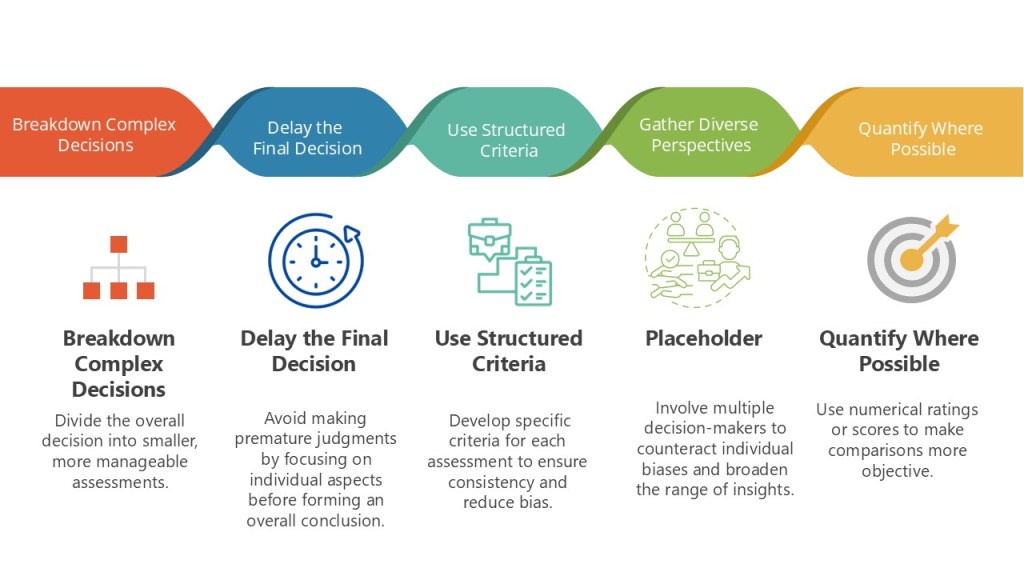
The Mediating Assessments Protocol (MAP) is a structured approach to strategic decision-making aims to reduce errors and improve the quality of judgments. I think this a good tool for the toolbox, as it:
Break down complex decisions: Divide the overall decision into smaller, more manageable assessments.
Delay the final decision: Avoid making premature judgments by focusing on individual aspects before forming an overall conclusion.
Use structured criteria: Develop specific criteria for each assessment to ensure consistency and reduce bias.
Gather diverse perspectives: Involve multiple decision-makers to counteract individual biases and broaden the range of insights.
Quantify where possible: Use numerical ratings or scores to make comparisons more objective.
Implementing a structured approach like MAP can yield several benefits. First and foremost, it significantly reduces bias in the decision-making process. By breaking decisions into smaller components, the influence of initial impressions or irrelevant factors is minimized. This allows decision-makers to focus on each aspect individually, leading to more objective evaluations.
Another key advantage is improved consistency. Structured criteria ensure that all options are evaluated on the same basis, eliminating the variability that often occurs when different decision-makers use their own subjective standards. This consistency not only improves the quality of decisions but also makes it easier to compare and contrast different options.
Enhanced transparency is yet another benefit of a structured approach. The decision-making process becomes clearer and more defensible when each step is well-defined and documented. This transparency can be particularly valuable in organizations where decisions need to be justified to stakeholders or where there’s a need for accountability.
Lastly, a structured approach like MAP can lead to better group dynamics. By providing a framework for evaluation, it helps prevent groupthink and encourages diverse viewpoints. Team members are more likely to voice their opinions when there’s a clear process for considering different aspects of a decision, leading to more robust and well-rounded strategic choices.
To adopt a structured approach to strategic decision-making:
Identify key decisions: Determine which strategic decisions would benefit most from a structured approach.
Develop assessment criteria: Create specific, measurable criteria for each aspect of the decision.
Train decision-makers: Ensure that all involved parties understand the MAP process and its benefits.
Document the process: Keep records of assessments and final decisions for future reference and learning.
Review and refine: Regularly evaluate the effectiveness of your structured approach and make improvements as needed.
By adopting a structured approach like MAP, organizations can significantly improve the quality of their strategic decisions. This method helps mitigate cognitive biases, reduces noise in the decision-making process, and ultimately leads to more reliable and successful outcomes. In an increasingly complex business landscape, such an approach can provide a crucial competitive advantage.
References
Kahneman, D., Lovallo, D., & Sibony, O. (2019). A structured approach to strategic decisions. MIT Sloan Management Review, 60(3), 67-73.
Sinnaiah, T., Adam, S., & Mahadi, B. (2023). A strategic management process: the role of decision-making style and organisational performance. Journal of Work-Applied Management, 15(1), 37-50.
Mintzberg, H., Ahlstrand, B., & Lampel, J. (2020). Strategy safari: A guided tour through the wilds of strategic management. Free Press.
Calabretta, G., Gemser, G., & Wijnberg, N. M. (2017). The interplay between intuition and rationality in strategic decision making: A paradox perspective. Organization Studies, 38(3-4), 365-401.
Hodgkinson, G. P., & Sadler-Smith, E. (2018). The dynamics of intuition and analysis in managerial and organizational decision making. Academy of Management Perspectives, 32(4), 473-492.
Keeney, R. L. (1982). Decision analysis: An overview. Operations Research, 30(5), 803-838.
Gregory, R., Failing, L., Harstone, M., Long, G., McDaniels, T., & Ohlson, D. (2012). Structured decision making: A practical guide to environmental management choices. John Wiley & Sons.
Eisenhardt, K. M., & Zbaracki, M. J. (1992). Strategic decision making. Strategic Management Journal, 13(S2), 17-37.
Hammond, J. S., Keeney, R. L., & Raiffa, H. (1998). The hidden traps in decision making. Harvard Business Review, 76(5), 47-58.
Papadakis, V. M., Lioukas, S., & Chambers, D. (1998). Strategic decision-making processes: The role of management and context. Strategic Management Journal, 19(2), 115-147.

.png)
 Investigations of a Dog