Changes stems from learning from mistakes

As we build quality culture we need to question our basic assumptions and build new principles of every day interactions. At the heart of this sits a culture where change is viewed as a good thing.

Willingness to change

To what extent are employees willing to continuously review and adapt their own behavior in response to a changing environment? The ideal scenario is for the entire workforce to be willing to change. This willingness to change should not be confined to situations where changes are already being implemented. It means that people should look at environment with open eyes, recognize when there is an opportunity or a need for change and initiate the relevant actions themselves. Willingness to change should be the first principle of culture and is a key enabler of the popular concept often called agility.

Learning Culture

To what extent do employees think that their actions should be guided by data- and fact-based knowledge? The term “knowledge” encompasses any knowledge acquired through targeted observation, by chance, through data-based analysis or from practical experience.

Willingness to make mistakes

Learning cultures attach great importance to mistakes. These organizations have understood that learning and change processes can only be triggered by mistakes. Mistakes provide an opportunity to gain a better understanding of the company’s processes and uncover previously unknown cause-and-effect relationships.

The way an organization deals with mistakes is therefore a key aspect of its culture. Two fundamentally different approaches to mistakes exist.

  • A negative attitude towards mistakes is reflected in a strategy based on the systematic avoidance of errors, strict penalties for making mistakes and the correction of errors as rapidly and unobtrusively as possible. Employees of companies where this culture prevails are not usually willing to disclose mistakes. This attitude inhibits their willingness to change.
  • On the other hand, a culture that recognizes the value of mistakes is characterized by open discussion of mistakes when they occur, systematic error documentation and a determination to find both the causes of the mistakes and their solutions. When investigating mistakes, it is critical to focus on understanding the causes rather than on finding out who is to blame.

Openness to Innovation

Openness to innovation and new ways of doing things is an important capability that is required in order to initiate change and adopt the right measures, even if they may sometimes be rather unconventional.

Social Collaboration

An environment characterized by trust and social relationships provides the basis for open, uninhibited knowledge sharing between employees. Social collaboration, helps to accelerate knowledge sharing within the organization. Good strong social networks build resilience and enable the ability to change.

Open Communication

In order for companies to respond rapidly and to be able to effectively change, employees need to have access to the necessary explicit and implicit knowledge. While explicit knowledge can be provided through the appropriate communication technology, the sharing of implicit knowledge calls for direct communication between the people who possess the knowledge and the people seeking it.

An effective organization needs to abandon the “us and them” mentality. Employees have acquired the capability of open communication if, having taken on board the fact that openly sharing knowledge and working together to achieve a vision increases the total sum of knowledge, they then also act
accordingly. Once the organization’s entire workforce is willing to share knowledge with everyone, it becomes possible to significantly accelerate learning processes within the company.

What Does This Look Like?

Social collaboration exists between employees and with customers and partners. Confidence in systems and processes results in high process stability. People are willing to document their acquired knowledge and share it with others. The democratic leadership style values people for the contribution they make and there is a culture of open communication. The workforce is both receptive and willing to change. They learn systematically from the captured data, are open to innovative approaches and participate in shaping change processes. Employees are also conscious of the need to continuously develop their skills and competencies. While mistakes are still made, people recognize that they are valuable because they have the potential to trigger improvements.

Where we need to be

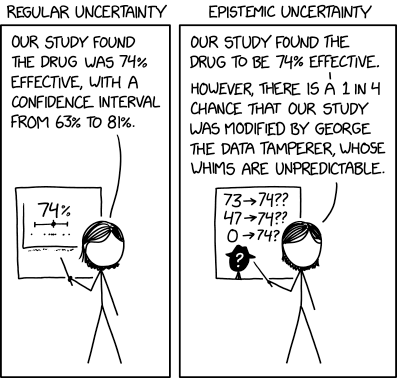
Types of Uncertainty

XKCD “Epistemic Uncertainty” https://xkcd.com/2440/

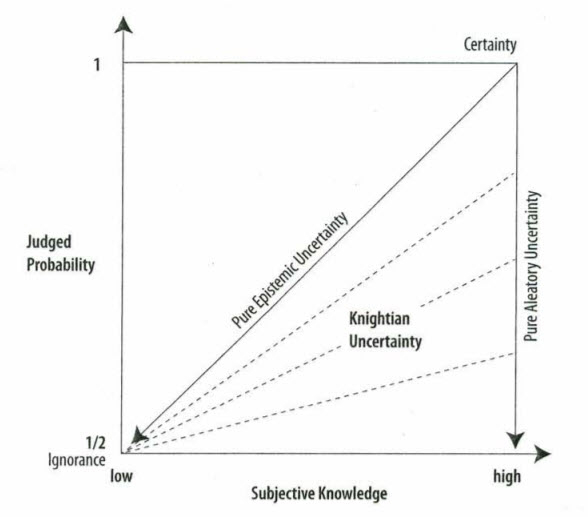
An important part of innovation, risk management, change management, continuous improvement is overcoming the fear of the unknown. We humans are wired with an intense aversion to both risk and uncertainty. Research shows that both have separate neural reactions and that choices with ambiguous outcomes trigger a stronger fear response than do risky choices. Additional research shows that the risk itself isn’t so much the problem, but the uncertainty is: we are afraid primarily because we don’t know the outcome and less so because of the risk.

There are three types of uncertainty:

  • Aleatoric Uncertainty: The uncertainty of quantifiable probabilities.
  • Epistemic Uncertainty: The uncertainty of knowledge. 
  • Knightian Uncertainty: The uncertainty of nonquantifiable risk.
A Two-Dimensional Framework for Characterizing Uncertainty from “Distinguishing Two Dimensions of Uncertainty” by Craig R. Fox and Gülden Ülkümen

I wrote more on this in my post “Uncertainty and Subjectivity in Risk Management.” This post mostly stems from wanting an excuse to share a funny comic.

Ensuring our practices are linked to science

There is a lot of poor to outright bad science in business, leadership and quality circles. We also have a tendency to place anecdotal evidence over objective.

Here are some of the ones I am always on the look out for, on a “horrible to I can live with it” scale. It is by no means an exhaustive list. I tried to avoid “fads” as that is a debatable set.

Myers Brigg (MBTI)

Corporate astrology, pure and simple. Once I see this, I know everything that comes after it is problematic. Books and books have been written on how useless this is. So stop it already.

Learning Styles

The research is definitive. There is no such thing as a learning style and focusing on them is basically a waste of time and will distract you from actually creating valuable training content.

70:20:10 Rule

This is no rule. It was a guideline thrown out on the fly and because of the nice round numbers has become widely used. No empirical evidence supports it in any way. The only study of any repute, a 2003 study by Enos, Kehrhahn and Bell actually showed completely different ratios – 16% from experience on the job, 44% from learning from others, 30% from formal training and a leftover 10% that they couldn’t quite define. But those aren’t round and cool sounding.

It doesn’t even work as a general principle, it is too rigid to be of any use and doesn’t (again) represent how people learn and do work.

Triune Brian

This is just outmoded, the idea that we have a lizard brain has been show to be wildly inaccurate. There are just way better models. Also, the way it is used in most contexts we can just cut it out and not have a loss. It’s time to see this outdated model retired from good in quality circles. The tool using crows will be less likely to plot our demise.

Nonverbal communication

Unfortunately, although thousands of peer-reviewed publications provide very important insights on the impact of nonverbal communication in social interactions, we are exposed to a plethora of false beliefs, stereotypes, and pseudoscientific techniques to “read” nonverbal behaviors. Frankly, I just assume that whatever is being presented is mostly untrue and work from there.

Brainstorming as a crowd

Group driven brainstorming has reducing value and we are better off utilizing brain writing activities.

Case Studies

I love reading about other’s experience, and do enjoy a good case study. However, the belief that case studies of successful (or unsuccessful) organizations present valid advice is not a conclusion that has been tested, and can create an illusion of causality. This constructivist sensemaking is useful, but we should always be careful in drawing wider parallels or establishing ‘facts.’ Call it the ‘Wisdom of Teams’ effect if you want to engage in a little drawing of the illusion.

Similar reasons exist to be careful of benchmarking, which is all opinion and no science.

Employee Engagement

There is little to no evidence that any of the vague concepts of employee engagement actually improve productivity or even that any interventions will actually raise the scores. The only thing proven about employee engagement is the number of hours folks spend on it.

Dunning-Kruger Effect

Looks more and more like a statistical anomaly. More details here.

Jargon and business terms

Does your office have a jargon problem?

The answer is inevitably yes.

In the quality profession we need to be careful to differentiate between jargon, slang, and technical terminology. Avoid the faddish and those terms that require socialization to learn and we’re usually doing okay.

The article from HBR above gives some good advice for striving to communicate as widely as possible. A good thing to think about as we get ready to start a new week.

Democratic Leadership Style

A building block of Quality culture is learning how to make decisions faster without impairing their quality. We do this by ensuring availability of the right knowledge so that the appropriate measures can be decided on and making the decision-making processes quicker.

Adopting a flexible but consistent approach to decision-making and giving people greater leeway creates the organizational framework for faster decision-making processes. In addition to creating the right framework, however, it is equally important for employees to have confidence in each other so that decisions are not only taken quickly but also implemented swiftly. Rather than merely seeing employees as resources, this requires management to value them as part of the community because of the competencies that they bring to the table. The underlying capability that makes this possible is a democratic leadership style.

Democratic leadership is a style where decision-making is decentralized and shared by all. This style of leadership proposes that decision-making should be shared by the leader and the group where criticisms and praises are objectively given and a feeling of responsibility is developed within the group. Leaders engage in dialogue that offers others the opportunity to use their initiative and make contributions. Once decisions are collectively taken, people are sure of what to do and how to do it with support from leaders to accomplish tasks successfully. It is the “Yes…but…and” style of leadership.

This style requires a high degree of effort in building organizational decision-making capabilities. You need to build a culture that ensures that everyone has an equal interest in an outcome and shared levels of expertise relative to decisions. But nothing provides better motivated employees.

For those keeping track on the leadership style bingo card, this requires mashing democratic and transformational leaders together (with a hefty flavoring of servant leadership). Just the democratic style is not enough, you need a few more aspects of a transformational leader to make it work.

Characteristics of a Democratic Leader

Idealized Influence means being the role model and being seen to be accountable to the culture. Part of this is doing Gemba walks as part of your standard work.

Inspirational Motivation means inspiring confidence, motivation and a sense of purpose. The leader must articulate a clear vision for the future, communicate expectations of the group and demonstrate a commitment to the goals that have been decided upon.

Through Intellectual Stimulation, the leader presents to the organization a number of challenging new ideas that are supposed to stimulate rethinking of new ways of doing things in the organization, thus seeking ideas, opinions and inputs from others to promote creativity, innovation and experimentation of new methods to replace the old ways. The leader articulates True North.

Decentralized decision-making around these new ways of doing are shared by all. Decisions are taken by both the leader and the group where criticisms and praises are objectively given and a feeling of responsibility is developed within the group, thus granting everyone the opportunity to use their initiative and make contributions. Decentralized decision-making ensures everyone empowered to take actions and are responsible for the implementation and effectiveness of these actions. This will drive adaptation and bring accountability.

Reading list

  • Arenas, F.J., Connelly, D.A. and Williams, M.D. (2018), Developing Your Full Range of Leadership, Air University Press, Maxwell AFB
  • Gastil, J. (1994), “A definition and illustration of democratic leadership”, Human Relations, Vol. 47 No. 8,pp. 953-975
  • Hayes, A.F. (2018), Introduction to Mediation, Moderation and Conditional Process Analysis, 2nd ed.,The Guilford Press, New York, N