There is a lot of pop psychology, outdated science and just questionable assumptions in business circles, including quality thought. It is important for us to critically engage with this material.
“The Repressive Politics of Emotional Intelligence” by Professor Merve Emre is a must read on the shaky underpinnings of emotional intelligence. I enjoyed this discussion of the problematic politics behind Goleman’s work. Professor Emre is also the author of The Personality Brokers, another important book that lays bare all the pseudoscience and problems behind the MBTI and other tests companies love so well.
Dave Snowden wrote last week on the Woozle Effect, which hits the issue right on the head. The Woozle effect is something we need to be very concerned about as concepts enter our practice.
I recommend reading both pieces, they fit nicely together.
People are at the heart of any organization. They set the organization’s goals, they manage it, they deal with suppliers and customers and they work together to produce results.
We manage this by processes. Process are on a continuum by how complicated and complex they are. Simpler jobs can be reliably done by following procedure. More complex ones require the ability to analyze a situation – using established rules – and decide which of several alternative paths to follow. In even more complex cases they analyze, diagnose, design, redesign, program, plan or schedule. In some cases, they create new products, processes and new ways of being. Very complex jobs require individuals who can analyze and solve very complex problems.
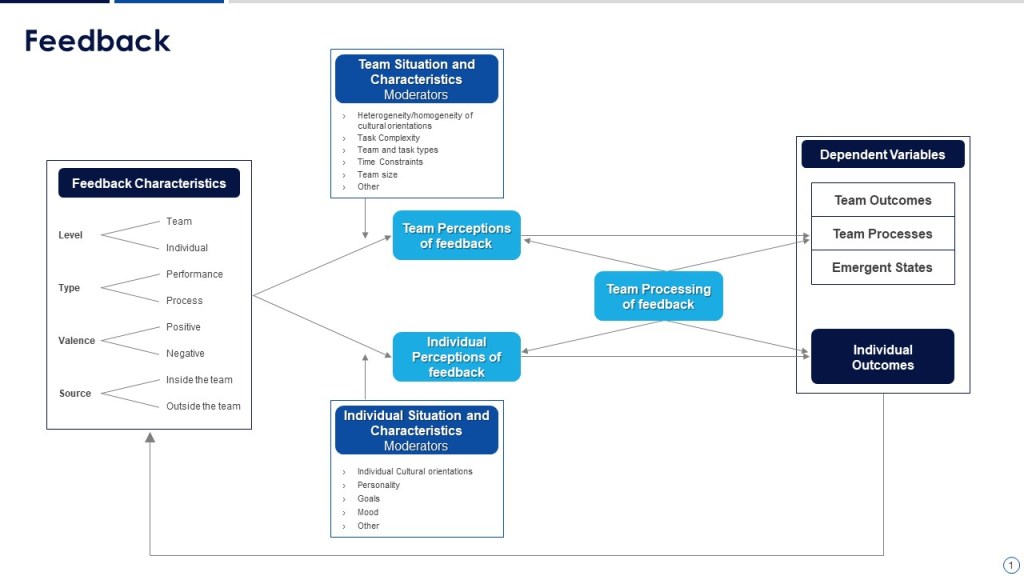
Research on feedback in teams recognizes the importance of continuous reflection and feedback mechanisms to team success and generally finds that the feedback process is an ongoing dynamic system of performance management rather than an isolated event. Feedback is critical to teams learning.
Four characteristics make feedback effective:
Type of feedback: Feedback can describe performance or processes behaviors. Performance feedback contains information about individual or team performance to reinforce good performance or repair poor performance by identifying areas for improvement. Process feedback is information regarding the way one performed a task and did or did not reach expected results.
Feedback level: Feedback can target the team as a whole (i.e., team-level feedback), individual team members (i.e., individual-level feedback), or both. In the latter, team members receive information about how the team behaves as a whole along with information about their individual contribution.
Feedback valence: The positive or negative evaluation of one’s performance in relation to the goal or standard. In teams, potential benefits of negative feedback might be explained by the activation of goal-striving iterative cycles.
Feedback source: Objective (e.g., a measure of delay of delivery) or subjective (i.e., opinion of a source). Feedback-subjective sources can be classified as (a) sources from outside the team (e.g., manager, researcher, expert, and customers) and (b) sources from inside the team (e.g., the team leader debriefing about the feedback or team members who give feedback to each other).
Feedback quality is determined by how specific, well timed, regular, non-threatening, shared, directed at teams it targets, and fairly distributed among team members the feedback is. When feedback meets these criteria, it has been found to be most effective.
Most feedback models state that feedback can only be powerful when individuals attend to and perceive this feedback as being relevant, meaningful, and useful. Conversely, if team members perceive feedback as being unrelated to actual performance, irrelevant, or inaccurate, or do not pay attention to cues presented in the feedback, they are likely to disregard, discount, or reject this feedback. If feedback perception is favorable for team members, and if individual perceptions are externalized in the team and shared among team mem-bers (i.e., team perception), teams as a whole will likely engage in interactions during which they will collectively make sense of the feedback and plan changes accordingly.
We live in the age of culturally heterogeneous teams, defined as two or more individuals from different cultural backgrounds who pursue a common goal, work on interdependent tasks, require social interaction, share responsibility for a team product, and have clear differentiated responsibilities and roles. Teams with members from various cultures can provide a broader range of perspectives, task-related knowledge, abilities, and skills. However, culturally related individual differences in social behavior, communication, and cognition can greatly increase the complexity of intra-team dynamics.
We’ve all seen by now the latest NYT reporting about Emergent and the mix-up that cost between 13 and 15 million doses of the J&J Covid-19 vaccine. As a human performance practitioner, my hair lit on fire when reading this statement: “An investigation is now underway, but federal and former company officials suspect the lot […]
My friend and colleague Dakota Stad writes on what recent reporting tells us about Emergent’s culture. Dakota’s points are spot-on – these issues start with senior leadership and are not on indicative of any sort of “rogue actors”.
It would be an easy narrative to blame the workers, but as always we should stay focused on building a just culture.
The kind of accountability most of us are familiar with is direct accountability: a role is assigned a task and is directly accountable for their result. The role understands the quality, quantity, timeframe, and resource constraints of the deliverable and has the authority to implement plans to achieve it. When completing a RACI this is what we mean by accountability.
Ideally, the individual with direct accountability has the context to understand the limits in which they must work and sufficient knowledge about all of the factors that must be considered to make good decisions. However, that’s not always the case, and for this reason, organizations need to establish lateral roles of indirect accountability to ensure these factors are brought to the attention of the role with direct accountability.
Indirect roles are responsible for initiating action toward directly accountable roles. Indirect roles may be responsible for:
Informing: being aware of the factors surrounding the direct and initiating contact to offer advice and recommendations.
Persuading: persuading the direct to adjust their actions when there is a risk of undermining process control or when multiple roles fail to work together effectively.
Instructing: ordering the direct to stop when working outside of limits and/or take prescribed action to mitigate a catastrophic event.
Responding: Provide the direct service and support
Often these indirects are accountable in a supporting process.



 Investigations of a Dog