Quality professionals are often defined by our technical knowledge, and with that can come a genuine and intense love and interest in the work. In the pharmaceutical/med-device work, I work in this is defined by both a knowledge of the science and of the regulations (and that stuff inbetween – regulatory science).
The challenge here is that we start defining ourselves by our role as we progress as representing the highest level of expertise in this technical expertise, which means senior Quality (as in the department) jobs are defined in terms of in service to our function – patient safety and product quality (safety, efficacy, and quality). This can then lead to seeing people as the “means” to that end. This inevitably leads to prioritizing that outcome over people.
Do not get me wrong, results matter, and I am a firm proponent of product quality and patient safety. But this approach is reductionist and does not serve to drive fear out of the organization. How can people be safe if they are considered a means to produce value? We need to shift so that we realize we can only get to quality by focusing on our people.
A month back on LinkedIn I complained about a professional society pushing the idea of a document-free quality management system. This has got to be one of my favorite pet peeves that come from Industry 4.0 proponents, and it demonstrates a fundamental failure to understand core concepts. And frankly one of the reasons why many Industry/Quality/Pharma 4.0 initiatives truly fail to deliver. Unfortunately, I didn’t follow through with my idea of proposing a session to that conference, so instead here are my thoughts.
Fundamentally, documents are the lifeblood of an organization. But paper is not. This is where folks get confused. But fundamentally, this confusion is also limiting us.
Let’s go back to basics, which I covered in my 2018 post on document management.
When talking about documents, we really should talk about function and not just by name or type. This allows us to think more broadly about our documents and how they function as the lifeblood.
There are three types of documents:
Functional Documents provide instructions so people can perform tasks and make decisions safely effectively, compliantly, and consistently. This usually includes things like procedures, process instructions, protocols, methods, and specifications. Many of these need some sort of training decision. Functional documents should involve a process to ensure they are up-to-date, especially in relation to current practices and relevant standards (periodic review)
Records provide evidence that actions were taken, and decisions were made in keeping with procedures. This includes batch manufacturing records, logbooks and laboratory data sheets and notebooks. Records are a popular target for electronic alternatives.
Reports provide specific information on a particular topic on a formal, standardized way. Reports may include data summaries, findings, and actions to be taken.
The beating heart of our quality system brings us from functional to record to reports in a cycle of continuous improvement.
Functional documents are how we realize requirements, that is the needs and expectations of our organization. There are multiple ways to serve up the functional documents, the big three being paper, paper-on-glass, and some sort of execution system. That last, an execution system, united function with record, which is a big chunk of the promise of an execution system.
The maturation mind is to go from mostly paper execution, to paper-on-glass, to end-to-end integration and execution to drive up reliability and drive out error. But at the heart, we still have functional documents, records, and reports. Paper goes, but the document is there.
So how is this failing us?
Any process is a way to realize a set of requirements. Those requirements come from external (regulations, standards, etc) and internal (efficiency, business needs) sources. We then meet those requirements through People, Procedure, Principles, and Technology. They are interlinked and strive to deliver efficiency, effectiveness, and excellence.
So this failure to understand documents means we think we can solve this through a single technology application. an eQMS will solve problems in quality events, a LIMS for the lab, an MES for manufacturing. Each of these is a lever for change but alone cannot drive the results we want.
Because of the limitations of this thought process we get systems designed for yesterday’s problems, instead of thinking through towards tomorrow.
We get documentation systems that think of functional documents pretty much the same way we thought of them 30 years ago, as discrete things. These discrete things then interact through a gap with our electronic systems. There is little traceability, which complicates change control and makes it difficult to train experts. The funny thing, is we have the pieces, but because of the limitations of our technology we aren’t leveraging them.
The v-model approach should be leveraged in a risk-based manner to the design of our full system, and not just our technical aspects.
System feasibility matches policy and governance, user requirements allow us to trace to what elements are people, procedure, principles, and/or technology. Everything then stems from there.
I’ve written before on how storytelling is a critical skill. The ability to take data, take the events of the past and transform it into a coherent narrative is central to the quality profession, and frankly just about every other job out there.
This week I got one of my favorite compliments. We were working to take a series of events and shape it into a coherent narrative to explain what had happened, why we could be confident of the results, and how we had improved over time. And one of my co-workers had commented on how much they were learning from this process, and another responded that of course I was good at this because I was a gamer. And I was just tickled pink.
I make no secret of my hobby. My Twitter feed, for example, is one part geek, one part quality, one part politics. Search for me in google (and who doesn’t google search their coworkers?) and you’ll see gaming stuff on the front page. And in this day of working from home, my background is a bookshelf crammed full of games.
And I do think I am, to a large amount, the quality professional I am today because of that gaming background. There are many paths within quality, and this is part of mine.
Some of the things I’ve learned as a gamer include:
Storytelling skills
Communication skills
Organization skills
The ability to “think on your feet”
Humor
Patience
Creativity
Fairness
Knowledge of rules and how they work together in a system.
How to use visual aids, pictures et all
Paying attention to everyone, giving everyone a chance to be heroic
Conflict resolution skills
Which as a list definitely feels like the core of the profession.
So, fellow gamers in quality, next time we actually meet face-to-face at a conference, let’s find a little time to meet each other at the table.
The quality profession in the pharmaceutical industry is wider than the overseeing regulations from health authorities. The GXPs are truly a starting point, not an ending point which is why we often use that little “c” for “current.”
The GXPs (and the regulations behind them) serve an important purpose. But they are the start of excellence and not the end.
The GXPs are an outline. When we start with these requirements and then fill in the details we build a robust and beautiful engine for quality.
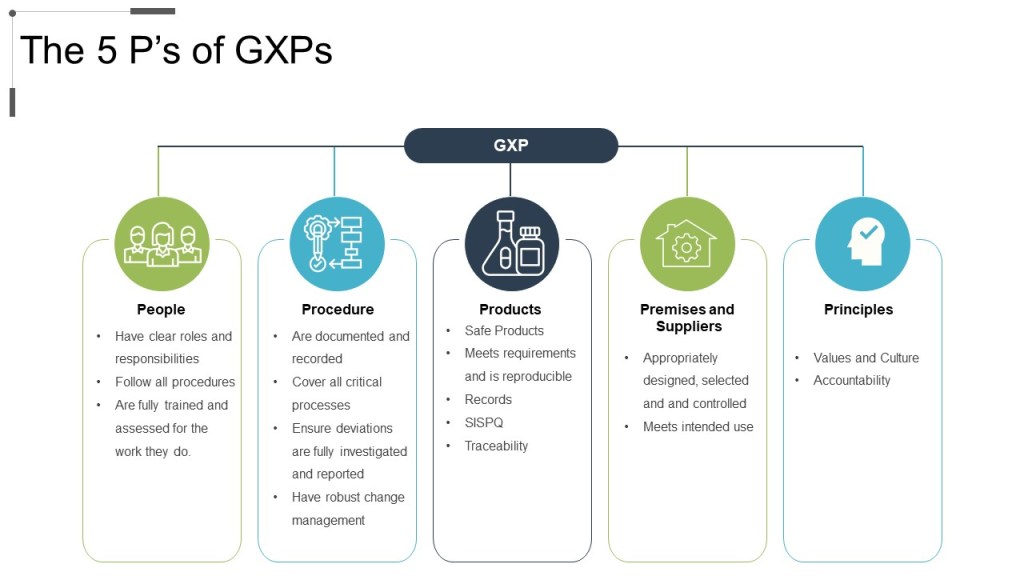
The 5Ps of GXPs: People, Procedure, Product, Premise, and Principles.
This is often why we talk about compliance being the start of quality, and not the end.
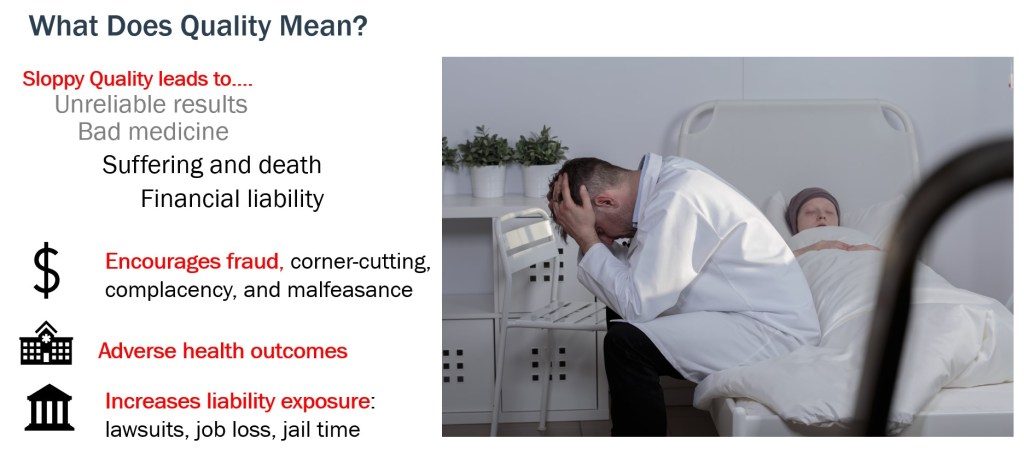
Admit it, we’ve all been through GxP training that utilizes the stick. I’m assuming many of you have designed it. It might have looked like this:
Perhaps you have went over the hundred-and-fifty-plus years history of regulatory action, discussing Elixir Sulfanilamide, thalidomide, and a dozen other noteworthy cases that shared the modern regulatory environment.
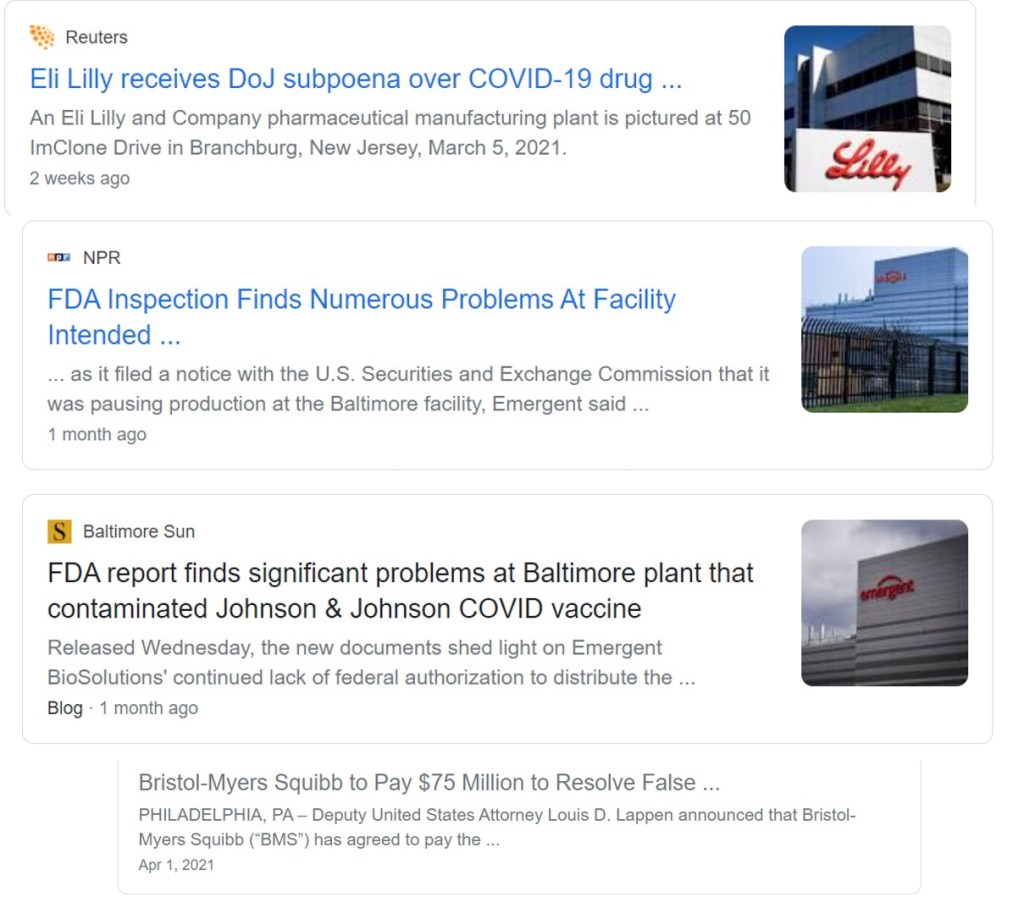
Or perhaps you just like to show a slide with recent headlines on it.
Let’s put aside all the excellent research about the power of positive messaging etc. Valid stuff but not the point I’m trying to make.
The point I want to make in this post is that the regulatory stick has long been broken. Companies suffer at most a slap on the wrist, fines that are weeks or months of profit. But real repercussions are absent.
The Sackler family walks away with billions, MacKenzie gets a slap on the wrist, and other companies are all protected from their deliberate actions in fueling the opioid epidemic.
J&J avoids all real accountability for knowingly causing cancer.
The list goes on.
Frankly, I think this is really bad for our industry. If the price of being caught is pennies to the dollar earned, it has become merely a cost of doing business.
This erodes trust in the safety of our drug supply. And if the last year hasn’t brought home the importance of that trust, you may be hiding under a rock.
We need more perp walks. We need a real system of deterrence that involves arrests and punishments that match the crimes. We can’t even count on the one form of deterrence left, liability lawsuits because companies are playing shenanigans with bankruptcy laws.
We talk about how quality culture starts at the top. But as we see again and again, the top only cares about profit.
That makes me fundamentally worry about the safety of our drugs and medical devices. And if I someone who has dear friends who work at large and small pharma worry, I must admit I can understand why people start to hold suspicions.