Well, another virtual WCQI

Another, and hopefully, last virtual ASQ World Conference on Quality Improvement.

Stand out presentations:

  • John Dew’s on Metacognition, which is a critical part of reflective thinking and John is so right about it being a fundamental part of our profession. More on this one later as it has prompted a post.
  • Peter Gallagher on change management. Great slides, great summary of key points. Change management is my bread and butter and I always learn something from Peter.
  • Erin Urban “Steps for Leaders to Connect Better with Virtual Teams” is gold. Good presentation, engaging speaker and her section on creating tiny moments is pure gold.

Here are some other thoughts:

  • We need a requirement that every quote be checked. If I see one more “Culture Eats Strategy for Breakfast” attributed to Drucker I am going to cry.
  • Text heavy presentations with few graphics have got to go. Every presenter should have to attend a class on slide structure and build.
  • A virtual conference platform needs to do 3 things right – closed captioning of recorded presentations and ideally live ones, robust breakout sessions, easy to use chatting. The one used could use some work in all three areas. I would love to have seen a platform that easily integrated with the ASQ app on my phone as well.
  • My junk science bingo card is kind of full.
  • There is a very real discussion to be had about the use of the Service Mark in presentations when all someone is doing is using a standard tool (an annotated swimlane is not unique). The ASQ can be accused of being too much dominated by consultant companies and I think balance is important here.
  • Not understanding the sticking to 4:3 aspect ratio slides. 16:9 is better for conferences and video.

Virtual events are important, they enable inclusion. While I miss face-to-face events I do believe we should have a mix of events going forward. events that are more than passive webinars. So sick of webinars. Looking forward to experiments in making that blend happen. We’re experimenting with a storytelling event in the Team and Workplace Excellence Forum.


Problem Statement Framing

A well-framed problem statement opens possibilities, while a bad problem statement closes down alternatives and quickly sends you down dead ends of facile thinking.

Consider a few typical problem statements you might hear during a management review:

  1. We have too many deviations
  2. We do not have enough people to process the deviations we get
  3. 45% of deviations are recurring

You hear this sort of framing regularly. Notice that only the third is a problem, the other two are solutions. And in the case of the first statement it can leave to some negative results. The second just has you throw more resources at the problem, which may or may not be a good thing. In both cases we are biasing the problem-solving process just as we begin.

The third problem statement pushes us to think. A measurable fact raises other questions that will help us develop better solutions: why are out deviations recurring? Why are we not solving issues when they first occur? What processes/areas are they recurring in? Are we putting the right amount of effort on important deviations? How can we eliminate these deviations?

If a problem statement has only one solution, reframe it to avoid jumping to conclusions.

By focusing on a problem statement with objective facts (45% of deviations are recurring) we can ask deeper, thoughtful questions which will lead to wisdom, and to better solutions.

To build a good problem statement:

  1. Begin with observable facts, not opinions, judgments, or interpretations.
  2. Describe what is happening by answering questions like “How much/How many/How long/How often.” This creates room for exploration and discovery.
  3. Iterate on the problem statement. As you think more deeply on the situation modify your first version. This is a sign that you understand more about the situation. This is the kind of data that will join with the facts you discover to lead towards sound decisions.

The 5W2H tool is always a good place to start.

5W2HTypical questionsContains
Who?Who are the people directly concerned with the problem? Who does this? Who should be involved but wasn’t? Was someone involved who shouldn’t be?Roles and Departments
What?What happened?Action, steps, description
When?When did the problem occur?Times, dates, place In process
Where?Where did the problem occur?Location
Why is it important?Why did we do this? What are the requirements? What is the expected condition?Justification, reason
How?How did we discover. Where in the process was it?Method, process, procedure
How Many? How Much?How many things are involved? How often did the situation happen? How much did it impact?Number, frequency

Remember this can be iterative as you discover more information and the problem statement at the end might not necessarily be the problem statement at the beginning.

ElementsProblem Statement
Is used to…Understand and target a problem.
Provide a scope.
Evaluate any risks.
Make objective decisions
Answers the following… (5W2H)What? (problem that occurred)
When? (timing of what occurred)
Where? (location of what occurred)
Who? (persons involved/observers)
Why? (why it matters, not why it occurred)
How Much/Many? (volume or count)
How Often? (First/only occurrence or multiple)
Contains…Object (What was affected?) Defect (What went wrong?)
Provides direction for…Escalation(s)  Investigation

ASQ Storytime – A Team and Workplace Excellence Forum

Join the ASQ Team and Workplace Excellence Forum on Tuesday, June 15 at 7:00 p.m. Eastern, for ASQ Storytime, a fun story share where you are invited to share your stories as a quality professional. Stories may either be free-style or in PechaKucha style on the themes of “Driving out Fear” or “Quality Life After the Pandemic.”

Each story will be five minutes.

Register to speak here

Prizes (books) will be awarded for the best stories (voted by participants) in each style category, for funniest, education, and “Thing I will use tomorrow”

Register for the Event here

Quality Profession Needs to Stand for Quality in Public Practices

The Quality profession either stays true to its’ principles and ideals, or it is useless. We either support transparency and driving out fear or we don’t. Then we become the shallow, and dangerous crutch of demagogues and tyrants. One of the reasons Six Sigma has immense problems it still has not successfully grappled stems from how it is centered on the tyranny of Jack Welch.

The ASQ’s Government Division has taken a great step recently by endorsing the adoption of ISO/TS 54001:2019 “Quality management systems — Particular requirements for the application of ISO 9001:2015 for electoral organizations at all levels of government”.

We should be demanding elections built on the foundations of good quality. This should be part of electoral reform requirements at the Federal level. We need to oppose attempts to restrict voting. We need to drive fear out of our electoral system.

The United States is a signatory of international standards of policing. And yet no state follows those standards. Federal law needs to respect our treaty obligations and impose these standards, and we need to hold states and localities accountable.

As a quality professional I spend the day figuring out how to truthfully measure results. Yet an entire party has gleefully adopted lies and disinformation. I strive to democratize leadership, to build a culture of psychological safety. And yet all around us we see demagoguery.

Our workplace cultures are influenced greatly by external factors. We cannot hope to drive lies and fraud out of our systems, to create cultures of safety, to build excellence when all around us is a disregard for those standards. For this reason the quality profession must be political. It must standard for truth, for fair standards applied equitably. For driving out fear.

Site Training Needs

Institute training on the job.

Principle 6, W. Edwards Deming

(a) Each person engaged in the manufacture, processing, packing, or holding of a drug product shall have education, training, and experience, or any combination thereof, to enable that person to perform the assigned functions. Training shall be in the particular operations that the employee performs and in current good manufacturing practice (including the current good manufacturing practice regulations in this chapter and written procedures required by these regulations) as they relate to the employee’s functions. Training in current good manufacturing practice shall be conducted by qualified individuals on a continuing basis and with sufficient frequency to assure that employees remain familiar with CGMP requirements applicable to them.

(b) Each person responsible for supervising the manufacture, processing, packing, or holding of a drug product shall have the education, training, and experience, or any combination thereof, to perform assigned functions in such a manner as to provide assurance that the drug product has the safety, identity, strength, quality, and purity that it purports or is represented to possess.

(c) There shall be an adequate number of qualified personnel to perform and supervise the manufacture, processing, packing, or holding of each drug product.

US FDA 21CFR 210.25

All parts of the Pharmaceutical Quality system should be adequately resourced with competent personnel, and suitable and sufficient premises, equipment and facilities.

EU EMA/INS/GMP/735037/201 2.1

The organization shall determine and provide the resources needed for the establishment,
implementation, maintenance and continual improvement of the quality management system. The organization shall consider:

a) the capabilities of, and constraints on, existing internal resources;
b) what needs to be obtained from external providers.

ISO 9001:2015 requirement 7.1.1

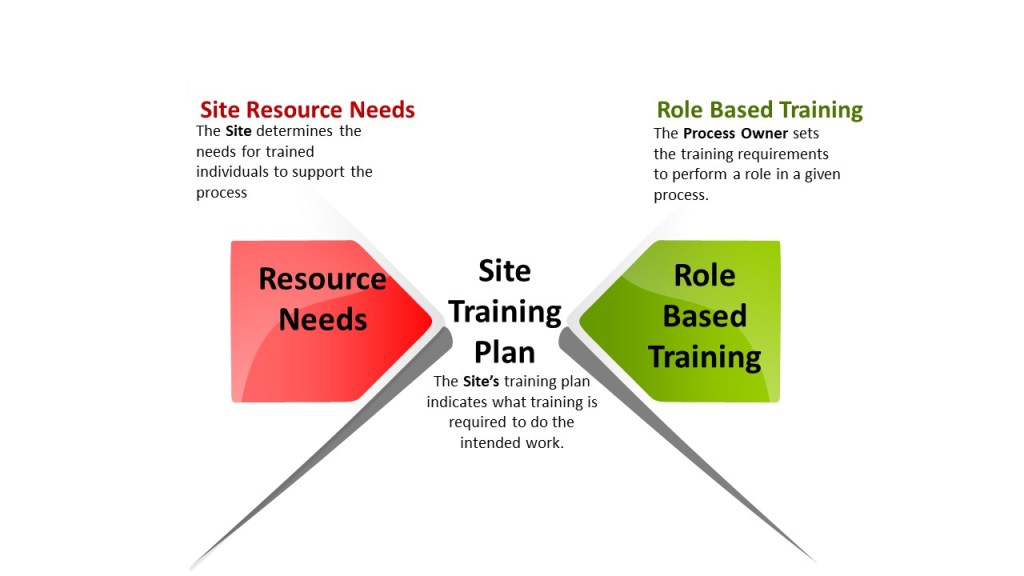
It is critical to have enough people with the appropriate level of training to execute their tasks.

It is fairly easy to define the individual training plan, stemming from the job description and the process training requirements. In the aggregate we get the ability to track overdue training, and a forward look at what training is coming due. Quite frankly, lagging indicators that show success at completing assigned training but give no insight to the central question – do we have enough qualified individuals to do the work?

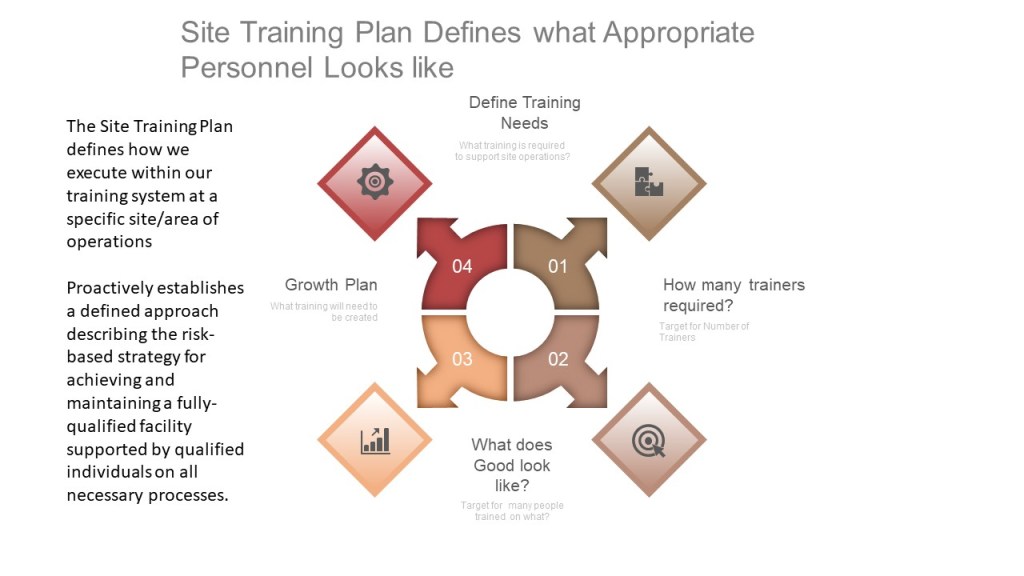
To get this proactive, we start with the resource plan. What operations need to happen in a time frame and what are the resources needed. We then compare that to the training requirements for those operations.

We can then evaluate current training status and retention levels and determine how many instructors we will need to ensure adequate training.

We perform a gap assessment to determine what new training needs exist

We then take a forward look at what new improvements are planned and ensure appropriate training is forecasted.

Now we have a good picture of what an “adequate number” is. We can now set a leading KPI to ensure that training is truly proactive.