Take responsibility. Say, “I was wrong.” (Don’t say “mistakes were made” or “it didn’t turn out the way I had anticipated” or any other version that deflects or minimizes your personal contribution). Offer a brief explanation, but do not make excuses. Acknowledge that your error had a negative impact on others, and be willing to really listen, without defensiveness, to others’ recounting of that impact. Do not interrupt. Apologize.
Address what you need to do right now. Taking responsibility is critical, as is taking action. This is core to crisis communication, even if your mistake doesn’t constitute a major crisis. Tell others what you are doing right now to remedy the mistake, and distinguish between the parts that can be fixed, and those that can’t. Include what you are doing to address the substantive impact (money, time, processes, etc.) and well as the relational impact (feelings, reputation, trust, etc.) of having been wrong. Be open to feedback about what you’re doing. Over-communicate your plans.
Share what you will do differently next time. Being wrong is messy. Being wrong without self-reflection is irresponsible, even if you hate self-reflection. Take some time to think about what your contribution was to this situation, and identify how others contributed as well. (Try to stay away from using words like “fault” or “blame” — which tend to put people on the defensive.) Then tell those impacted by your error what you’ve learned about yourself, and what you’re going to do differently in the future. For example, you might recognize that you tend to dismiss the input of someone you don’t see eye-to-eye with, and that in the future, you’re going to actively engage her, and consider her perspective. Ask for help where you need it. And ask others to give you frequent feedback down the road on the commitments you’re making.
The MHRA GPvP inspectorate recently published their latest inspection metrics for the period from April 2019 to March 2020.
Someday these reports won’t take a year to write. If I took a year writing my annual reports I would receive an inspection finding from the MHRA.
There is no surprise that the five critical observations are all from risk management. Risk management is also the largest source of major findings, with quality management a close second with a lot of growth.
There are a lot of observations around the smooth and effective running of the CAPA program; a fair amount on PSMF management; and a handful on procedure, training and oversight.
Looking at the nine major observations due to deficiencies in the management of CAPA, the MHRA reports these problems:
Delays to CAPA development
CAPA that did not address the root cause and impact analysis for the identified noncompliance
Open CAPA which were significantly past their due date
CAPA raised from a previous critical finding raised at an earlier MHRA inspection had not been addressed
I’m going to go out on a limb here and say some of these stem from companies thinking non-GMP CAPAs do not require the same level of control and scrutiny. Root Cause Analysis and a good CAPA program are fundamental, no matter where you fall on (or out of) the pharmaceutical regulatory spectrum.
PIC/S recently updated an Aide Mémoire on inspections of biotech manufacturers in January. The aim of this AiM is to harmonize GMP inspections in biotechnological and biological facilities and to ensure their quality. There wasn’t much new in this version, the revision history says “Minor edits to update cross-references to PIC/S GMP Guide (PE 009-14),” but this is a good time to review the document.
Many of the influencing tactics require you to have informal power. It is a good idea to understand what your major forms of informal power are, so here’s an evaluation tool.
Step 1: List your top 10 contacts that enable you to get work done. These contacts can be either internal or external to your organization.
Step 2: For each contact, assign a score from 1 to 10 indicating how much you depend on them. If a contact provides a lot of value and is also difficult to replace, assign a high score. Think broadly about the value your contacts offer. This includes career advice, emotional backing, support with daily activities, information, and access to resources or stakeholders.
Step 3: Do the same in reverse. Assign a score to yourself from others’ perspectives. Approximate how much value you offer your contacts and how difficult it would be to replace you. Be honest.
Next, look for red flags which could indicate that you lack informal power.
Do all of your contacts work in one team, function, product unit, or office building? This could indicate a limited ability to generate value beyond the basic requirements of your job description.
Do your contacts provide you with more value than you return? Such relationships are difficult to sustain in the long run. Asymmetries in dependence indicate others hold the power in a relationship.
Is all of the value you give or receive concentrated in a couple of contacts? You could be vulnerable if you lose these contacts or your relationship changes.
Once you understand where your informal power lies, figure out how you can improve.
To address the unfavorable power scores, earn relationships by delivering value to your contacts. Ask yourself: what value can you deliver to them? One way is to develop and continuously improve upon a skill set that leads others to value your contributions. Then proactively use your skills to help others, well beyond the demands of your formal role. You don’t want to be the expert whom nobody knows.
Let your job help you. Manage your job description so that you can contribute to the workflows of multiple functions inside the organization as well as customers, outside partners, or regulators. Volunteer for cross-functional initiatives. View lateral transfers as a move up. By positioning yourself at the intersection of workflows, you position yourself to meet, learn from, and deliver value to a variety of diverse groups in the organization.
Get to know your stakeholders and collaborators better as individuals. You may be surprised how something that is rather easy for you to do carries significant value for them. Sometimes we freeze because we believe that we have to offer really significant contributions or do massive favors for others. Knowing others well can present us with helpful alternatives.
Outside of work, join social and professional ones. Shared activities have an underestimated impact on expanding our networks.
Your value is never solely defined by your ability to perform a formal organizational role. By creating value for diverse stakeholders and making yourself irreplaceable, you open possibilities for yourself within the organization and beyond. And, by doing so, you add value to your company.
A core function of quality leadership is building the case of quality and raising the level of awareness and adoption through the organization. As we work to mature our quality system we build commitment. This is the salesperson aspect of our role where we go out and sell quality and the improvements we are advocating for.
Understand what the customer is buying
You first need to understand what the customer is buying. A person selling a food processor is really selling the ability to easily make tasty food. A person selling a car is selling a whole lot of cultural assumptions about mobility, and power, and the dream of success. Similarly, our stakeholders are not buying specific quality methodologies and tools (e.g. process management, knowledge management, risk management), they are buying something wider, which quality methodologies can deliver to them, and you need to understand what that is. Two of the more wider things that the customer wants that quality usually promises are protection and opportunity.
Quality at heart offers protection against deficiencies and risks. Quality protects against loss of capability.
Quality is also an opportunity – gaining more value from our resources.
Segmenting your audience
Every salesperson needs to know their market and their customer base which we can think of in terms of three market segments:
Those who ‘get’ the quality improvement and become immediately enthused, moving rapidly from first contact to positive perception and trial. These are your allies, supporters, and early adopters.
The folks who just do not care about maturing quality. They will engage with quality if they must, if it is part of the job, or if everyone ese is doing it. If the improvement is voluntary, or unusual, they will not bother. Moving them to the trial phase of buy-in will require a range of influencing tactics.
Those who do not like quality, seeing it as a threat to their way of working, or even as a personal threat. These people will resist everything unless it is embedded into the very structure of the organization. They can be exceedingly difficult to move to the positive perception state, let alone higher than that. Here your primary tools are peer pressure, social proof, appeals to authority and compulsion.
Think through the types of quality initiatives you are working on. Those that are voluntary will only reach the first third, and that is the best place to start. Or you need more inescapable methods. I usually find for any set of improvements it is a mixture of experiment with early adopters, build social proof and introduce a few critical compulsions.
Influencing Tactics
In their book Mind Gym Sebastian Bailey and Octavius Black outlined nine influencing tactics you can select from, based on the character and situation of the ‘buyer’.
To add context to these, I am going to provide an example of implementing Gemba Walks for leaders, managers, and floor level employees, with standard work that emphasizes pushing to a learning culture.
Tactic
Includes
Example
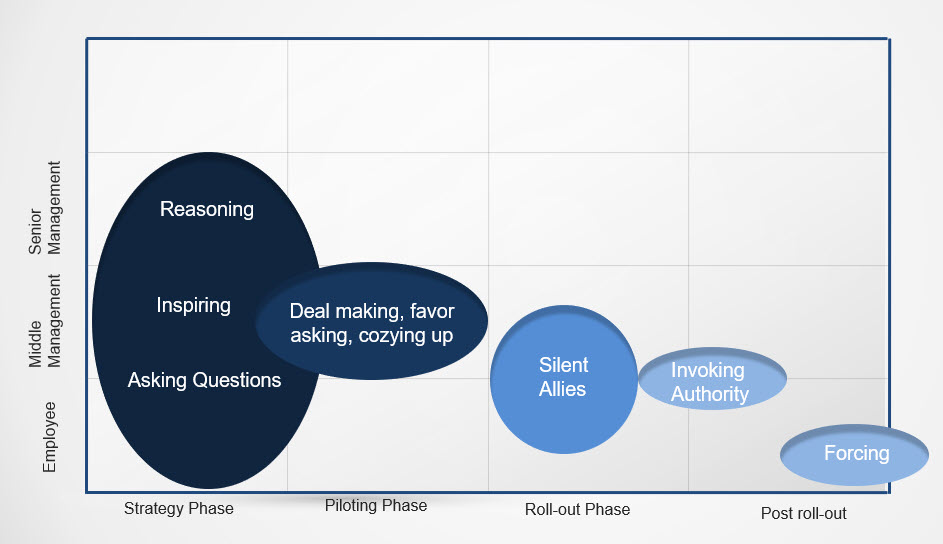
Reasoning
Using logical argument to make a case. Reasoning is necessary to support your case with all stakeholder, even if other influencing techniques will create the closing sell. You need to create a compelling logical case for quality improvement, and it needs to be a case for the individual was well as the company.
Presenting case studies and evidence on how this is successful.
Inspiring
Appealing to emotions and creating the vision. Inspiring people generates an emotional commitment to the vision. Being inspiring demands conviction, energy and passion but is especially effective with the early adopters.
A vision of a gemba walk being the hallmark of quality culture and building a culture of inclusivity.
Asking questions
Leading the other person to make their own discovery of the value of the quality improvement.
Drawing out examples of an individuals own experience of the value of observation and good coaching.
Ingratiating(Be a buddy)
Your stakeholder will almost feel positive toward someone who makes them feel good about themselves. This is not a great approach for people more senior than you, it comes across as sucking up. You also need to be sincere – people always detect insincerity.
Friends helping friends get things done
Deal making
When you give another person something in return for their agreement with you. Your ability to use this approach depends very much on your confidence and ability to offer something in return. To keep trust, make sure you deliver on any promises made.
Through introducing the Gemba walk we will see a reduction of human error deviations and we will be able to close minor deviations in three days.
Favor asking
Simply asking for something because you want or need it. This works well only when the other person cares about you or their relationship with you. If used sparingly, it is hard to resist, but be prepared to pay back that favor!
If you can support the Gemba Walk, then we will be able to free up the time for that important project of yours as a result.
Using silent allies (aka social proof)
Using the fact that others are getting value from the quality improvement as an argument in its favor. Social proof is sharing the stories of people as like your ‘buyer’ as possible. This really gets to that big middle of uncertain individuals. Each success, no matter how small, is an opportunity to gather social proof. Hold lessons learned, don’t be afraid to capture good feedback on video!
Listen to Nancy here as she discusses how much Gemba Walks have changed the work in her team.
Invoking authority
Appealing to a rule is one you use late in the roll-out program to convince the laggards once the quality improvement has become a clear expectation.
Your boss tells you to do Gemba Walks and enforces them happening (report a metric of how many Gemba Walks)
Forcing (“do it or else”)
Bringing senior management in to demonstrate clear requirements with clear ramifications that can include temporary or permanent removal of the individual. This is a tactic of last resort.
Do this or else
Influence Tactics
Influencing Tactics per Implementation Phase
Be prepared to spend a lot of time in “Yes…but…and” territory, especially in the Strategy Phase.



 Investigations of a Dog