

Ignore my last post (for this instance) were I pointed out the deficiencies in the 5 whys tool.
Ignore my last post (for this instance) were I pointed out the deficiencies in the 5 whys tool.
The biggest thing I am working on is situational humility. How do I successfully balance the subject matter expertise my organization needs with the humility to truly lead? It is clear that such humility is critical to building psychological safety, and psychological safety is critical to building innovative teams.
For most of my career I’ve been prized for my subject matter expertise, but there are huge limits, no one can know everything, so I am cultivating the following behaviors in my practices.
| To build Humility do this | Which means | And I do this |
| Know what you don’t know | Resist “master of the universe” impulses. You may yourself excel in an area, but as a leader you are, by definition, a generalist. Rely on those who have relevant qualification and expertise. Know when to defer and delegate. | I have a list of key topics that are both in my space and overlap and individuals who involving in the discussion is critical. I’ve created a “swear jar” for every time I say something like “I have an answer” and at this rate I’ll be taking a lot of people out for drinks by the time this pandemic is over. It is all IOUs right now because I don’t remember the last time I used cash and I don’t think I’ve seen a dollar bill in 11 months. |
| Resist falling for your own publicity | We all put the best spin on our success — and then conveniently forget that the reality wasn’t as flawless. | This is an interesting one for me. Having joined a new company 10 months ago it has been important to avoid the spin on my joining, and to not exacerbate it. I’ve taken to keeping a list of problems and who is the right people who are not me that can solve them. |
| Never underestimate others | The world is filled with other hard-working, knowledgable, and creative professionals | I purposely look for opportunities to meet with folks at all levels and ask them to collaborate. |
| Embrace and promote a spirit of service | Focus on finding ways to help others to succeed | I’m all about the development. Crucial for me here is stepping back and letting others lead, even if its more work for me as I spend more time coaching and mentoring than would actually take to do the job. But lets be honest, can’t and shouldn’t do anything. |
| Listen, even (no, especially) to the weird ideas | Only when you are not convinced that your idea is or will be better than someone else’s do you really open your ears to what they are saying. But there is ample evidence that you should: the most imaginative and valuable ideas tend to come from left field, from some associate who seems a little offbeat, and may not hold an exalted position in the organization. | I love the weird, though maybe most when they are my weird ideas. Been working to strengthen idea management as a concept and practice in my organization. |
| Be passionately curious | Constantly welcome and seek out new knowledge, and insist on curiosity from those around you. Research has found linkages between curiosity and many positive leadership attributes (including emotional and social intelligence). Take it from Einstein. “I have no special talent,” he claimed. “I am only passionately curious.” | I’m a voracious reading machine, its always been a central skill. How I am trying to teach others to be curious and turn it to their advantage. |

Leadership is a critical element of a problem solving culture and rightly is emphasized in frameworks like the Baldridge or standards like ISO 9001:2015. Leadership is best looked at as the process for determining a possible future state that does not yet exist. As we strive to build excellence we need a passion for this work and to believe it to be truly important. Sharing that enthusiasm is motivating for all people involved and is a way to leverage greater success.
Good leaders encourage behaviors to maintain and improve quality by means of sound decision-making and risk-based thinking.
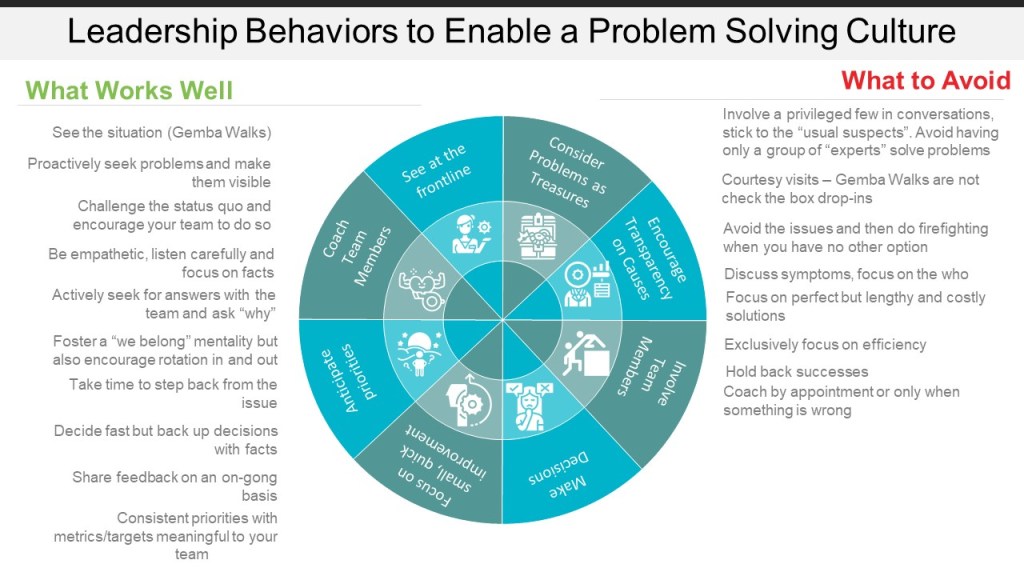
All of these leadership behaviors stem from four building blocks:
Let’s be honest – slides and presentations from quality professionals tend to be text heavy and graphic poor. I’m no expert here, but I have settled on a few subscriptions that help me produce fair to middling presentations and graphics.
My goal this year is to use more graphics in my blog. Well actually my goal is to post more this year, 2020 was kind of a wash.
Improvement is a process and sometimes it can feel like it is a one-step-forward-two-steps-back sort of shuffle. And just like any dance, knowing the steps to avoid can be critical. Here are some important ones to consider. In many ways they can be considered an onion, we systematically can address a problem layer and then work our way to the next.
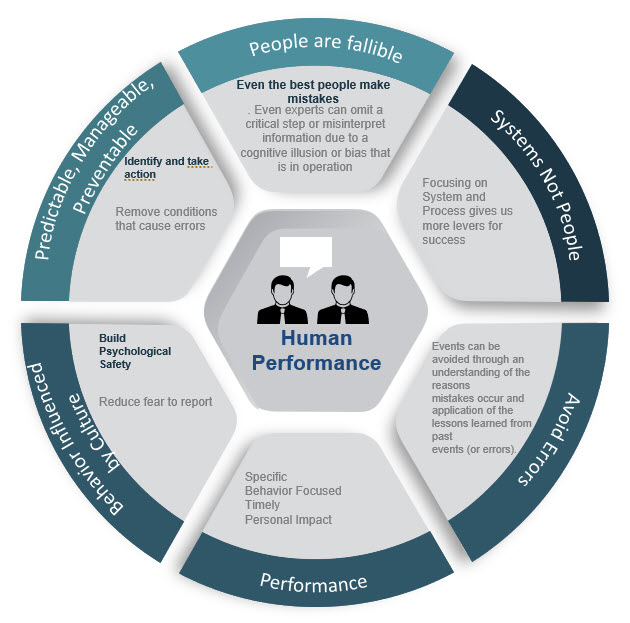
The vague, ambiguous and poorly defined bucket concept called human error is just a mess. Human error is never the root cause; it is a category, an output that needs to be understood. Why did the human error occur? Was it because the technology was difficult to use or that the procedure was confusing? Those answers are things that are “actionable”—you can address them with a corrective action.
The only action you can take when you say “human error” is to get rid of the people. As an explanation the concept it widely misused and abused.
| Attribute | Person Approach | System Approach |
| Focus | Errors and violations | Humans are fallible; errors are to be expected |
| Presumed Cause | Forgetfulness, inattention, carelessness, negligence | “Upstream” failures, error traps; organizational failures that contribute to these |
| Countermeasure to apply | Fear, more/longer procedures, retraining, disciplinary measures, shaming | Establish system defenses and barriers |
Human error has been a focus for a long time, and many companies have been building programmatic approaches to avoiding this pitfall. But we still have others to grapple with.
We like to build our domino cascades that imply a linear ordering of cause-and-effect – look no further than the ubiquitous presence of the 5-Whys. Causal chains force people to think of complex systems by reducing them when we often need to grapple with systems for their tendency towards non-linearity, temporariness of influence, and emergence.
This is where taking risk into consideration and having robust problem-solving with adaptive techniques is critical. Approach everything like a simple problem and nothing will ever get fixed. Similarly, if every problem is considered to need a full-on approach you are paralyzed. As we mature we need to have the mindset of types of problems and the ability to easily differentiate and move between them.
We remove human error, stop overly relying on causal chains – the next layer of the onion is to take a hard look at the concept of a root cause. The idea of a root cause “that, if removed, prevents recurrence” is pretty nonsensical. Novice practitioners of root cause analysis usually go right to the problem when they ask “How do I know I reached the root cause.” To which the oft-used stopping point “that management can control” is quite frankly fairly absurd. The concept encourages the idea of a single root cause, ignoring multiple, jointly necessary, contributory causes let alone causal loops, emergent, synergistic or holistic effects. The idea of a root cause is just an efficiency-thoroughness trade-off, and we are better off understanding that and applying risk thinking to deciding between efficiency and resource constraints.
Our problem solving needs to strive to drive out monolithic explanations, which act as proxies for real understanding, in the form of big ideas wrapped in simple labels. The labels are ill-defined and come in and out of fashion – poor/lack of quality culture, lack of process, human error – that tend to give some reassurance and allow the problem to be passed on and ‘managed’, for instance via training or “transformations”. And yes, maybe there is some irony in that I tend to think of the problems of problem solving in light of these ways of problem solving.

